
Tag: PAUL SAGINAW
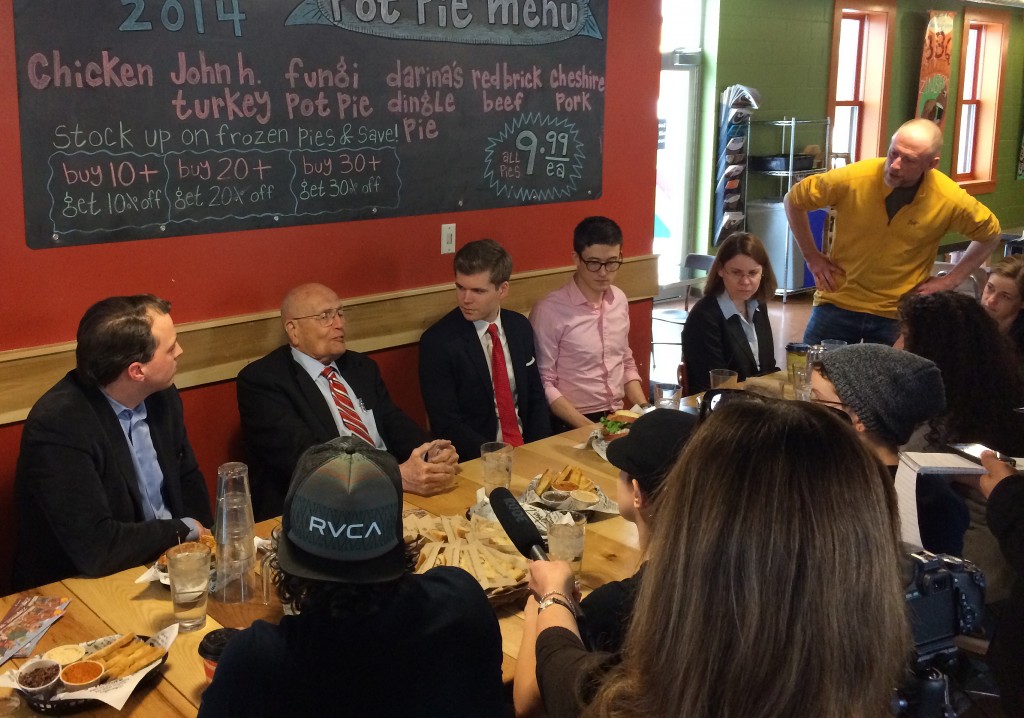
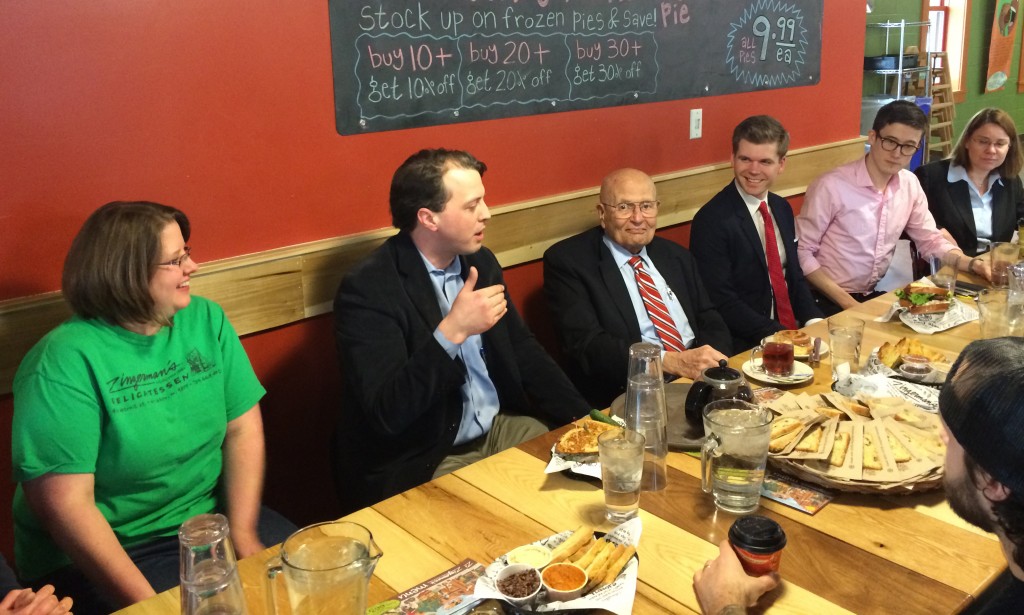
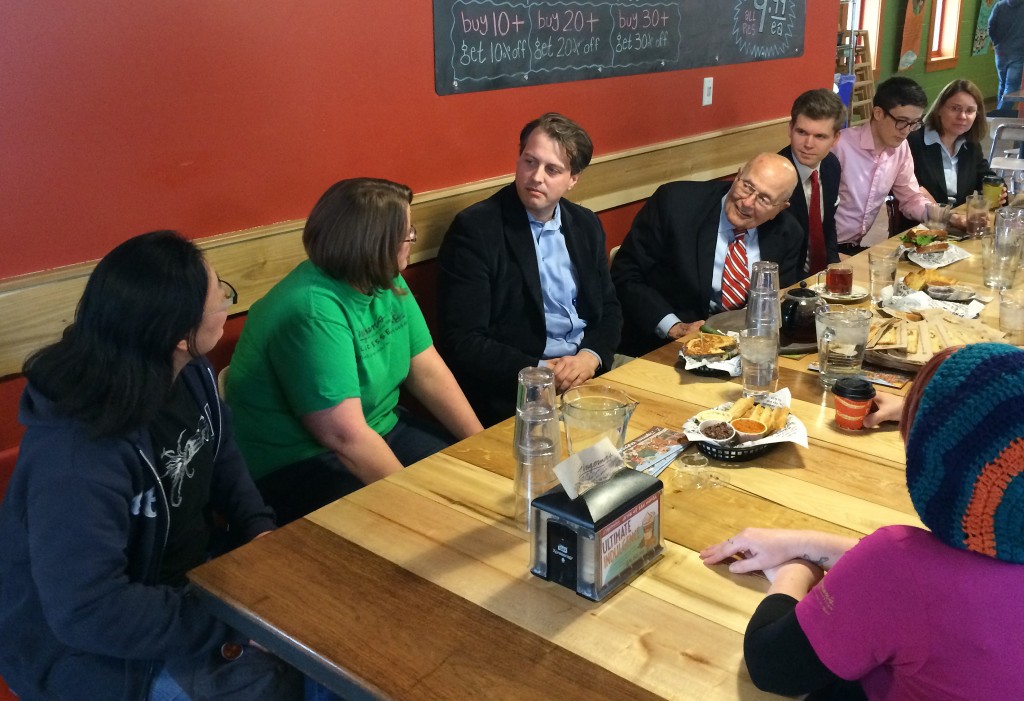
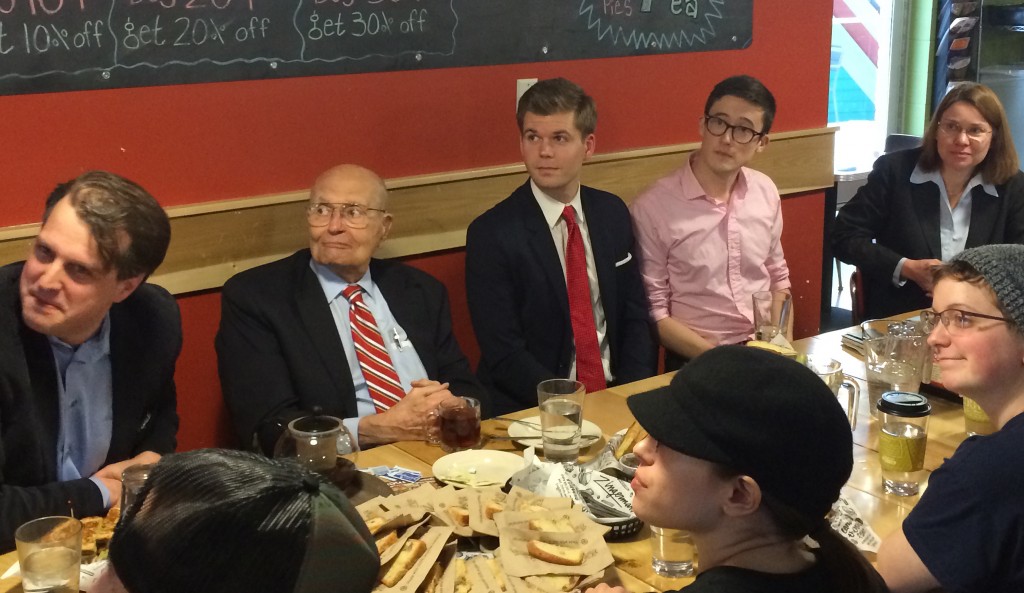
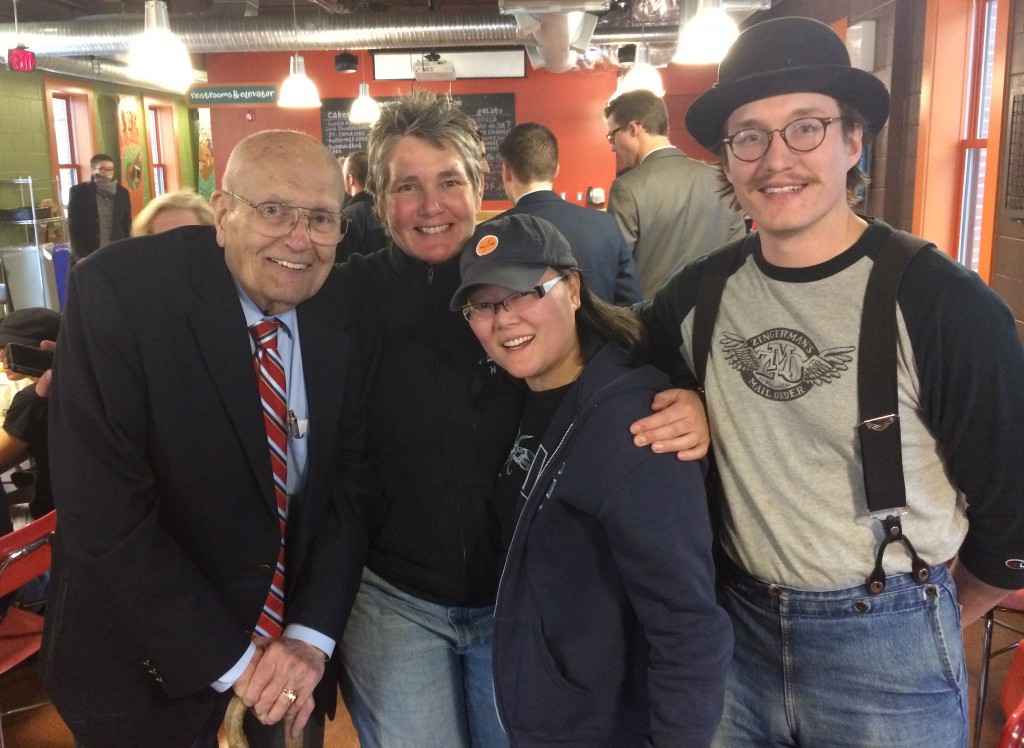
U.S. Rep. John Dingell, D-Dearborn, State Rep. Adam Zemke, D-Ann Arbor, and State Rep. Jeff Irwin, D-Ann Arbor met with Zingerman’s Deli staff and Ann Arbor business owners at the Deli yesterday afternoon to discuss proposed increases in the state and federal minimum wage.
The Congressional Representatives chose to meet at Zingerman’s following a recent trip by Paul Saginaw to Washington D.C., where he, along with other national business leaders, met with U.S. Secretary of Labor, Thomas Perez.
Dingell praised Paul’s trip to Washington, saying, “It says that there’s conviction there, which is sufficient to cause a very substantial expenditure to inform the Congress of what Zingerman’s and what Mr. Saginaw, who made the trip, thinks is the need of the country.”
Dingell is a co-sponsor for bill H.R. 1010, the Fair Minimum Wage Act of 2013, which would increase the federal minimum from $7.25 to $10.10. Irwin and Zemke are co-sponsors for Michigan House Bill 4386, which would increase the state minimum wage from $7.40 to $9 in 2014.
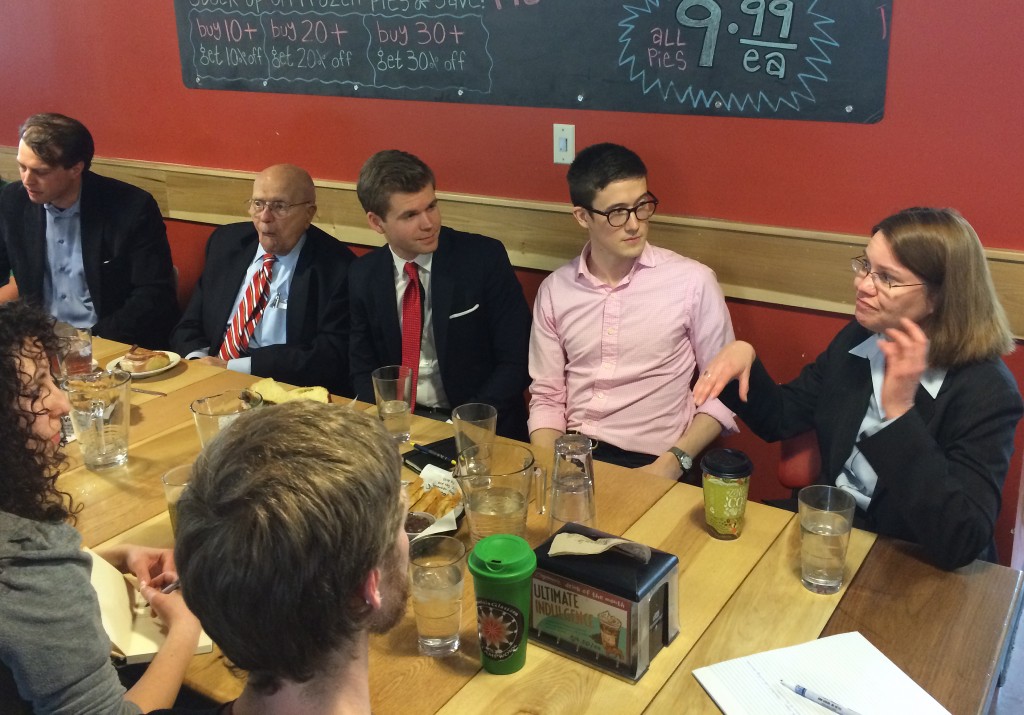
During the meeting (known as the #SandwichSummit on Twitter), the Representatives listened as Deli staff shared their experiences, and talked about the implications and benefits of raising the minimum wage.
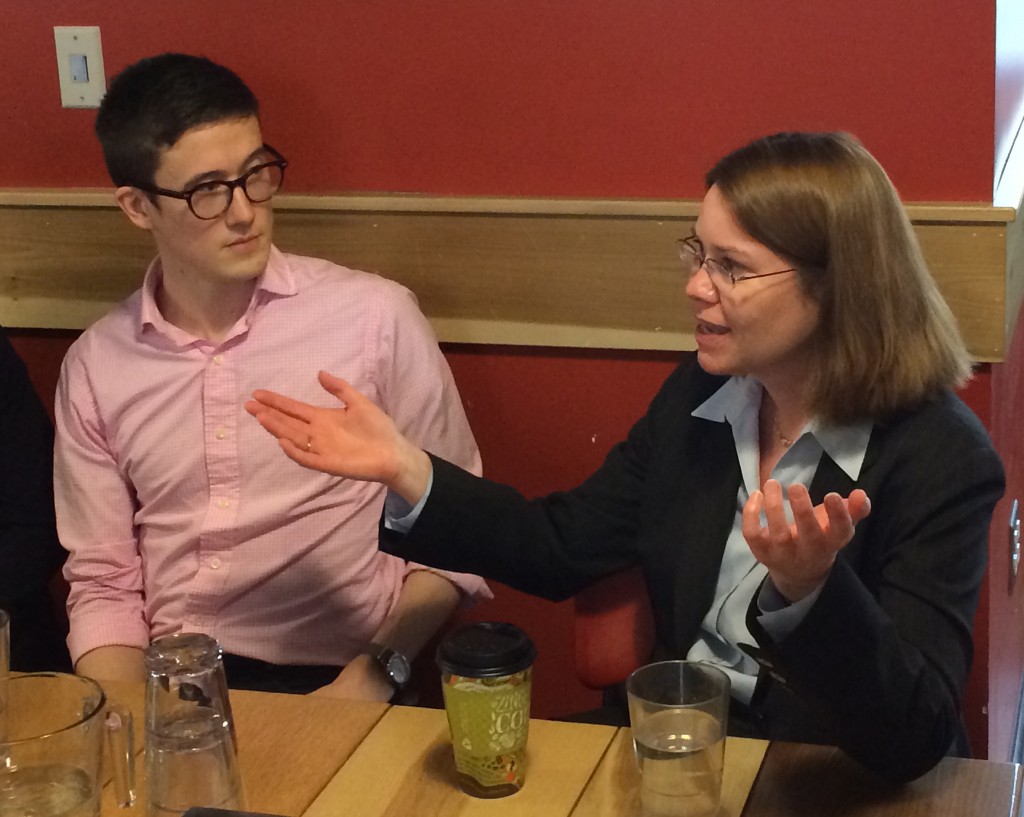
Also present to express their support for the proposed legislation were local businesspeople Sandy Bledsoe, owner of The Espresso Bar in Braun Court, and Eve Aronoff, owner and chef at Frita Batidos on W. Washington St. downtown, as well as Comptroller for the City of Grand Rapids, Sara Vander Werff.
“It is but equity…that they who feed, clothe and lodge the whole body of the people, should have such a share of the produce of their own labor as to be themselves tolerably well fed, clothed and lodged.” – Adam Smith, The Wealth of Nations
A big thanks to everyone who participated!
A high road on minimum wage
by Paul Saginaw
 It is a cruel irony that many of the 13 million men and women who produce and serve the food in my industry are forced to use food stamps to feed themselves and their families. The average, full-time, fast food worker earning $7.25 an hour makes $15,080 a year, 20 percent below the poverty rate for a family of three. Contributing to this situation is the fact that the sub-minimum wage for tipped workers has been frozen at $2.13 per hour for more than two decades. In the absence of meaningful action from industry groups like the National Restaurant Association to alleviate this crisis, I believe, as a restaurant owner and food service entrepreneur, we need to raise the federal minimum wage now.
Our success at Zingerman’s with over 30 years of operating and opening food-related businesses was not achieved by underpaying or withholding benefits from our employees. From day one, my sixteen partners and I have paid wages above the federal minimum and offered company-subsidized health care and paid time-off. We have never considered these critical costs of doing business obstacles to profitability or our annual compounded growth rate of 10 percent.
I reject the argument put forth by many in the restaurant industry that livable wages and profits are mutually exclusive. Our experience at Zingerman’s proves exactly the opposite and I am not convinced we are exceptions to any rule. To prove taking the high road is viable, the Zingerman’s Community of Businesses in Ann Arbor has joined RAISE, an alternative restaurant association of successful establishments all across the nation, and we are honored to partner with businesses, like DC’s Busboys and Poets, Detroit’s Russell Street Deli, Chapel Hill’s Vimala’s Curryblossom Cafe among nearly 100 others, who are committed to a “high-road” approach to labor practices. Our success stands in direct opposition to the false claims about livable wages and profits that have dominated the debate for decades. We are uniting to prove to the rest of the industry investing in our employees has been a driving force to our growth and success, not an impediment.
To those who argue raised menu prices will result in loss of customers and diminished profits, I question the scale of your profit margins and wonder who is shorted to maintain those margins — is it your employees? Yes, menu prices could increase. A study by the UC Berkeley Food Labor Research Center found raising the minimum wage (as proposed in the current Fair Minimum Wage Act) would only cost the consumer an extra dime a day, and that’s assuming employers pass 100 percent of the extra cost onto customers. This is not a compelling argument to me against making the choice to pay workers a higher wage. The benefits we’ve seen at Zingerman’s from investing in our employees far outweigh the “liability” of charging higher prices.
We would be irresponsible employers if the jobs we provided could not support housing stability and health security. So we are motivated to gradually raise wages to a “thrive-able level” for all of our lowest-paid employees across the board. A living wage is the path to a living economy and the antidote to the current suicide economy trajectory we find ourselves on. We don’t own this approach. Nothing would please me more than for it to go viral, industry wide. But in the mean time, to start to lift millions of people out of poverty and create an economic stimulus through increased consumer spending, we cannot wait on voluntary adoption. The legal minimum wage level must correspond to the actual cost of living to produce and enforce the action needed.
As the largest low-wage job provider in the country — home to 7 of the 10 lowest paying jobs in the U.S. — restaurant owners play a critical role in raising industry standards, including combating myths surrounding our workforce and the minimum wage. It’s a fabricated assumption that the minimum wage is “a starting wage and rarely received by either full-time employees or those acting as head of the household.” Here are the facts:
- 77 percent of people paid the minimum wage are adults, according to the Bureau of Labor Statistics.
- 55 percent are employed full time, according to the Economic Policy Institute.
- 70 percent live in families with a household income of less than $60,000.
- Over 34 percent are married.
- Over 25 percent are parents.
I sense we are ready for this change. Just as customers have voted with their pocketbooks for locally-sourced, organic and free-range products, they are voting for ethical employment by patronizing high-road restaurants. Raising wages would lift millions out of poverty, create an immediate economic stimulus, and adjust our current economic trajectory to avoid self-destruction. But delivering this antidote to our flailing economy requires more than the voluntary adoption of high-road practices. The Fair Minimum Wage Act raises the federal minimum wage to $10.10 and raises the tipped minimum wage to 70 percent of that over the next 6 years. Let’s just agree to break the cycle and wage structure holding too many American families in poverty.
![paul's-signature-[Converted]](https://www.zingermanscommunity.com/app/uploads/2013/09/pauls-signature-Converted.png)