
Tag: RECIPES
Zingerman’s 4th Annual Camp Bacon is coming soon and to help get everyone prepared, we’re sharing tasty excerpts and recipes from Ari’s book, Zingerman’s Guide to Better Bacon.
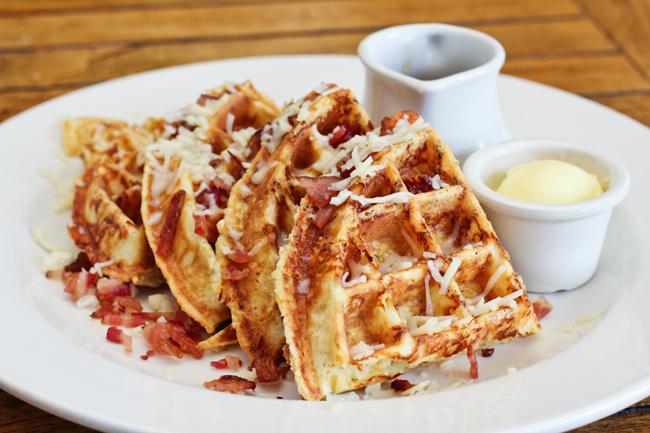
Grits & Bits Waffles
This old Georgia dish has long been one of the most popular items on the Zingerman’s Roadhouse brunch menu. The story is that the Dutch brought waffle irons here with them and that as they moved south from Manhattan they began to blend the local leftover grits that were so common into their waffles to make breakfast the next morning.
The dish really isn’t very hard to make, but by bringing together the flavors of wheat, corn, bacon and maple syrup you really get a great, unique way to start the day. As always I’ll recommend the Anson Mills grits, though other artisan offerings will also serve you well. The key is that the grits add flavor as well as texture to the dish. If you’re into sorghum or cane syrups, you could certainly use either one instead of the maple. When it comes to the bacon, I’d go with one of the dry-cured offerings—Broadbent’s, Edwards’ or Benton’s to stand up to all the other good flavors here.
Ingredients:
- 2 cups all-purpose flour
- 2 tablespoons sugar
- 1¼ teaspoons baking powder
- 2 cups water
- 6 tablespoons unsalted butter
- 1 cup Anson Mills (quick-cooking) grits
- 1 teaspoon coarse sea salt
- 4 eggs
- 1½ cups whole milk
- 1 pound sliced bacon (about 8 to 12 slices), cooked and coarsely chopped
- 6 ounces sharp cheddar (I’d recommend a nice two-year-old white cheddar like the one we get from Grafton Village in Vermont), shredded
- Maple syrup and butter to taste for serving
Procedure:
- 1. In a mixing bowl, combine the flour, sugar and baking powder and set aside.
- 2. In a saucepot, bring the water and butter to a simmer. Before the water comes to a boil start adding the grits, stirring steadily until incorporated. Add the salt and stir well. Reduce heat to low, cover and continue to simmer for 30 minutes, stirring occasionally. Add more water if needed.
- 3. While the grits are cooking, separate the eggs. Set the yolks aside in a dish, and refrigerate the whites.
- 4. When the grits are done (you can always cook them longer than half an hour—they’ll continue to get creamier the longer you cook them), remove them from the heat; transfer to a large mixing bowl and let cool to 110°F. Stir the egg yolks into the grits one at a time, mixing well after each addition.
- 5. Add the milk and mix well.
- 6. Add the flour mixture, mixing until just combined.
- 7. Beat the cold egg whites in a mixer or with a hand beater to medium peaks. Gently fold the whites into the batter and mix gently. Chill for at least 1 hour prior to cooking. (Note: the batter can be made the night before and stored in the refrigerator until you’re ready to start cooking.)
- 8. When you’re ready to eat, pour the batter into a preheated and well-oiled Belgian-style waffle iron, and add a generous bit of chopped bacon and shredded cheddar. (We use 1 cup of batter with ¼ cup each of bacon and cheddar.) Close the waffle iron and cook until golden brown. Remove the waffles from the iron and place on warm plates. Sprinkle more chopped bacon and shredded cheddar over the top of the waffles. Serve with good butter and real maple syrup.
- 9. Repeat until all the batter, chopped bacon and grated cheddar have been used.
Serves 4 to 6 as a main dish.
SEE YOU AT CAMP!
Zingerman’s 4th Annual Camp Bacon is coming soon and to help get everyone prepared, we’re sharing tasty excerpts and recipes from Ari’s book, Zingerman’s Guide to Better Bacon.
Angels, Devils, Pigs . . . and a Nice Date with Bacon
These four little appetizers have been around a long time. They’re great ways to bring bacon into a party setting without a whole lot of work. You can adjust the portions easily to fit whatever appetite, group size, budget or BQ (Sarah Katherine Lewis’ “bacon quotient”) you’re working with.
Angels on Horseback
The angels, in this case, are oysters—their little frilly flaps get all fluffy and angelically wing-like under the heat of the broiler. Angels on Horseback is often presented as fancy food, but it’s in really basic books too, like V. M. Sherlock’s Apalachicola Seafood Recipes—a small, softcover, brown pamphlety thing that I like a lot. Ms. Sherlock calls them by the unfancy name “broiled oysters,” which just reinforces my belief that they’re really a pretty darned down-to-earth way to eat. I like to use Arkansas long pepper bacon—it’s got a nice bit of spice, but the moderate smoke level keeps the wood from completely overtaking the dish. Other bacons from the lighter smoke end of the spectrum, like Vande Rose, Nodine’s and Nueske’s, will also work well. As for the angels, any good oyster will work. I love Apalachicolas, which we bring to the Zingerman’s Roadhouse regularly from Florida. I’ll just share this note from Sherlock, who wrote that, “Throughout the ages, men have argued over the superior flavor of oysters of their regions, but until they have tasted the Apalachicola oyster, they’re in no position to judge.”
Ingredients
- 8 oysters, shucked
- 4 slices bacon, cut in half crosswise
Procedure:
- 1. Heat the broiler.
- 2. Wrap a half-slice of bacon around each oyster and then run a toothpick through the whole thing to hold it together. Place on a baking sheet, run it under the broiler and cook until the bacon is done, giving it a turn halfway through. If you want the bacon well done you can cook it part way in a pan before wrapping it around the oysters.
- 3. Cook carefully: as V. M. Sherlock says, “Local appetites may differ but most will agree that you should never wash an oyster and never overcook one.”
Devils on Horseback
These are made in the same manner as Angels, except that the oysters are replaced by dark Devils—in this case, prunes. Pork and prunes are a classic combination found in all sorts of big-flavored dishes from southwestern France, and this easy-to-make appetizer delivers that same wonderful flavor pairing to your guests in mere minutes! Of course you know already that I’m going to say you have to find really good ingredients to work with—my favorites are the prunes from Agen in France, but I don’t think you can get them in the U.S. anymore. If you find a variety that’s better than the standard supermarket grade, grab it. I like to make this dish with one of the smoky, dry-cured bacons to balance the sweetness of the dried fruit.
Ingredients:
- 8 really good prunes, pitted
- 4 slices bacon, cut in half crosswise
Procedure:
- 1. Heat the broiler.
- 2. Wrap a half-slice of bacon around each prune and then run a toothpick through the whole thing to hold it together. Place on a baking sheet, run it under the broiler and cook until the bacon is done, turning the “devils” halfway through the cooking. Again, if you want the bacon well done, you’ll do better to cook it partially through on its own before you do the wrapping.
Clam Pigs
This is the same dish as Angels on Horseback, but made with fresh clams instead of oysters. Gotta love the name, which I came across in Sherlock’s Apalachicola cookbook!
Ingredients:
- 8 fresh clams, shucked
- 4 slices bacon, cut in half crosswise
Procedure:
- Follow the instructions for Angels on Horseback, substituting the raw clams for oysters.
Bacon Dates
Taking our passion for bacon a tad bit beyond the now-standard allusions to love and sex, it seems reasonable to go ahead and actually make a real life “date with bacon,” don’t you think? That said, I guess this recipe really is a literal as well as figurative date with bacon (or, actually, if you prepare the whole recipe, 16 dates with bacon). Of course there’s really no limit, since you can multiply the recipe as many times as you like.
Bacon dates are a great little appetizer and extremely easy to make. If you’re up for a “double date” you could serve it for dessert, too—I’ve never thought of using the same dish to both start and end a supper before, but given Americans’ fondness for bacon it sort of makes sense to bacon-end the meal. I love the organic dates from Four Apostles in Bermuda Dunes, California. The sweet smokiness of the bacon with the buttery richness of their ripe dates and the spice of the long pepper gives this finger food a great bit of balance in its flavors.
Ingredients:
- 16 dates, pitted
- 8 slices bacon (we prefer these with the Broadbent bacon), cut in half crosswise
- 4 whole Balinese long peppers, quartered lengthwise
Procedure:
- 1. Heat the broiler.
- 2. Stuff each date with a sliver of long pepper, then wrap with a half-slice of bacon and secure with a toothpick. Place the bacon-wrapped dates on a baking sheet and broil 10 to 15 minutes or until the bacon is crisp, turning once. Keep an eye on them so they don’t burn!
- 3. Remove from the oven once the bacon is done, let cool for a couple of minutes and serve while still warm.
SEE YOU AT CAMP!
Zingerman’s 4th Annual Camp Bacon is coming soon and to help get everyone prepared, we’re sharing tasty excerpts and recipes from Ari’s book, Zingerman’s Guide to Better Bacon.
 American Fried Bread
I learned this really simple dish from the book Things Mother Used to Make, published in 1914 by Lydia Maria Gurney. It’s probably as down-to-earth, backwoods American cooking as you’re going to get. You can serve it as is for breakfast or add a bit sorghum syrup, maple syrup, or molasses drizzled on top. It’s also good sitting next to a salad for lunch or a light supper.
If you have reserved bacon fat on hand already you can just use that. If not, start by frying some bacon (let’s say one slice per slice of bread) in a skillet. Remove the bacon, leaving the fat in the pan. (In tight time, the meat would have been used for other purposes later, but I’d say chop it and serve it on a salad alongside the bread.)
Keeping the fat hot, put slices of stale bread into the pan. You can, of course, use most any bread, but my current favorite is a Zingerman’s Bakehouse mainstay and longtime American classic. Around here we call it Roadhouse Bread, but it was known in the eighteenth and nineteenth centuries as Rye ‘n’ Injun, or, at times, Thirded Bread. It’s made with a mix of rye, wheat, and corn (hence the reference to thirds) and has a bit of molasses in it, as well. It’s great on its own, and better still with bacon.
While the bread is frying add a couple of teaspoonfuls of either warm water or milk to the pan, and, if you like, flip it and cook until it’s nicely browned on the other side. As Mrs. Gurney said at the start of the last century, “This is a very appetizing dish.”
SEE YOU AT CAMP!
Zingerman’s 4th Annual Camp Bacon is coming soon and to help get everyone prepared, we’re sharing tasty excerpts and recipes from Ari’s book, Zingerman’s Guide to Better Bacon.
Bacon hash
This hash has turned out to be a big hit with most everyone who’s had it. It’s an excellent way to take advantage of the big flavor of top-of-the-line bacons. The bacon is the headliner rather than just a couple of strips alongside another main dish. I like making it with the dry-cured intensity of the Broadbent’s, Benton’s, Father’s, or Edwards’, but it would really work with any good bacon.
You can make the recipe a day or tow in advance if you like, then reheat it in a skillet when you’re ready to serve. Regardless, you’ll want to cook both the bacon and potatoes and let them cool before you move on to the rest of the recipe. Serve with rye toast and a couple of poached eggs if you like, as well.
Ingredients:
- 4 tablespoons rendered bacon fat
- 1 medium onion, coarsely chopped
- 1 medium red bell pepper, coarsely chopped
- 1 stalk celery, coarsely chopped
- 2 tablespoons flour
- 1 1/2 cups chicken broth
- 2 tablespoons Worcestershire sauce
- 10 ounces sliced bacon (about 5 to 7 slices), lightly cooked and shopped
- 2 pounds potatoes (I like Yukon Golds, German Butterballs, or others of that ilk), steamed over salted water until tender, then diced with the skins on
- 1/4 cup heavy cream
- Coarse sea salt to taste
- Freshly ground Tellicherry black pepper to taste
Procedure:
Melt the bacon fat in a large skillet over moderate heat. Add the onion, bell pepper, and celery, and cook, covered, for 5 to 6 minutes, until soft.
Sprinkle the flour over the wilted vegetables and stir well to avoid lumps. Cook for another 4 to 5 minutes, stirring constantly to keep from sticking, until the flour blends with the bacon fat into a thickened roux.
Add the broth, a bit at a time, stirring well after each addition so the mixture stays smooth and creamy. The sauce should coat the back of your spoon before you add more liquid. Stir in the Worcestershire sauce.
Continue simmering the sauce over moderate heat until it thickens, about 5 minutes. Add the bacon and potatoes and mix well. Add the cream and cook, stirring, a few more minutes. Stir in salt and freshly ground pepper tot taste.
Serve immediately, or cool and reheat in a skillet until you get a nice golden brown crust.
Serves 4 to 6 as a main dish.