
Tag: ZINGERMAN’S CANDY MANUFACTORY
Spreadable, spoonable goodness at the Candy Store
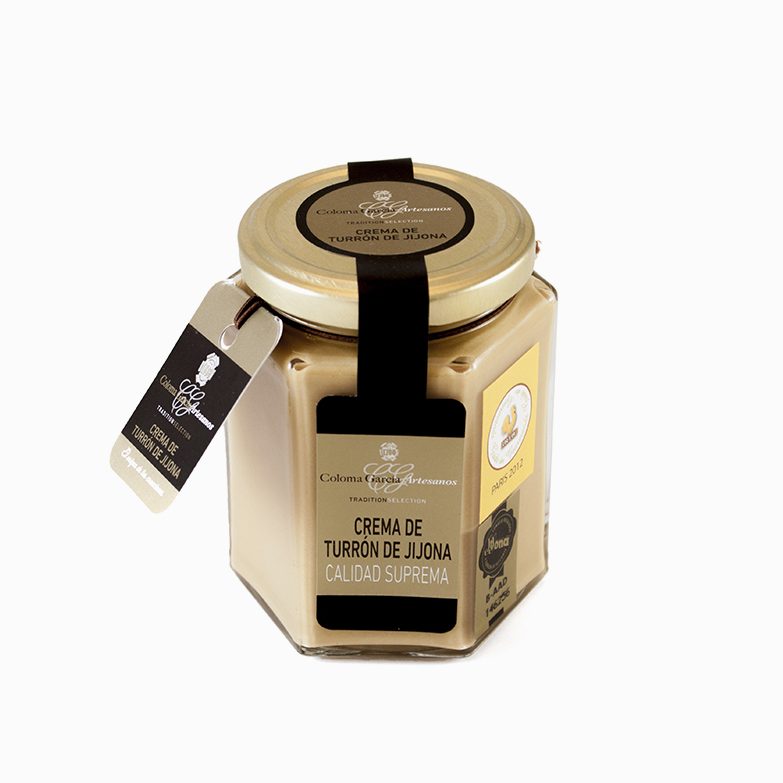
Up until a few weeks ago, I’d never even imagined anything like turrón cream existed! It’s seriously so good, I keep going back to the jar for “just another spoonful.” Given that it’s not all that big of a jar, I’d better grab another since I’ve almost finished my first!
To be clear, there’s no actual cream in turrón cream. “”Cream” describes the texture, not the usual dairy product we all associate with the word. The actual ingredient list is happily brief—just a whole bunch of the very special Spanish varietals of Marcona and Comuna almonds, the wonderful orange blossom honey that is so well known in the area, plus a bit of egg white and sugar, all finely ground together to make a magical, butterscotch-colored paste. Per the name, it is essentially a turrón taken out of its firmer, bar-shaped form and converted into a creamy, compellingly flavorful almond cream. Spread on toast or eaten by the spoonful, it’s beyond terrific. You can also spoon some into one of the Bakehouse’s beautiful Cultured Butter Croissants (and help keep the positive momentum going in the process). Or put it in a sandwich or in tiny tartlets with some jam—my vote is for apricot, of course. (Wondering why apricots are getting so much attention from me right now? Read this.)
The turrón cream at the Candy Store comes from the town of Jijona—or Xixona in the old, traditional Valencian language—in southeastern Spain. In 1961, Coloma García purchased the machinery of Eliseo Miquel, a local turrón maker whose family history went back nearly 200 years. Today, the confectioner is run by the next generation and is still located in Coloma García’s small hometown of Jijona.
While turrón cream is new to us, turrón itself dates all the way back to the 15th century, when honey and almonds were being combined to make this now-famous Spanish sweet. In an era in which chocolate was unknown in Europe, turrón was at the top of the list of confectionery achievements. The nuts, now famously known as “Spanish almonds,” were brought to the Iberian Peninsula by Arabs arriving from North Africa.
To be clear, the Spanish almonds used in all Coloma Garcia products are not interchangeable with the more common offerings that we see from California. Average almond yields in the Golden State are about 3,000 pounds per acre. In Spain, it’s about 100! Spanish almonds generally have less moisture and hence far more intense flavor. The almond varietals are different in Spain as well. As usual, you really can taste the difference.
The turrón cream we carry comes in a lovely little jar. A great gift for any almond lover, a terrific item to brighten a winter Tuesday, and a lovely way to deliver a bit of southern Spanish beauty to somebody’s afternoon! Turrón terrificness is ready to take your morning toast to the next level!
Try turrón cream
A limited supply of Cioccoarancia comes to the Candy Store
It’s been nearly 10 years since I first stumbled upon the remarkable chocolate hazelnut spread from central Italy that so many of us around here now know well as Noccioliva. It was on display at the Fancy Food Show. Of the literally thousands of “specialty foods” I tasted over the course of a couple days while walking up one aisle and down the next, the Noccioliva was near the top of my list of items I was sure we should bring back to sell at the Deli. As I explain regularly to anyone who’s interested, Noccioliva is essentially what that really well-known, widely sold “chocolate hazelnut spread” whose name you almost certainly know aspires to be but isn’t.
In other words, Noccioliva is our kind of food. A small number of really great ingredients, combined to make one truly delicious chocolate hazelnut taste treat. No artificial stuff. Just lots of Italian hazelnuts, a good amount of dark chocolate, a small bit of sugar, and some extra virgin olive oil. It has a complex and beautifully balanced flavor with a lovely, long but not overly sweet finish. You might well have already tried Noccioliva on the Roadhouse’s dessert menu or on the Nutty Monkey toast at the Coffee Company. Longtime Roadhouse Catering Manager Taralyn Brinks told me that her favorite toast is Noccioliva with bananas on Bakehouse bread. Seriously, this is 100 percent eat-it-by-the-spoon kind of stuff, which is, in fact, my preferred method!
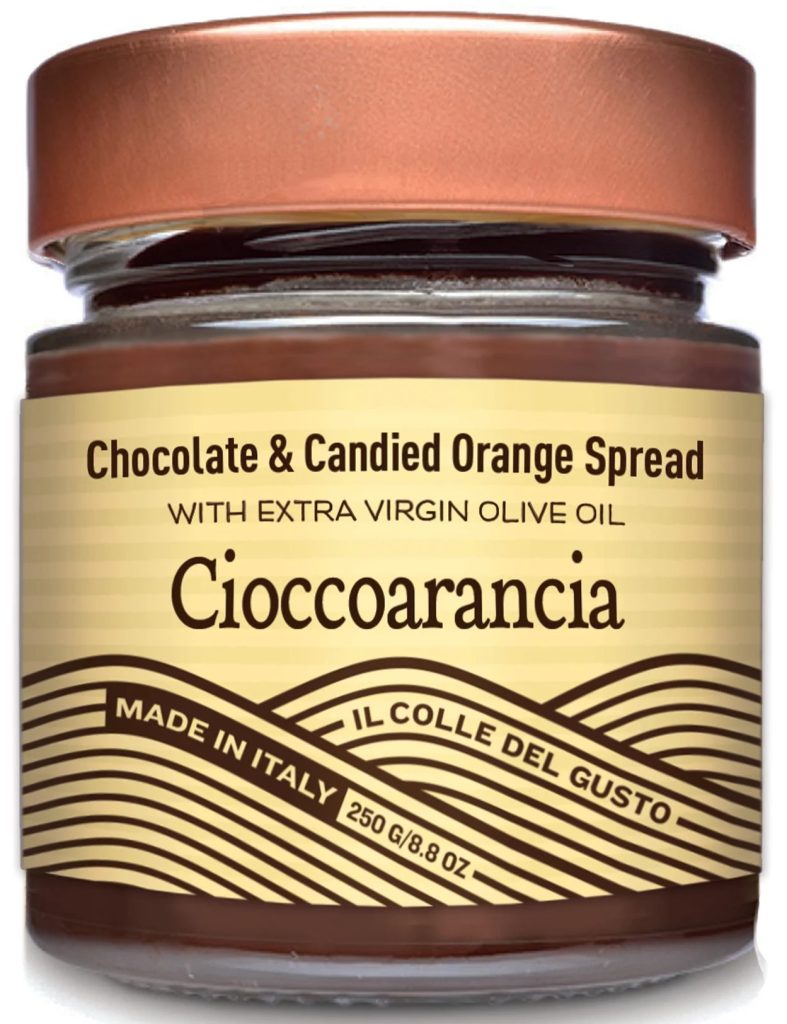
By the way, a few weeks ago, we received a limited supply of Noccioliva’s newly available cousin, Cioccoarancia. If you, as so many people do, love the combination of chocolate and orange, you will not want to miss it! It’s essentially the Noccioliva so many of us already know and love, enlivened and enriched by the addition of orange oil and small, crunchy bits of candied orange. Man, oh man, is it tasty!
Both of these remarkable chocolate nut spreads—and the Pistachiossa, a very light and super-lovable pistachio and olive oil spread—are made by the small artisan firm of Colle de Gusto (“hills of flavor”). It’s located in the tiny town of Fara di Sabina in the region of Lazio, smack in the center of Italy. A lovely, small medieval village that was built about halfway up a mountainside, Fara di Sabina is also home to the Museo del Silenzio (Museum of Silence). This special place gives visitors a glimpse into what life would have been like in the monastery of the Eremite nuns that’s located near the center of the town. Anyhow, we get these spreads thanks to the wonderful work of Rolando Beramendi, the man behind Manicaretti Imports, one of our longest-standing suppliers. In a sense, I see now, he’s someone who moves regularly between different worlds.
Born and raised in Buenos Aires, Rolando is of Italian ancestry, as you likely guessed from his name. Like Tuan Andrew Nyugen, he moved back to the place that held his heart when he became an adult. He now lives in a lovely small apartment in the central part of Florence near the Arno River. He is also quick, as you’ll see below, to wander into new worlds whenever he can. The rest of us are the culinary beneficiaries of Rolando’s willingness to regularly reach beyond his comfort zone. Here’s what Rolando had to say about how he found the amazing Colle del Gusto spreads in the first place:
You know that I love “to get lost”! By that I mean I go into a city, a place I’ve never been before, even for a day, and walk aimlessly, just like in David Bowie’s “China Girl”: “I stumble into town, just like a sacred cow” and this particular day I was walking aimlessly around Rome along the Tevere, down towards the Tempio de Minerva, Buca della Verita … then crossed to the Circo Massimo and I saw a sign to a marketplace called “Coldiretti” (“straight from the hills”). So, I wandered all around, looking, talking, tasting, and just as I was about to leave, from the corner of my left eye, I see a gelato stand with a very funny logo, called “Colle del Gusto” … I saw some nice jars with “nutty” spreads or syrups or whatever you might want to call them, which they would swirl on your gelato. After I tasted it, I was blown away!
They invited me to come up and we spent the most amazing time getting to know each other. They are lovely people, and I am so proud to say that now they have a nice big warehouse space where they make all the spreads, and have employed many local people in a horrible time for humanity.
Cioccoarancia is wonderful spooned into a Cultured Butter Croissant from the Bakehouse. Great on any toasted Bakehouse bread. Delicious on Zingerman’s gelati. Even better still, some say, is spreading it onto pancakes or waffles! If you’re looking for a good stocking stuffer for a chocolate lover you know, or just something nice to perk up your own day, buy a jar or three today! Shelf life is theoretically long, but the practical reality is that it nearly always disappears quickly.
Spread some sweetness
The Candy Store scores big with this amazing new arrival
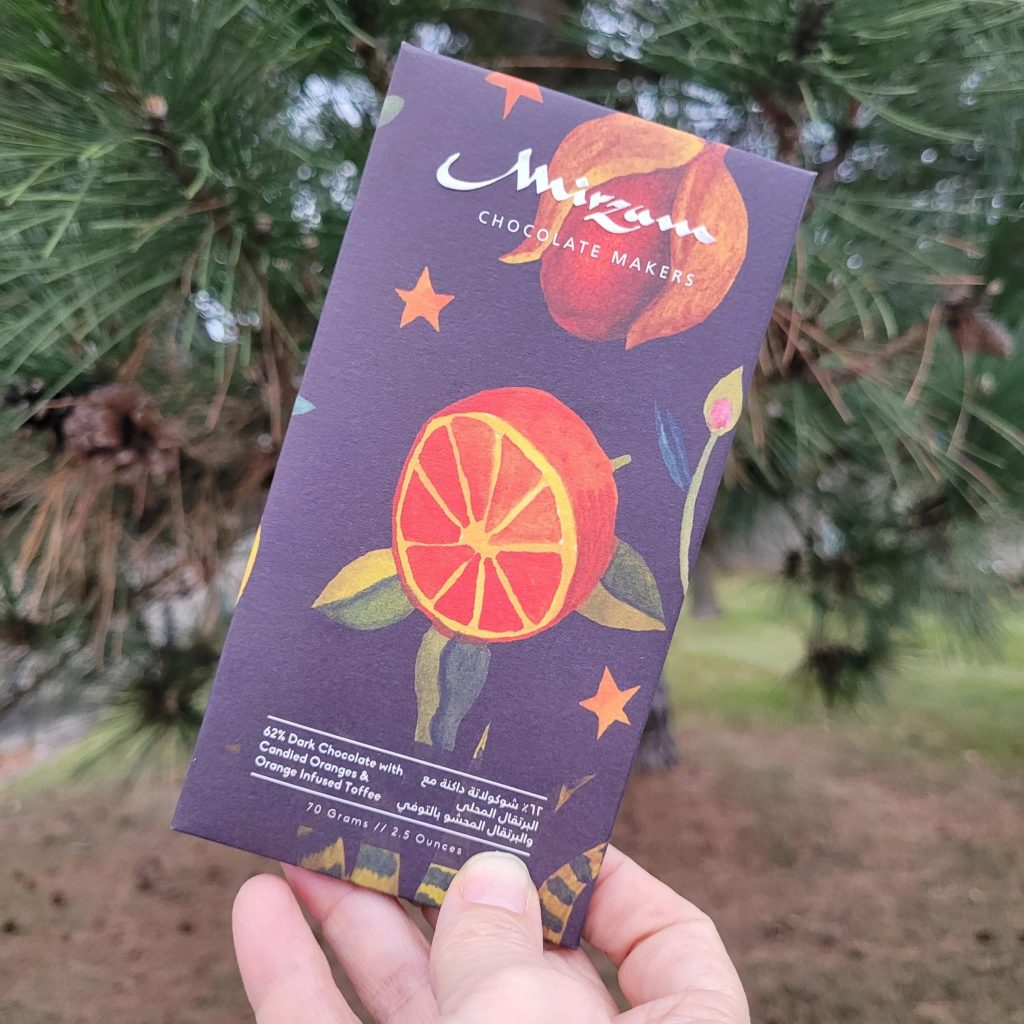
I’ll confess to being a bit concerned when we began buying chocolate bars from Mirzam in Dubai many years ago. I mean, chocolate made in a desert capital? Over the years, I came to realize though that I had nothing at all to be concerned about—the Mirzam chocolates have been uniformly excellent. In fact, they have become some of my favorites over the last five or six years! Each new arrival seems especially special, so good that I have a hard time imagining that Kathy Johnston and the rest of the Mirzam crew can top it. And yet, time after time, they do. This new Double Orange Dark Chocolate bar, which came to town for the first time a few weeks ago, is no exception. I’m already on my third one in three weeks!
The bottom line is that Kathy Johnston and the Mirzam team are, quite simply, crafting some of the best bean-to-bar chocolate around. The flavors are lovely, complex, and compelling. And the artwork on the labels, created by the remarkable Romanian artist, Aitch—is equally lovely! Of this new creation, Kathy shares:
I had called this one, while it was under development, the “Double Orange Bar,” because it has the crispy orange toffee pieces, as well as the candied navel oranges that we sell separately. The origin of making it happen was after a collaboration request from the team at Z&Z, a Palestinian restaurant/bakery in Washington D.C. Their father comes from the town of Yaffa, which is famous for its connection to oranges; and so this was the place where I started to think about the recipe. It was originally created as a short-term pop-up kinda recipe; but I love it so much. I love oranges with chocolate, I think they are deeeeelicious together!
The Double Orange Dark Chocolate bar is made with a blend of a couple of cacao origins. It has Indian beans from the south of the country, which are known for their complex, fruit-forward, nutty flavor, and Dominican cacao, which is regularly recognized for being beautifully balanced and quite creamy. Add in the crispy orange toffee and gild the citrus lily by adding bits of Mirzam’s dark chocolate-covered oranges, and man oh man, do you have a magical bar.
Swing by the Candy Store soon to score some of this special chocolate. Complex flavors, great balance between the 62% dark chocolate and the orange, and a lovely finish. The label, like everything Mirzam does, is as amazing as the chocolate inside! It’s a great way to make any chocolate lover’s day!
Add a bar to your bag

New, 70% Barrel-Aged Dark Chocolate Bar
This just in: A dark and super-tasty Tanzania chocolate bar has landed at the Candy Manufactory! It’s extra special because its nibs were first aged in whiskey barrels. If you’re looking for a chocolate to wow your friends and family, or just your own discriminating taste buds, this bar will fit the bill!
This new bar is made by my buddy, the amazing chocolatier and remarkable human being Shawn Askinosie, along with the rest of the team at Askinosie Chocolate in Shawn’s hometown of Springfield, Missouri. Shawn has shared a bit of the bar’s story:
We lucked into these used whiskey barrels years back and so we decided to make good use of them. We decided to age roasted Tanzania cacao nibs in those barrels. We wanted a flavor experience that was subtle and lasting, and not overpowering. It’s more art than science how one judges the flavor over time, and how that what one tastes will translate into the finished chocolate. One thing we’ve become decent at is forecasting what a roasted cocoa nib will taste like when it transforms into chocolate. That is what we did here with this new bar. I love [Ashkinosie co-owner] Lawren’s tasting note: “A soft and mellowed chocolate with subtle notes of malty smoke, charred oak, and mild whiskey-vanilla-sweetness.”
The rye whiskey barrels from Blackland Distillery are heavily charred to impart subtle but significant flavor to the nibs. What happens in the barrels? Essentially the same thing that happens with wine or whiskey. The flavors of the wood—and the whiskey that soaked into it during many months of maturing—enhance the flavor of the cacao that’s stored inside. Of the chocolate made from those barrel-aged nibs, the crew at the Askinosie factory has this to say: “It’s our most quietly complex bar ever, and did we mention it’s a limited edition? We have a finite amount of these aged nibs, and once these bars are gone, that’s it!” The chocolate really is terrific. Lovely tannins and a wide, well-rounded flavor. Like Lawren said, there’s a little vanilla and, to me, a titch of black cherry along with some of that superb oaky smokiness lingering along the edges. It’s super tasty!
Like a good bottle of red wine, I like to let dark chocolate breathe a bit after I open the bar. Side note: I’ve never seen anything written about this, but, after years of tasting, I swear that the bars are texturally creamier a day after I open them. Anyhow, if you have enough self-control to buy a bar, slit the paper wrapping and wait a day before you eat what’s inside. I believe this is when it will be at its best. Alternatively, you can do some research by tasting immediately and then again the following day. It’s a tough job, but somebody’s gotta do it! Make a toast to the meaningful work Shawn, everyone at Askinosie, and all the caring cacao growers do to make this possible!
You can buy this great new limited-edition bar at the Candy Store on Plaza Drive (inside the Coffee Company).
Exceptional artisan caramels from southern Vermont
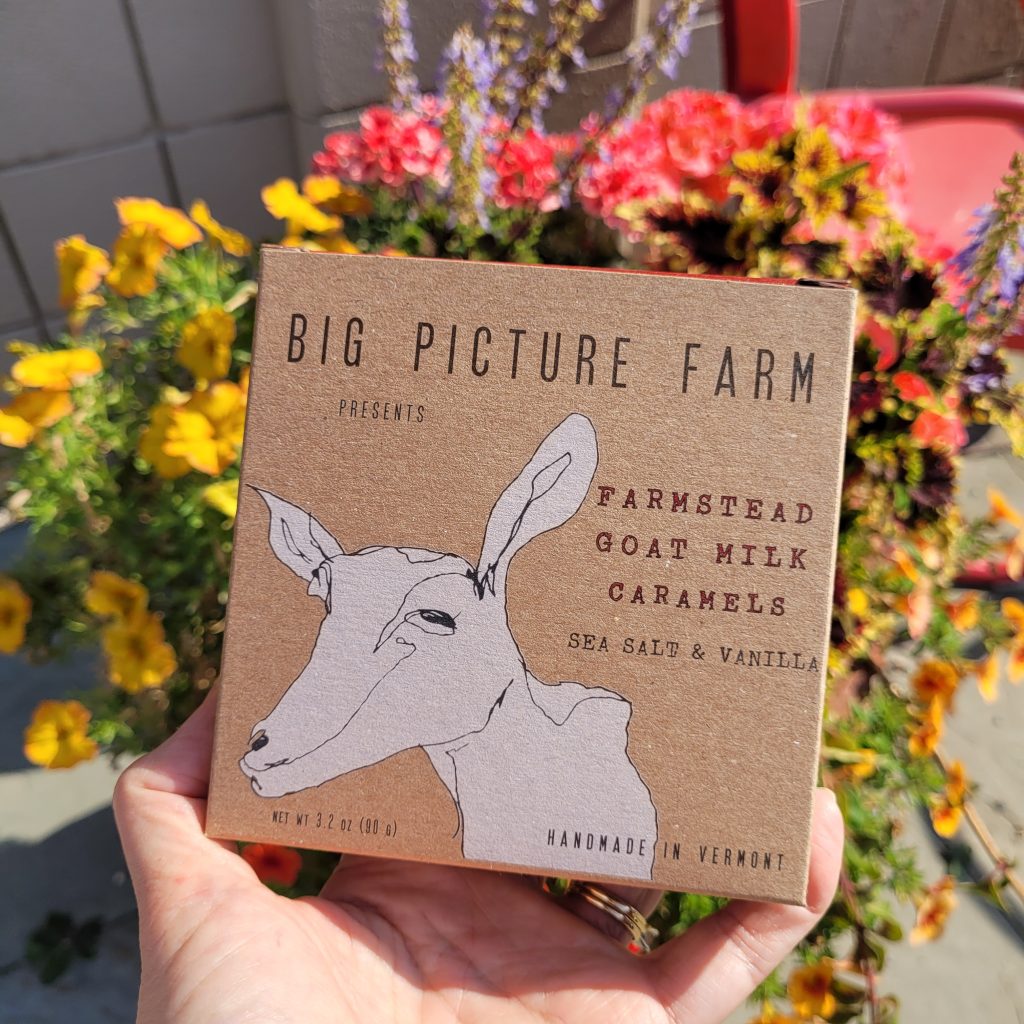
These totally terrific handmade goat milk caramels just came into the Candy Store last week! Everything about them exudes excellence. They’re made by hand at Big Picture Farm, which was founded in 2010 by photographer and artist Louisa Conrad and her husband, the poet and writer Lucas Ferrell. The two met as students at Middlebury College, went to the West Coast for grad school, and then got married. Fifteen years ago, determined to make their dreams come true, they took out loans to buy an old nine-room farmhouse back near the southern Vermont village of Townsend.
Today, the two manage a working goat farm, raise kids (both the goat and human kind), make caramels, and craft artisan goat cheese. They are actively playing their part in making a positive story about American farming. As Louisa says, “The stories behind what’s going to happen in American agriculture are largely dependent on how these transitions go from all of the older farmers to the next generation.”
Louisa and Lucas are very values aligned with what we do here: Regenerative grazing, 100% solar power, and the boxes into which the caramels are packed are beyond beautiful. And most importantly, the caramels taste great. The quality is truly exceptional. Louisa gives credit where credit is definitely due: “The secret ingredient is 100% the milk that we use from our goats that are extremely spoiled.” They’ve won a wealth of awards at the Fancy Food Show and the Good Food Awards over the years. Food critic Florence Fabricant writes in The New York Times, “The candies are simple and irresistible.”
Lucas is also a poet—the blue-collar sun won the 2020 Sundog Poetry Book Award. Although the work of caramel making and poetry writing could seem a strange juxtaposition, he points out that they work in parallel. In the spirit of what I wrote about in “The Art of Business” pamphlet, an interview with the Vermont weekly newspaper Seven Days (founded 30 years ago and still run by Paula Routly, the good friend of my good friend Molly Stevens,) Lucas says,
Poetry and caramels aren’t so different. They share a process of boiling down their material (milk or language) in an attempt to distill, sculpt, or otherwise express the fundamental components of life — in small but sweet and wondrous form! … I think of the farm as art. I think of our caramel as art. They’re things that we’re actively making,
Of his writing, poet Joanna Klink writes in Raptus, “Lucas Farrell throws a spell over everything his voice touches.” I think these artisan goat caramels could do something similar to your taste buds. We have three flavors of the caramels at the Candy Store right now, and all are terrific—Sea Salt & Vanilla, Maple Cream, and Brown Butter Bourbon. They’re all super silky, surprisingly soft and buttery, not too sweet, complexly flavored with a wonderful, lovely, long finish, and a gentle hint of sea salt. (In a way, they remind me of what would happen to the Roadhouse’s remarkable Butterscotch Pudding were it to cook it all the way down to this texture!) Fantastic gift for anyone who loves confectionery like this! Or for that matter, for yourself!

Orange and chocolate come together to make something super special
If you like orange and chocolate, this exceptional bar from my good friend Shawn Askinosie and the crew at Askinosie Chocolate is an awesome option! It has become a widely appreciated staff favorite across the ZCoB over the four or five years that they’ve been crafting it!
Four hundred years ago in Europe, the combo of orange and chocolate was completely cutting edge. If one wanted to impress a couple of your royal cousins, catch the attention of upper-crust colleagues, or get in good with a high-ranking court dignitary, chocolate with orange might well have been the almost-impossible-to-ignore ticket. Both ingredients were then relatively new on the European culinary scene.
But that was then, and this is now. Orange and chocolate in some form are everywhere. They’re on my mind, though, because of this very special iteration of the combination in my good friend Shawn Askinosie’s incredible chocolate bar. The bar begins with the relatively rare (it accounts for less than 10% of the world’s chocolate) and very carefully crafted Trinitario cacao that Shawn brings from the Philippines. It’s a 58% dark chocolate—very smooth and gentle—that comes from grower Peter Cruz. Thanks to Shawn’s good work, Cruz became the first Filipino farmer to export cacao since the country’s land reform in the mid-1970s. Shawn shares that “Peter is known nationally as an expert in organic and regenerative cocoa farming,” and his skill comes through in the quality of the cacao. The beans are conched and blended with turbinado sugar and cocoa butter (made by the folks at Askinosie from the same beans), and then a nice bit of orange pulp and orange peel. The finished flavor is something special.
To be clear, developing an offering of this quality is not an overnight activity. Natural Law #10 (see “Secret #01: Twelve Natural Laws of Building a Great Business”) is that “it takes a lot longer to make something great happen than most people think.” This bar is no exception—Shawn says it took about 20 iterations to get the ratios right, all done in a series of experiments that took about 18 months. I appreciate all the hard work, and I’m betting that, if you like orange and chocolate, you will most definitely want to buy a bar too. Or five. The flavor is fantastic. The chocolate and the orange are beautifully balanced. Like any good partnership, they bring different things to the table. The chocolate is the bass line—dark, nutty, cocoa-y. The orange comes at it from the other end—it’s the violin playing over top. Light, bright, sensual, ethereal. Together, the combo is otherworldly. The royal court of Spain, which brought cacao to the Philippines early in the 17th century, would likely have swooned over it
Can a chocolate bar make that much difference? Both Shawn and I are big fans of the work of the Irish philosopher John O’Donohue, so I’ll close this piece with a quote of his that conveys what I’m thinking after eating and reflecting on how good this bar is. Share a bit of your bar with anyone you care about. Or even someone you don’t yet know. As O’Donohue writes, “The time is now ripe for beauty to surprise and liberate us.”