Super tasty cup for the highlands of central Africa
If you want something to sip while you’re savoring a slice of that really fine Rhubarb Cheesecake, the Roaster’s Pick from the Coffee Company right now could be just the ticket. It’s terrific coffee from Zambia right now! One industry expert shared recently that, “Specialty coffee from Zambia today is a very rare find, but the few estates that do produce it have an excellent product.” I feel fortunate to have a small bit of it available to us in Ann Arbor this spring! Coffee writer Kate MacDonell says,
Zambia coffee is soaring in popularity. Known for its mild flavor and high quality, a cup of this lovely brew can be compared to some of the highest-end coffees on the market. … If you are a true coffee lover and want an elegant, high-quality bean in your cup, choosing Zambia coffee is a great idea. With one sip, you may find yourself a new favorite you simply can’t do without!
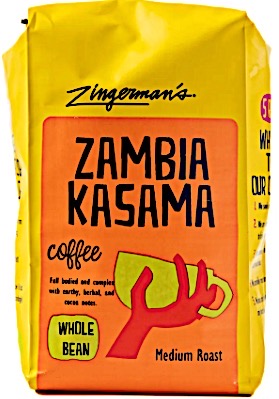
This coffee from the NCCL Estate in Kasama is a wonderful example of that sort of central African excellence. Super smooth, rich, full-bodied, and complex, I’m really enamored of its earthy, herbal, and bittersweet cocoa notes. Zach Milner who manages the Roadshow (and hence the Roadhouse’s coffee work) says, it’s got “strong chocolate and bright citrus notes!”
The NCCL Estate sits at elevations of 1300-1600 meters above sea level—ideal for high-quality coffee. The farm is the largest coffee estate in Zambia and is dedicated to the future of coffee growing in the region through a wide variety of social and economic initiatives. For this special offering, we’ve gotten hold of a peaberry coffee that comes from the Estate. Peaberries, if you don’t know them, are the naturally occurring “single” (rather than the usual, split, “double” bean) found inside a small segment of coffee cherries. Peaberry beans typically come toward the end of a branch of the coffee trees and account for less than a twentieth of a typical tree’s production.
Zambia, for the geography and history buffs amongst you, used to be known in the U.S. by its colonial name of Northern Rhodesia. Independence came in 1964 and the country is now named, more appropriately, for the Zambezi River that runs through it. Zambia, if you’ve forgotten your African geography, lies in the southern half of the continent, sort of in the middle—Tanzania to the northeast, Malawi and Mozambique to the east, Zimbabwe to the south, Angola to the west, and the Congo to the north. It’s one of the few landlocked countries in Africa. Coffee came to Zambia later than to most of Africa. Native of course to Ethiopia, it was planted in other countries only as part of colonial expansion.
In Zambia, coffee planting commenced in the 1950s. Kasama estate is in the northeast section of the country, about 400 or so miles to the west of the Mababu Coop with which our very good friend Shawn Askinosie works to get the great cacao beans for his terrific Tanzania chocolate (swing by the Candy Store or the Deli and grab a bar or two—it pairs almost perfectly with this coffee).
To my taste, the Kasama cup is creative, caring, and nicely cocoa-y. Easy going, but not in a bland way. Something with style, elegance, purpose, and subtle power, but all delivered in an unobtrusive, thought-provoking, emotionally supportive way. I think it’s got a savory, almost meaty richness that makes me want to keep sipping! I’ve tried it so far in about half of the Coffee Company’s brew methods. It was definitely excellent as an espresso! My favorite brewed cup was done with the Clever method—super smooth with a hint of dark milk chocolate (that’s with no milk in the coffee) and toffee. I could drink this stuff every day.
Want more from Ari?
Sign up for Ari’s Top 5 e-newsletter and look forward to his weekly curated email—a roundup of 5 Zing things Ari is excited about this week—stuff you might not have heard of!
|