
Tag: ZINGERMAN’S DELI
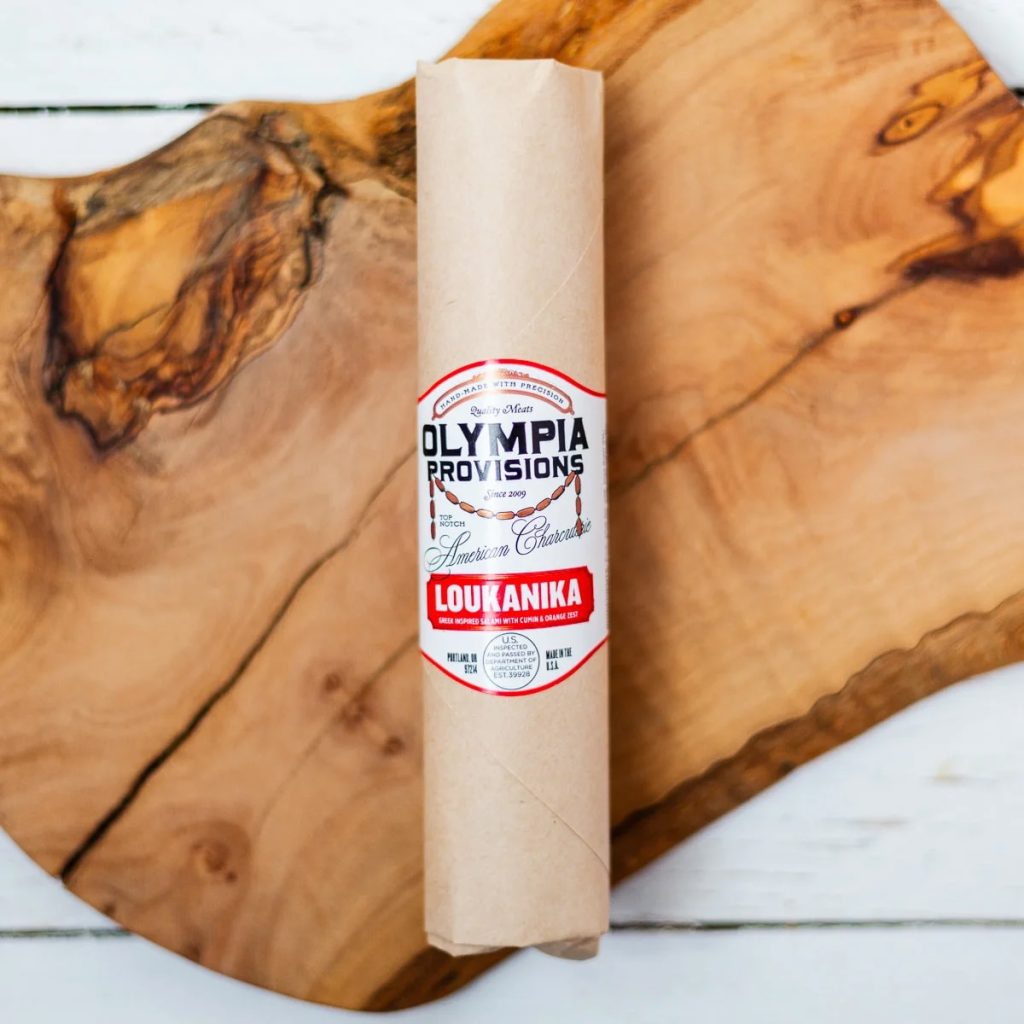
A taste of traditional Greek salami-making from the West Coast
It had been a while since I’d eaten this lovely artisan salami from out west. My mistake—I knew all along it was good, but eating a bit again last week reminded me why I’ve long loved it. In fact, it seems even better than I remembered. Lovely flavors, great aromatics, superb spicing, long finish!
Out in Portland, Olympia Provisions is crafting some of the best of the new generation of American charcuterie. The company was founded by Elias Cairo, his sister Michelle Cairo, Nate Tilden, Tyler Gaston, and Martin Schwartz—all with backgrounds in food and hospitality. Elias and Michelle grew up just outside Salt Lake City, with a Greek father who cured meats at home. All these years later, they’ve turned their father’s personal passion into a profession!
All of Olympia Provisions’ many products are carefully crafted and terrifically tasty. My favorite, though, is this lovely Greek-style Loukanika salami. It brings some of the flavors of Elias Cairo’s Hellenic heritage into play with the thriving charcuterie scene in Portland in the 21st century. Like all of their offerings, the Loukanika salami starts with sustainably-raised, heritage pork—you can taste the quality of these old breeds of pork in the complex, full flavor you get with every bite. Well over 95% of pork in the U.S. is raised in factory farms. Olympia, and the other folks we buy from, are a tiny minority of artisans who are actively working hard to return hog raising to more regenerative practices.
Building on the high quality of the pork, the spicing of the salami is also superb. There’s cumin, garlic, and hints of orange zest—all used to build on an old Cairo family recipe. The Loukanika is naturally fermented (much like a well-made cheese) to slowly develop its flavor, as salami has been matured for millennia now. Like all the Olympia Provisions products—and like all the salami we sell—it has a lively white mold on the outside. This mold is key to fermentation and slow, natural flavor development. When the mold is gone, the salami has almost certainly passed its prime.
Connor Valone, long-time salami selector at the Deli, says,
Elias’ commitment to naturally cased salami, made with pork farmed as sustainably and locally as possible, and filthy rich in penicillium nalgiovense, makes it taste and feel better than anyone else’s salami on the market. Every time I bring one home and unroll that brown paper, I wonder why it’s been so long since the last time.
The Loukanika salami is super tasty and easy to use in a thousand different, wonderfully delicious ways. Great in salami and eggs, and cut into small cubes and tossed into pastas. Cut it into thick slices and serve it up for a snack, or eat it alongside a green salad. I love it with good feta cheese, or a generous spread of Vermont Creamery’s Cultured Butter and some of the Bakehouse’s French baguette. And small chunks of salami are a great way to spice up a green salad—I think it’s one of the most underappreciated ways to take advantage of an artisan salami’s full flavor!

Mayhaw, Beautyberry, and Mimosa Flower Jelly from the Florida Panhandle
Looking for a lovely lunch alternative? Here you go! A little spice, a little sweet, a little smoke, some great Bakehouse bread, and the crowning culinary jewel—a couple spoonfuls of one of the great new fruit jellies we just started getting in from the Florida Panhandle.
The sandwich starts with Bakehouse bread. I made mine with Rustic Italian, but really, a couple of moderately thick slices of any of them would probably work really well. Toast them until they’re golden brown.
Next, spread on some of our Pimento Cheese—a bit on the inside of each slice of bread. It’s been two decades now since I first came up with this recipe, and over the course of those 20 years, Pimento Cheese has become one of the most popular items we produce. You can score some seven days a week at the Creamery, Deli, Roadhouse, and Bakehouse!
Atop the cheese, spoon on a thinnish layer of one of these special Panhandle jellies. While they’re not all that hard to find in the Southeast, up until they arrived at the Deli last month, you might have gone most of your life without ever seeing them here in Southeastern Michigan. They come from the folks at Bright Acres Homestead, in Wakulla County, not too far from Tallahassee. The farm has been owned and run by Dan and Jenn Bright since the middle of the aughts, right around the same time I started working on the pimento cheese recipe! Bright Acres is a real working farm—animals, crops, and crafts. I look forward to getting down there in person one day.
Right now, we have three of their special Florida Panhandle jellies in stock:
- Mimosa Flower Jelly – Mimosa flowers are beautiful to look at, but few folks know you can also make jelly out of them. Freshly plucked from the trees on the farm, then gently simmered with sugar into a jelly. Since the mimosas bloom only once a year, the jelly is remarkably rare! Delicate, aromatic, elegant flavor. Mimosa—Albizia Julibrissin—is also known as “The Joy Tree,” so if you, like me, are always looking to add a bit of joy to your day, give it a try!
- Mayhaw Berry Jelly – Mayhaw berries come from early spring blossoms. Tart and terrific! The color of a light red wine, the jelly has a bit of the tartness I’m so taken by when it comes to cranberries.
- Beautyberry Jelly – Beautyberries come from a small shrub that grows in both the American Southeast and Southeast Asia. If you happen upon a plant, take note that the leaves are said to act as a natural mosquito repellent. The berries, though, are what the jelly is based on—tiny and bright purple when they’re harvested in August. The freshly pressed juice is also purple, but in cooking with sugar, it turns a wonderful pinkish purple. The Beautyberry Jelly is quite hard to come by, so score a jar or two ASAP if you want to try it!
After you’ve spread on the jelly, lay on a slice, or two, or three, or four, of your favorite bacon. Nueske’s applewood smoked bacon is often my choice—24 hours of smoking over applewood logs makes one seriously lovely bacon.
That’s it! Close up the sandwich, slice, eat, and enjoy. Open a bag of Zingerman’s potato chips (I’m partial to the Tellicherry Black Pepper) and you’ve got a lovely lunch.

A restored estate, a bird sanctuary, a whole lot of history
Fritz Maytag, the founder of Anchor Steam Brewery, once told me, “It’s not all that hard to find a great product. And it’s not that hard to find a really wonderful story. But when you can find a great product that has a great story behind it, you’re onto something special!” The Italian rice from Cascina Oschiena is just that—both the rice and the story behind it are exceptional. Oschiena’s work exemplifies beautifully all of what I wrote in “A Taste of Zingerman’s Food Philosophy,” and thanks to the always amazing work by our friends and importer Rogers Collection, their rice has finally arrived in Ann Arbor!
Cascina Oschiena is one of the oldest farms in their area in the province of Vercelli in the Piedmont, up in the northwest corner of the country. All the way back in the 13th century, Cascina Oschiena was being farmed by the friars at the Abbey of St. Stephen of Vercelli. As was true in those days, estates of this sort were essentially self-contained communities. As the crew at Oschiena writes:
All the inhabitants contributed to life on the farmstead, each with their own activity: the paddy weeders, diggers, carters, riders, saddlers, blacksmiths, carpenters and joiners. … The traditional hand broadcast sowing method was accompanied by the transplant technique in the 1930s, and this continued until the end of the 1950s.
Rice growing at that time was almost exclusively done by hand. If you want to see what it was like, check out the amazing 1949 black and white film Riso Amaro, which is centered around the work of the folks who worked so hard in the fields. For the most part, they were women, known in Italian as mondine. Today, Cascina Oschiena is again run by a woman. It is the passion project of Alice Cerutti, whom I had the honor of spending a day with back in 2019, when I visited Cascina Oschiena. Of her work, Alice shares,
I am a farmer with a degree in Business Studies from the University of Turin. … We are deeply involved in safeguarding the environment, and are committed to biodiversity and conserving the historical landscape. Over the years, we have made renovations to maintain the essence and character of the original structures, honoring a centuries-old history of our farmhouse.
In the spirit of what I wrote above about stories and birds, part of the drive for the project was to create a safe resting place for some very special winged creatures. Alice shares the backstory:
The fields surrounding our farmhouse constitute the last recorded Italian nesting site of the Black-tailed Godwit. This … brought us to create the Cascina Oschiena Nature Reserve by converting 60 acres (one fourth of the farmland) from rice cultivation to Natural Reserve and the Black-tailed Godwit became the symbol of our Farm and its Products.
Of course, the main culinary question is “What is the quality of the rice?” The answer is, it’s excellent! There’s a wonderful freshness to the flavor, a vitality and aliveness that I love. It is, in the context of what I wrote last week, the essence of the amazing ecosystem from which it emerges.
We have four risi from Oschiena on hand at the Deli to get going with:
Arborio – The classic for making risotto. Rice arrived in Italy as an immigrant, coming from the Spanish-ruled Sicily, where rice had earlier arrived from India. Arborio (and Carnaroli) are actually descended from rice varieties that came from the Philippines in 1839. Nearly 200 years later, Arborio and Carnaroli would clearly be called some of the most Italian agricultural products available.
Carnaroli – With a bit more “tooth” and a little more flavor, this is my personal pick for risotto.
Selenia – A special short-grain variety that works well for making Sicilian arancini and other similar dishes that call for a stickier rice. Though it’s rarely seen in the U.S., we have this rice on hand, and I’m especially excited!
Ebano – A rare black rice with a great toasty, earthy flavor. Super tasty and visually appealing for summer rice salads, main course rice dishes that aren’t risotto, and more.
All four rices are remarkable, as wonderful as the story of Alice Cerutti, her family, friends, and team at Cascina Oschiena have created over the last eight years. Swing by, take some home, and start cooking soon!

Extraordinary organic oil from California
Over the last few months, trying to figure out how to lead through such trying times, I’ve been reassuring myself regularly that working through hard times like these (which I wrote about in the pamphlet of the same name) builds character, increases resilience, and enhances long-term health. In a sense, I suppose, that is what was proven true for us throughout the Covid pandemic. Although it was incredibly challenging, I can see now that there are indeed some good things that came out of it. ZingTrain added online classes. BAKE! did the same as well. Roadhouse Park was created in response; in fact, it just opened for the spring season a few days ago. (Swing by on a nice afternoon, appreciate the fresh air at the picnic tables, and enjoy some oysters—they’re only $2 each if you come for Happy Hour, Monday through Friday from 2–6 pm. Order up beer, wine, cocktails, and the whole compelling Roadhouse menu anytime this spring and summer.)
Another one of the good things that emerged out of the Covid pandemic was my connection with the Independent Restaurant Coalition (IRC). The non-profit brought together quality- and community-focused independently owned and run restaurants from all over the country. The group advocated for restaurants with great effectiveness in very thoughtful, collaborative ways throughout those Covid years, and is still actively engaged in doing terrific advocacy work today. Maybe most meaningful of all, out of that group of caring people, I probably also made 14 or 15 new friends! On every level, it was, and is, an inspiration!
One of the many great friends I’ve made through that work is Camilla Marcus, one of the IRC’s co-founders. At the time, she was running a recently opened restaurant in Manhattan. Unfortunately, like many small businesses I know, the restaurant did not make it through the pressures of the pandemic. To her enormous credit, Camilla came out of Covid by creating a whole new company, which she called west~bourne, in its place. Fast Company called Camilla one of the “Most Creative People in Business.” I just call her kind, caring, compassionate, and a great cook and businessperson to boot! All the products on the west~bourne website are worth taking a look at. My total top pick, though, is the exceptional extra virgin avocado oil.
The folks at west~bourne have set a whole new standard for me of what avocado oil can be—it really does redefine the class! Each bottle is filled with a beautiful green-gold, cold-pressed oil that’s really the essence of what makes the best avocados so special. The flavor, like any of the great extra virgin oils we sell, is complex, beautifully balanced, and has a lovely, long, lingering finish. It tastes, as you would expect, intensively of what you would expect from the best ripe avocados (which, to be clear, we rarely get around these parts)—buttery, subtly sweet, amazingly aromatic with a little hint of licorice and a titch of tarragon! Food & Wine journalist Kyle Beechey says west~bourne’s is the best avocado oil she’s ever had. Ever since it arrived at the Deli a few weeks ago I’ve been saying the same!
Use west~bourne’s extra virgin avocado oil to dress salad as you do olive oil. Make bruschetta with it—toast some Bakehouse bread, and while it’s hot, pour on some avocado oil and sprinkle with a pinch of good sea salt and some freshly ground black pepper. (I love the top grade Tellicherry at the Deli, and also at the Roadhouse, where it’s on all the tables and those incredible Pepper Fries.) Drizzle it on avocado toast, and you’ll take your usual favorite to new culinary heights. Great on a tin of high-quality tuna—try Salade Nicoise with avocado oil. Superfine on a salad with fresh fennel and oranges and, if you want, slices of ripe avocado as well. Great on pasta with grated Parmigiano Reggiano (the Valserena is tasting particularly great right now) or Pecorino, a bunch of freshly ground black pepper, and avocado oil, along with maybe some sautéed spring asparagus or fresh English peas. You can bake with it too—here’s west~bourne’s recipe for lemon cake made with avocado oil.
Camilla Marcus’ marvelous new cookbook, My Regenerative Kitchen: Plant-Based Recipes and Sustainable Practices to Nourish Ourselves and the Planet, is full of great recipes, including many for avocado oil. Oh yeah, chef and restaurateur Alice Waters wrote the foreword! A big part of what makes west~bourne’s work so special is the significant commitment to work towards ecological sustainability. It is, from the outside looking in, what appears to be the essence of the business. In fact, west~bourne was founded with one simple mission:
… to cure the climate crisis through regenerative food. With a focus on our collective decisions around food and the kitchen, we create products to shift the current paradigm while repairing the relationships between ourselves, our food, and our Earth.
Want to emulate west~bourne’s wonderful efforts at sustainability? west~bourne’s writer Angela Fink offers this sound suggestion:
Start small and stay consistent. In fashion, focus on buying fewer, better-quality pieces that reflect your style. For food, support local farmers, plan meals, and opt for seasonal produce. Sustainability isn’t about perfection—it’s about progress and making mindful choices that align with your values.
Your new favorite finishing oil?
P.S. You won’t see the extra virgin avocado oil on the Zingermans.com Mail Order website, but we’d love to ship you some—just send us an email at [email protected].

What is a cheesemonger? Just for fun, guess the right answer:
- A farmer who makes cheese.
- An artist who makes sculptures out of cheese.
- An athlete who chases wheels of cheese down mountains.
- A merchant who shares their cheese expertise with shoppers.
Did you guess d? Nice work! That’s what Zingerman’s Delicatessen cheesemonger (aka professional curd nerd) Scott Evans does for a living. He decides which cheeses to buy for the Deli’s specialty food shop and helps customers choose which ones to take home. Pairing a shopper with the perfect cheese is an art. Figuring out how their sense of taste works is the name of the game.
“You can give someone a cheese they walked in wanting but had never heard of, and that they didn’t know how to ask for, if you know how to ask the right questions,” Scott explains.
The key is knowing how to ask “why?” Sometimes, Scott asks why a customer likes a particular flavor. Other times, he explores why they’re drawn to a certain texture. Often, he inquires about how they want to use the cheese.
“Nailing that down is what gives them an extraordinary experience,” Scott says.
Extraordinary cheese experiences weren’t a big part of Scott’s upbringing. Like many Midwesterners, he encountered so much block cheddar that he almost stopped noticing it. As he grew up, he started appreciating more complex flavors, and as he entered the culinary world, he learned how to tease out what shapes people’s gustatory preferences.
An appreciation for “why” questions drew Scott to Zingerman’s in 2019. He’d worked behind the scenes in restaurants, and the Deli’s specialty food shop offered an opportunity to interact with customers face to face. He started specializing in cheese – especially cheese from American producers – in 2021.
“I help people learn that a cheese from Indiana or Wisconsin can be as good as anything you’d find abroad, and that it doesn’t have to be shipped halfway across the world,” Scott explains.
Learning from cheesemakers is one of Scott’s favorite parts of the job. Visiting farms and other producers is a special perk. He’ll never forget his first trip to Wisconsin to watch suppliers work their magic.
“That trip crystallized the value of cheese for me, and how different it is from other products,” he explains. “Cheese is an agricultural product at its core: It’s weather, it’s grass, it’s cows. That makes it regional, seasonal, and something that changes. So much work goes into it, and so many hands touch it. They all influence what you’re ultimately selling.”
Ready to tap into Scott’s expertise? Check out Real Simple’s guide to cheese shopping.

When dairy deliciousness and doing the right thing come together
While the country seems suffused in controversy on any number of social issues, here’s a cause that could bring anyone who loves great food into the fold: the campaign to Save The Emmentaler® is calling for our help!
Gourmino’s Save The Emmentaler initiative is committed to supporting “small-scale cheesemakers and their centuries-old craft, promoting the genuine, natural qualities of Emmentaler AOP as an authentic product that goes beyond tradition to ensure its continued excellence.” I’m on board!! If you’d like to enlist as well, the action step is easy—swing by the Deli and buy a bit of this terrific cheese! (If you’re out of town, just email [email protected] and we can ship you some!) Don’t delay! Supplies of this handmade artisan offering are, not surprisingly, sort of limited!
Emmentaler AOP has long been revered as the “king of Swiss cheeses”; it comes in a massive, 30-inch diameter, 200-pound wheel, and features distinctive holes. Its iconic shape is so well-known that children often draw it when depicting cheese. Tracing its origins to the 13th century, Emmentaler AOP is still crafted by this small number of tradition-minded cheesemakers using the same centuries-old methods. Old-school Emmentaler like this is made only in the Emme Valley, in the central part of Switzerland, about two-thirds of the way from Zurich to Bern. It dates back to the same era as the founding of the Swiss democratic system, in the late 13th century and has been exported since the 16th century. Minimum standards have been legally in place since the formation of the Swiss Cheese Union in 1901, the year before the Deli’s building was built. The far stricter Appellation d’Origin standards were put in place a century later, and these are the standards that the Emmentaler AOP we’re working so hard to save has exceeded. You really can taste the difference. It is, in truth, a truly remarkable cheese. The mission of the Save the Emmentaler movement is both simple and powerful: “Preserve Emmentaler AOP’s integrity through sustainable, small-scale cheesemaking and traditional ripening methods.” Here are six reasons that it really resonates deeply for me.
- It tastes terrific—there are hundreds of “Swiss cheeses” in the world, but they are not the same as this one, the original. It is to the flavor of supermarket “Swiss” what a stuffed whale would be to the sort that swims in the ocean and that most everyone reading this will also want to help save. It is an ideal fit for our longstanding definition of quality at Zingerman’s: full-flavored and traditionally made.
- When a community loses its cheese, it loses part of its spirit and connection to place. As Sinead O’Connor sang in “I Want to Talk About Ireland,” “We’ve lost contact with our history … And this is what’s wrong with us.” The work behind Save the Emmentaler was established to keep that from happening. Rooted, connected community is the core of caring; healthy countries are made up of caring communities.
- Switzerland is one of the oldest democracies in the world, and craft-based, cheesemaking spread throughout the country is one of its anchors, economically, environmentally, agriculturally, and culturally.
- The more we can demonstrate that there IS a viable market for traditional foods like this traditional Emmentaler AOP, the more people are likely to take on the work of making them.
- Full-flavored foods like this create joy and beauty in the world. And we could certainly use more of both!
- As I discussed in the pamphlet “A Revolution of Dignity in the Twenty-First Century Workplace,” this system is built on the foundation of dignity at every level. The farmers, the cows, the land, the community, the cheese, and the customers—all are treated with respect and care in this wonderfully regenerative process.
What makes this cheese so special? It starts with the cows. They graze on a diverse diet of grasses and herbs in open meadows, which gives the milk—and the cheese—a unique and rich flavor. The herds are small, usually just 12 to 20 cows, allowing farmers to maintain a close connection with each animal. Healthier, well-cared-for cows naturally produce higher-quality milk. The milk itself is raw and delivered to the dairy twice a day. It still arrives in old-school milk cans—unlike industrial pumping (which is faster but can damage the delicate fat globules in the milk), cans can help preserve quality. The milk is made into cheese within 12 hours of milking, ensuring it’s as fresh as possible when the process begins.
Gourmino itself was founded nearly a quarter century ago by a quintet of quality-conscious farmers in the interest of helping sustain traditional Swiss cheeses into the 21st century. Today the group is up to 12 producers, and, I will say with confidence that every single cheese we’ve ever gotten from Gourmino has been great!
The Emmentaler AOP Reserve we have on hand right now was made by the Schöpfer family at the Mountain Dairy of Kleinstein. It’s been aged for an impressive two years. The affinage process begins in Gourmino’s Langnau Emmental cellars, where the wheels are hand-washed weekly. Later, the best wheels are moved to the facility in Reichenbach Mountain Galleries for what they refer to as “Affinage in the Mountain,” since the cellar is literally carved into the mountain.
With 24 months of maturing, it should be no surprise that the flavor of the Emmentaler AOP Reserve is meaty, concentrated, complex, and compelling. There’s a small touch of sweetness, a good bit of lovely bitterness. Eat it at room temperature to access its full flavor. Great with some of the heirloom apples we can still get around here this time of year! Totally terrific on slices of Bakehouse’s Dinkelbrot, which have been spread generously with Vermont Creamery Cultured Butter.
For anyone who loves full-flavored traditional cheese, the Emmentaler AOP Reserve is a really great choice! And, the more we eat it, the more demand goes up, and the more effective the campaign to Save the Emmentaler is going to be!