
Tag: zingermans delicatessen
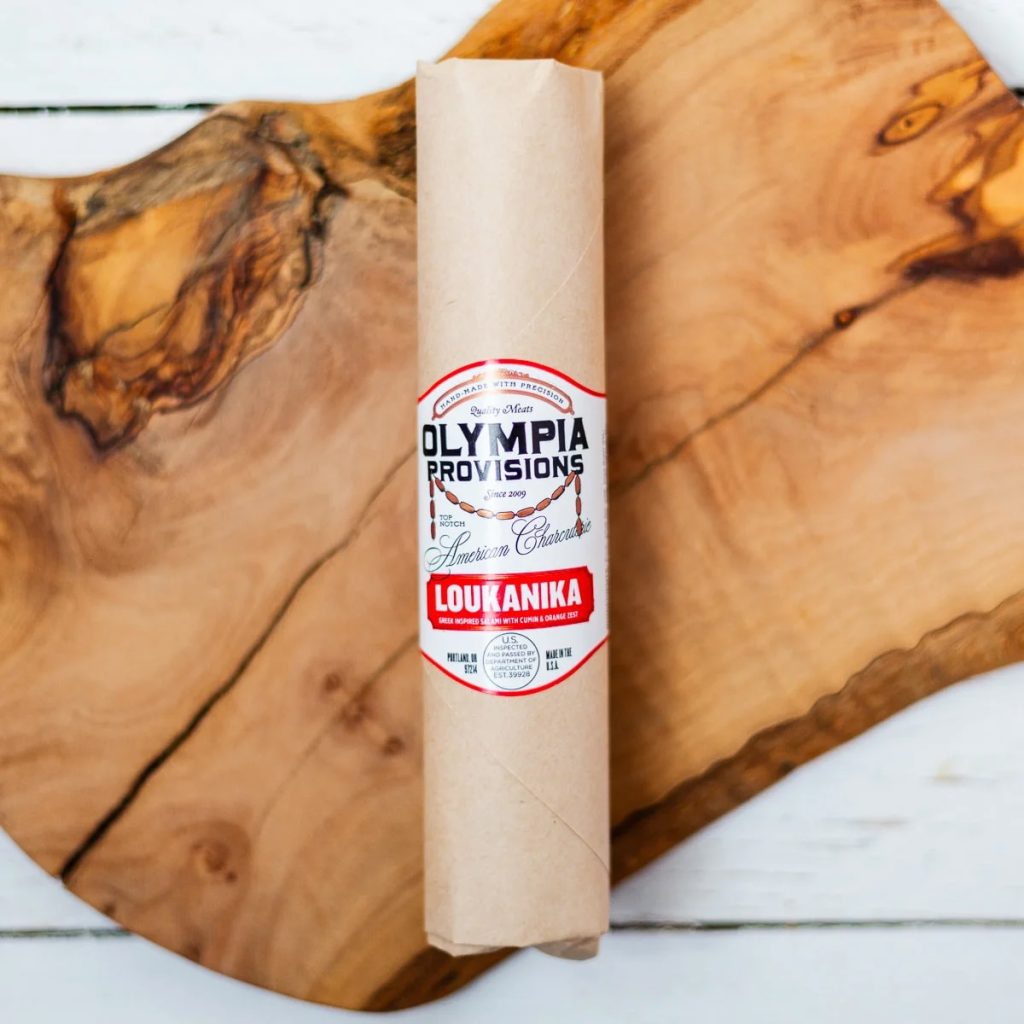
A taste of traditional Greek salami-making from the West Coast
It had been a while since I’d eaten this lovely artisan salami from out west. My mistake—I knew all along it was good, but eating a bit again last week reminded me why I’ve long loved it. In fact, it seems even better than I remembered. Lovely flavors, great aromatics, superb spicing, long finish!
Out in Portland, Olympia Provisions is crafting some of the best of the new generation of American charcuterie. The company was founded by Elias Cairo, his sister Michelle Cairo, Nate Tilden, Tyler Gaston, and Martin Schwartz—all with backgrounds in food and hospitality. Elias and Michelle grew up just outside Salt Lake City, with a Greek father who cured meats at home. All these years later, they’ve turned their father’s personal passion into a profession!
All of Olympia Provisions’ many products are carefully crafted and terrifically tasty. My favorite, though, is this lovely Greek-style Loukanika salami. It brings some of the flavors of Elias Cairo’s Hellenic heritage into play with the thriving charcuterie scene in Portland in the 21st century. Like all of their offerings, the Loukanika salami starts with sustainably-raised, heritage pork—you can taste the quality of these old breeds of pork in the complex, full flavor you get with every bite. Well over 95% of pork in the U.S. is raised in factory farms. Olympia, and the other folks we buy from, are a tiny minority of artisans who are actively working hard to return hog raising to more regenerative practices.
Building on the high quality of the pork, the spicing of the salami is also superb. There’s cumin, garlic, and hints of orange zest—all used to build on an old Cairo family recipe. The Loukanika is naturally fermented (much like a well-made cheese) to slowly develop its flavor, as salami has been matured for millennia now. Like all the Olympia Provisions products—and like all the salami we sell—it has a lively white mold on the outside. This mold is key to fermentation and slow, natural flavor development. When the mold is gone, the salami has almost certainly passed its prime.
Connor Valone, long-time salami selector at the Deli, says,
Elias’ commitment to naturally cased salami, made with pork farmed as sustainably and locally as possible, and filthy rich in penicillium nalgiovense, makes it taste and feel better than anyone else’s salami on the market. Every time I bring one home and unroll that brown paper, I wonder why it’s been so long since the last time.
The Loukanika salami is super tasty and easy to use in a thousand different, wonderfully delicious ways. Great in salami and eggs, and cut into small cubes and tossed into pastas. Cut it into thick slices and serve it up for a snack, or eat it alongside a green salad. I love it with good feta cheese, or a generous spread of Vermont Creamery’s Cultured Butter and some of the Bakehouse’s French baguette. And small chunks of salami are a great way to spice up a green salad—I think it’s one of the most underappreciated ways to take advantage of an artisan salami’s full flavor!

A rare and delicious treat from Tenuta di Valgiano
As we move through summer, you might have given thought to spending some time on the beach. But have you considered honey made by beach-dwelling bees? If you appreciate single-origin honey even half as much as I do, don’t miss this one. We have a limited supply in stock at the Deli right now, and it is truly remarkable. In fact, it’s Specialty Food Manager Aislinn McAllister’s current favorite!
Unless you live on the west coast of Tuscany, odds are that you’ve never tried a honey called Miele di Spiaggia. It comes from one of our longtime, top-notch olive oil producers, the Tenuta di Valgiano. While the estate dates back to the 16th century, its place in modern culinary history is relatively recent. Laura di Collobiano, Moreno Petrini, and Saverio Petrilli took over the estate in 1992, with a commitment to turning the fruits of its ancient olive groves into an outstanding olive oil. They began farming biodynamically a few years later, with great results. The oil from the Tenuta di Valgiano estate has won an array of awards, and it’s regularly selected as one of the best in Italy. It’s lush, richly fruity, and outstandingly olivey, with a soft, prickly spiciness that spreads slowly across your tongue. Great on almost anything, from ripe red tomatoes to bruschetta, salad, or steak. The Tenuta di Valgiano team is adamant that the essence of the land must be manifested in each bottle they pack, and to my taste, they succeed in doing that year after year.
The honey comes from the beaches west of Valgiano’s land, where the bees feed on the natural flora that grows along the Lecciana seashore on the Tuscan coast. This area is part of the natural parks of Migliarino San Rossore and Massaciuccoli, where the salty waters of the Tyrrhenian Sea wash up on the sand. In the summer, the winds that Italians call “libeccio” blow salt onto the dunes, and even past them, into the Valgiano olive fields. Pine trees, heather, and helichrysum (a member of the sunflower family) live on the land. The bees sip nectar from their blossoms. And from their diligent work, we get this rare and wonderfully delicious honey.
I’ve been eating a bit of this treat, which we call Seaside Honey here at Zingerman’s, almost daily for the last few weeks. Honestly, in all my years of tasting, I’ve never really tried anything like it. Very thick and golden in color, with a beautiful butterscotch flavor and aroma. Long finish and subtly minty, I think. Terrific on toast or in tea. Tammie, who doesn’t waste time on mediocre food, worked her way through a whole jar in under a week!
In fact, the oil and the honey, served together, make a marvelous combination. Find yourself a nice-looking plate (or even an ugly one if that’s all you have). Put a healthy tablespoonful of the honey onto the center of the plate. Pour some Valgiano Olive Oil around it. Use enough oil to cover the plate and still let the honey stand up in the center, like a mountain rising out of a gold-green lake. Heat a loaf of the Bakehouse’s Paesano Bread in the oven at 350 degrees Fahrenheit for about 20 minutes, until it’s hot in the center and the crust is crispy. Break the loaf open, and as soon as it’s cool enough, grab a chunk and drag it through the honey and the oil. Your day will be markedly better for it.
This honey is a beach vacation for your taste buds. Come grab some now!
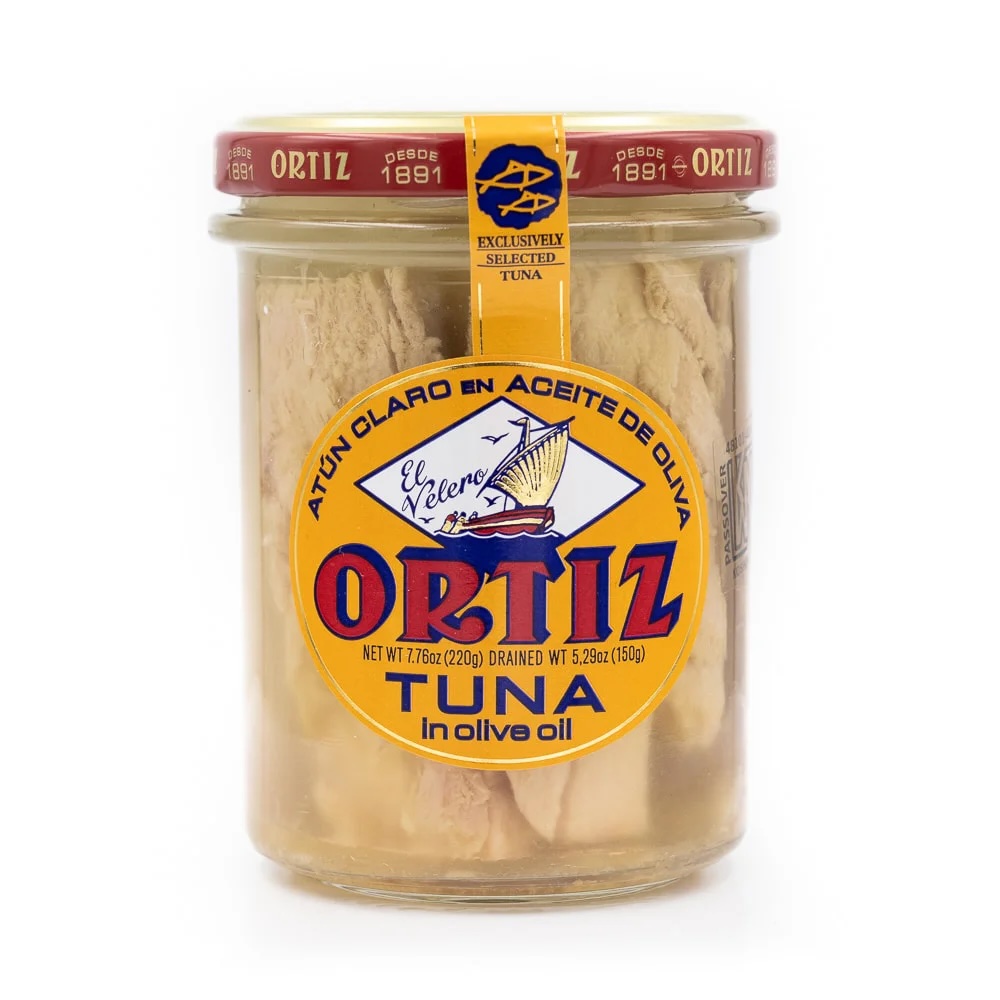
“Surf & turf” combo for some fine summer sandwiches
One of the quickest and absolutely most delicious meals I make—combining tuna and the spicy, spreadable Calabrian pork sausage called ’Nduja. A while back, I decided to call it Tu’nduja. It starts with some really good tuna. We have the Ortiz bonito (aka, albacore) on hand always—it’s one of our biggest sellers. Personally, though, I’m inclined toward the fuller flavor of the Yellowfin. Then I add some of the Tempesta ’Nduja from Tony Fiasche and friends in Chicago.
To make the Tu’nduja, start by adding about 2 parts tuna to 1 part ’Nduja in a mixing bowl—you can adjust the ratio to fit your taste. Add a squeeze of lemon juice and a few spoonfuls of mayonnaise. Stir to combine. Season with freshly ground black pepper (you probably won’t need salt, but taste and see), and fold in some chopped fresh flat-leaf parsley for brightness. That’s it. Super tasty.
Spread your Tu’nduja on toast. Make a Tu’nduja salad sandwich. Use it as a party spread or snack. Stuff it into small peppers or tomatoes. Or blend it smooth, add a drizzle of olive oil, and you’ve got a terrific spicy tonnato sauce for cold meats or vegetables. Thin it with more mayo and it becomes a great dressing for green salads or potato salad.
You can also toss Tu’nduja with hot pasta—just mix the sauce in at the end, after you’ve drained the pasta, and don’t cook it too long, or the mayo might separate. Add diced tomatoes, roasted peppers, or more chopped parsley if you like. Finish with toasted breadcrumbs—it’s darned delicious!

A sweet-spicy meal you can make at home in under 20 minutes
Sometimes small things we find can alter our sense of the world. The Mahjoub family’s hand-rolled, sun-dried couscous is one of those. I came upon their offerings at the Fancy Food Show in New York City—a place where one goes in great part to find new things. For almost 20 years now, the connection that came from that meeting has had a meaningful impact on both the ZCoB and the Mahjoubs. Their products are now integrated into nearly every ZCoB business. And without question, into my home cooking. I reference them more than once in the pamphlet “A Taste of Zingerman’s Food Philosophy.”
From the first day I tried it, I knew I’d found a new understanding of just how good couscous could be. I also learned just how easy it is to make. It is—even just eaten alone with a little olive oil, salt, and pepper—a remarkable meal. Basically, you bring water to a boil with a little sea salt, add couscous, stir, cover, and turn off the flame. Wait 12 minutes. Fluff with a fork. Eat up! You will find some of the tastiest couscous you’ve ever tried.
To start this particular dish, cook a good amount of the Mahjoub’s M’hamsa (which means “by hand”) Couscous. When the couscous is done, gently take it out of the pan and put it into a large mixing bowl.
Meanwhile, in a separate smaller bowl, make the vinaigrette. Mix a small bit of vinegar with a couple spoonfuls of the lovely Leelanau Apricot Preserves I wrote about last week from American Spoon Foods up in Petoskey. Add some great olive oil—we’re big lovers of the Mahjoub family’s organic extra virgin oil made from the uniquely Tunisian Chetoui olives. For obvious reasons, it’s an ideal ingredient for this dish! Add a bit of the Mahjoub’s spicy, superb Traditional Harissa. Alter the ratio of apricot preserves to harissa to get to the balance point of sweet and heat that’s right for you.
Add the vinaigrette to the couscous. Coarsely chop a fair bit of fresh parsley and fresh mint. Coarse chop some toasted hazelnuts. You can also use a different nut if you like—almonds, walnuts, or the Ziba baby pistachios we have from Afghanistan work really well. Add the nuts and the chopped herbs to the dish. Assess salt and pepper levels to your taste and adjust accordingly.
Pit some fresh, ripe apricots and break them into small bite-sized pieces. Add them to the dish. And add pieces of high-quality cooked chicken. If you have it grilled, all the better—the smoke from the grill goes well with the sweetness of the apricot and the happy heat of the harissa. Grilled shrimp would be good too!
This dish can be served hot for a main course or held at room temperature to serve as a salad. If you leave the meat out, it can be held without refrigerating for a while if you’re considering taking it on a picnic! Enjoy.

A beautiful and tasty taste of Northern Michigan in a jar
My friend Lex Alexander in North Carolina, who’s studied the subject of artisan jam making for many decades, always tells me that apricot is the hardest fruit to successfully put up in preserves. It follows well from the metaphor up top—democratic engagement is perhaps the hardest way to learn to govern. When either or both are done well, though, the results are inspiring. With Lex’s wise words in mind, I’m perpetually impressed by American Spoon Foods’ amazing Leelanau Apricot Preserves—they’re a great way to put an inspirational bit of apricot into your daily dining, and a wonderful way to appreciate the beauty of the apricot at its absolute best.
Apricots are not, of course, native to this part of the world. The fruit was originally cultivated in China and Central Asia as far back as 2000 B.C. From there, it moved west with merchants who traveled the Great Silk Road, eventually arriving in Persia, where it was called a “yellow plum.” Arabs took apricots to the Middle East, and it also made its way to ancient Armenia. The amazing English writer John Ruskin (who also famously and I believe accurately said, “Quality is never an accident; it is always the result of intelligent effort.”), described it as “shining in a sweet brightness of golden velvet.” Although the biggest volume of American apricots comes from California, some of the most flavorful fruit is actually grown here in Michigan. Apricot trees were planted near South Haven around the end of the 19th century. Early efforts were not successful, but eventually, apricot growing took hold. Today, Michigan apricots are known all over the country for their amazing flavor.
Noah Marshall-Rashid, second-generation owner at American Spoon, says of this wonderful jam,
Our Harlayne apricots are grown by Marty Jelinek on a hillside farm a few miles north of Leland, Michigan. The Harlayne is a richly colored, highly aromatic, late-ripening variety specifically developed by Richard Layne in Harrow, Ontario for cultivation in our cool Northern climate. These precious fruits are hand-pitted and then macerated to achieve a silky, succulent texture in our small batch copper preserving kettles.
I never take the excellence of the American Spoon Apricot Preserves for granted. As Amy Emberling, long-time co-managing partner at the Bakehouse, once told me, “Good apricot preserves are hard to come by.” American Spoon crafts the preserves in the best possible, totally traditional way—about 60% apricots (nearly double the fruit content of many commercial jams), cane sugar, a small bit of lemon juice, and a lot of slow cooking in the copper kettles. And they’ve been this good for 43 years now—American Spoon started making preserves in 1982, the same year we opened the Deli.
The jam is super spoonable. It goes great with hard cheeses like Spanish Manchego, over the top of the Creamery’s Cream Cheese, and/or also with cured meat. As you would expect, it’s wonderful on toast. Or take home a dozen of the Roadhouse biscuits—now even better thanks to Vermont Creamery’s Cultured Butter that I wrote about last week—and serve them at your place with apricot preserves on the side. American Spoon makes a curried apricot chicken salad that seems like a great idea—I’m planning to try it with tuna too. And if you spot fresh apricots at the market (now’s the time!), try making what we call a Jamwich: toast a Zinglish Muffin, spread on some Creamery Cream Cheese, add a generous layer of apricot jam, and top it all off with slices of fresh apricot.

Mayhaw, Beautyberry, and Mimosa Flower Jelly from the Florida Panhandle
Looking for a lovely lunch alternative? Here you go! A little spice, a little sweet, a little smoke, some great Bakehouse bread, and the crowning culinary jewel—a couple spoonfuls of one of the great new fruit jellies we just started getting in from the Florida Panhandle.
The sandwich starts with Bakehouse bread. I made mine with Rustic Italian, but really, a couple of moderately thick slices of any of them would probably work really well. Toast them until they’re golden brown.
Next, spread on some of our Pimento Cheese—a bit on the inside of each slice of bread. It’s been two decades now since I first came up with this recipe, and over the course of those 20 years, Pimento Cheese has become one of the most popular items we produce. You can score some seven days a week at the Creamery, Deli, Roadhouse, and Bakehouse!
Atop the cheese, spoon on a thinnish layer of one of these special Panhandle jellies. While they’re not all that hard to find in the Southeast, up until they arrived at the Deli last month, you might have gone most of your life without ever seeing them here in Southeastern Michigan. They come from the folks at Bright Acres Homestead, in Wakulla County, not too far from Tallahassee. The farm has been owned and run by Dan and Jenn Bright since the middle of the aughts, right around the same time I started working on the pimento cheese recipe! Bright Acres is a real working farm—animals, crops, and crafts. I look forward to getting down there in person one day.
Right now, we have three of their special Florida Panhandle jellies in stock:
- Mimosa Flower Jelly – Mimosa flowers are beautiful to look at, but few folks know you can also make jelly out of them. Freshly plucked from the trees on the farm, then gently simmered with sugar into a jelly. Since the mimosas bloom only once a year, the jelly is remarkably rare! Delicate, aromatic, elegant flavor. Mimosa—Albizia Julibrissin—is also known as “The Joy Tree,” so if you, like me, are always looking to add a bit of joy to your day, give it a try!
- Mayhaw Berry Jelly – Mayhaw berries come from early spring blossoms. Tart and terrific! The color of a light red wine, the jelly has a bit of the tartness I’m so taken by when it comes to cranberries.
- Beautyberry Jelly – Beautyberries come from a small shrub that grows in both the American Southeast and Southeast Asia. If you happen upon a plant, take note that the leaves are said to act as a natural mosquito repellent. The berries, though, are what the jelly is based on—tiny and bright purple when they’re harvested in August. The freshly pressed juice is also purple, but in cooking with sugar, it turns a wonderful pinkish purple. The Beautyberry Jelly is quite hard to come by, so score a jar or two ASAP if you want to try it!
After you’ve spread on the jelly, lay on a slice, or two, or three, or four, of your favorite bacon. Nueske’s applewood smoked bacon is often my choice—24 hours of smoking over applewood logs makes one seriously lovely bacon.
That’s it! Close up the sandwich, slice, eat, and enjoy. Open a bag of Zingerman’s potato chips (I’m partial to the Tellicherry Black Pepper) and you’ve got a lovely lunch.