
Tag: ZINGERMAN’S ROADHOUSE
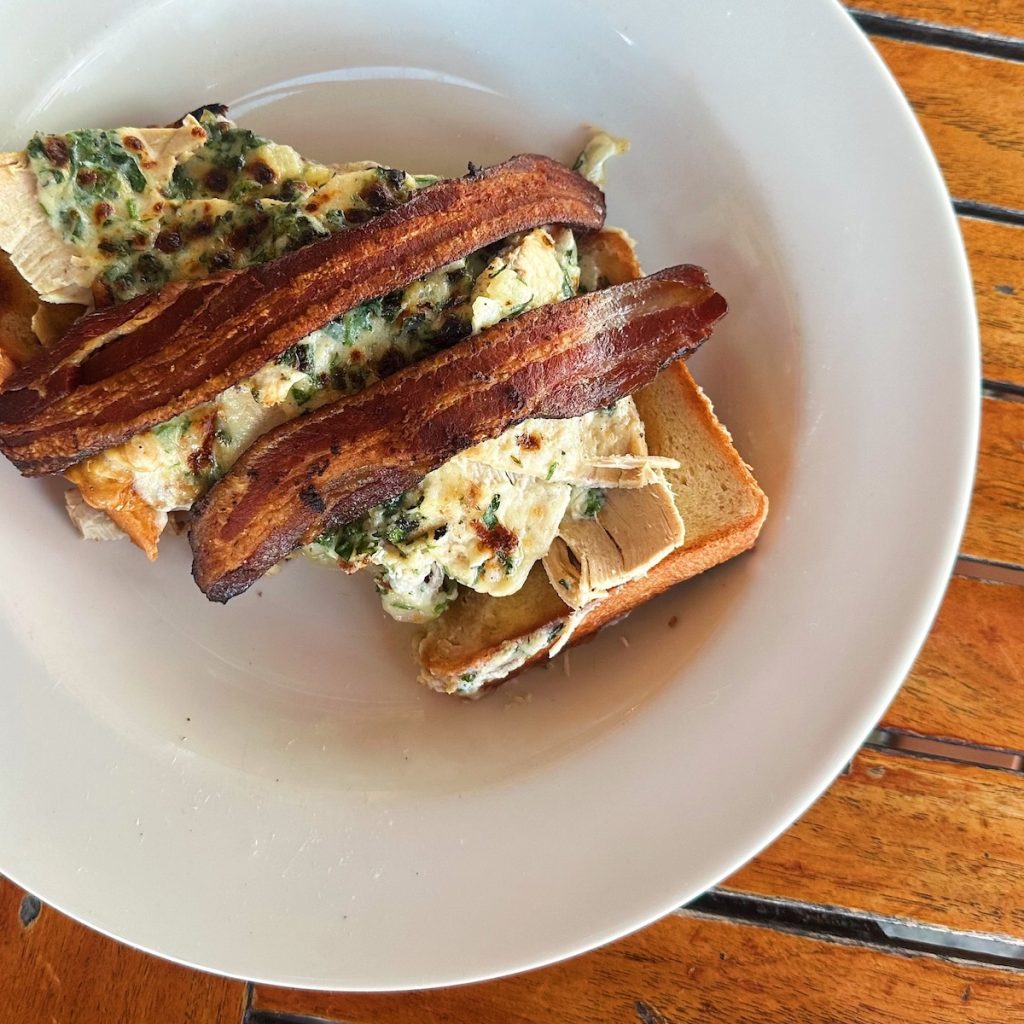
Terrific taste of Kentucky that’s soon celebrating 100 years!
Looking for a lovely lunch this week? Want a terrific taste of American culinary history? The Roadhouse kitchen crew might have just the ticket: the Kentucky Hot Brown, a classic recipe from Louisville’s legendary Brown Hotel, is on the midday menu this month!
This sandwich also makes me think of synchronicities and coincidences. In line with the work of Erik Pevernagie, American writer and life coach Anthony Lombardo defines the two terms like this:
Synchronicities and coincidences are the magic within the mundane. They are sprinkled generously throughout your day, but if you’re not paying attention, you’ll surely miss them.
When we both pay attention and take advantage of them, coincidences can help build momentum. To wit, it turns out that I actually stayed at the Brown Hotel 20 years ago this past summer, when I attended the American Cheese Society conference! And better still, the ACS’s 2026 conference will, by coincidence, be back in Louisville. I’ll be there and will almost certainly swing back by the Brown to taste another Hot Brown at its original best.
Speaking of coincidence, 2026, which is now less than a month away, will mark the 100th anniversary of the creation of this sandwich. As someone whose roots are in being a line cook, I have to laugh a little at the origin story. Back in the 1920s, the Brown Hotel was apparently quite the hot spot for late-night dancing. Late-night partiers, as partiers are wont to do, would head to the bar to get something to eat well after the dinner hour. By far the most oft-ordered item was ham and eggs, something to “start” the new day that was already arriving. The chef, Fred Schmidt, growing increasingly tired of making the same, unglamorous dish all the time, decided to develop a new one! The Hot Brown is what he came up with. Sliced turkey on toasted white bread, topped with a couple strips of bacon and a creamy Mornay sauce—one of the three classic sauces, a list that also includes Hollandaise and Bernaise. Today, 99 years later, the Hotel serves something like 80,000 of them a year!
At the Roadhouse, all of the ingredients, per what I wrote about in the “A Taste of Zingerman’s Food Philosophy” pamphlet, are great to begin with. The bread is the outstanding Bakehouse White. The turkey is from Amish farmers down in Indiana, roasted right here in the Roadhouse kitchen. The bacon was cured in-house by head chef Bob Bennett. The Swiss cheese in the Mornay is what I think is the best Baby Swiss in the U.S. It’s from Chalet Cheese in Monroe, Wisconsin, the oldest cheese co-op in that very dairy-centric state! The gentle savoriness of the turkey, the smokiness of the bacon, the creaminess of the cheese, and the delicious bread all come together to make a pretty marvelous meal! The whole thing comes out piping hot, bubbly, and lightly browned—open-faced and ready to eat. Full-flavored cold-weather eating with a whole lot of history behind it!
Reserve your table
Tag: ZINGERMAN’S ROADHOUSE
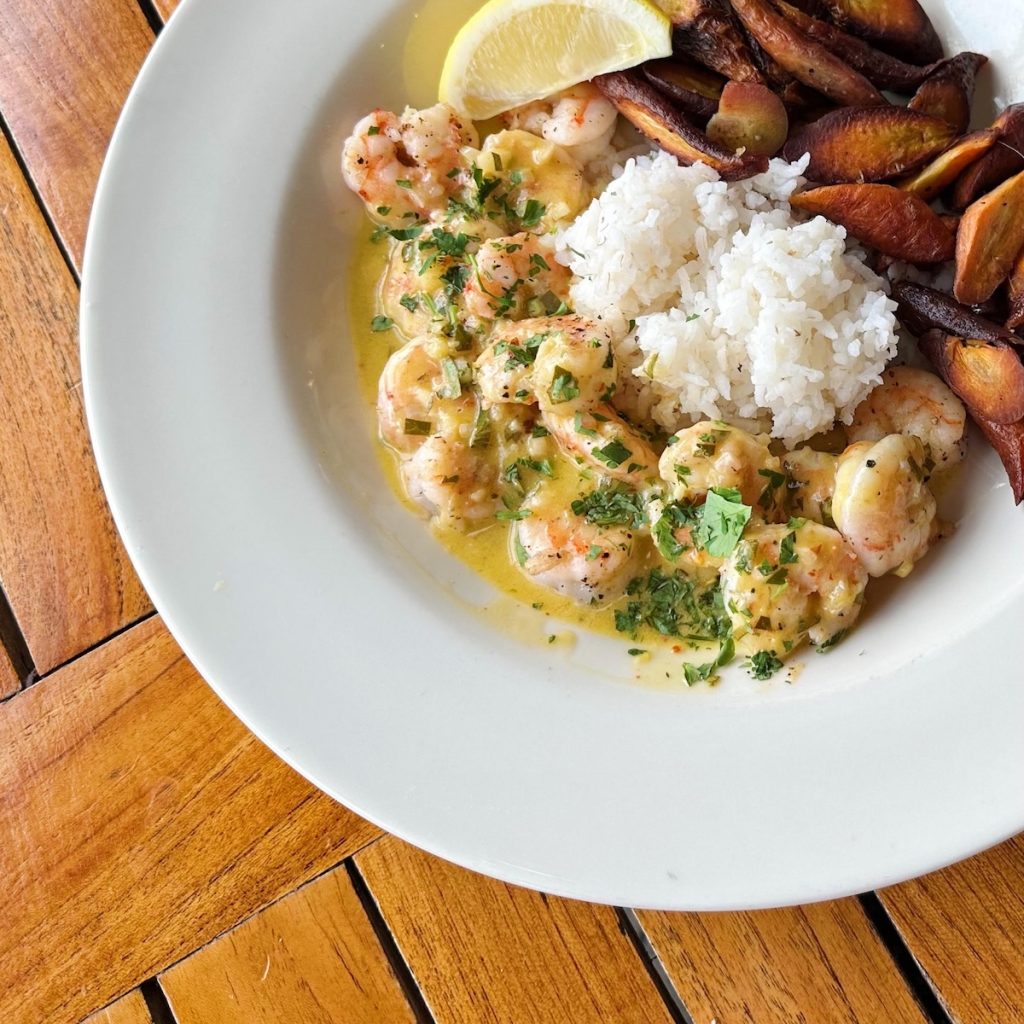
A culinary homage to Ann Arbor’s Greek community
In his inaugural address as the president of the University of Michigan (U of M) in 1852, Henry Tappan shared a piece of his vision for the still-young university town: “Here a new Athens shall arise.” Tappan was speaking about the commitment to learning, philosophy, and art that he imagined ancient Athens to have had. He also imagined U of M attaining a level of fame and excellence equal to Europe’s finest institutions of higher learning!
At the time, the enormous university we know today was five years younger than the ZCoB is now. U of M was founded in 1817 in Detroit and had moved to a relatively empty 40-acre plot in Ann Arbor in 1837, right around the same time the house and barn at what we now know as Cornman Farms were being built. At the time, the faculty of Science, Literature, and Arts was only eight professors, and there were all of about 60 students in undergrad programs—not even enough to make a busy lunch rush at the Deli. The university’s first African American student arrived to study medicine in 1853, a year after Tappan gave his speech..
Despite the appeal to Athenize Ann Arbor, Tappan was not, I’m pretty confident, suggesting that the town should become a focal point for Greek immigration. On the day he spoke, not a single one of the 3,000 or so residents of Ann Arbor would likely have been of Greek origin. The first Greek arrivals came nearly half a century later, starting in the late 1890s, not long after Rocco and Katherine Disderide, who built what’s now the Deli’s building in 1902, moved here from northern Italy. Most of the new Greek immigrants were single men who came to find work.
At the time, Greeks in the U.S. were “classed” as “non-white” and were often discriminated against; in the Immigration act of 1924, Greeks were put into the smallest allowable quota category. The Greek population of Ann Arbor stayed relatively small until its first Orthodox priest was brought to town in 1927. In the 1930s, Ann Arbor’s first Greek church, St. Nicholas, was built, and the community grew rapidly from there. Many Greek families at the time anglicized their names to fit in. William and Adriana Skinner ran the Ideal Restaurant in the 1930s on East Washington Street, and the Curtis family ran Chicken in the Rough on Main Street in 1947. The Parthenon on the corner of Main and Liberty, opened by the Gavras brothers, was a classic in town from around the time I came to school here in the ’70s until they sold it in 2012. (My friend John U. Bacon—whose wonderful book about the Edmund Fitzgerald, The Gales of November, came out recently—wrote a lovely homage to the Parthenon.)
All of which is a lead-in to a description of this great dish of wild-caught shrimp that’s on the Roadhouse specials list this month. These amazingly flavorful shrimp are cooked with a traditional Greek lemon olive oil dressing and served with wonderful Carolina Gold rice and roasted organic carrots (the best in the county, in my opinion!) from Tantré Farm. This dish is delicious and, to my taste, most definitely worth driving across town for.
The shrimp, to be clear, are the key. They are so, so, so seriously good! As one guest said the other evening, “These taste totally different from what everyone else gets. This is the only place I order shrimp around here!” We get them from the team at Locals Seafood in North Carolina. The Locals story starts back in the later years of the Aughties, when Ryan was living in the Outer Banks. A year or two later, in 2010, he and his longtime friend Lin started selling wild shrimp that were caught off the coast of Stumpy Point Bay on the north coast of the state. A few years later, they had a fish shop and restaurant in Raleigh and a thriving wholesale business that recently added the Roadhouse as a customer! Of their outstanding work, the Locals crew offers:
We’ve forged strong personal relationships with the folks who catch, harvest, and process the product we sell… these relationships result in a better product for our customers and a shorter supply chain for our seafood. We know where our product came from, when it came out of the ocean, and how it was caught or harvested.
North Carolina shrimp, like what we get from Locals, are renowned for their clean flavor and finish, and these fill the bill. They’re the top choice of many of the country’s best chefs.
The day-to-day, in-restaurant reality of the shrimp market is, unfortunately, not so great. In the New York Times, my friend Melissa Clark wrote, “Domestic, wild-caught shrimp accounts for less than 10 percent of all the shrimp we eat in this country.” Chef Edward Lee says, “Most farmed shrimp from Asia have no detectable flavor, good or bad.” The Locals shrimp are the opposite: 80 percent come from Pamlico Sound and the rest from boats fishing just off the coast, nearly all of which are caught by “day boats” that fish and then return quickly to port to ensure freshness. You really can taste the difference. The flavor is mellow but meaty, clean, and complex, with a beautiful, long finish.
The wild-caught shrimp show up in other spots on the menu, too, but here they’re cooked in a classic Greek sauce of fresh lemon juice, extra virgin olive oil, garlic, shallots, and a bunch of fresh herbs. In the pan, the dish is finished with some of that remarkable Vermont Creamery Cultured Butter I keep talking about! Swing by this month and grab a taste of this super-tasty wild shrimp dish!
Let us save you a table
Tag: ZINGERMAN’S ROADHOUSE
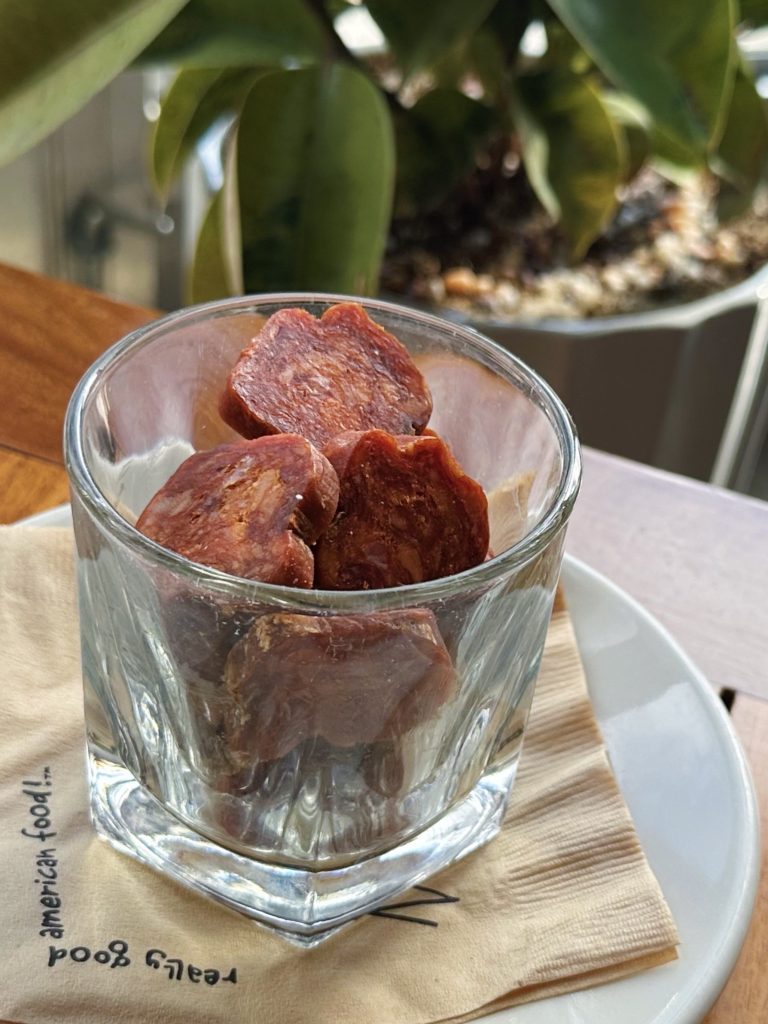
Super tasty and cured by a longtime friend!
The food section of the New York Times shared a then-cutting-edge insight into the centuries-old tapas culture of Spain 40 years ago next week. “SPAIN’S TAPAS BECOMING INTERNATIONAL!” the headline announced. The article, by food writer Moira Hodgson, referenced the then-new work of author Penelope Casas. Casas’ classic, The Foods and Wines of Spain, came out in 1982, the year we opened the Deli. With her informative insights in hand, the traditional foods of Spain entered into the Zingerman’s ecosystem. Her next book, Tapas: The Little Dishes of Spain, came out 40 years ago this year, in 1985. Around that time, we got to know Penelope personally when she came to Ann Arbor to teach classes on Spanish cooking at the Deli. Without question, she was at the cutting edge of introducing authentic regional Spanish food to American audiences.
All these years later, we’re excited to offer an amazing American-made artisan chorizo, crafted true to the Spanish style by Charles Wekselbaum and the crew at Charlito’s Cocina! Back in the ’80s, there was nothing close to this quality level being made in the U.S. One had to go to Spain to enjoy it. Today, we live in a wonderful and completely different culinary world.
Chorizo, as you and I eat it today, most likely originated in the 17th century. It was, historically, the first “tapa.” Slices of it were used to cover glasses of sherry and, so the story goes, to keep the flies out. It remains hugely popular. Native Spanish Tapas says that the “best Spanish tapa in Madrid is undoubtedly CHORIZO, yes, Spanish zesty pork-sausage!” This is the way it is when you eat out in Spain. Small plates of sliced chorizo are everywhere. This means that although the newest addition to the Roadhouse’s appetizer list may seem novel to some in southeastern Michigan, anyone who has been to Madrid or anywhere else in Spain will know that chorizo’s presence is ubiquitous.
The quality of this cured chorizo is truly special, and what’s on the Roadhouse’s menu right now is exceptional. Charles Wekselbaum has spent nearly a quarter-century studying traditional curing techniques. He is also, as we are here, determined to use exceptional raw materials. We both understand that it’s pretty much impossible to make amazing food out of so-so ingredients. For the Spanish chorizo, Charles and crew begin with heritage breed, Animal Welfare Certified pork. Charles spices it with Pimentón de la Vera—the remarkable, denomination-of-origin-controlled, oak-smoked paprika from western Spain—sea salt, and a very gentle bit of fresh garlic, curing salts, and that’s pretty much it. Careful curing, time, and natural molds (similar to those on cheese) do the rest of the work. The flavor is truly fantastic—clean, complex, and mouth-filling, with a fantastic long finish.
You can nibble the chorizo on its own, sip some wine, beer, or a cocktail. Great, too, alongside a plate of Bakehouse bread with Vermont Creamery Cultured Butter, a glass of single-origin peanuts, or a couple of choices off the cheese list. A 2-ounce portion is plenty for two people, even three, though, to be honest, I ate a whole half-portion the other evening on my own. The 4-ounce would be more for a four- or six-top, though your appetite will dictate how far it goes. The good news is you can always order another round.
Although Charlito’s Cocina and Charles himself are both in New York City, his family’s roots, at least in our era, in Cuba, and before that, Eastern Europe. His grandfather came from the town now known as Pruzhany, the same town where the Torah scholar Joseph Soloveitchik was born. The 10,000 or so Jews who did not leave around the time that Charles’ grandfather did were all murdered by the Nazis in 1941. When he decided to cross the Atlantic, Charles’ grandfather’s intention was to come to the U.S., but he wasn’t able to get in, so he diverted to Cuba as a short-term solution. He ended up in a small Cuban town called Colon (as in Christopher Colon) on the northern end of the island, At the time, his was the only Jewish family in town. Soon after, he heard that a second Jewish family had arrived in the area from Warsaw. That family included Charles’ grandmother.
The first Jewish presence on Cuba may have come 400 years earlier, in the form of one of Columbus’s original crew, Luis de Torres, a converso (a secret Jew, pretending to be a Christian in the autocratic setting of 15th-century Spain, where being anything but Catholic put one at risk). Most of the Jewish community in Cuba, though, came much later. A number of American Jews began to go there in the latter years of the 19th century. By 1924, there were nearly 25,000 Jews on the island. The American Immigration Act of 1924 closed borders to most refugees seeking asylum and made it much harder for many Jews fleeing persecution in Europe to get into the U.S. This increased the Cuban Jewish population still further. Then the vast majority of them left Cuba before 1959, when the Cuban Revolution began, and in the years that followed.
And now, thanks to his grandparents and parents, we have Charles Wekselbaum in New York, where he started his small craft salami company in 2011. Charles has long been a generous supporter of what we do in the ZCoB, so I’m especially happy that we can return the favor by featuring his chorizo at the Roadhouse. Here’s what Charles shares about his own passion for cured meats:
I was fascinated by the process of transformation, how I could turn a highly perishable food—raw meat—into something that does the opposite of perishing, by leaving it in the zone in which it is most prone to perishing. It is a way of elevating the food into something completely different than it was to begin with, something delicious and beautiful. It is a true triumph of human ingenuity!
I keep that in mind every time I savor a small slice!
Make a reservation
Tag: ZINGERMAN’S ROADHOUSE

Polish comfort food with a fungi-focused twist!
Looking for a remarkably delicious, warming, and wonderful bit of comfort food, one that will help you confront the newly cooler temps around town? Swing by the Roadhouse in the next couple of weeks and order up some of the remarkably good potato pierogi that are on the menu!
The autumn rendition of this traditional Polish dish is covered with sauteed Michigan mushrooms and the requisite side of sour cream. The dish is finished in the pan with a good bit of that delicious Vermont Creamery Cultured Butter that we’re all (rightly) raving about. The crowning detail is the beyond-terrific Chicken-Fried Mushroom that sits atop the bowl. It’s a big, beautiful, Maitake mushroom from Michigan’s “thumb”—for those of you who aren’t familiar, that’s the part of the state that sticks out to the east on the Michigan “mitten.” As the name suggests, we prepare the mushroom just like our fried chicken. It’s got that same delicious, softly spicy crunch. The plentiful ridges on Maitake make them especially good for deep frying. These marvelous mushrooms are on the menu without the pierogi, too—as an entrée and a sandwich. If you ask, we can sometimes make them as a side with another entrée, too. They are, by far, one of my favorite things on the menu!
To prepare the platter, we lightly pan-cook the pierogi in butter so the dough on the outside gets to a beautiful golden brown. The browning creates the perfect foil for the soft, creamy potato filling. You get the creaminess of the potato filling, the lightly caramelized dough of the pierogi themselves, the earthiness of the sautéed mushrooms, the smoothness of the sour cream, and then the spicy crunch of the Chicken-Fried Mushroom on top!
Pierogi are, of course, a big part of the culinary tradition of Polish immigrants who came to the U.S. most prominently in the 19th and 20th centuries. Polish settlers started arriving in the North American colonies far sooner, some as early as the late 16th century. Two of the early immigrants, Casimir Pulaski and Tadeusz Kościuszko, led Revolutionary War armies. Michigan has the third-largest Polish population in the U.S. (after Illinois and New York), so it’s only fitting that we fit this terrific platter onto the specials list. The pierogi we serve at the Roadhouse are handcrafted by a third-generation family business in Hamtramck, the center of Polish life in Michigan. In Polish, pierogi refers to just what it is—a stuffed dumpling. A bit of trivia: The word pierogi is linguistically connected to the Ukrainian pyrizhky and the Russian pirozhki, and it’s plural—one would be a pierog. The linguistic root in Old Slavic is piru, which means “feast,” and that’s exactly how I think of this platter. Many groups of visitors have been ordering a plate of pierogi to share as an appetizer.
This pierogi dish is terrific for lunch or dinner. Additionally, it’s a great meatless meal—ideal for vegetarians. We can make a vegan version for you by using olive oil to cook the pierogi and sautée the mushrooms. Comforting, delicious, and a taste of Polish-American tradition!
Tag: ZINGERMAN’S ROADHOUSE
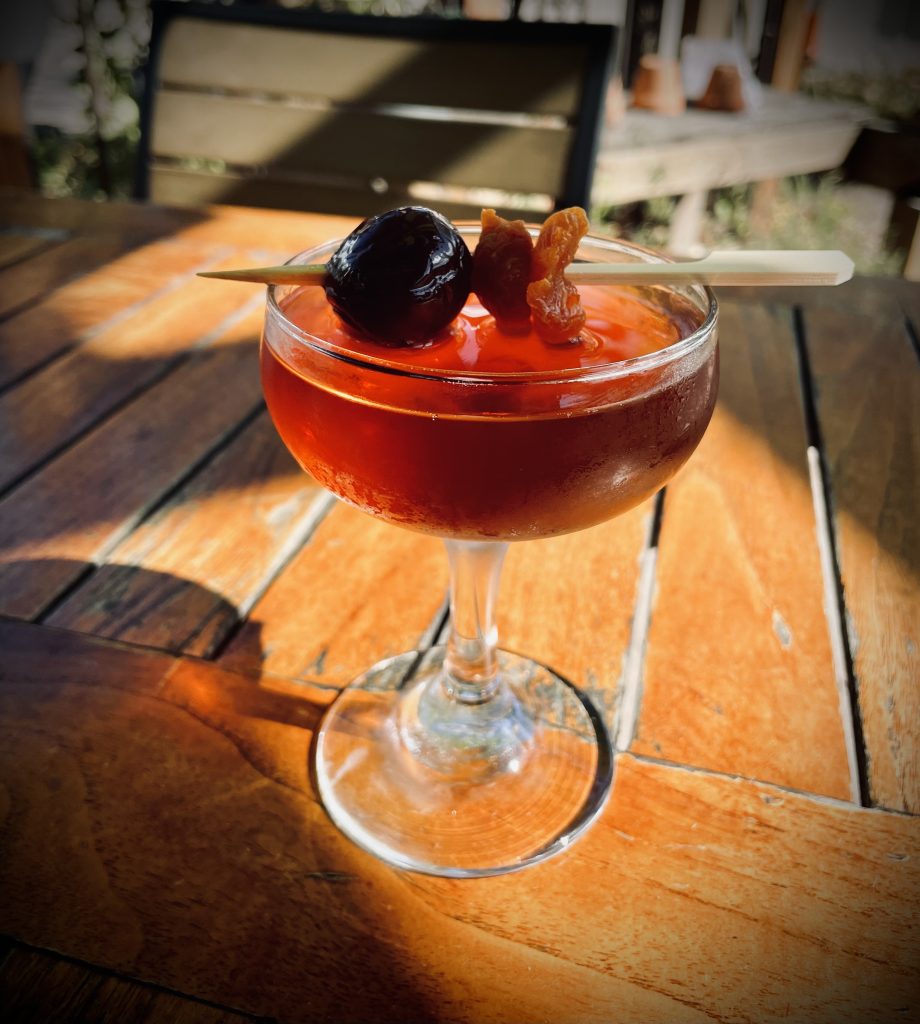
Apricot cocktails from Paris in the ’30s to the Roadhouse
What do you get when you shake up a good amount of Zingerman’s Roadhouse Bourbon (specially blended for us by Highline Spirits), some housemade dried-apricot infused vodka, the dark artichoke overtones of Cynar, and a small bit of Vya Sweet Vermouth to balance out the bitter? If you swing by the Roadhouse this month, you can find out. This cocktail is called a Montparnasse Manhattan. It features amazing flavors, a fascinating foot in history, and a symbolic but still significant connection to dignity and democracy!
The Montparnasse Manhattan is an outgrowth of a phrase I have often said to myself in recent months, “It’s a small thing, but it’s something.” It’s part of an effort to help make apricots into a meaningful symbol for dignity and democracy. As per everything I wrote above, I sometimes feel self-doubt starting to drive me into inaction, but I have managed to push forward in the belief that something meaningful would come from it. Apricot t-shirts went up online last week, and proceeds go to Democracy Now! As I wrote last week, the Anarchist Apricot Toast is on the special menu at the Coffee Company all month! And thanks to bartender Kat Franko, we have this amazing apricot cocktail on hand at the Roadhouse.
The cocktail, as is true for most of our food and drink, is rooted in history. My early research on apricots turned up the true story of the persistent and positive presence of apricot cocktails in the storied conversations of some of the 20th century’s most famous philosophers. Existentialist anti-Fascists in the 1930s had a proclivity for consuming apricot-based cocktails. In a sense, the subtitle of Sarah Blakewell’s 2016 At the Existentialist Café sums up this entire essay with a surprising succinctness: “Freedom, Being, and Apricot Cocktails.” It turns out, much to my surprise, that while autocracy was on the rise in Germany, a whole range of French philosophers—most prominently Simone de Beauvoir and Jean-Paul Sartre—were gathering in Parisian cafes and sipping, more often than not, on apricot cocktails. The headnotes for the book’s opening chapter illustrate metaphorically what I’ve been imagining in recent weeks. Creating the kind of community in which people (metaphorically, at least) “drink apricot cocktails, more people stay up late talking about freedom, and even more people change their lives.”
In the spirit of this week’s opening essay, de Beauvoir shares in the preface to her autobiography that she began writing this book when she was in her teens, really with no intention of ever finishing it or putting it into print. Forty-five years later, she finished and published it. The Prime of Life came out 60 years ago, in 1965. In it, she writes extensively about her own work, and also about her storied relationship with fellow philosphe Jean-Paul Sartre in Paris. Beginning in 1929, when de Beauvoir was only in her early 20s, the two began to spend more and more time together, enjoying life, and working out the philosophical framing that would shape their lives, with the shadow of authoritarianism on the rise in neighboring Germany. De Beauvoir writes:
We ate bread and foie gras Marie [which you can see featured in this beautiful 1931 poster by the most famous poster artist of the era, Leonetto Cappiello] in my room, or had dinner at the Brasserie Demery … we did not feel deprived of anything. In the evening, we would look in at the Falstaff or the College Inn and drink our cocktails like connoisseurs—Bronxes, Sidecars, Bacardis, Alexanders, Martinis. I had a weakness for two specialities—mead cocktails at the Vikings’ Bar, and apricot cocktails at the Bec de Gaz on the Rue Montparnasse.
The role of the apricot cocktail in their lives had only just begun, though. It became famous in the annals of philosophical history in 1932, when philosopher Raymond Aron returned from a year in Berlin studying Edmund Husserl’s phenomenological philosophy:
We spent an evening together at the Bec de Gaz in the Rue Montparnasse. We ordered the speciality of the house, apricot cocktails; Aron said, pointing to his glass, ‘You see, my dear fellow, if you are a phenomenologist, you can talk about this cocktail and make philosophy out of it!’
All these years later, we have picked up Aron’s challenge. I’m not sure the work with apricot cocktails and their symbolic connection to dignity and democracy would fully fit Raymond Aron’s phenomenological frame, but at least they’re a start. (If you’d like, you can read more about the roots of this apricotian ideology.) The cocktail tastes great. Kat Franko describes its deliciousness as:
Honeyed apricots, a little smoke, and a nice bite from the bourbon. … We’re infusing a local Ann Arbor vodka with California apricots to make cocktails akin to what was sipped by French philosophers in Paris cafes in the 1930s, adding our own chapter to history and donating one dollar from each cocktail to Democracy Now! So that democracy might spread as far as the small, sweet orange fruit we’re so obsessed with.
Swing by, sip, convene with a couple of friends, and talk about what dignity and freedom might mean. Enjoy the day and drink a toast to what matters most to you and yours.
Make a reservation at the Roadhouse
Tag: ZINGERMAN’S ROADHOUSE
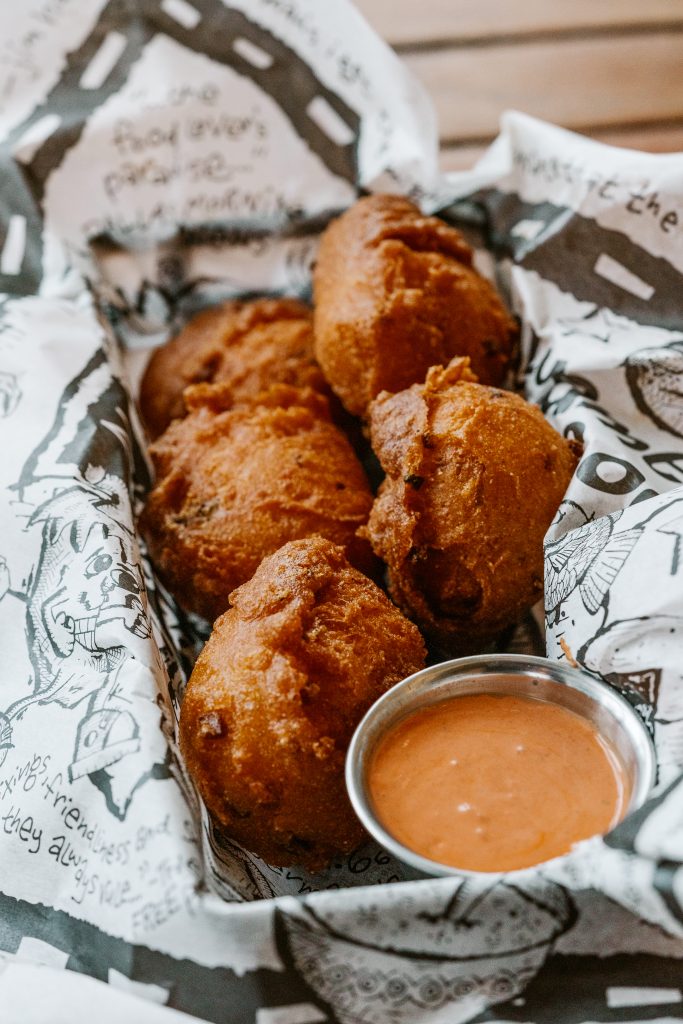
One more week to score some of these super-tasty appetizers
Hush Puppies are one of those Southern classics most folks have heard of, but not many around here have actually tried—and even fewer have had a truly great one. All of which inspired me to write about them here. You’ve got one more week to catch these Pimento Cheese Hush Puppies on the Roadhouse specials!
If you aren’t familiar with them, hush puppies are deep-fried balls of cornmeal batter that are typically served alongside everything from ketchup to catfish. The name, legend has it, comes from cooks tossing bits of cornbread dough to their barking dogs to keep them quiet. Whether that story is true or not, they’re an epically Southern tradition. One friend of mine, who has spent years in the South, put it perfectly: “I love hush puppies. They’re comforty, they’re fried, and they taste good—like what you make in big old Southern kitchens.”
Hush puppies here at the Roadhouse start out with exceptionally delicious cornmeal from Anson Mills in South Carolina. Anson Mills raises the old varieties of heirloom corn (low-yield, high flavor), field-dries it (as opposed to the far faster machine drying) to protect its natural flavors, then stone-mills it at very low temperatures—downright cold, actually. They leave in the germ, aka the natural oil in the corn kernel, from whence so much of the flavor comes. All of which is why Anson Mills’ cornmeal really taste like corn, not just fried, slightly sweet dough. To make them even tastier still, in this case, the Roadhouse kitchen crew has mixed in some of our super popular Pimento Cheese, which makes them slightly spicy as well!
Although it doesn’t say it on the menu, the Pimento Cheese Hush Puppies are particularly delicious dipped into some hot bacon fat! The connection to pork fat like that came about courtesy of a very nice couple from South Carolina who stopped in at the Roadhouse one spring evening many years ago with their son and his girlfriend, both students at Michigan. Toward the end of the evening, the father gently inquired if I was up for one suggestion. “Of course!” I answered. “Your hush puppies are really good,” he said in a slightly conspiratorial tone. “But you’re missing one thing that would really put them over the top. You need to put a little bacon fat in them.” Sure enough, the bacon fat takes the already excellent hush puppies to the next level. We don’t add it to the hush puppy mix (to keep them vegetarian), but we can easily serve you some on the side if we have some on hand when you ask. It’s a compelling combo—a little like eating amazing cornbread with applewood-smoked bacon!
I got so jazzed about the Pimento Cheese Hush Puppies and the bacon fat that when I did the first draft of this piece, I almost forgot to mention what is probably for many the highlight on the plate—the Pamlico Bay Crab Cakes that are on an appetizer plate with the hush puppies! They’re terrific! Made with crab caught off the North Carolina Coast by our friends at Locals Seafood, they’re an East Coast classic that most everyone who loves shellfish loves to eat.
We are, of course, always happy to cook up either the hush puppies and/or the crab cakes on their own if that’s where your taste runs! And, although it’s not listed on the menu this way, I’d suggest getting hush puppies as your side for any fish or steak dish, too.
Swing by over the next week and order up!