
Tag: ZINGERMAN’S ROADHOUSE
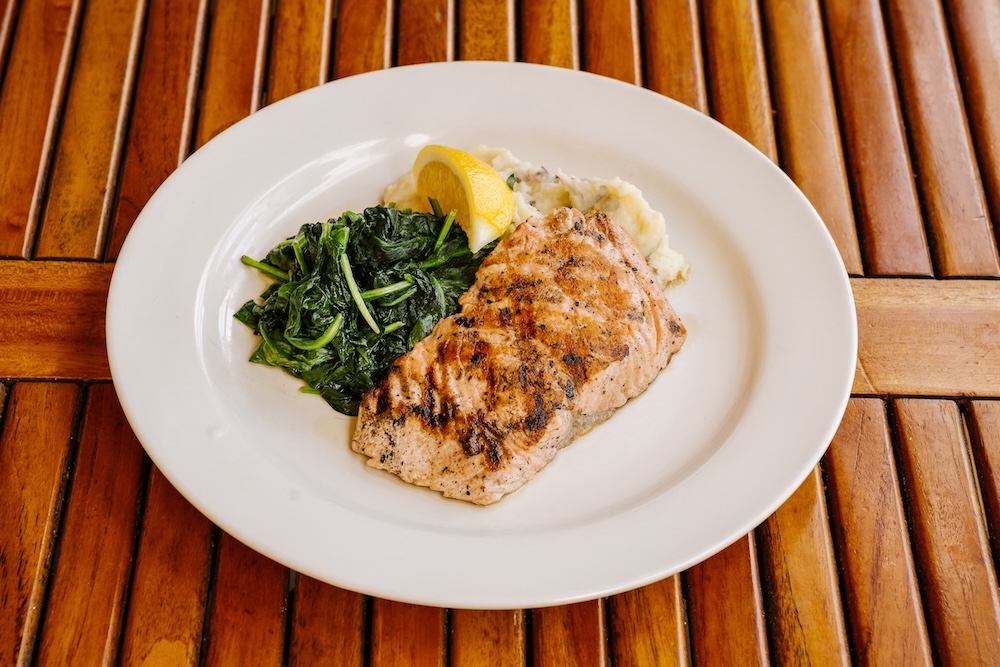
Thanks to the folks at Foley Fish for this superfine salmon
It’s one of the rarely talked about realities of the restaurant world. Though few know it, there are BIG differences in the quality—read flavor and texture—of farm-raised salmon. And since, to be clear, there are no wild-caught Atlantic salmon on American restaurant menus right now, that means that there are very significant differences in quality between two items that are each listed on the menu of their respective restaurants simply as “salmon.”
Needless to say, knowing that reality really well, we’ve been determinedly buying fish from the Foley family to broil, grill, and sauté at the Roadhouse every week since we first opened the restaurant’s doors back in September 2003. Then, and now, Foley Fish has been one of the best of the best. As Michael Foley, the grandson of the founder, writes in his history of his family and their now 119-year-old fish business, Swimming Upstream, “We have always had an absolute standard quality, not a relative one. ‘Best available’ or ‘good enough’ have never been good enough.”
Today, the Foley folks are still just as diligent about the quality of their fish, and they’re also at the forefront of promoting sustainability in the seafood world. Foley is as picky about who they sell to as what they sell; I feel honored to be one of their accounts. As Frank Foley, Michael’s dad, who I met many years ago on a visit to Boston, said, “Foley’s gimmick is quality. … Quality comes before everything. It’s the reason why profit is always the bottom line of a profit and loss statement—it comes after quality.”
The Bay of Fundy itself is an amazing place. Off the east coast of Canada, tucked into the Canadian Maritimes between New Brunswick, Nova Scotia and the east coast of Maine, it was recently named one of the “Seven Wonders of North America.” Its remarkable tidal range of about 50 feet is the highest in the world—the average is just over three! Better water movement in the Bay most definitely makes for healthier farmed salmon.
What makes this particular Bay of Fundy fish so good?
- Time out of the water—the Bay of Fundy salmon gets to Foley’s within 30 hours, and to the Roadhouse the following day! (Most salmon, often coming from Chile, Norway, or New Zealand, is 48-130 hours old before it even gets to the distributor, let alone the restaurant.)
- The quality of the feed—For Foley’s Bay of Fundy salmon, no chemicals are used, and wild herring is added to boost both flavor and fat content, making for a more tender texture.
- The fish are farmed at 20 to 30 percent less density, meaning there’s more room to move, better muscle development, and ultimately, better flavor.
- A century of good work by the folks at Foley’s, who say, “We have been working with this product and farm for decades, they know our quality standards. … We expect the best, and if any of the fish is below our quality checks, we simply send it back.”
At the Roadhouse, we buy whole, 12- to 15-pound salmon, and butcher them regularly in the back kitchen. Because it’s been on the menu for so long, I have, I confess, taken the Bay of Fundy salmon a bit for granted, but I tasted some the other day and was reminded just how darned good it is. One piece had the Roadhouse’s Blackening Spice on it, the other was made with the compellingly aromatic Spicy Coffee Spice Rub! Both were outstanding—the contrast of the spices with the delicate richness of the fish was a beautiful combo.
Swing by the Roadhouse soon and order some of the Bay of Fundy salmon. Great for lunch or dinner, or added to a green salad or those terrific Smothered Grits, it will likely brighten your day in a big way. I know it did mine!
Make a reservation at the Roadhouse
Get Ari’s favorites in your inbox every week
Tag: ZINGERMAN’S ROADHOUSE

Vermont Creamery Cultured Butter takes ’em to new heights
The big news around ZCoB parts right now is that the Roadhouse’s long-loved Buttermilk Biscuits, made from scratch every day, just got even better!
It’s been two years since we added the Vermont Creamery Cultured Butter to the bread service at the Roadhouse. The commercial butter we’d been serving up until that point had been a relatively peripheral product for us. Now, the cultured butter has become a signature offering with glowing reviews. The Vermont Creamery Cultured butter is a game changer—I actually added a few paragraphs to the “A Taste of Zingerman’s Food Philosophy” pamphlet in the final weeks of production just to highlight how good it is. We have had it on our counter at home regularly for many months now. I’m pretty confident that if you try it (be sure it’s at room temperature), you will be doing the same for your house as well!
Credit for the butter goes to Allison Hooper, longtime industry colleague and friend, who, along with her business partner Bob Reese, started Vermont Creamery back in 1984. Working in the small town of Websterville, the pair pushed from the beginning to make the kind of cheese and butter that Allison had experienced when she’d interned in France a few years earlier. I asked Allison for the back story on the butter:
The butter was developed early on, in the early ’90s. The story is that the farm that I worked on in Brittany had Jersey cows. They were separating cream, and they were selling butter and crème fraiche at the local market. It was so delicious!!! I wanted to make that butter here. Bob and I found a used churn outside a dairy barn and we bought it. We figured out how to use it, and we started making butter. I found this pretty famous French chef in New York, and I decided to take a chance and send him some butter. He called me back, and he was so excited. He said, “This is exactly what the great French chefs in New York are all looking for. It’s the butter of our childhood!” The chefs there loved it, and they really helped us get it off the ground. The chefs knew! They say we make the best butter in the country, and to this day, that’s what we’re known for.
The Vermont Creamery Cultured Butter is made with cream from nearby St. Albans Cooperative. Cream is cultured overnight and then churned into butter. All, and au natural! The butter is 86% butter fat. And like I said, you really can taste the difference! The American standard for butter is 80%. Even most fancy European butters are 82 or 83%. The Vermont Creamery Culture Butter is 86%. And it is so darned delicious!
The Roadhouse has been making its ever-popular Buttermilk Biscuits for decades now. As of last week, we began baking them with this spectacular butter. What has been really wonderful for many years is now noticeably better still. The aroma of the biscuit is amazing—bigger, beckoning you in to take a bite, or two or three. A small luxury to bring a little cultured, buttery, culinary joy to your day! They’re so good they’ve got me thinking I might well want to write a bit of poetry about them. After all, Carl Sandburg, the classic poet of my hometown of Chicago, once wrote, “Poetry is the synthesis of hyacinths and biscuits.” At the Roadhouse, you can gild the butter-rich biscuits by spreading more of the same cultured butter on top just before you eat them! Grab a biscuit (or two) when you drive through the Roadshow. And/or, buy a dozen in the morning to bring home for brunch!
Tag: ZINGERMAN’S ROADHOUSE

How a lost pup united a community of givers at Zingerman’s SafeHouse fundraiser
When we lose a loved one, we grieve not only the loss of their presence but a loss of meaning and identity. We may wonder who we are without them. What matters most might not be as clear as it was before. As we search for answers, we can lean on the communities we belong to and find new ways to make meaning — and even joy — within them.
Jelly Bean Jump Up, Zingerman’s annual charity fundraiser, grew out of this quest. In addition to honoring the beloved canine companion of Zingerman’s co-founder Ari Weinzweig, this event supports Ann Arbor’s SafeHouse Center, which protects and empowers survivors of sexual assault, dating violence, and stalking. The 10th rendition of the campaign, which raised more than $21,000, included a March 25 dinner at Zingerman’s Roadhouse, donation drives, sales of pet-themed calendars and corgi cookies, and more.
Dinner attendees enjoyed a family-style meal designed by renowned chef and award-winning cookbook author Molly Stevens and cooked by Roadhouse chef Bob Bennett. Many took part in a silent auction featuring donated goodies such as a CSA share from Tantré Farm, line-caught fish from Shoreline Wild Salmon, and a pizza kit from Nueske’s Applewood Smoked Meats. Everyone celebrated the power of friendship and community by breaking bread – or biscuits, in this case – with new acquaintances.


Breaking bread, building community
Ari introduced Jelly Bean Jump Up by reminiscing about the event’s namesake, a sweet and curious corgi who was a minor celebrity on Ann Arbor’s Clark Road. That’s where she and Ari would often go for a jog, passing SafeHouse on their route. Over the years, the perspicacious pup earned nicknames such as Jelly Bean the Jogger Dog and Zinger-man’s Best Friend. Ari organized the first Jelly Bean Jump Up in 2016, a few months after she passed away.
Ari also highlighted his friendship with Molly, which began at an American Cheese Society in the late 1980s. Over the years, she has appeared at five Roadhouse dinners and Camp Bacon, a bacon-themed festival with special classes, speakers, meals, and more.
“Molly is a great cook and a great cookbook writer, which are different things. But I don’t think of her for her cookbooks, like a lot of people do. I think of her as my friend,” Ari said.
Molly’s cookbooks include All About Braising, All About Roasting, and All About Dinner. She also hosts the Everything Cookbooks podcast with Andrea Nguyen, Kate Leahy, and Kristin Donnelly.
The menu Molly devised reflected several special moments from her life as a chef. For instance, a vegetable course dubbed a “mess of bitter greens” was a nod to Zingerman’s other co-founder, Paul Saginaw, who she cooked with during a trip to Greece.
“I would relive that trip if I could, especially the experience of cooking with other people. I find the idea of this dish so comforting,” Molly said.
The menu also featured several dishes that incorporated cultured butter from one of the event’s sponsors, Vermont Creamery. These included butter-poached shrimp with tomatoes and garlic, butter pecan gelato topped with brown butter hazelnut shortbread, and a warm dip made with artisanal olive oil, garlic, and Fishwife anchovies. The centerpiece of the meal was braciole, a pasture-raised flank steak stuffed with SarVecchio parmesan, Newsom’s country ham, pinenuts, and raisins, all of which were braised in a savory tomato sauce.
During the meal, Molly shared some of her family’s Thanksgiving traditions and quirks with her tablemates, who shared details about their own holiday meals in return. Micki Maynard, a food writer at the table, said she was excited to see Molly Stevens’ name attached to this year’s Jelly Bean Jump Up.
“I’m a huge fan of Molly Stevens. I have come to her special dinners in the past, and Molly was super helpful to me when I was writing Satisfaction Guaranteed, my book about Zingerman’s,” Micki explained, adding that the dinner’s menu was “delicious from top to bottom.”
Micki also noted the positive energy the event’s crowd brought to the Roadhouse.
“It’s a treat to see everybody come here because they’re so fired up for SafeHouse and so generous. There are such interesting people to talk to, and there’s a real feeling of community,” she said.


Showing up for vulnerable neighbors
Christine Watson, SafeHouse’s executive director, gave a short speech during the dinner. In addition to acknowledging the generosity of Zingerman’s and several community partners — Plum Market, Tito’s Handmade Vodka, Dollar Bill Printing, Old National Bank, and Probility Physical Therapy — she thanked the audience for showing up for abuse survivors.
“You remind me we have a community around us who genuinely care. SafeHouse exists because of people like you,” she said. “There need to be places for survivors of abuse and assault to tell their stories, because we don’t always get to hear them. You help make that happen.”
In the United States, families and communities lose more than 1,300 of these survivors to violence each year. Pets also get caught in the cycle of abuse. Sometimes people stay in dangerous living situations because they can’t find shelter for an animal companion. In addition to increasing survivors’ access to counseling, legal advocacy, and temporary shelter, Jelly Bean Jump Up has helped SafeHouse expand its capacity to house pets fleeing violence.
Jelly Bean Jump Up reflects the hard work of Melaina Bukowski, Zingerman’s community giving coordinator. She’s proud that this event has benefited SafeHouse for a decade, becoming one of the center’s main sources of financial support.
“Our pets give us a sense of security and safety, and SafeHouse serves this need to feel safe in such a deep and fundamental way,” she said. “It’s such a crucial space within our community, and the people there do lifesaving work advocating for so many people.”
This relationship with SafeHouse inspired Melaina to create Nonprofit Spotlight, a blog that introduces readers to charitable organizations the Zingerman’s Community of Businesses supports. So far, more than 50 groups have been highlighted.
Jelly Bean Jump Up continues to be one of Melaina’s favorite events because it shows how pain can spark generosity and transform lives.
“It’s a remarkable thing to take the grief of loss and turn it into a big, loving act to take care of other people,” she says. “I’m always honored to be a part of it.”


Tag: ZINGERMAN’S ROADHOUSE

A spicy and simply delicious way to start your day
After eating one of these the other morning, I was reminded that, to my biased palate, this Texas breakfast taco at the Roadhouse is one of the tastiest foods you’ll find in the ZCoB! I could happily eat a couple a day!
It’s one of a trio of different Texas breakfast tacos on the Roadhouse menu right now during the week. A warm flour tortilla, filled with freshly scrambled eggs, dressed up with some freshly grated Monterey Jack cheese and a bit of that zesty IASA Peperoncino from Italy.
What makes it so good? Like so many things we make here, each of the ingredients is lovely on its own, and then they all come together in a singular, super tasty way. The Monterey Jack might be one of the more underappreciated of the exceptional ingredients we work with. We’ve been buying it from Vella Cheese in Sonoma—just a couple miles from Sam Keen’s house for over 30 years. While probably thousands of dairies make Monterey Jack, to my knowledge, only TWO make it using old-school artisan methods. The cost, of course, is far higher, but the result is radically more flavorful. The Roadhouse probably pays 20 times more to get the Vella Cheese than it would to get some standard commercial offering, but man, is it good. At every level, our determination and dedication to this special cheese, I believe, is one of the many ways we turn our food philosophy into real-life values.
From the time we started buying the cheese in the late ’80s until he passed away a bit over a decade ago, Vella Cheese, for me, was almost synonymous with the man who ran it. Ignazio (Ig) Vella was an amazing supplier with whom we shared so many guiding principles. Now that I think about it, in Sam Keen’s context, Ig was very much an insightful if informal philosopher of what we could call “the world of curd.”
Writing for the Los Angeles Times, journalist Valerie J. Nelson described Ig as:
The elder statesman of artisanal cheeses … He was a gruff straight shooter, and the salvo was his way of warning that success required a willingness to toil for uncertain financial gain. Once that caveat was spelled out, Vella invariably became an unselfish teacher and tireless advocate for small-scale producers of cheese, according to those in the industry.
I would agree. To me, he was also a friend and mentor. Ig passed away in the spring of 2011 at the age of 82. In reflecting on his life and work, I find a kind of spiritual calling—a reminder that dedication, integrity, and craftsmanship matter. A reminder that when we do our work well—honoring our values and staying true to the hard-working, down-to-earth, community-conscious commitment to quality that Ig embodied—special things are very likely to emerge. In that sense, each of these tacos is more than just food—it’s a testament to the values that Ig Vella lived by his whole life.
The IASA Peperoncino is what really takes this taco to a special place. It comes from Italy, where Ig’s father, Tom Vella, was born. IASA is an outstanding “spread” of spicy red peppers in olive oil. At our house, we buy quart jars and use it nearly every day! At the Roadhouse, it’s already appeared on a number of specials. It’s also on the menu as an optional condiment and as a part of the Bakehouse artisan bread appetizer. The eggs, the creaminess of the cheese, and the umami-spice of the IASA all come together on the taco to make for what I think is a wonderful way to start your day.
If you like a bit of spice, you’ll love it. Swing by the Roadhouse during the week for breakfast, order a cup of that really good Roadhouse Joe coffee, and get your day off to a solidly delicious start!
Tag: ZINGERMAN’S ROADHOUSE

A Conversation about Poetry & Leadership
Once upon a time, Michael Dickman was a cook at Zingerman’s Delicatessen. Now, he’s an award-winning poet and Princeton University creative writing lecturer. Michael shared a taste of his latest book, “Pacific Power & Light,” at Zingerman’s Roadhouse earlier this month. Afterward, he and Zingerman’s Co-founder Ari Weinzweig discussed how poetry helps people pause, notice details that typically get lost in the hustle and bustle, and make unexpected connections between ideas.
Engaging with poetry benefits people in all kinds of professions, according to Michael. His students from Princeton often email him this discovery after they become doctors, lawyers, stockbrokers, and more.

“They often say, ‘This has changed what my life is like, whether they’re working in an ER or teaching at an elementary school,” Michael told the audience. “They felt that something was missing, and poetry helped them find it.”
Ari remarked that poetry is not only a missing piece but a tool for navigating challenging situations. It helps him process stressful world events and reflect on his personal journey as a leader.
“New situations call for new tools, and poetry is one of them,” Ari said.
Michael also told the story of how “The Captain’s Verses,” a poetry collection by Pablo Neruda, ignited his poetic imagination in high school. It happened at an unlikely moment: after a friend dragged him into the local mall’s bookstore.
“I’d never read a whole book before,” he admitted. “I read it from cover to cover and cried at the end. I’d never had that experience before.”
Michael read a poem from this book and a few other favorites, then dared the crowd to create five-line poems with a series of crowdsourced words: alligator, Panama, patty melt, periwinkle, and running, plus the title “All Night Long.” At least 40 new poems resulted, each wildly different from the next.
Deli Chef and Managing Partner Rodger Bowser was one of those audience members. He and Michael Dickman became fast friends on the job more than 20 years ago.
“Never in my life have I been as creative as when I was working with Michael,” Rodger explained. “He got what I was trying to do and provided inspirational energy I can still feel when he’s in the room. This workshop took me back instantly.”
Don’t miss the next one!
Check out all the upcoming events at the Roadhouse.
Tag: ZINGERMAN’S ROADHOUSE

Pepper-spiced deep-fried maitake make for some marvelous eating!
One of my favorite new foods in the ZCoB over the last few years, these chicken-fried mushrooms are more than worth making a trip across town to try!
To be clear, there’s no actual chicken involved here. The “chicken-fried” is a reference to the batter in which they’re dredged, and the way they’re deep fried! They are, to my taste, absolutely delicious! They start with buttery, meaty, moist maitake mushrooms grown in Michigan. The maitake—also known as hen-of-the-woods—are spiced with that totally terrific farm-to-table Tellicherry pepper from Kerala on the west coast of India. Like the Roadhouse’s more famous fried chicken, the heat from the pepper is prominently present upfront but not overpowering.
Maitake are used widely in Chinese medicine, loaded with nutrients, and contribute to immune system health. So there are, it seems, possible health benefits to eating them, though for me, it’s all about how tasty they are. In the wild, maitake can grow to be huge, but the folks at Stony Creek manage the growth so the mushrooms are harvested at a more manageable size. Because they’re cultivating the maitake so effectively, Stony Creek is making it possible for us to get a year-round supply of these great mushrooms, which opens up the door to doing delicious dishes like this one for many months to come. Mycologist Paul Stamets says,
Maitake mushrooms are known in Japan as “the dancing mushroom.” According to a Japanese legend, a group of Buddhist nuns and woodcutters met on a mountain trail, where they discovered a fruiting of maitake mushrooms emerging from the forest floor. Rejoicing at their discovery of this delicious mushroom, they danced to celebrate.
When you taste these chicken-fried mushrooms—either on a Chicken-Fried Mushroom Sandwich or as an entrée of their own—I forecast that you will find yourself dancing as well! I know they sure get me going. The other evening a guest stopped me to say, almost glowing as she spoke, how darned good they are! I agree!