
Tag: ZINGERMAN’S
A week of enjoying the food and wine of Lyon and the Jura awaits
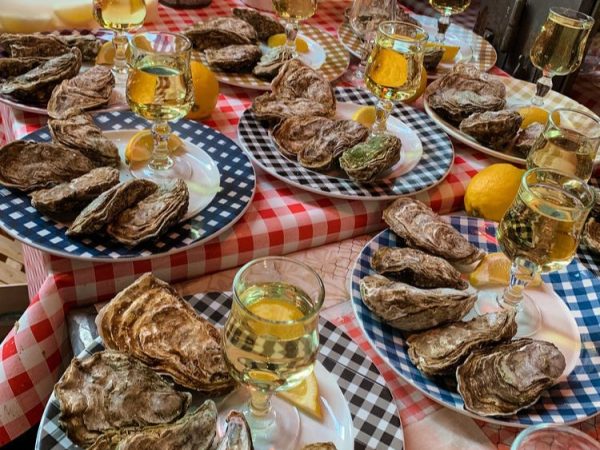
If you’re one of the many folks I know who’s thinking about heading out for some significant overseas travel to try to make up for the last few years, this Zingerman’s Food Tour to France might just be the ticket. Not only is it an amazing culinary destination, the tour next year happens at pretty much the perfect time of year to go to France—the final days of May and the first few of June, when the weather is nice, but not too hot, and before the height of the tourist season begins!
Of all the tours on our docket, this is the one that Kristie Brablec, Managing Partner of Zingerman’s Food Tours, is currently most excited about. Why?
Lyon is the heart of gastronomy in France, started by the mothers of Lyon (this is a story we could tell in itself); many people don’t know that the gastronomy movement in Lyon was born from women. From Françoise Fillioux to Eugénie Brazier, the history is deep with women leading the kitchen. Paul Bocuse is the most well-known, of course, but still, he was trained by Eugénie Brazier, and sadly this is often overlooked. Eugénie was also the first person ever awarded 6 Michelin stars—three at each of her restaurants, and this dates back to 1933—a true female powerhouse in the culinary world, and it all started in Lyon.
The region is home of Comté, one of the finest cheeses produced in the world. Secondly, it’s home to one of my favorite wine regions worldwide. This region is often missed and very rarely traveled. It’s difficult to gain access to this region for various reasons. Outside of serious wine nerds, tourism is very limited in this area, even to the French. The Jura is the smallest wine region in France. Less than 500 producers spread across 80 kilometers of vineyards, covering four wine Appellations.
Lyon could be to France what Bologna is to Italy—a gastronomic wonderland that’s loaded with luscious cheese, wine, world-class cured meats, lots of good eating, and plenty of additional art and culture to boot. The city has shown up regularly on the New York Times’ list of “52 Places to Go.” The Comté-Jura region is, for me, even more special. I love the mountains and I love mountain cheese, and the Jura has the best of both! Comté cheese has long been one of my favorites, and the little-known Vin Jaune of the region is very much the perfect fortified wine you want to accompany it! Sipping on the latter, nibbling on some well-aged bits of Comté on a beautiful spring evening, and watching the sunset over mountain peaks sure sounds pretty superb.
If you’re ready to spend a week traveling, tasting, and creating lifelong memories, give some thought to signing up for this trip with Kristie. If you’re looking for skillfully guided travel, incredible food, wine, people, history, and culture, this superfine food tour will pay big dividends! You will still be sharing stories from it ten years from now when we are finishing our 2032 vision!
Reserve your spot!
Want more from Ari?
Sign up for Ari’s Top 5 e-newsletter and look forward to his weekly curated email—a roundup of 5 Zing things Ari is excited about this week—stuff you might not have heard of!
Lisa started at Zingerman’s Roadhouse in 2004 as a server, worked her way up to Restaurant Manager in 2013, and now, as of August 18th, is Managing Partner! She has a passion for providing excellent service (she’s played an integral role in creating the service culture of the Roadhouse) and a focus on helping the managers and staff be the best they can be every day. Lisa answered a few questions to help us all get to know her a little better:
 What recent work are you most proud of at the Roadhouse?
It might sound cliché, and I’m certainly not the only one to feel this way, but the pandemic was the most challenging thing I’ve ever dealt with. We had so many ups and downs: having to furlough 80% of our staff, shifting to pick-up only and completely revamping our to-go food area, manipulating our floor plans, and then building back up our capacity and staffing. I worked side-by-side with our crew to help strategize, implement, and train staff on all of our changes. While it was extremely challenging at times, I enjoyed training and supporting our staff to help them provide top-notch service to each other and our guests. I’m proud that we made it through and are in a good place—and I’m hoping to help get us to an even better place!
What does good service mean to you?
Getting it right the first time, with any aspect of service. Consistency is one of the hardest things to achieve and I have spent much of my professional career teaching and training others on how to provide an accurate, friendly, and memorable experience every time someone steps foot inside the Roadhouse.
Why did you want to become a partner in the Zingerman’s Community of Businesses (ZCoB)?
I have had an interest in becoming a partner for the last 6 or 7 years after gaining experience as a manager; I wanted to move toward ownership and financial investment in the restaurant and the ZCoB. I love what I am afforded to do every day in the ZCoB. I’m grateful to work in an organization that values people and that strives to help improve staff not just while at work, but in their daily lives (outside of work) as well.
What’s been impactful about the Path to Partnership process?
Being reminded that even though you are leading your own business, you are also a representative of the entire organization. As a partner, I’m not just advocating for myself and the Roadhouse—all of the different ZCoB businesses are working together as a whole.
What is your first order of business as Roadhouse managing partner?
Continue what I’m doing right now and work on getting us fully staffed. The hospitality industry is known for having high turnover. Luckily, we have lower than most, but staffing is still a definite challenge right now.
What are you most passionate about in the Roadhouse’s Vision?
All of it, honestly. I am excited to carry all of our successes into the future. As well as to pick up meaningful improvements along the way. I’m honored to be able to lead in all different areas to get us to greatness. I am excited to do this with our team and make sure we continue to treat our employees well. I’m excited to make and keep the Roadhouse a great place to dine and work while achieving financial viability and beyond for many years to come. I am dedicated and passionate about getting us there.
Tell us about the No Drama or Calm is Contagious work at the Roadhouse.
The Calm is Contagious work at the Roadhouse started several years ago as somewhat of a joke. Restaurants can sometimes get a bad rap for being dramatic environments, so Ari asked if we should write a Bottom Line Change (BLC) on reducing drama in the restaurant. I laughed it off, not realizing that it would be an integral part of Roadhouse culture years later.
Ari wrote that BLC and we incorporated the concepts into our Welcome to the Roadhouse class. We include things we ask staff to do (and not to do). We also offer tools and resources for things like managing energy and staying grounded, all to help manage stress and conflict inside the restaurant. My experience with teaching the No Drama work and holding staff accountable is an important part of what makes our culture alluring, fun, and successful. I’m happy to teach it to any ZCoB business!
What are your current favorite items on the menu?
So many! Huevos Rancheros, the new Rice Bowl is phenomenal, the scallops, Smothered Grits, all of the heirloom tomato specials, and the shrimp we get from North Carolina are out of this world, so I add shrimp to a lot of things. I also tend to make a lot of stuff on the fly in the Roadshow!
What’s one of your favorite Roadhouse memories?
One of my favorite memories at the Roadhouse was moving from being a server to a front-of-house assistant manager. This was such a defining moment for me in gaining confidence and starting my leadership role at the Roadhouse.
Fun Facts
- Total Townie: I have lived in Ann Arbor all of my life and don’t plan on leaving! I love living in a diverse and educated town with so much to offer. I love having so many cuisines and tasty food options at my fingertips.
- Outdoor Lover: I love all that the many city and local parks have to offer being a runner and one who loves the outdoors!
- Former Vegetarian: I was actually a vegetarian when I started serving at the Roadhouse! That didn’t last long though, I felt really good about our sourcing. We work with smaller farms that utilize responsible and sustainable practices—and started eating meat again.
Approaching our work as art can change our worlds
Designer Debbie Millman once wisely shared this life advice: “If you imagine less, less will be what you undoubtedly deserve.” Inverting Debbie’s insight into a more positive frame, I arrive at this: “Imagine ourselves as artists and it’s amazing what can come of it.”
When I think back on all that I’ve learned over the past forty years, I have to laugh. The list of tools, mental shifts, and changes in mindset is long! I knew so little back in 1982. Many of the approaches I’ve adopted have changed my life. Practicing visioning, embracing the power of beliefs, finding open book finance, starting to live servant leadership, creatively applying the tenets of anarchism, and the more recent exploration of the organizational ecosystem metaphor lead the list. Zingerman’s, and my own life, is almost impossible to imagine here in 2022 without them. Although I’ve sometimes given it less attention, the idea of approaching my work and my life as if they were art, poetry, or music has, quietly, been equally impactful.
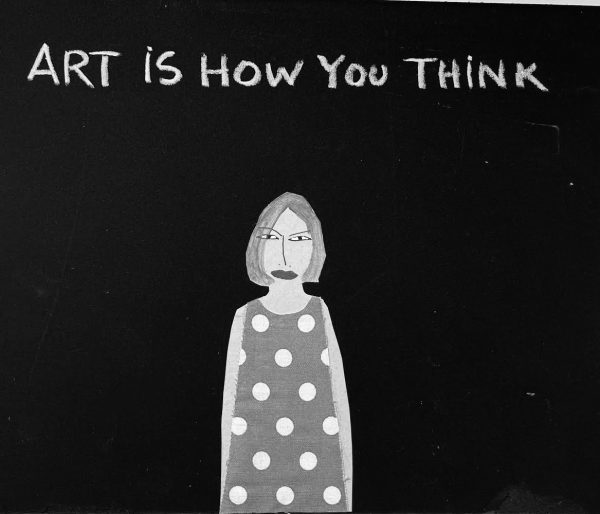
While the idea of living an artful life had in some sense probably been an intellectual undercurrent for me for quite some time, the idea clicked one day when I was looking at the website of my friend Patrick-Earl Barnes—whose new painting, “Blacks in Culinary,” I wrote about last week. From the day we first met back in 2004, I have been drawn to all of Patrick-Earl’s work. The day I was looking at his website, though, one piece completely caught my attention. It was a painting of one of his classic folk art characters, wearing a t-shirt with the message: “Art is how you think.”
True to his message, Patrick-Earl’s art immediately got me thinking. It was, in essence, an epiphany. The painting took a subconscious, meandering thought I’d been having and framed it in a way I could intentionally and mindfully approach my life. Nearly twenty years later, art is very much how I think, work, look, listen, and live.
Can a small subtle shift like that really make that much difference? For me, the answer is absolutely. Integrating this artful approach to—well, everything—has helped me to see more clearly, deal with the world more effectively, and appreciate everyone and everything around me in a more engaged way. It’s nudged me to notice nuance and to attend more actively and caringly to details I would likely have otherwise missed. The small shifts add up in a big way. As playwright David Mamet put it, “Art is an expression of joy and awe.” When art is how I think, sure enough, to Mamet’s well-made point, I feel joy far more frequently. And, without a doubt, I’m amazed at how often awe shows up in what I might many years ago have mistakenly imagined as mundane.
Seth Godin did a post a while back that sums up this work:
Poets use words (and silence) to change things. They care about form and function and most of all, about making an impact on those that they connect with.
Every word counts. Every breath as well.
In a world filled with empty noise, the most important slots are reserved for the poets we seek to listen to, and the poet we seek to become.
As this approach evolved, and as I began to work at thinking artfully rather than just looking at art, I began, as I so often do, to write about it. A few years after I saw Patrick-Earl’s piece, we published “The Art of Business” pamphlet. Its 30-plus pages are based on the suggestion that no matter what we actually do for a living, we will benefit from starting to imagine ourselves as artists. You can plug in “poets,” or, if you’d prefer, make it “musicians,” or “songwriters,” but the point is the same. When we start to move through our worlds as artists, the shift is easy for an outside eye to miss, but ultimately, the impact can be enormous. Done well over time, thinking and living artfully is life-altering.
“The Art of Business” is based on what I had begun to understand and wrote about in The Power of Beliefs in Business—when we change what we believe, we experience the world differently, we act differently, and others around us are, in turn, impacted, influenced, and inspired in the process. Here’s a snippet of what I suggested at the start of the pamphlet:
Next time someone asks what you do for a living, try telling them you’re an artist. Watch their response. My forecast? They will pay far more attention when you start to share more about your life. So, I’m pretty sure, will you.
. . .
When we choose to live our lives creatively, to make the most of the days and months and years we have on the planet, to be true to ourselves as best we can and as often as possible, then our lives—and our organizations—are truly art as well. Most of us, I know, haven’t conceived of ourselves as artists. But I’m guessing that if we start imagining ourselves in this new light, our lives will likely become richer and more rewarding. Excellent, if imperfect, works of art in the making.
The impact, while subtle, has been significant. It’s pushed me to approach every small interaction I have with the same sort of care and commitment to craft that I work on in my writing. To put as much thought into how I end an email as I do to where to place paragraph breaks when I’m working on a book. Whether I’m greeting a new staff member, working the floor at the Roadhouse, creating an agenda for a meeting, or making dinner, actively thinking as if I were an artist:
-
Pushes me to pay radically more attention. I still slip regularly. But my attentiveness to the world around me has absolutely increased. Artists notice nuance. Many of us have been raised to focus on the finish line; thinking and working more artfully has taught me to tune into and appreciate the process.
-
Helps me call up my creativity all day, every day.
-
Makes me more appreciative. Beauty in the organizational ecosystem metaphor is akin to gratitude—both, I’ve learned, are there to easily be appreciated if we’re paying attention.
-
Gives me a gentle way to raise issues, initiate conversations, and express care and concern; art allows us to do what arguments almost never can.
-
Helps me feel better about myself since I, like most humans, feel at my best when I’m flowing with my creative abilities.
-
Makes my life better by bringing beauty more intentionally to the fore.
Perhaps the most important part of this shift is the realization, the belief, that everyone can do it. This is not about elite experts crafting world-class paintings—it’s about being the world-class human being everyone is capable of becoming. When I do the work well, it’s very much as artist, author, and former physicist Enrique Martínez Celaya writes:
Being an artist is not a posture or a profession, but a way of being in the world and in relation to yourself. An artist is revealed in his or her choices. Watch your actions as well as what you like and notice who is the person suggested by them. Understanding who you are as an artist should be thought of as a life-long process inseparable from your work.
What follows are half-dozen ways that I believe anyone who’s interested can put this into practice. I continue to work to get better at each of them every day.
1. Creatively manage your creative inputs.
If we are, we know, radically influenced by who—or what—we spend the most time with, then it only makes sense that our inherent, naturally occurring artistic abilities will be brought out most by spending more time around art, artful thinkers, and being in creative conversations. As I shared in Secret #39 in Part 3, “It turns out that the biggest thing anyone can do to increase their innovative ability is to go hang around in a creative environment.” This can be in person, on the phone, in our workplace, or in the café we hang out in. It might be in music, books, films, podcasts, going to plays, or reading poetry. The energy and inspiration I get from all that creative connection is a bit like living on solar power. My energy stays high most of the time. It’s much like what musician Rachel Baiman says of music producer Tucker Martine: “He runs his life in service of maintaining inspiration at all times.”
One of the chefs who appears in Patrick-Earl’s art piece is the late Leah Chase who, with her husband, and later, with her children and grandchildren, ran the legendary Dooky Chase restaurant in New Orleans. I’ve had the pleasure of eating in the restaurant, and I had the honor of meeting Leah Chase twice. She was, for me and many others, an inspiration. When you dine at Dooky Chase, you will be surrounded by incredible artworks by some of the country’s best Black painters. Historian and author Jessica Harris, who is also featured in Patrick-Earl’s piece, writes:
While the kitchen may have been her heart, art was her soul: It was a world where she found her true self, and where she delighted in being. The art in Dooky Chase’s restaurant reflects that love and connection.
The little things matter—we can draw inspiration from fresh flowers on the counter or taking a few minutes to read a poem every morning. I keep six vintage Bakelite Scottie-dog-shaped pencil sharpeners in my pocket everywhere I go—one for each of the dogs at our house. When I feel stressed, they serve as grounding, creativity-evoking touchstones. Rachel Baiman said of Tucker Martine’s studio: “Even the bathroom is majestically wallpapered and smells like designer soap. This is an environment in which magic will be made.”
2. Actively find the beauty in everything.
Although I spent much of my life ignoring it, most of the time there is, I’ve come to understand from this work, beauty to appreciate all around me. If we learn to look—or listen, or taste, or touch—as an artist, it’s amazing what we notice. Kazuo Ishiguro says, “An artist’s concern is to capture beauty wherever he finds it.” I saw it in the reflection on the glass bottle of sparkling water that was sitting on the table next to me the other morning while I journaled. I’ve experienced it with the color, aroma, and superfine flavor of the Thorburn’s Terracotta tomatoes that Tammie is growing this year for the first time. Flipping through the most recent Mail Order catalog, I noticed the beauty of Ian Nagy’s amazing illustrations and the craft that went into the placement and the copy. I appreciate that the U.S. Post Office is now selling stamps that feature mariachi musicians. I paused for a few minutes to take in the personalities of the people portrayed in the first wall piece Patrick-Earl did for the Roadhouse in early 2020, and the poster that Ian Nagy did of Patrick-Earl. And I just noticed the other evening—Ian’s poster is on the opposite side of the room, “looking” straight across at Patrick-Earl’s piece. That now makes me smile every time I enter the room!
3. Artfully make a difference.
Great art in this context is not for decoration; it’s about making a meaningful difference. Playwright Aaron Sorkin says, “If you feel that strongly about something, you have an obligation to try and change my mind.” Artful action—whether it’s in a painting or in person—draws us in. This is, in great part, why my eye went to Patrick-Earl’s paintings in the first place when I saw him selling them on Spring Street in Soho nearly twenty years ago, why I walked over to look more closely, and why I bought three of them to carry home in my luggage. It’s what made me want to hang his art—alongside the amazing work of Ian Nagy and Ryan Stiner—in the Roadhouse. It’s absolutely what gave me the thought to commission the new “Blacks in Culinary” piece. We can make a difference in people’s lives, and bring beauty to our communities. Elizabeth Catlett, whose painting of Leah Chase is now hanging in the Smithsonian, once said, “We have to create an art for liberation and for life.”
3. Be more attentive to what’s happening in your head and your heart.
If I don’t keep myself centered, it’s unlikely my art will be effective in its impact. Journaling, as I wrote about in “Working Through Hard Times,” has been a huge help. Running every day nearly always brings unexpected insights. Talking to friends, teaching, reading, etc. all help me tune into what’s in my heart. The folks at Indigenous Resistance write about the importance of “taking care of one’s inner dub in order to the work of the outer dub.” Managing Ourselves (which we really, really hope will get past the paper supply chain issues soon!) has 400-plus pages of my thoughts on this broad and important subject.
4. Go for mindful greatness.
No artist wants to put out below-average art. No poet calmly settles for so-so. Tucker Martine says, “If we aren’t doing this to make the best record that we can, then what’s the point?” When art is how I think, I take that mindset into every small interaction I have—taking time to thank the postal carrier with a heartfelt smile. To add a bit more meaningful appreciation to what starts out to be an otherwise mundane email. To listen more closely when someone tells me their name so that I actually remember it in the understanding that even our brief introduction can be done superficially, or, instead, with an artful intent to attain excellence in the exchange.
5. Nurture other artists.
The other day I got interviewed by Jonathan Fields on the Good Life Project podcast. At the end of the conversation, he always asks, “What does living a good life mean to you?” I began my answer by referring back to many of the things we had talked about—increasing hope, enhancing positive beliefs, paying attention to purpose, etc. A sentence or two into my response though, I realized the obvious answer I was working my way back to: “Living a good life is helping other people to live a good life.” Sharing this approach with everyone, noticing the beauty in their work, and encouraging them to do the same with their own surroundings, helps a lot. As Seth Godin says, “Art isn’t painting or canvas or prettiness. Art is work that matters.” The amazing, difference-making artist Samella Lewis, who passed away earlier this year at the age of 99, was mentored as a young woman by Elizabeth Catlett who was eight years her senior. Who can we help this week to see themselves through this sort of artful lens?
6. Make a positive difference.
Elie Wiesel writes, “The opposite of love is not hate, it’s indifference. The opposite of art is not ugliness, it’s indifference.” The point of this piece is, ultimately, to help enable anyone interested to make their life richer, their ecosystem more connected and caring, and to tap into their creativity and purpose more purposefully. Despite laws that said it couldn’t happen, the upstairs at Dooky Chase became the first integrated restaurant in New Orleans. And as Leah Chase said, “In my dining room, we changed the course of America over a bowl of gumbo and some fried chicken.”
Approaching our work and our lives as artists is not in conflict with doing what we need to do to make a living. The key is that we do it in ways that are true to us, true to our values, infused with dignity, and done daily with grace. Here’s a snippet of a bit from “The Art of Business”:
Poet Gary Snyder came to visit Ann Arbor a few months ago for a reading. He’s studied Japanese drawing and Chinese poetry, and he used to hang out with Allen Ginsberg and Jack Kerouac. He’s been called “the poet laureate of deep ecology,” does environmental work, and has also published a good bit of insightful prose, including an essay that particularly resonated with me called “Buddhist Anarchism.” As I write, he’s in his 85th year. He was born ten months after Robert Henri died. I’m honored that Gary chose to eat at the Roadhouse (as he did on his previous visit as well) on the evening of the event. Over 500 people came to hear him read poetry on a farm 10 miles west of town. Wow. Snyder shared his belief that “[c]ommercial art is when you do something to respond to a demand in the marketplace. That’s not a bad thing. But when you do something because it’s what you love, and then you figure out how to get people to buy it, even though they didn’t know they wanted it until you made it, now that’s really great art.” It’s what we’ve tried to do here at Zingerman’s for 34 years now.
The poet Guante says, “Don’t write a poem about war. Write a poem about what it’s like to stand in your brother’s empty bedroom.” When I’m engaging with the world as an artist, it reminds me to look more closely, notice more, hear more, and in a regenerative way, do better. It pushes me to see not just at the plate of food being served to the guest but to focus equally on the energy of the person who’s putting it down in front of them.
What we know now about neuroplasticity makes clear that this artful approach, practiced regularly over a period of years, will literally change our minds. Not only will that change help us, and those around us, it also serves to help inoculate us against the fear, negativity, and unnecessary drama that dominates so much of the world’s daily conversation. As scientist Norman Doidge describes, “Once a particular plastic change occurs in the brain and becomes well-established, it can prevent other changes from occurring. It is by understanding both the positive and the negative effects of plasticity that we can truly understand the extent of human possibilities.”
In the urgency of the world’s current crises, it would be easy to ignore this call for thinking and acting more artfully. I could have walked right past Patrick-Earl selling his paintings in Soho all those years ago. But look at the impact of that seemingly small decision to honor my instinct, to engage artfully with his art, and to build a friendship and find ways to connect creatively and caringly. Every person we see, every interaction we have, has the potential to also make this kind of difference. These acts of artfulness get little attention from others, but they might just save the planet.
John O’Donohue wrote many years ago that the world was suffering from a crisis of ugliness: “In a sense, all the contemporary crises can be reduced to a crisis about the nature of beauty.” Stepping back and working at approaching our lives and work like artists or poets or painters helps us to gain much-needed perspective. “Perhaps,” O’Donohue says, “for the first time we gain a clear view of how much ugliness we endure and allow.” I don’t have any statistics to prove it, but I’m confident that there are more artfully-minded folks doing good work in the world, and that most of those doing ill (though I know not all) are not spending time on palindromes, poems, or careful selection of paint colors.
Learning to think in artful terms has shifted the way I see the world, and I hope, through that shift, also altered my impact for the better as well. Dooky Chase has posters on the wall by the artist Jacob Lawrence. Leah Chase told Jessica Harris:
I learned to look at his work, and from there on, I just learned to look at things. Sometimes you don’t understand it. Sometimes you look at it, you say, “Oh my goodness, this is so ugly.” Look again. Look again and you’ll see something.
Chase’s artfully spoken comments reminded me to return my attention to the ending of “The Art of Business,” where I shared a similar lesson from a story that James Baldwin told, a story that took place maybe a mile to the west of where I first met Patrick-Earl:
I remember standing on a street corner with the black painter Beauford Delaney down in the Village waiting for the light to change, and he pointed down and said, ‘Look.’ I looked and all I saw was the water. And he said, ‘Look again,’ which I did, and I saw oil on the water and the city reflected in the puddle. It was a great revelation to me. I can’t explain it. He taught me how to see, and how to trust what I saw. Painters have often taught writers how to see. And once you’ve had that experience, you see differently.” Baldwin’s story sticks in my head. Every time I start to skip past something unthinkingly, I try to turn my mind back to look—or listen, or taste—again, to see what I missed the first time around. It’s amazing how much more interesting the world gets when we take the time to pay careful attention. Beauty begins to appear in the most unexpected places.
If you’d like to purchase a bunch of copies of “The Art of Business” pamphlet to get your organization moving in a more artful direction, email Jenny at [email protected].
Want more from Ari?
Sign up for Ari’s Top 5 e-newsletter and look forward to his weekly curated email—a roundup of 5 Zing things Ari is excited about this week—stuff you might not have heard of!
A small shift in beliefs that can have a big impact
You might well know the old, cynical restaurant anecdote in which a customer flags down a server who’s passing his table and politely asks for another glass of water.
“I’m sorry, sir,” the server replies, “but you’re not in my section.”
This story is symptomatic of the shoulder-shrugging unwillingness to take ownership of anything that’s not directly our “duty”—at best, customers get bad service. At worst, companies and communities come apart.
Stories, as I’ve written any number of times in recent months, are beliefs made manifest. I’d like to tell you stuff like this only happens in poorly-run restaurants, but the reality is that it reflects a widely held belief. Most people, in most companies, and in most countries, have been led to believe that they are only responsible for themselves—accountable only for their own work assignments. As a result of which, customers get shunted from one office to the next. One department blames the next, one party points at the other. Stas’ Kazmierski, who taught us the visioning process back in 1993, used to tell the story of a company he worked for: “When you asked who was responsible, people would essentially cross their arms over their chests and point in either direction. We called it the company ‘salute.’ It was always someone else’s responsibility.”
This essay is about the opposite belief. The radical idea that we can all start by taking on total responsibility for everything of which we’re a part. While we are responsible for our own actions, our organizations would be healthier and happier places if we each were to skip the blame, defensiveness, and finger pointing and instead act with a sense of grounded, caring ownership. This small shift, I believe, is a powerful one that can have a meaningfully positive impact on mindsets, energy, and outcomes. Over time, it can change company cultures. It is a big part of ours. While it might seem like “more work,” it works the other way around—when it’s done well (by both the individual and the organization), people feel more empowered, more engaged, and, in the process, they gain a greater sense of purpose.
Over the course of the last few years, through ZingTrain, I’ve found myself working with some organizations that have, unintentionally, got me thinking this all through in greater depth. On the surface, they seem to be doing well. Many have already adapted some of our approaches, along with a host of other ideas that they’ve picked up from around the progressive business world. While all have had some good success, they are also, as they tell me, feeling frustrated: “We do so much for our staff, but they don’t seem to appreciate it. We’ve made all these changes to help them, but all they seem to want to do is show up, do their jobs, and go home. We’re trying to make this a great organization, but mostly people just want to punch in and out.”
I can certainly relate to the feeling of frustration. And yet, over the years, I’ve learned to push past it. Blaming staff for being unappreciative helps nothing. In Freedom and Accountability, Peter Block and Peter Koestenbaum write, “To blame others merely means making a decision to avoid the responsibility which ultimately and inescapably is one’s very own.”
I grew up, like many people, learning how to do all the blaming, finger pointing, and deflecting—our family dinners were all too often about engaging in endless arguments. I’ve tried, instead, to reground myself in the maxim Paul taught me 40 years ago: “When furious, get curious.” Which made me wonder… Why are companies who care about their staff, who are giving so much, finding that they get back so little? As I reflected on what wasn’t quite working, I started to realize that this belief about personal responsibility might be a big piece of the organizational puzzle. There’s something here in our culture that we don’t talk a whole lot about, but I realize is making a bigger difference than I’d given it credit for. It’s the sort of thing that, as Peter Block describes,
… [C]an be thought of as peripheral vision: you look at something, say a picture on the wall, and on the edges of your field of vision are images that are definitely there, but difficult to see definitively and clearly.
Here, we believe that we are each, fully, 100%, responsible for everything of which we’re a part.
This is not something we invented. I was reminded of that the other day while I was reading through a tome entitled, appropriately for the moment, Managing in Turbulent Times. Although the title might lead you to believe that it probably came out in the last couple of years, the book has nothing to do with Covid, attacks on the American Capitol, or the war in Ukraine. Managing in Turbulent Times was written 40 years ago by longtime leadership guru Peter Drucker.
Reading Drucker’s work helped me realize what was missing in some of these organizations where frustration with staff runs so high. Staff members are cared for, but they don’t care as deeply as someone who feels fully responsible for their organization, their department, their colleagues, or their work community. They’re asked only to do tasks, and that is what they do. The sense of belonging that goes with feeling fully responsible for the whole goes missing. The typical employee, Drucker explains, “is held responsible neither for his ownership power nor his knowledge power. And that, at bottom, explains his unease, his discontent, his psychological hollowness. … he has function but lacks status. He lacks responsibility.” As a result of which, Drucker writes:
The employee in most companies … is basically “underemployed.” His responsibility does not match his capacity, his authority, and his economic position. He is given money instead of the status that only genuine responsibility can confer—and this trade-off never works.
…
The employee on all levels … needs to be given genuine responsibility for the affairs of the … community. … He must be held responsible for setting the goals for his own work and for managing himself … he must be held responsible for the constant improvement of the entire operation. … He must share responsibly in thinking through and setting the enterprise’s goals and objectives, and in making the enterprise’s decisions.
When we accept responsibility for the whole of our work, what we create, Drucker says, “is citizenship.” While the word is well known, the approach is the inverse of what exists in most companies. Instead of citizens, the typical business quietly sees staff members as “subjects.” The leader—very much like a sovereign ruler, a king, or a queen—is the one who is, patriarchally, responsible for the health and well-being of all. The staff member is accountable only for their own work, but is neither empowered nor expected to take responsibility for the whole. This approach, Drucker demonstrates, will often lead to apathy. At its worst, the unwillingness to share responsibility creates alienation, anger, blame, bias, and burnout.
We did not consciously have Drucker’s directive in mind when we opened the Deli, but Paul and I both believed that we and everyone we hired would work in the way that Drucker describes: People who worked with us ought to have a meaningful say in what we were doing. And, at the same time, they would take total responsibility—as we felt ourselves—for what was going on. We weren’t trying to be radical. It just seemed like the right and obvious way to work. I don’t know that we talked much about it in those early beginnings, but taking responsibility was informally woven into what we do every day. It’s a way of being in the world of which I was reminded again this past weekend when Bill Russell passed away at the age of 88. For Russell, the long-time star of the Boston Celtics, and an active campaigner for civil rights throughout his life, the focus was always on the health and success of the group. As columnist Jim Rohn writes, “Russell was a player who wanted to take responsibility for the success or failure of his team.”
The mindset that Russell brought to the Celtics is what we want, and have always wanted, for our organization. In more turbulent and less turbulent times, it’s our hope and intent that all of us here take total responsibility for what’s going on. By embracing the whole, taking responsibility for the ecosystem and everything and everyone in it, we have a shot at making something magical happen.
I still remember when I realized that this unspoken hope could be hard-wired into the way we work. While I might well have read it first in Peter Drucker, I wasn’t savvy enough to see the power that a shift in responsibility could have until I came upon Gay Hendricks and Kate Ludeman’s 1997 book, The Corporate Mystic. They list “7 Radical Rules for Business Success.” Number 2 blew my mind:
Always take 100 percent responsibility for any activity you’re involved in. If you are in a leadership position, take 100 percent, not 200 percent. Require that each participant take 100 percent. Equality is only possible through meeting at the 100 percent level.
I must have read the statement something like ten times trying to let the concept sink in. It certainly didn’t mesh with what my 8th grade algebra teacher had taught me. And yet, it totally made sense in a belief-altering way. What had I believed up until that point? I’d probably just gone along, unconsciously with the “obvious norm” of what I’d been taught underlay all equity. We would share responsibility the equitable way: “50-50.” It felt fair and the math worked out. Unfortunately, though, that model just doesn’t actually work. It leads to the kind of blame and finger-pointing that Stas’ had taught me about. When I would inquire about something that had gone awry, it nearly always seemed to be the “50%” of the other person, almost never of the one I was asking. As Hendricks and Ludeman say:
The ordinary definition of responsibility: Whose fault is this?
The successful person’s definition: “How can I respond to this so everybody wins.”
Someone else who has challenged these old beliefs about responsibility for decades now is Peter Block. In his book Community, Block writes, “Choosing to be accountable for the whole, creating a context of hospitality and collective possibility, acting to bring the gifts of those on the margin into the center—these are some of the ways we begin to create a community of citizens.” Block, too, talks about citizenship:
A citizen is one who is willing to be accountable for and committed to the well-being of the whole. … a citizen is one who produces the future, someone who does not wait, beg, or dream for the future.
Instead of looking to leaders, bosses, teachers, politicians, or professors as either heroes or villains, we can take a deep breath and realize that we are all, like it or not, in this together. None of us have full control, but we can each work to make the kind of company, and/or community, that we want to be part of. If we do that work well, we create an ecosystem in which people will speak up, voice concerns caringly and constructively, participate in pushing for improvement, actively work to innovate, and come together when things go wrong. The sort of place where, rather than talking behind people’s backs, people calmly call meetings to have difficult conversations. Spots in which cynicism still starts up, but is relatively quickly nipped in the bud through effective self-management. The kind of place where, no matter who you ask for help, it’s always “their section.”
For those of you who write job descriptions, please know that none of this is meant to suggest that particular people aren’t also fully responsible for particular things. To be effective, we need to know who’s doing what. AND, at the same time, we are also, all, 100%, responsible for the whole. Responsibility for the whole can be written right into the job description. It’s a prerequisite for having a healthy, inclusive, equity-based, organization in which people participate fully. When we step up and take full responsibility for what we’re a part of, we grow stronger both individually and collectively. I’m inspired by what historian Keisha Brown writes about civil rights activist Fannie Lou Hamer’s “bold message—that each of us has the responsibility to work toward the just and equal society we envision.”
All these years later, the idea of taking 100% responsibility is embedded, ever imperfectly, in dozens of places here in the ZCoB. It’s an explicit expectation that’s written into our Training Compact. It’s a critical part of Open Book management and of why most all our meetings are open. It’s supported by our work with staff ownership and Staff Partners. And it’s at the heart of Secret #22, in which I share my belief that everyone in the organization is responsible for leadership. Taking 100% responsibility is also essential to the work we do to teach effective self-management, in our recipes for Customer Service, and on how to have caring conversations. And, it’s written clearly into our Statement of Beliefs:
We believe we’re each 100% responsible for the health of the ZCoB, of which we’re a part.
All of this is a way to shift power away from the people at “the top” and put it where I believe it really belongs—in the cultural soil of the organization. Peter Block suggests that it invites us to invert old school, hierarchical models that most of us are used to. Instead, we enter a world where we begin to see that power is moving in very different ways from what we’re used to imagining. In this new model, where everyone takes full responsibility, we are at the same time also dependent on, and empowering of, each other. It’s an inspirationally inside-out world in which, as Block puts it:
– The audience creates the performance.
– The subordinate creates the boss.
– The citizen creates its leaders.
– The student creates the teacher and the learning.
Does everyone at Zingerman’s avail themselves of these empowering options? Of course not. All of us, me included, can slip back into cynicism, or start to watch passively from the sidelines as if we have no say. But there’s a big, big difference I’ve learned over the years between freely choosing not to participate and the more commonly encountered alternative where you aren’t allowed to.
How can we expect people to take responsibility for what they can’t control? Natural Law #13 reminds us that “Everything is out of control; all we have are varying degrees of influence.” This push to take 100% responsibility for our work, for our boss, for our peers, and for the performance of the whole organization, means that we need to accept this Natural Law and then move forward anyway. After all, as Peter Block says, “the willingness to accept responsibility and blame for all our acts is a central ingredient in an authentic existence.” Asking people who work in an organization to take 100% responsibility for the whole only works if people also have access to power. If people have no say in how things go, it’s hard to honestly ask them to take responsibility.
How big of a scale can this concept of everyone taking 100% percent responsibility work at? I don’t know. I do know that all social change starts with people accepting responsibility for the group. The other day I saw a clip of Ukrainian young people organizing a rave party during which they started to rebuild a bombed-out building while DJs spun discs and blasted tunes.
What are the practical implications of this work? My belief is that it quietly helps us to create what writer Bankole Thompson, a regular at the Roadhouse, told me last month: “You’ve created an alternative reality here!” If we do it well, we can build the kind of balanced relationship and responsibility that I wrote about in Secret #29. The first two of the twelve tenets of anarchism reflect this. (Tenet 1. All for One—Bringing Out the Best in Each and Every Individual in the Organization. Tenet 2. One for All—Individual Responsibility for the Organization’s Success.) When we do it together, good things come from it. As adrienne maree brown reminds us, “It is our right and responsibility to create a new world.”
Peter Drucker was not an anarchist, and he saw the need for hierarchy in ways that might not be fully aligned with what I would advocate. And yet, half a century ago, he still saw that everyone in an organization taking responsibility was essential to the health of the organization and to everyone in it as individuals:
The task of building and leading organizations in which every man sees himself as a “manager” and accepts for himself the full burden of what is basically managerial responsibility: responsibility for his own job and work group, for his contribution to the performance and results of the entire organization, and for the social tasks of the work community.
Can this concept of each of us taking total responsibility for the whole really work? I’ve come to believe that it’s really the only way. It’s a belief that I see—and feel—in great businesses, on basketball teams, in communities, and in countries. We cannot create collaborative, caring greatness, without it. As Grace Lee Boggs said, “You cannot change any society unless you take responsibility for it, unless you see yourself as belonging to it and responsible for changing it.”
While there is no ZingTrain seminar or Guide to Good Leading book specifically on radically taking responsibility, the belief is quietly woven into all of them. Sign up for a seminar soon! Or, put all this into practice by ordering a complete set of all 34 pamphlets and have everyone on your team read one and share back with the group what they learn.
Want more from Ari?
Sign up for Ari’s Top 5 e-newsletter and look forward to his weekly curated email—a roundup of 5 Zing things Ari is excited about this week—stuff you might not have heard of!
Defining the service we give to our guests in the same way we do our cheese, bread, and coffee
Sometimes things come together for me in strange times and unexpected ways. Some of those ideas melt away over time and lead to very little. Others play out very positively. What follows is new, and I don’t know where it will go. In the spirit of sharing thoughts and uncertainty, I decided to put it out there.
What’s been on my mind is something of a quiet coming together of two subjects to which I’ve long been deeply committed: craft (aka “artisan”) production and customer service. Though we’ve been dedicated to providing an exceptional service experience and serving full-flavored, hand-crafted food and drink for over four decades now, I had not really put the concepts together in this way up until last week. Since then, the connection between the two has been going around and around in my head, getting stronger with each passing day. So much so that I decided to stick my neck out and share the unfinished and not-fully-formed idea:
-
What would happen if we start thinking about mastering and making our customer service happen with the same seriousness and commitment to craft?
-
And, would it be helpful to start actually calling it out that way, both for ourselves and our customers, to make it clearer what we’re doing and also to hold ourselves effectively accountable?
The connection between craft and customer service began, as many good things do, with humility. As I wrote last week, I was heading west to Portland to give a talk on the subject at the annual American Cheese Society conference. ACS has long been one of my favorite professional gatherings of the year, and I’ve been going pretty much annually since the late ’80s. As I was thinking through the talk on the way there, it dawned on me that one of the reasons I love going is that it is a very humble group. As per the words of the wonderful writer and teacher Edgar Schein who I referenced last week, as a rule, the members of the group are “committed to being helpful, bring a great deal of honest curiosity, and have the right caring attitude.” If you’ve ever presented in public, when you have a humble group who’s bringing those three things to their side of the conversation, it’s highly likely things are going to go well—as I believe they did with this talk. Thank you to those who were there.
In the spirit of finding the sweet spot between the rhythm of our ego and the counter-rhythm of our humbleness, I started to think about how that same groundedness and good energy is what I experience in the cheese of the artisans, wholesalers, and retailers who attend this conference each year. While all of us need to make a living, I seriously doubt that anyone there (including me) started working with artisan cheese to make a lot of money. To the contrary, nearly all do it because they love the work and care deeply about the products they make or sell; because it’s become their vocation; because they believe their work is making a positive difference for the land; and because they believe it matters for their families, for their companies (many of which are very small), for their customers, and in the process, for themselves as well.
Reflecting after the talk, I realized that the contrast between mass-market cheese and the hand-crafted offerings the folks at ACS make is much the same with customer service. Just as most modern grocery stores are filled with industrially-made, low-cost but consistent (and, I will say, low flavor) cheese, so too, is the world of customer service now dominated by the mass market equivalent of processed cheese. It serves a purpose, but it’s not great service. By contrast, everyone reading this can pretty quickly call up images of beautiful craft beers, craft-roasted and hand-brewed coffees, artisan cheese, and artisan bread. Done well, we all know that these craft offerings have a higher quality level, greater complexity, and reflect a way of “making” that honors the ecosystem—more flavorful and usually more healthful products, made by people who are super passionate about what they’re doing. They are most often made in commercial volumes—people make their living from them—but are done with a level of care that is way beyond mass market alternatives.
All of which got me thinking. If we call out craft beer and craft coffee, then why can’t we also call out—and commit to—craft service? If you’d rather imagine it as “artisan service,” that’s fine too; the two terms are used pretty much interchangeably in our end of the food world. The key for me is that naming it changes my own approach, and alters the mental images that arise, because, as Margaret Wheatley writes, “To name is to make visible.”
The more I think about it, the more the idea resonates. As I’m imagining right now, “Craft Service” is a much clearer way to call out the kind of service we’ve always been committed to here, but have not necessarily had a name for. The important thing to me isn’t really the name, but at the same time, I’ve learned a lot over the years about the power that names have. The book I wrote about it many years ago, Zingerman’s Guide to Giving Great Service, gets into all the how-tos of making it happen, but in hindsight, now I’m wondering if Craft could be a better way to frame it than “Great.” It’s true that we call our training “The Art of Giving Great Service,” but I’m reflecting now that, for me at least, imagining something as a craft calls up images of the importance of regular repetition, or years of working at mastery, and of acknowledging inevitable imperfection while seeking inspiration.
Craft Service, as I imagine it, could help companies steer clear of the transactional approaches that are the hallmark of mundane, mass market service. Just as we would want to determine whether we want to work with industrial cheese or hand-crafted alternatives, this idea pushes me to be clearer in my communication, both to customers and new staff coming in. Craft Service allows us to elevate and differentiate our work more effectively and it helps us appeal to new applicants and trainees. It’s an overt appeal to excellence, to passion, to vocation, to mastery. Craft Service, as I’m thinking about it here, is a call to all of us—starting with me—to push ourselves to ever higher heights of mastery. To care and commit, to dig deeper, to pay close attention to every small detail in the spirit of the Irish idea of Silver Branch Perception that I referenced in last week’s piece on humility. Craft Service (again, feel free to come up with your own term) seems aligned with singer-songwriter Claire Cronin‘s framing: “A poetic phrase [that] comes closer to the truth than a simple recitation of the facts.”
In the spirit of curiosity, what came to my mind next was a question: “What exactly is craft?” Joyce Lovelace, editor Craft Magazine, says, “Let’s face it, ‘craft’ is a curious word. We think we know it, but do we?” I realized that I didn’t, so I started to study. Webster says craft means “to make or produce with care, skill, or ingenuity.” I like the work of author, curator, and craft-historian Glenn Adamson, whose new book, Craft: An American History, came out back in January of 2021. Adamson’s approach is fascinating to me—he takes the time to look at things with new lenses. He works in the creative overlay between craft, design, curation, and a couple of other intriguing fields of study as well. Adamson defines craft as “skilled making at a human scale.”
Adamson is adamant that craft is best imagined not as a noun, but rather as an actionable activity, a verb. “Craft,” he writes, “only exists in motion.” Which fits well for this imagined melding of craft and customer service. Service isn’t just what we think about—it’s something we need to do! Craft, as Adamson frames it, and as I’ve experienced it, is rarely easy. Craft, Adamson says, is meant “to be hard-won rather than stumbled across as if by magic.” That makes sense to me—customer service is something that we master only by working incredibly hard at it over long periods of time at high levels of attentiveness. As Adamson says, “craft involves a considered consciousness about matters of execution.”
Does a new name make any difference? I guess I’ll find out as I explore. For some, it won’t matter at all. For me, in the short time I’ve been pondering this, I do believe that everyone who’s interested will understand immediately that anything made by a skilled craftsperson will be of far higher quality than a comparable offering made for the mass market in an anonymous factory. In the same way that we all have very different expectations for artisan cheese—we expect it to taste better, we expect it is made with radically more care, and we expect to pay more for it. We know that we could easily go down the block and buy something less costly that’s been made en masse by machine. We choose craft because we believe in it, we want it, we value the work that goes into it, and we appreciate how we feel after we’ve had it.
To be clear, I’m not suggesting that “Craft Service” is likely to be any different in content from what we’ve been working so hard to do here at Zingerman’s for over 40 years now. It’s just a way to talk about it that sets it apart. So, I’ve started to see that Craft Service would help us to differentiate, define, refine, and reframe our work more effectively. And to help us raise our own bar even higher on the effectiveness with which we serve you all every single day. I’m certainly not suggesting that anyone do what Glenn Adamson refers to as “craftwashing”—where people pretend to be craft, mostly by marketing their products that way, all the while continuing to do industrial, mass production. Marketing with dignity, as I wrote a few weeks ago, clearly precludes that. Craftwashing would be wholly inauthentic and the opposite of what we have been about since we opened in 1982.
One person who comes to mind in the context of craft is the letterpress printer Amos Kennedy. I met Amos for the first time many years ago through the Southern Foodways Alliance. I loved his posters, his personality, his down-to-earth wisdom, and his wonderful, socially-provocative wit. I bought a handful of posters and brought them home. Then one day at the Roadhouse, many years later, I saw someone who looked really familiar but couldn’t quite place, having dinner with a woman I knew. It was Amos Kennedy, wearing—as he has every time I’ve seen him—his coveralls over a button-down, oxford-cloth shirt. He has a wonderful energy about him, energy that, in my experience, is always exuded by people who are living their lives well, being true to themselves, and making their creative, craft-focused mark. Reflecting on what I wrote last week, Amos Kennedy hits the sweet spot between rhythm and counter-rhythm; authenticity comes through in everything he does. He works skillfully within the bounds of his craft, putting his personality effectively and energetically into all he does. Of his approach to his printing work, Amos says, “In the moment is creation. Creation is within every human. We must celebrate our creativity. The moment fuels our creativity.” And in this context, our craft.
Thinking about Amos Kennedy reminded me that around the same time I first met him at Southern Foodways, I had come close to making this connection, but hadn’t quite put it together as clearly as I did last week. It’s in an essay in Part 1, entitled Secret #10, “A Question of Systems,” which stresses the importance of … you guessed it, “craft systems.” Service, as I wrote in the essay all those years ago and have long taught, is a classic example of a “craft system” in action. The piece in Part 1 was inspired by an article in Harvard Business Review called, “When Should a Process Be Art, Not Science?” by Joseph M. Hall and M. Eric Johnson. The article, which came out in the winter of 2009, broke out four sorts of systems:
Type 1: Broken Processes
Type 2: Mass Processes
Type 3: Mass Customization
Type 4: Craft Systems
There’s more of my take on each of the four types of systems in Secret #10, but my focus here is on Type 4 and the idea that is now, nearly 15 years later, coming particularly clear in the specific context of customer service. And, in the spirit of what I’m writing about here, it was perhaps most helpful because it gave me a name and a category with which I could both think and talk about what I’d already been experiencing but had a hard time conveying to others. Ever since I read the article and wrote the piece, the concept of “Craft Systems” has been incredibly helpful to me in framing the work we need to do every day:
[The] last of Johnson and Hall’s four types really made me smile. The question they posed is, “When does a well-designed system need to be both systemically sound and still artistic?” … And the answer is:
When we have a sound system. … well-trained people, and so many variables that you can’t guarantee consistency, then what we have here is what the HBRers call an “artistic system.” I’ve switched that up slightly to call it a “craft system,” because “art,” as I’ve learned the term, basically means you can do whatever you want as long as it’s creative and inspired. For us it’s not all art: there’s actually a big need for good science and solid systems work.
This first line is what clicked for me this week:
Craft systems are, I think, exactly what we do in all our service work here at Zingerman’s. … We want to standardize as many parts of the system leading up to the customer interaction as possible. And we want to prepare our staff members to handle all of the various sorts of service situations they may come up against. But once the staffers actually go out on stage, we have to rely on their ability to adapt, to use their insights, and to make great things happen all on their own. …
In this context, our 3 Steps to Great Service and 5 Steps to Handling Customer Complaints (see Zingerman’s Guide to Giving Great Service for details) provide a broad framework, but they don’t even attempt to script out entire conversations. Instead, they give effective, well-thought-out, and well-practiced guidelines: the kind of flexible structures (what we refer to as “organizational recipes”) that prepare our staff members—i.e., the craftspeople at the end of the system—to use their expertise and insight to get to great results.
How would this approach help? For one thing, I believe an overt commitment to Craft Service could help all of us avoid getting pulled into the middle of the road, under pressure to use technology or efficiency to streamline and reduce cost. You, and I know I, have likely experienced it any number of times in the last few weeks. It’s when we call places at which we are customers and we get long, incessantly annoying (my judgment) auto-answers. This is the opposite of “skilled making at a human scale.” Theoretically efficient and low cost, but sorely lacking when it comes to the complexity, full flavor, personal touch, and connection to places that we properly associate with artisan, craft products. I love what musician Rosanne Cash writes:
Craft is the dovetailing of discipline and imagination, dedication and inspiration. When those spiral around each other, and serious attention is given over to that alchemy, then one’s craft can be realized. My particular craft uses notes and words, and sometimes they are difficult to wrangle into a pleasing shape, but no more difficult than thread and fabric, wood and knife, canvas and paint, flour and butter.
When I think of “Craft Service” in action here at Zingerman’s, there are thousands of examples that come to mind. Roadhouse staff who write thank you notes on to-go boxes, Mail Order service staff who write back to guests long after the order shipped, the Bakehouse making it possible to somehow get our hand-crafted Hungarian cakes and tortes to the Mississippi wedding of a woman who grew up in Ann Arbor—for whom having those cakes will make the celebration beyond-special. The work that I keep coming back to, though, that I really believe exemplifies this kind of craft work in action, is what Jenny Tubbs does when you order books from Zingerman’s Press. She’s been artfully giving amazing service here in the ZCoB for 24 years now. When you order a book, she could simply put it in a box with an invoice and send it off. It’s how I get dozens of books delivered to my house every month. Instead, Jenny very often takes the time to write a note, or to gift wrap the books. Sometimes she puts in a surprise. I know this only because I get gleeful notes of delight from many of you who have been the beneficiaries of this great work.
You could clearly call this, as I’ve been doing for decades, “great service,” or also “artful service”—both certainly make sense. In my head right now though, the idea of framing the work as a craft is connecting in a new way. It pushes me to study, to practice over and over again, to elevate every interaction so that I will be more and more effective at working with dignity and humility every day, to make every single experience exceptional in the way Jenny does so well with the books, or Amos Kennedy does with his prints. (As he points out, even though he might print 100 of the same poster, each one is slightly different!) It also gives me a way to explain to others in business what it is that we do more quickly and effectively than I have been.
When I think of craft, I think too of my longtime friend (someone else I met many years ago at the Southern Foodways Alliance symposium), Natalie Chanin. Natalie and the crafters who work with her at Alabama Chanin make beyond-beautiful, hand-sewn clothing, tablecloths, and a whole array of amazing artisan offerings in her workshop in northern Alabama. What Natalie says about craft is completely congruent with how I think about customer service here at Zingerman’s:
I’ve come to believe that craft, making, and creative endeavors toward producing sustainable products will create an enduring future for our community. … Craft is designing, making, and building something that provides value to your life or someone else’s. Value can mean many things: happiness, usefulness, function, self-worth. Craft is an intrinsic expression of life and creation.
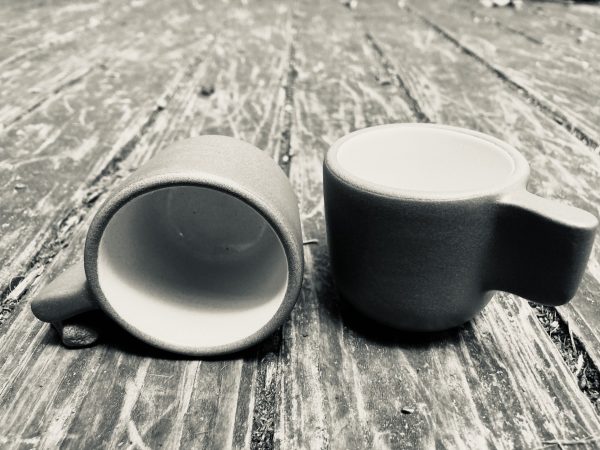
Heath Ceramics is another small company dedicated to craft that inspires me. Not surprisingly, Robin Petrovic and Cathy Bailey, who bought the company from founder Edith Heath back in 2003, are good friends with Natalie. I met Robin and Cathy I think back in 2010 after teaching ZingTrain in the Ferry Building in San Francisco where they have a shop. We went on to do ZingTrain work with them to help them write a couple of long-term organizational visions. They’re terrific people and I love their work—the espresso cups in the photo above are theirs. We use their plates with the traditional Korean foods Ji Hye and crew cook at Miss Kim, and we eat off of Heath plates at our house as well. They talk about their craft work as being:
Transparent and honest, with nothing to hide, and everything to celebrate—we make products in our community. In a human-scale factory, blending hand and machine. Human-scale means we’re grounded and relatable, neither too big nor too small. It means we celebrate process, material, and the people and places behind the products we make. This reminds us that we’re human. And maintaining humanity means a great deal to us.
Take out “products” and put in “service” and, for me at least, it fits really well. Robin says: “We always leave room for the touch of the hand. The touch of the hand leaves room for imperfection for surprise and for experimentation … it’s important on a couple different levels. It’s beautiful. There’s beauty in each piece.” And that same beauty, I believe, comes through when we do our customer service work really well. It is helping me imagine how to practice and teach this more effectively.
I realize that without having named it, our commitment to what I’m calling Craft Service here is a big part of what has helped us to do what we’ve done over the last 40 years. Giving Craft Service when you’re a tiny start-up, especially when the owner is on-site and the staff is small—isn’t all that hard. But sticking with it when one grows is increasingly challenging. Most companies give up—instead, they start to make Craft Service into what Hall and Johnson call a “Mass Process.” When these companies give up, they write customer service scripts, they require staff to ask permission to do pretty much anything, and they remove the personality to avoid “problems.” Others opt to outsource their call centers altogether. Even worse, people now push everything into phone trees and computer-recorded “conversations.” Holding to what for the moment here I’m calling Craft Service work at the size of Mail Order’s holiday phone staff is no small achievement. Does it cost more? Sure, in the same way that the products we sell also cost more. But like the bread, brownies, cheese, olive oil, etc. that we ship so much of, the service stands out. It’s real people humbly having real conversations—conversations in which the small imperfections like the products of Heath Ceramics might well just be part of the beauty. It is the practice of Glenn Adamson’s “skilled making at a human scale” by a holiday-sized Service Center team of about 100 people.
In the end, it’s the content and quality of the work that matters most, not the name. But for me, giving it this name has shifted my thinking. Glenn Adamson writes, “A central theme in my work has been modern craft: the application of skilled making to the world around us. … I have argued for the crucial importance of artisanal values to modern life.” The more Craft Service there is in the world, the better that world is going to be.
Part of approaching service as a craft is that it elevates the work. So many folks providing customer service have been trained with a factory mindset: “Answer questions,” “Follow the procedure,” “Fill in the blanks,” or maybe, “Call the manager.” Approaching it as if you’re making an Amos Kennedy print, a set of Heath Ceramics plates, or one of Natalie Chanin’s hand-sewn shirts, for me at least, changes the mental model. Everyone would need to have their own images—these are just ones that resonate for me. The point is simply that mentally elevating every service experience to that level, thinking of oneself/myself as a world-class artisan in training, for those who are willing and interested, could make a meaningful difference.
That difference, I believe, isn’t just for the guest or the client. When we do service well, when we come at it with an effort to be master craftspeople, the work changes us, makes our lives better as much as, or even more than, it improves the guest’s. Amos Kennedy says it beautifully: “One does not master the craft. The craft allows you to master yourself. The craft makes you a better human being.” What we hope to get is very much I think what Maria Shriver wrote about her Sunday Paper enews this past weekend:
What I’m hopeful that you find here is a place of belonging. I want this … to be a place of hope and acceptance. I want it to be a place devoid of judgment, a place where you can learn something new from the many wise, reflective thinkers who write here. I want you to have your mind activated and your heart opened.
And when we deliver Craft Service as I know we can do, that is exactly what happens. Hearts are opened, everyone is honored for who they are. Diversity and dignity are welcomed into our daily work. And the lives of all involved are made better and more beautiful in the process.
P.S. We have Zingerman’s Guide to Giving Great Service in Spanish translation, too!
P.P.S And for hands-on teaching, check out ZingTrain’s “The Art of Giving Great Service” seminars.
Want more from Ari?
Sign up for Ari’s Top 5 e-newsletter and look forward to his weekly curated email—a roundup of 5 Zing things Ari is excited about this week—stuff you might not have heard of!
Healthy cultural soil, counter-rhythms, and the power of Silver Branch Perception
I’ve written about humility many times since the pamphlet “Humility: A Humble, Anarchistic Inquiry” first came out in the fall of 2020. As I’ve been preparing to go speak about humility again later this week out west in Portland, I’m reminded how much this seemingly simple and eminently human way to be in the world is badly needed right now. When humility levels drop, despair, conflict, and crises are almost certain to follow. Check the news and you’ll find more than enough evidence of humility’s unfortunate absence. Without humility, it’s impossible to build caring workplaces, communities, and countries in which we can create well-being for all involved. Conversely, an increase in humility would lead us all to more love, more care, more kindness and, I’m pretty sure, peace and dignity.
As I studied the subject over the years, I began to see humility as the metaphorical equivalent of topsoil. In nature, without humus, nothing much is likely to grow. As scientist Suzanne Simard says, “The humus is the foundation of the forest. … It’s an absolutely fundamental part of the being of the forest.” What follows then is a call to all of us—starting with myself—to rebound in the quiet regenerative powers that humility offers to anyone who wants to welcome it into their life. Humility doesn’t get much attention, but it is grounding and good for the planet as well as the people we work with. I wrote in the pamphlet:
The linguistic origin of the word “humble” comes from the Latin humilis, meaning “grounded” or “from the earth.” It’s connected to the word “humus,” which refers to the organic component of soil. In Hebrew, the name of the first man in the Old Testament, Adam, comes from adama, or “earth.” Which leads me to wonder if living humbly is a prerequisite for bringing our full humanness to the fore? Perhaps humbleness happens when we’re at our most human? And when we’re at our most human, we’re effectively in a grounded state of humbleness?
Unfortunately, neither humility nor humus seem to be on the rise right now. Smithsonian reported earlier this spring that “More than 50 billion tons of topsoil have eroded in the Midwest; the estimate of annual loss is nearly double the rate of erosion the USDA considers sustainable.” A few years ago, the Union of Concerned Scientists announced, “If soil continues to erode at current rates, U.S. farmers could lose a half-inch of topsoil by 2035—more than eight times the amount of topsoil lost during the Dust Bowl.” If I follow the metaphor through, a lack of humbleness leads us away from our humanity, and into trouble. The “topsoil” that’s needed for us to grow as we were designed by nature erodes. The result is the emotional equivalent of climate change; moods become more and more extreme, and swing more and more quickly. Arbitrary applications of authority appear with greater regularity. Temperatures rise as arguments ensue ever more frequently. It makes me think of the state of the nation’s politics as the metaphorical equivalent of the Dust Bowl. What should naturally hold together begins to blow around so badly it’s hard to see clearly—I look at the news today and think back on what it was like to walk through a dust storm in central Kansas during the Great Depression. When the topsoil is gone—both real and metaphorical—we’re in trouble. A few years after the Dust Bowl ended, Dr. Ted Albrecht, an agronomist and professor of soils at the University of Missouri, wrote:
Without humus the earth becomes a corpse, as the Gobi Desert or the Sahara is, and the enormous increase of desert condition … a phenomenon even more terrifying than the savagery of the present war, which is the logical outcome of living for wealth rather than for health.
At times, I will admit, I worry that I’m overfocusing on humility. In light of all the problems we face, humility can seem so small and insignificant. Humble, perceptive leaders like Kathleen Lonsdale inspire me to keep going with it. Lonsdale, who was born in 1903 in County Kildare, just south of Dublin, spoke from experience. An outspoken pacifist in an era when war was the norm, and a woman in a scientific world wholly dominated by men, she repeatedly spoke out—and modeled for the world—what she believed was right. Lonsdale was willing to stand up (and go to jail) for what she believed, and she humbly but powerfully spoke her mind. In her 1957 book, Is Peace Possible?, Lonsdale proposes, “Those people who see clearly the necessity of changed thinking must themselves undertake the discipline of thinking in new ways and must persuade others to do so.” Which leads me to, humbly, keep suggesting that an increase in humility would help us all. We are all, whether we like it or not, imperfect, interconnected, and interdependent. Lonsdale writes:
The pure scientist … must be willing to share his knowledge with others, and since truth is not the monopoly of any one person or nation, he must have an international outlook. He owes a debt to the past, because his own knowledge is based on free publication of the results of other people, and therefore he should dislike secrecy. He ought to be humble, because he knows he does not have the whole of truth, partly because truth is not the monopoly of the scientist and partly because the scientific method includes a realization of the mistakes and misinterpretations of past scientists, the elimination of successive error in his own results and those of other people.
What Lonsdale is describing is not likely to win anyone a political office, but it does, quietly and effectively, make a big difference. While the world fixates on quick fame and fast fortunes, it’s actually by focusing on building the humble topsoil that we can create the kind of healthy lives and organizations to which we aspire. Humility allows us to admit that none of us have all the answers, and embrace the wisdom of Edgar Schein, the country’s leading expert on company culture, who wisely writes: “I’m the consultant, and I don’t know what to do!”
Humility is easy to miss, but it matters. A lot. As I wrote in the pamphlet,
Humility, by definition, won’t win big headlines. It waits quietly in the wings.
If we listen closely, humility has a lot to teach us.
Mozart once said, “The music is not in the notes, but in the silence between.” Humility fits that frame. It’s the space between the sounds. The whisper between the words. The energy between the egos. Humility is both ethereal and essential. Like great music, it’s hard to measure—and often goes past unnoticed by casual listeners. But if we pay close attention, we can begin to benefit from the beauty and grace that humility brings to the world.
Thinking musically like this leads me to share a recent learning I’ve had that has given me a new and helpful lens through which to look at the power of humility. It’s about what the art and music world calls “counter-rhythms.” The dictionary says that a counter-rhythm is “a rhythm that complements another rhythm.” It stands in contrast to what gets more attention; each makes the other more immediately apparent. In this context, I’ve started to see our ego as the rhythm; we need to draw on it to lead, and to push, as Kathleen Lonsdale and so many others have, for what we believe. Ego helps us to stand up for what’s right, to speak our minds, to put our art out into the world. On its own, though, the ego creates all kinds of problems. Humility is the counter-rhythm. It balances out the ego, brings us back to ourselves. Finding that balance is easier said than done; I struggle with it regularly, as does everyone I know who has started to see the quiet importance of humility. When we use the two well in tandem, our work has a powerful authenticity. You can feel the difference. Counter-rhythms quietly make the music and art we admire possible. While the eye or the ear goes naturally toward the rhythm, the counter-rhythm is the contrast that makes it great. The artist—or leader—who masters counter-rhythm can, quietly, create magical work.
Painter Robert Hunt (who designed the DreamWorks logo) shares that counter-rhythms “became a mantra to me.” The shift in the quality of his work was significant. “My drawing immediately improved,” he says. Same goes for leadership, I’ve come to see. Strong-willed, innovative leaders without humility go off the rails. Rather, it’s when the rhythm of our main message is effectively balanced with the counter-rhythm of humility that our work is most evocative and effective.
Speaking of which, one quiet source towards which I’ve started to look for a deeper understanding of humility is the late Irish philosopher John Moriarty. Born in 1928 in County Kerry, Moriarty, himself, was something of a counter-rhythm. His philosophy is intriguing but it’s his humility, I believe, that makes it so special. Writer Michael W. Higgins says, “For most of his life Moriarty remained a neglected treasure.” After Moriarty’s passing in 2017, Higgins called him an “epic visionary in the tradition of the Franco-American monk-poet Thomas Merton.” Moriarty, Higgins says, “… sought the consolations of contemplation, the sanctuary of isolation.” He was clearly quite humble, a mindful and thoughtful model for the rest of us to learn from. Réamonn Ó Ciaráin writes:
Moriarty seems to have thumbed a lift to his speaking engagements. He was a contemplative uninterested in prestige or wealth. He was more fascinated by the caterpillar metamorphosing from leaf-eater to butterfly feeding on nectar, than in academic prestige. For almost threescore and ten years John Moriarty emitted gentle waves of challenge almost like dropping a rose petal down the Grand Canyon, he was so fond of and waiting for the echoes.
Moriarty wrote a lot about the ancient Irish concept of “Silver Branch Perception”—a practice of “opening our minds, eyes, and ears” to pay attention, and to tune into the quiet that those who are racing through life will very likely miss. Moriarty said that Silver Branch Perception gives us “a marvelous way of seeing and knowing things that, in effect, is paradise regained.” Slowing down to get centered around humility can help us to see the small things, and notice the nuances that actually make a big difference.
Knowing that humility is a good idea is infinitely easier than making it an integral part of our organizational culture. How do we make humility happen? On an organizational level, writing humility into our vision can work wonders. Encouraging meaningful equity helps as well—we work to create a workplace where everyone matters and no one is better or worse than anyone else. Regular reflection almost always increases humility. This could be journaling, intentional mindfulness, therapy … Talking about our struggles with friends who are themselves grounded in humility helps us gain valuable perspective. Openly admitting our own shortfalls, asking for help regularly, and paying attention to the small successes of people who are typically ignored on the organizational periphery can all contribute to our humble cause. Edgar Schein, in his wonderful book Humble Consulting, recommends that we stay “committed to being helpful, bring a great deal of honest curiosity, and have the right caring attitude.”
Here at Zingerman’s, humility is, ever imperfectly, embedded in the way we work with consensus decision-making at the partner level. It’s an implicit part of Open Book Management and also open meetings. Using Bottom Line Change is a very effective way to make humility come alive in the day-to-day—I might be the CEO, but I still need to use the process to make a change. Diversity drives us to understand we’re all flawed but finding our way by working together. Humility is also now clearly and directly written into our Statement of Beliefs:
We believe humility is an essential ingredient for effective leadership and contributes to personal growth and success.
Another way to increase humility is simply to recognize quiet caring acts of effective, humble leadership when and where they happen. In the spirit of which, I noticed the article that K.C. Johnson—who has been writing about basketball for nearly thirty years now—posted about the coach of the Chicago Bulls Summer League team, John Bryant. While coaching professional basketball is a line of work that usually recognizes drama and yelling, Johnson’s experienced and insightful eye effectively identifies the gentle counter-rhythms of Bryant’s coaching. His quiet humility makes his messages far more powerful. “Leadership is hard to fake but easy to spot,” Johnson writes. Bryant, he says, “displayed it calmly and consistently. From his pre-practice habit of having players share thoughts and opinions about each other to his vulnerability in talking about losing his father to COVID-19, Bryant represented the franchise with class.”
In a society that admires awards, idolizes its heroes, and tears down those it doesn’t like, it’s hard to stay centered in a caring, dignity-based, humble middle ground. And yet, when we make humility a high priority, we will be better able to work together instead of going to war. We can focus on acceptance instead of anger. We can learn to do right instead of worrying about being right. Humility is what allows us to work caringly and collaboratively together, to find the answers, ideas, and insights that we would otherwise miss. Building humility up, instead of wearing it out, can quietly but effectively transform our organizations. And our lives.
As I was working on this piece, I realized I ought to practice what I’m preaching. When I went to the Roadhouse chefs’ meeting the other day, I decided to ask for help understanding what impact humility has had in our kitchen. I proposed that we use the question “What does humility mean to you all?” as the meeting’s icebreaker (a humble and equitable way to get everyone’s voice into a room at the start of any session). They had more to say than I can squeeze in here, but their comments were inspiring. Head chef Bob Bennett said, “There are a lot of kitchens where ego dominates and there’s lots of yelling. Humility means we don’t do that.” Sous chef Jessica Forbes said, “It’s about staying ‘right–sized’ with your ego. You try not to take too much credit, but you try not to beat yourself up either. It looks like walking down the middle of the road, always trying to keep your side of the street clean.” Supervisor Chris Kucera said, “Humility is listening to everyone, no matter their position. It’s trying to take in everyone’s advice.” At the end, Bob added, “Humility reminds us to make time to help someone in need.”
Bob’s comment reminded me of a small personal story that I’ve been watching unfold out behind our house. It’s about the kind of meaningful difference humility can make. As some of you know from her Instagram, Tammie has been rescuing dogs over the last few years. On New Year’s Eve, she saved a pit bull named Blu from an abusive setting where he was chained up outside in the mud 24 hours a day (not good in the Michigan winter). Blu is very strong, and hence, to many, also scary. Most everyone who worked with him at the shelter where Tammie took him liked Blu, but still politely wrote him off as reactive, hostile, and risky. In the spirit of Silver Branch Perception, Tammie, as she often does, saw something others didn’t. Humbly following her heart, knowing that she didn’t have the perfect answer but might still be able to make a difference, she did what Kathleen Lonsdale called for: she took action. She has stayed grounded within herself, but also treated Blu with dignity from day one. Tammie got Blu into a tiny house on our property where she’s helping him get used to being around people, eat better food, get exercise, love, and get ready to find someone who can pay him proper attention and offer him a forever home. Slowly but surely over the last month, Blu’s anxiety has been going down, his eyes have softened, and his energy is slowly shifting. A few nights ago, something wholly unexpected happened. Blu gently put his head on Tammie’s leg and held it there. It was, as she says, the canine equivalent of a hug. The next night, out on our porch, he laid on his back and let her rub his tummy—the most vulnerable position a dog can put himself in. It was a remarkable thing to see, something that would never have happened without the quiet power of humility. There’s still a long way to go, but thanks to Tammie’s care, Blu is slowly becoming the dog he was born to be.
This sort of shift is what, I realize, we can do for people we bring into our organizations who have suffered in bad workplaces or challenged lives where they, like Blu, have understandably hardened their hearts and learned to keep their defenses high at all times.
Why does all this even matter? Like topsoil in nature, we need humility to grow as healthy human beings. Without humility, it’s hard to collaborate. Both dignity and democracy depend on it. It’s only with humility that we can make our organizations and our communities more caring, more peaceful, and more positive places to be. The cost is very low, but the upside for those who are humble and patient is big. Robert Hunt wrote this about counter-rhythms, but it could just as easily be applied to humility:
It’s all around us—the first step is to know it’s there, the second is to look for it, the third is to incorporate it. You may be surprised to find out that it could have a transformational effect on your work. Maybe it will help you make something no one else has seen before…but they will know it has something special in it.
Want to learn more about how to lead from a grounded, humble place of self-awareness? Maggie Bayless and I will be co-teaching the ZingTrain Master Class next month—it’s almost full but there are still a few seats left! It’s on Zoom so you can sign up from New Zealand, Nova Scotia or anywhere else from which you want to learn more about effective self-management.
The “Humility” pamphlet is available at the Deli, Roadhouse, Coffee Company, and online at ZingTrain.com and Zingermanspress.com. We’ve also put together this Leading with Humility Pamphlet Bundle filled with philosophies and practical tools that together can help you create a humbler culture. If you’d like to help increase the topsoil in your organizational culture, we would be glad to arrange bulk pricing if you buy a bunch. Email Jenny at [email protected].
Want more from Ari?
Sign up for Ari’s Top 5 e-newsletter and look forward to his weekly curated email—a roundup of 5 Zing things Ari is excited about this week—stuff you might not have heard of!