Tag: ZINGERMAN’S

Befriending the occasional dark reality that can open creative doors
Intellectually, I knew it was likely to happen. And still, I was emotionally caught off guard. My morning had gone great—teaching about ecosystems at ZingTrain’s ZingPosium. Then, later that afternoon I looked at the news. My stomach sank. My spirits went into the tank. If you’re reading this, it’s likely you know the feeling. It’s called despair. Unlike joy or sadness, it’s not a feeling I experience regularly, but in my efforts over the years to embrace and honor the full, meaningful, range of my emotions, I’ve come to accept that despair does show up in my life here and there. Two weeks ago, it hit me hard.
What triggered my emotional downturn were the four days of significant Supreme Court decisions that were released at the end of last month. As someone wrote in the wake of the news, the announcements were not really surprising, but were still shocking. I’m not suggesting that those days need to have been dark for everyone. Politics and policy demand personal points of view, and of course, some folks reading right now will have felt very differently about the Court’s decisions than I did. Diversity dictates there will be different views. I decided to share this story not to convince anyone to change their views about guns, women’s rights, reproductive freedoms, or government, but to focus on the feelings—everyone in leadership will almost certainly have experienced despairing days of their own, and we will again in the future. Despair comes quietly in our heads, hearts, and bodies, but if we don’t handle it well, it can have negative impacts on our entire organization.
One person who has spent a lifetime studying the subject of despair is existential psychiatrist and author Irwin Yalom. Yalom was born to Jewish immigrants who came from what’s now Belarus (as did my grandfather). The Yaloms arrived in Washington, D.C. during WWI, where they went on to open a grocery, above which Irwin Yalom grew up. Yalom, who turned 91 ten days before the Supreme Court’s series of decisions, has written seventeen books, many of which have helped me and millions of others to manage ourselves in more caring ways. In his 1992 book of historical fiction, When Nietzsche Wept, Yalom writes about an imagined connection between 19th century Austrian psychologist Joseph Breuer and the philosopher Friedrich Nietzsche. It includes this snippet of conversation, which, in a sense, sums up much of the struggle most all of us might have with despair:
Breuer: “… I ask you to heal me of despair.”
Nietzsche: “Despair? … What kind of despair? I see no despair.”
Breuer: “Not on the surface. There I seem to be living a satisfying life. But, underneath the surface, despair reigns …”
Nietzsche: “No, no, Doctor Breuer, this is impossible. I cannot do this, I’ve no training. Consider the risks—everything might be made worse.”
Breuer: “… Who is trained? … Aren’t your books entire treatises on despair?”
Nietzsche: “I can’t cure despair, Doctor Breuer. I study it. Despair is the price one pays for self-awareness. Look deeply into life and you will always find despair.”
What Yalom writes resonates with me. There is no way, I’ve come to see, to live a considered, mindful life and not experience despair many times. Denial won’t do the trick; pretending—to ourselves or others—that we don’t feel it just makes things worse. As Brené Brown reminds us, “Without understanding how our feelings, thoughts and behaviors work together, it’s almost impossible to find our way back to ourselves and each other.” There is likely no one we look up to or admire who has not dealt with despair regularly throughout their life. Despair can be caused by any number of things: deep loss, seemingly impossible financial circumstances, paths forward blocked by systemic bias, the unexpected departure of a partner or key coworker, a series of critical customer comments … Sometimes it’s a combination of all of the above. When it hits—which, even with all the advantages I have going for me, it does—despair is hard to handle.
Although it’s difficult for me to remember when I’m in the middle of it, despair, dealt with caringly, can lead to positive and creative outcomes. Psychologist Mary Pipher says:
What despair often does is crack open your heart. When your heart cracks open, it begins to feel joy again. You wake up. You start feeling pain first. You feel the pain first, but then you feel the joy. You start to experience being alive again.
My hope in writing this piece is that naming despair, owning my own, and being real about a topic that’s only rarely talked about in leadership circles, might help others to deal more effectively with their own days of despair. If we don’t know how to deal with it, we go into denial, act out in anger, launch into destructive rage, or withdraw suddenly from the world. Denial about despair can, it seems, lead to long-term depression.
Although I know the word, and I’ve grown familiar with the feeling over the years, I’m not sure I could describe despair with any degree of meaningful clarity. David Whyte writes:
Despair takes us in when we have nowhere else to go; when we feel the heart cannot break anymore, when our world or our loved ones disappear, when we feel we cannot be loved or do not deserve to be loved, when our God disappoints, or when our body is carrying profound pain in a way that does not seem to go away. We give up hope when certain particular wishes are no longer able to come true and despair is the time in which we both endure and heal, even when we have not yet found the new form of hope.
For me, despair comes when hope is blocked; if “hope” in the organizational ecosystem is the sun, maybe despair is like an eclipse—the sun is completely blocked out. Unlike in nature, that eclipse can last a lot longer than just a few minutes. Despair, as I’ve experienced it, is a loss of belief in the future. It’s the sense that all the existential exits have been blocked, making a path to a more positive future impossible. At best, despair is difficult. At an extreme, the depths of despair is a place in which we wish that our lives would end. It would be disingenuous to say I’ve never had that feeling. Søren Kierkegaard says that in dark times, “Despair is the disconsolateness of not being able to die.”
In damaged, unhealthy, organizational ecosystems, Charles Blow reminds us, indignity and inequity can reach unmanageable levels of despair. Writing a week after the killing of George Floyd, Blow says:
Despair has an incredible power to initiate destruction. It is exceedingly dangerous to assume that oppression and pain can be inflicted without consequence, to believe that the victim will silently absorb the injury and the wound will fade. No, the injuries compound, particularly when there is no effort to alter the system doing the wounding, no avenue by which the aggrieved can seek justice. This all breeds despair, simmering below the surface, a building up in need of release, to be let out, to lash out, to explode.
What Blow describes isn’t just what makes the national news—you can see these small explosions in badly run businesses where pressure, sadness, abuse, and frustration build up over the years. Eventually, things blow up. By contrast, if we deal with despair well when it happens by owning it and moving through it with some modicum of authentic effectiveness, we can probably keep those explosions from happening.
We need to honor despair to create the kind of healthy lives we want to lead—individually and collectively. Here are some ways that have helped me, and I hope, will help you and yours as well:
Feel it – This may sound obvious, but it’s not the norm. So many of us have learned to respond to despair with distraction, drama, blaming, aggressive anger, drinking, or drugs. Raging at others, of course, simply makes things worse. As Ukrainian writer, lawyer, and women’s rights activist Larysa Denysenko reminds us, “It is always easier to bully and tyrannize someone who is smaller in order to feel that you are bigger.” Others (like me) might try denial or shutting down, but that doesn’t work well either. Nor does shaming ourselves for what we are going through. Uncomfortable as it is, learning to feel the feeling is, I’ve learned, the right thing to do. As Sam Keen says, “Despair is a primal emotion that is rooted in the honest awareness of our true helplessness to change the cosmic drama.”
Embrace that despair will eventually end – Despair is in great part what it is because, when we’re in it, it feels as if there’s no way forward. But if we work with it, despair does eventually depart. In the spirit of this, Anzia Yezierska arrived in New York as a young girl with her parents in 1893. They came from a region of Poland that was then part of the Russian Empire, leaving behind a time and place in which Jews dealt with a great deal of discrimination and despair. Yezierska became a chronicler of the Jewish American immigrant experience—sharing the story of people, very much like her parents, who came here with hope but found out quickly that America was not the panacea they had imagined. Yezierska became quite successful—Hollywood sought her out to make films of her books, but she was so uncomfortable with its inauthentic culture that she moved back to New York. Her 1925 book The Bread Givers is a great book, but working on it, it turns out, was not easy: “It took all morning to write one page—sometimes only a paragraph or a sentence. Many times the morning passed with nothing but despair for my labors.” Still, Yezierska saw, as so many of us have, that her period of despair would pass, and better things would follow. It was “in my darkest moments of despair,” she wrote, that “hope clamored loudest.”
Actively work at increasing hope – Despair comes when hope goes dark. Which means that one antidote is to gently work at growing hope. There’s a lot in Secret #45 about how to use the “Six-Pointed Hope Star” to make this happen—for others around us, and, importantly, even for ourselves.
Get curious – Writer Joe Cardillo says, “Curiosity is an antidote to despair. … curiosity disrupts despair, insisting that tomorrow will not be a repeat of today. Curiosity whispers to you, ‘You’re just getting started.’” One way to get curious is to explore the feeling. Studying the facts of the situation can help as well. Reading about Ukraine in the last four months has been one of the most interesting, inspiring, and insight-providing parts of my life. My studies have given me great understanding and a much deeper appreciation of the diversity, complexity, and creativity of Ukrainian culture. In the last week I’ve learned more about the history of the Supreme Court than I had learned in my whole life. From that learning, I’ve already had half a dozen realizations that can help us to be more caring and constructively run our organization (one good reminder—use Bottom Line Change when you want to make a big organizational change).
Work with dignity – If dignity is the way we show up in our ecosystems, then the frequency of despair will be diminished. Certainly, the destruction that Charles Blow described will be far less likely to happen. And when despair does happen, we can work together in dignified ways to deal with it. For more on dignity check out this post, or look at the current print issue of Zingerman’s News.
The first element of the revolution of dignity work is to “Honor the essential humanity of every person we interact with.” In the context of despair, it’s particularly important to help those around us to be seen and heard for who they are. Michigan State professor of English Kathleen Fitzpatrick writes in Generous Thinking; A Radical Approach to Saving the University about her struggles earlier in the 21st century to respond to the state of society and in her work in education. She was hit hard emotionally, much as I was a few weeks ago. Kathleen, who I met in one of the ZingTrain Master Classes, shares, “It’s hard to imagine paths forward at a moment of such profound despair.” Supporting her students, showing them positive paths forward, in turn helped her to gain purpose, reminding herself in the process, “… certainty that even in the midst of despair there was work to be done, and that it was my job to do some small part of it.”
Getting stuck down in despair will do nothing good; feeling it, honoring it, and working through it can quietly help change the world. This is the work, in a way, of the “Three and Out Exercise”—by authentically appreciating three individuals, one at a time. I started the practice to improve my energy, but it’s well suited to dealing with despair as well. In that same vein, listening to Briony Greenhill’s beautiful music while working on this piece reminds me that when I’m down in despair, pushing myself to honor others helps them, and also me at the same time. In Greenhill’s lovely song, “I see you, I love you,” she sings:
Is there a dream in your heart that wants to live but it doesn’t live yet?
What seed do you have in there that wants to grow, but it hasn’t been sown yet?
What would it be like to take that seed in the palm of your hand and say
“I see you, I love you, I believe in you, and I’m gonna give you some time”?
Watch for joy – While it’s true that joy can appear on its own, I’ve learned the hard way that no matter how deeply I feel despair, the reality is that there are joyous things happening all around me—the “butterflies” of joy are there, we just have to be mindful enough to notice them. I see coworkers do amazing things every hour. As you can probably tell, it’s a rare week that I don’t stumble on some new music or read a few pages of a great book. And, I am fortunate to work with fantastic food and drink every day. And later in the same week in which I felt like I was hitting bottom, Lisa Schultz from the Roadhouse taught the “No Drama” session for ZingTrain that I wrote about last month. Both the content and her presentation were terrific!
Get going – Most often, we take action in our lives because we’re motivated to move forward. There are times though—like when we’re experiencing despair in which the inverse is true: getting moving can help us get motivated. Even small steps in a good direction can help me make my way through despair. This isn’t about running away, it’s about moving one mental foot in front of the other to do something. Joan Baez is the daughter of an immigrant—her father, Albert Baez, was born in Mexico, came to New York, and went on to be a physicist who invented the x-ray microscope. Joan, who gained global acclaim for her music and her activism, once famously said: “Action is the antidote to despair.” (Baez, I’ve been told, once played a house concert in the living room where Tammie and I spend a lot of our time, perhaps in the fall of 1961 when Baez was in town doing a show at what was then called Ann Arbor High School.) Small positive actions (like the “Three and Out” exercise, taking on some small thing on an action list, reaching out to a long-lost friend, studying the history of Joan Baez’s appearances in Ann Arbor, etc.) can help move me—and maybe you—into a better mental space.
Make art – In “The Roots and Impact of African American Blues Music,” published through Whitworth University, Emily Weiler writes, “The earliest forms of blues reflected feelings of despair, sorrow and many other moods of the singers.” Listen to Son House’s “Death Letter Blues” to get a taste of what that despairing resolve sounds like in action. For me, art helps me deal with despair through writing; the appropriately titled “Working Through Hard Times” pamphlet is all about it. Throughout human history people have painted, written poetry, played music, etc. as a way to work through pain and despair. Rather than doom-scrolling or other routes of avoidance, it’s productive to engage with our emotions in creative ways.
Be actively grateful – Paying attention to the positives even when—or maybe, especially when—the problems feel overwhelming makes a difference. As Sam Keen writes,
Make a ritual of pausing frequently to appreciate and be thankful. … Notice that the more you become a connoisseur of gratitude, the less you are the victim of resentment, depression and despair. Gratitude will act as an elixir that will gradually dissolve the hard shell of your ego—your need to possess and control—transform you into a generous being. The sense of gratitude produces true spiritual alchemy, makes us magnanimous—large souled. … For no particular reason you can detect, depression lifts, despair is replaced with an undefinable sense of hope, and enthusiasm returns.
It’s always a good time for gratitude. I’m grateful to you for reading, I feel fortunate to be around so many great people and so much amazing artisan food and drink every day, and I’m appreciative of being part of an organization in which writing about despair is considered a healthy act of leadership. I’m grateful for my girlfriend, her big heart, and good work to farm and to rescue dogs, and all our own loving pups. Though I’ve never met her, I am very grateful for Boston College historian Heather Cox Richardson. Her nearly nightly enews, “Letters from an American,” gives me insight, understanding, and great historical perspective on an array of issues, including the situation with the Supreme Court. Once a week or thereabouts Richardson takes a “night off”—even then she sends a short note to say so. Far more often than not, her writing brings me hope. This one from last week felt right for what I was writing here:
It’s been a long, hard week. Going to call an early night.
Before I do, though. … Thank you all for being here. I have heard people this week despair of this country, but I look around at you all and I have faith.
And so … I’ll be back at it tomorrow.
Want more from Ari?
Sign up for Ari’s Top 5 e-newsletter and look forward to his weekly curated email—a roundup of 5 Zing things Ari is excited about this week—stuff you might not have heard of!
Doing marketing with dignity makes a big difference
In the back of Seth Godin’s book The Icarus Deception, he includes what he calls, “An Artist’s Abecedary.” I didn’t know what the word meant, but as per what I wrote last week, Seth’s work led me effectively towards some good learning. “Abecedary,” I now know, is Middle English for “an alphabet primer.” The one in The Icarus Deception is what Seth put together to guide his readers in making effective and creative work. It begins with “Anxiety” and concludes with “Zabaglione.”
Reflecting a bit after reading, I imagined an addendum. On Seth’s list, “D” is for “Dance,” as in “Dance with fear.” My suggestion is to consider adding “Dignity” to the list. There’d be no need to drop “Dance”—in the spirit of inclusion and also of abundance thinking, it seems like there’s plenty of room for both. I feel a little strange putting this suggestion in writing, but I’m reminded of what Seth himself says of effective art and marketing: “Better opens the door. Better challenges us to see what’s there and begs us to imagine how we could improve on that.” And, upon further reflection, dance and dignity would pretty surely work very well together. In this case, going through the newly-opened door has led me to see the importance of integrating dignity into all our marketing work.
Dignity, whether it’s in dancing, dining, or design, has grown increasingly important to me over the last few years. I wrote about it first in an essay that appears in the “Working Through Hard Times” pamphlet, in which I wondered:
What if we all just committed to treating each other, every day, and in every way, with dignity? At first the question seemed overly simple. Maybe naïve, or even silly. But the more I thought about it, the more it made sense. … Dignity in our relationships with family, with staff, with animals. Dignity in the way we relate to the planet. And maybe most importantly, with ourselves. What if every system we set up in our organizations and in our communities had dignity as a prerequisite? What if everything we did, and every conversation we had, was infused with dignity?
The conclusion I came to was that, without question, doing everything with dignity would most certainly make a really big difference. Then, this past March, when Russia invaded Ukraine, I found myself struggling to process anger, grief, and a whole range of other emotions that blew through me. I felt a deep sense of despair. Sitting here in the safety of southeast Michigan, I was having a hard time finding a way to feel like I was doing something meaningful to help innocent people who were suddenly under attack. Donating money was and is fine, but I felt helpless trying to find a way to contribute more than that.
After a few days, I decided to do something that often offers me a better perspective. I started to study the history of Ukraine—looking, in my Russian history major’s mind, for helpful lessons. It worked. My eyes opened wide a day or two later when I realized that the 2014 Ukrainian Revolution of Dignity could serve as an inspiration to the rest of us. We weren’t going to be able to stop the aggression of Vladimir Putin. What we could do, though, was to work to create a community, or maybe even a country, where leaders like Putin would not likely come to power. I started to see that if we could make our own revolutions of dignity into a daily reality, both we and the world around us would be much better for it.
Picking back up on the idea of marketing as a leadership act that I laid out last week, I want to take the conversation further. Building on Seth Godin’s alphabetic orientation, I’m remembering the transitive property from my eighth-grade math class. In case you forgot it, it goes like this:
If a = b and b = c, then a = c
In this case, if we are committed to making dignity an integral and essential element of effective leadership work, I’m imagining a Transitive Property of Business Philosophy:
If
- “a” represents Good Marketing,
- “b” represents Good Leadership, and
- “c” represents Dignity …
The conclusion is clear: Good Marketing must also then be based on Dignity. What follows then is a call—as much to myself as anyone else—to make sure that dignity is effectively part of all of our marketing work.
Unfortunately, the two have not historically been all that aligned. Seth Godin says:
Old-fashioned industrial marketing is built around the person who pays for the ads. It’s done to the customer, not for him or her. Traditional marketing uses pressure, bait and switch, and any available coercive methods to make the sale—to land the client, to get the money, to sign on the line that is dotted.
Marketing without dignity, I understand, might seem to many to be more efficient in the sense that catchy slogans could score us a bunch of quick sales. I’ve come to understand over time that what may appear efficient in the short term, can actually be highly ineffective, even very unhealthy in the long run. Gaining sales while eroding the integrity of our culture and our ethics may pay next week’s bills, but we will pay the price later in the form of diminished dignity. It’s what business writer Fred Reichheld calls an addiction to “bad profit.” We get used to getting our regular financial fix, so even though we know it’s not great, it’s increasingly hard to quit. Sales increase, but our spirit suffers, both for the one being marketed to, and also for the one doing the marketing. Debbie Millman, one of the world’s leading experts in branding, a former partner in Sterling Brands, and author of the beautiful and insightful new book Why Design Matters, shares how even she struggled with this in her past:
I had achieved a great deal, but there was an echoing vacuum of meaning and purpose in my life. I was consumed with the business of my work—shelf-presence and statistical significance, benefit violators, and back-of-the-pack romance copy. … At one point I was sure I had worked on at least 25 percent of everything you saw in the supermarket or drugstore. After nearly a decade at Sterling I began to wonder if I had lost my creative soul or, at the very least, abandoned it to my professional ambition.
Effectively integrating dignity into all our marketing does the opposite. In slow, steady ways, the lives of those of us doing the work and those who are on the receiving end are made a bit better. What we put out in the world—both energetically, economically, and artistically—will for better and/or worse, bounce back at us.
If you want a good example of manipulative marketing, check out Laura Shapiro’s superb Something from the Oven: Reinventing Dinner in 1950s America. In her book, she tells the story of how marketing was used—deceptively—to convince American women to shift to pre-packaged foods rather than buying fresh and cooking from scratch as most had done for centuries. The approach was to show that “most women were already doing it.” After all, who wanted to fall behind the times? The results, as you will likely know, were statistically enormous; I grew up eating boxed Kraft macaroni and cheese, Mrs. Paul’s fish sticks, Pop Tarts, Tang, and Twinkies. Sales of these industrial products increased dramatically but, unnoticed by most at the time, the dignity of the food, the people who make it, and American cuisine, dropped way down. Clearly, I survived and went on to eat artisan food every day. The American food system, though, is still trying to recover.
The idea of weaving marketing and dignity together is not a new one. Voltairine de Cleyre was one of Emma Goldman’s compatriots in American anarchist arms. Born in Leslie, Michigan a year after the Civil War ended, she died 110 years ago last month. In the brief 45 years she had on the planet, de Cleyre wrote a wide range of essays and poetry. Emma Goldman called her, “… the most gifted and brilliant anarchist woman America ever produced.” Like Emma, she wrote extensively and forcefully in favor of women’s rights: equality in marriage and economy, birth control, and civil rights. Dignity was an equally common theme in her work. As she wrote: “I would have men invest themselves with the dignity of an aim higher than the chase for wealth … not for a day, nor a year, but for a lifetime.”
Last March I wrote about six elements of dignity in daily action, which in Voltairine de Cleyre’s context, can help us make dignity a reality for the rest of organizational lives:
Honor the essential humanity of every person we interact with
No matter how “mass” our marketing is, it’s imperative that we remember that we are speaking to real people. The idea, as I’ve come to see it, is never to diminish or dumb down. Rather, marketing with dignity means uplifting and including, helping people feel more themselves rather than feeding their fears of what could go wrong, or even worse, what is “wrong with them.” This excerpt is from our 2032 vision (the complete vision is in the new “The Story of Visioning”):
While other businesses are using technology to offer fast and easy transactions with little human contact, we are finding ways to use technology to provide the Zingerman’s Experience. Our guests feel seen, known, and heard while still receiving easy and speedy service. Small considerations, small courtesies, and small kindnesses, habitually practiced, day in and day out, build the experience of great service in our many different business contexts. We make meaningful differences in people’s lives, one interaction at a time.
We are well known for our staff’s empathy and attention to detail when helping people. We engage with each person, open-minded, ready to serve them as they would like, and honoring their uniqueness.
We certainly don’t get it right every time, but we’re very committed to making it happen in our marketing, and in everything else we undertake.
Be authentic in all our interactions
Jazz musician Jacob Collier says, “Even if nobody was listening to it, I’d still be making music.” This, for me, has always been one of the key questions of our marketing work: Does it make me want to buy it? And secondly, would I feel good about the work—design, words, etc.—even if we weren’t actually selling anything? This may seem obvious, but it is clearly not the norm. Most of the marketing world is trying to sell stuff they don’t necessarily believe in. Great art, we know, comes from the heart. Dignity encourages us to be truthful, to take meaningful action, to boldly and beautifully become ourselves—to be true to our values and our vision.
I will never forget the time a very kind gentleman Paul and I met many years ago shared how much he loved our Mail Order catalog. He felt himself a kindred spirit since he had done similar sorts of marketing during the course of his career. “What you guys are doing is amazing. Congratulations. It’s fun to do it too. I just love making up those stories!” I felt suddenly very uncomfortable and unsure of what to say. I wanted to respond with dignity, but at the same time, to uphold my own need to be authentic. “Thank you so much,” I said. “You’re very kind! The thing for us, though, is that we don’t make up the stories. They’re real.”
Speaking of making things up, I nearly missed the most obvious application of this—quite simply, marketing work that does not tell the truth is destructive in every way. The dignity of the consumer, the designer, and the company that sells it are all diminished. This is true whether we’re talking about pierogi or politics. It may net quick results, tap into innate fears, or build false hopes, but in the end of the day the entire ecosystem is eroded. Conversely, authenticity isn’t just good for our souls. It also attracts good business. Ji Hye’s devotion to traditional Korean cooking at Miss Kim is one of many ZCoB examples of this in action. Paco Underhill, whose book Why We Buy was a big influence on us many years ago, writes, “Given the chance, people will buy from people who care.”
Make sure everyone has a meaningful say
Marketing, as I imagine it in this context, is a conversation, not a one-way communication. Part of this work, for us, means listening and responding to customer surveys. And when customers complain, we take it seriously (I can think of six quality improvements we’ve made of late all of which came from customer comments). We make a personal connection—I’ve given my email out so many times I’ve long since lost track. In the context of this enews, many of you write to me regularly. I love it. I learn from what you tell me, which means both our ecosystems are benefitting.
Begin every interaction with positive beliefs
Back when we started the Deli in 1982, the general wisdom in the American food world based its work on three deeply-rooted—and we believed false—beliefs:
False belief 1: “Customers can’t really tell the difference between so-so and superb.”
False belief 2: “People won’t pay the price for excellent food—better to sell/serve them something that’s just slightly better than average.”
False belief 3: “Employees don’t care and can’t be trusted.”
As you might imagine, Paul and I rolled our eyes at all three. The beliefs were widely held, but we weren’t buying. Instead, we went in the completely opposite direction. For 40 years now, we’ve based our work on three core tenets. We believe that:
- You really can taste the difference. I’ve always said that I don’t expect everyone to buy our food. If you have three kids, you’ve had a long day, and are already at the supermarket, I don’t have the illusion that you will load everyone back in the car and drive across town to buy your cheese at the Deli. We do, though, want customers to know that what they are getting at the supermarket is likely not as full flavored (meaning, in our world, “complexity, balance, and finish”) as what you might get from us.
- People will gladly pay more for a better product. Everyone? No, of course not. But to Seth Godin’s point, while we are committed to treating everyone with dignity, it has never been our belief that we would sell the most or be the biggest in the marketplace. Those who want better, we’ve found, will happily pay the cost that goes with higher quality. Our work—the core of our marketing—is to help people understand what the difference is.
- Staff are smart! Starting with positive beliefs, we just try to teach the staff everything we know and then, with agreed-upon guidelines and clear expectations, they can go out and do the great work that they do every day.
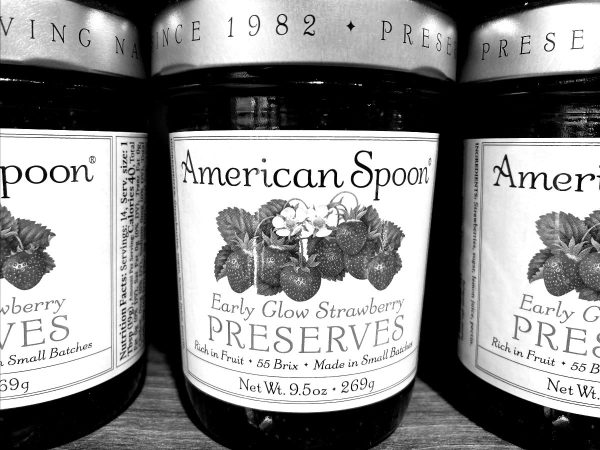
Nearly 40 years ago, Justin Rashid from American Spoon taught me that while most of the commercial-jam world was just trying to put as little fruit in their products as possible, firming things up instead with pectin, his vision of American Spoon was the opposite. He committed his small company to making preserves with the highest possible fruit content, using the best fruit he could find. One day while we were chatting, Justin said, “Look. If you put a jar of commercial jam on the shelf with 35% fruit content, and it sells for say $5 and then you put our preserves right next to it and they sell for $10, people will nearly always buy the less expensive brand. Unless, he said, you tell them why the $10 jam costs $10!” All these years later, everything we buy from them is excellent and their Early Glow Strawberry remains my favorite of all the preserves we have on our shelves!
Commit to helping everyone get to greatness
Peter Koestenbaum sums this up beautifully when he says, “Authentic selling means helping people, through the products you offer, learn (to be helped) to buy leadership greatness.” To this day, what we do in our work at Zingerman’s is built on this same concept—our marketing work, when we do it well, is all about leadership. The way we market needs to be good leadership in action; what you and others buy from us—whether it’s the Townie Brownies or “The Story of Visioning at Zingerman’s” pamphlet—are all about going for greatness. When we push ourselves to go for greatness, we welcome dignity into our days. And when we help our coworkers and customers go for greatness, we spread the good word even more effectively.
Create a sense of meaningful equity
This is an area in which we have been working hard to do much better in recent years. In the context of unconscious biases—which, inevitably, I/we have—it’s obvious in hindsight we were not doing a good job representing people of color in our marketing. We’ve committed ourselves in the last ten years to doing much better. The same with showing more diverse couples in wedding ceremonies. In the coming years, we will do better still. Small things, we know, make a big difference. This work for me is not about being “pc”—rather it’s about making dignity a real-life practice in everything, and in this case, in our marketing. It matters.
This element of equity presents an interesting paradox to us here at Zingerman’s—we sell costly artisan handmade products that we know will not be affordable for everyone. Even if not everyone can afford what we have, we can commit to:
- Never treat anyone with less dignity because they’re not spending a lot.
- Never treat anyone poorly because they prefer to buy, eat, or shop somewhere else.
- Work to rebalance the greater ecosystem so that over time more people can buy what we sell.
Doing this work in this way is not a quick fix. While Super Bowl ads may, I suppose, drive a lot of quick business, Seth Godin says it’s “Time to stop looking for shortcuts, and time to start insisting on a long, viable path instead. …This approach is simple, but it’s not easy to embrace, because it involves patience, empathy, and respect.” And dignity.
These six elements, I’ve come to see, can give us a quick and effective checklist to guide us, every day and in every way, as we do our marketing work. Debbie Millman’s new book, as just one example, shows how all six elements can be put into meaningful action. Consistently marketing with dignity may not get us rich quickly, but it will make a marked difference in the long-term health and well-being of everyone connected to our business.
Last month I wrote about Lithuanian artist and author Monika Vaicenavičienė and her magical book What Is A River?. Her art inspired me to connect the idea of rivers as the metaphorical equivalent of history in the organizational ecosystem metaphor. On the first page, she starts her story with an afternoon spent with her grandmother by the river. She writes,
I am picking flowers. Each flower has a meaning.
Daisies represent love; shamrocks, health; reeds, resilience.
That’s what my Grandma says. I’m going to make a wreath.
At the end of the book, she says,
I finish my wreath and let the current carry it away.
What Vaicenavičienė has described so beautifully, in a sense, is what happens in marketing. Many might think, “This marketing piece will just be out there for a few days and other than generating sales it doesn’t really matter.” But to Vaicenavičienė’s poetic point, we don’t really know where our messages, our newsletters, or our social media posts will go over time. Doing a better job showing diversity in our wedding ads, we have happily and successfully made for amazing wedding celebrations for many couples. Being authentically vulnerable, holding to our humanity, sharing our passions, our fears and our beliefs in caring ways can make for very effective marketing. By speaking in depth, and with dignity, about our products and purveyors, we elevate them to ever higher levels of excellence, improving eating and ecosystems in the process. In that sense, I hope in my heart that the essays in this enews, as one tiny part of all the marketing work we do here in the ZCoB, will prompt positive things. If I do my work moderately well, maybe they will contribute positively to the lives of the people who read them. And, I hope, they can go gently down the river to prompt new insights and ideas in the minds of others, in the same way that Seth Godin’s good work has done for me.
In the spirit of which, after writing about rivers and history and Monika Vaicenavičienė’s book last month, Tom van Vorhees, from Rogue River Creamery (check out their great cheeses at the Deli and Cream Top Shop) wrote me to say how much the piece got him thinking. And then he returned the favor, sharing an additional perspective I hadn’t considered:Someone is always downstream of us, so setting them up for success is the key. We never get to share the last moment of our customer interaction since it happens at their home or party; it’s so important to send them down stream with thought and care.We don’t really know where our marketing will go. Some marketing, I know, will make waves. Other times, what we are most excited about washes up on the shore a few feet from where we set it into the river of history. After all, Vaicenavičienė writes, a river, like history, is “a story without an end.” Marketing becomes part of our history as it continues downstream. We can choose, in that work, to put either indignity or dignity into the river of our organizational history as it flows past. If we do our marketing well, with dignity at every turn, we can thoughtfully send some lovely wreaths down the river, sell some good food, give great service, and make a meaningful, dignity-based difference in the process.
Want more from Ari?
Sign up for Ari’s Top 5 e-newsletter and look forward to his weekly curated email—a roundup of 5 Zing things Ari is excited about this week—stuff you might not have heard of!
Why making a difference is as important as making a sale
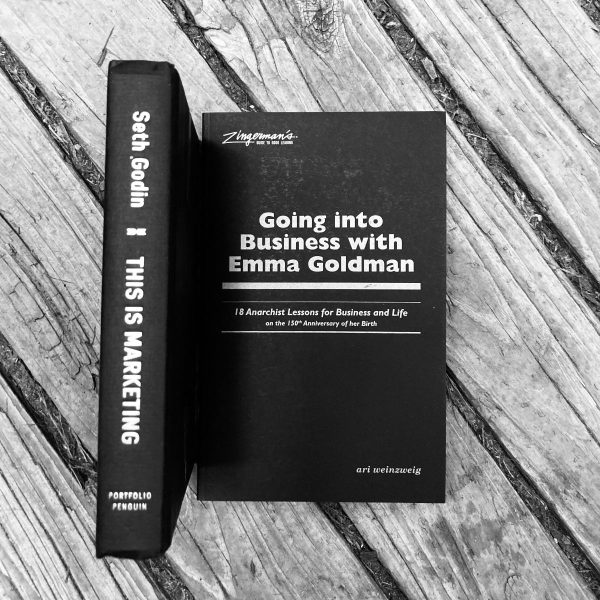
This past Monday, June 27, was the 153rd anniversary of Emma Goldman’s birth. Emma was born in Lithuania, the same small country that’s now the home of artist and author Monika Vaicenavičienė (author of What Is a River?), about whom I wrote a few weeks ago. Goldman arrived in the U.S. at the age of 16, a couple of days after Christmas in 1885. Within a few years, she had become a big believer in anarchism. By the time she was 20, Goldman was speaking to audiences of over a thousand (mostly men, in that era), advocating passionately and effectively for social change. In the course of the seven decades of her life, Emma Goldman had a huge impact on millions here in the U.S. and around the world. She definitely sought, and got, a lot of attention; both the police and the press followed her pretty much everywhere, and she was, without question, the leading voice of anarchism in North America. Goldman’s ability to connect, communicate, and make a difference made her one of the most prominent—and controversial—public figures of her era. Historian Paul Avrich wrote:
A born propagandist and organizer, she championed a wide range of unorthodox causes, from women’s equality, sexual liberation, and birth control to labor activism, [anarchist] education, and artistic freedom. Strong in her opinions, hot in her sympathies, she was a powerful orator who toured the country restlessly, incessantly [including regular visits to Ann Arbor], selling vast quantities of radical literature and raising funds for the anarchist movement, of which she was a leading representative.
Emma Goldman was remarkably wise, well-read, wonderfully witty, and well-spoken. While her delivery was inspiring, it was the content of her work that was so significant. Emma was all about change—changing the way society was structured; changing beliefs about human beings, about women’s rights, about freedom; and changing the lives of those with whom she was sharing her thoughts for the better. Given how many times she spoke out against war, and in favor of women’s rights, women’s reproductive health, the dignity of every human being, and that she wrote a book entitled My Disillusionment in Russia way back in 1923, we could use her voice out in the world right now.
I don’t imagine Emma Goldman would have thought of herself as a marketer, but, in the best possible way, she was a master at it. This belief is based on a very different view of marketing than popular opinion might offer, but it’s an approach that I believe underlies the work of any effective leader and their organization. They aren’t just selling a lot of stuff—they’re making a positive difference in the process.
If you were to ask a series of random people what marketing is, the majority would probably answer that it’s mostly about getting people to pay attention—advertising, Instagram likes, Google AdWords, and the like. Marketing, cynics might say, is merely slick tomfoolery; at its worst, a form of deception or disingenuous trickery. Catchy slogans, celebrity endorsements, cute quotes, and eye-catching imagery that can subconsciously lead people to shift their purchasing patterns through social media … or if you have a big budget, a Super Bowl commercial. While there are clearly many examples of that happening all day, every day, I take a different approach. For me, marketing is, referencing what Emma Goldman’s life-long compatriot Alexander (Sasha) Berkman once said about the wholly inaccurate popular perceptions of anarchism, “the very opposite of all that.”
Good marketing, as I’ve engaged with it, has never been about tricks. Instead, it’s about treating people to the truth. It’s about doing our work in ways that help our customers, our coworkers, and our community—all of which, we hope, will also help keep us in business in the process. Marketing, in my mind, has always been about leadership. Good marketing is about meaningful content, making a difference, and sharing stories of stuff we believe in. This is what Emma Goldman did with power and grace at the turn of the last century. And, as I reflect on it now, it’s what we’ve been doing here at Zingerman’s for 40 years.
It’s also a lot of what Seth Godin writes about so powerfully. I’m not sure when and where the first of the 20 or so books Seth has written entered the river of Zingerman’s history, but I do know that over the years I have read a lot of them. From my initial encounter with his work, Seth’s writing resonated with me. In part, because what he says is already aligned with my worldview and my beliefs about business. And also because his work helped lead me to see things more clearly. He helped me towards a better understanding of why the commonly-held belief that marketing is about slick ads and big budgets was totally wrong. In the same way that people like Emma Goldman said what they believed in ways that connected with the spirit and soul of those who were ready to hear her messages about social change, over the years at Zingerman’s we have helped many people to change their beliefs about what makes great food, to alter the way people eat, and to change their understanding of what good leadership and good business are all about. What we have worked to do is very much as Seth says in This is Marketing:
Marketers make change happen.
That’s the work. Not to run ads, not to sell crap, not to invent hoopla.
Marketing makes change. If you’re not proud of the change you’re making, do something else. …
The other kind of marketing gets a bad rap, and that’s well deserved.
But real marketing, the marketing that makes things better by making better things—that’s what we need more of.
Putting the various pieces of this piece together, there’s something poetically powerful about the parallels between the work of Emma Goldman and Seth Godin. Emma demonstrated that to make meaningful social change one had to effectively market their ideas; Seth shows that marketing done well means making change happen. Both Emma and Seth are exceptionally smart, both are willing to walk their own path despite pushback from the mainstream, both have used wit and humor to enhance their messages, and both have repeatedly shown themselves willing to say what they believe needs to be said even if it’s not what most of the world wants to hear. While they start, in a sense, in very different places—Emma on anarchism, Seth about business—the two still come together in the most positive way in the importance of making lasting change that makes a meaningful difference in the lives of the many. As Seth writes:
Marketing is driven by better. Better service, better community, better outcomes.
Most of all, marketing is change.
Change the culture, change your world.
Marketers make change happen.
This, I believe, is true whether it’s Zingerman’s, you or me, Emma Goldman, Seth Godin, or any of the many other great leaders who effectively convey constructive messages. There are certainly leaders who market messages with which, as you already know, I am not aligned. While they are also good at marketing, the intent of their work runs counter to the care, dignity, inclusion, community, and loving leadership we work hard on here. As Seth says, marketing means, “To make things better. To cause a change you’d like to see in the world. To grow your project, sure, but mostly to serve the people you care about.”
When we opened the Deli in 1982, I knew a good bit about Emma Goldman, but I hadn’t yet heard of Seth Godin. Intellectually and spiritually, though, without ever having communicated, Seth and I were thinking in surprisingly similar ways. The point of the work we’ve been doing at Zingerman’s since day one has been to make a positive difference. Yes, of course, we have been driven by making, selling, and serving full-flavored food and providing an exceptional experience. And at the same time, the subtext has also been to help those who were interested to understand why the traditional full-flavored foods we were making were so different from what most everyone else out there at the time was offering.
Marketing, to me, is every single thing we do. Yes, it’s this enews, and it’s also the energy that you experience when you walk into any of our businesses. It’s Ian Nagy’s amazing illustrations in the Mail Order catalog, and it’s also the independent thinking that so many ZCoBbers model every day. It’s “corporate image,” and it’s also consensus decision-making. It’s what we do online, and it’s also me teaching the Welcome to ZCoB orientation class for new staff that I did again a few days ago.
I was thinking of giving an example here of how our marketing at Zingerman’s evidences this sort of difference-making, leadership mindset. The products and projects I write about here prove the point. Last week’s look at putting better chocolate into the Townie Brownies, the deep commitment of the Marqués de Valdueza to community and quality, Foley’s Bay of Fundy salmon, and the deep educational engagement with Irish culture through our Food Tours all fill the leadership bill. None of them happened as a direct result of surveys or customer comments. They are products and changes we—and those who make them—believe deeply in. They are offerings that benefit you as the user, and they also have the power to help change you, me, and the people who produce them all for the better.
Isn’t it important to increase sales, though? Of course! In the context of the metaphorical organizational ecosystem, we clearly need minerals (money) to make our cultural soil healthy so things will grow. But minerals are not the main point. Selling for the sake of selling is fine, but it’s not, as I have experienced it, enough. The main point of marketing is to make a difference, which is also the main point of leadership: when we do our marketing work well, it helps us make a meaningful, positive, lasting difference. Meaningful work makes good marketing. As Seth Godin says, “Work that matters for people who care is the shortest, most direct route to making a difference.” Doing work in this way works. Yes, we have to pay the bills, clean the coolers, do deliveries on time, and all the other things too. Still, as Seth says,
The truth is that most brands that matter, and most organizations that thrive … grow because users evangelize to their friends. They grow because they are living entities, offering ever more value to the communities they serve. They grow because tribes coalesce around the cultural change they’re able to produce.
There are many amazing people out in the world leading in this way. Unlike Seth Godin, Maria Popova is probably not someone who comes quickly to mind for many people if I ask them about marketing. And yet, I would suggest the inspiring work that Popova does with her enews The Marginalian (it was known as Brain Pickings for many years) is, to me, a wonderful example of leading through marketing. I’ve been reading it, learning from it, and loving it for years. The Marginalian markets the value of insight, beauty, and meaningful connection. It markets the importance of reading, the value of poetry, and the inspiration of great art. The Marginalian is marketing for making a dignified difference in the world. Maria Popova’s pieces are odes to research and to thoughtful and thought-provoking work. She doesn’t run catchy ads promoting reading; she just makes you want to read. She does no advertising; her market spreads, like ours, mostly by word of mouth. Her first issue came out in 2006, and now goes out to large numbers of readers every week. The quality and complexity of her content is, for me, incredibly insightful and compelling.
Will everyone be influenced by what Maria Popova produces? No. As Seth Godin says, great marketing isn’t about selling our product or service to everyone. If we try to, we end up, inevitably, in the middle of the road, where meaningful differences are not made. Seth steers his readers in a different direction. Don’t go big, he says: “Begin instead with the smallest viable market.” Where so much of the mainstream focuses on selling (or saying) stuff that, to my view, doesn’t matter all that much, Maria Popova does the opposite. What she writes advocates substance, study, reading, writing, and reflection. Maria Popova’s work encourages us to go deeper and to think deeply, much as Emma Goldman’s friend Freda Diamond once said of Emma: “She opened your mind and made you think about things you never thought about before. That was her outstanding characteristic. She made people think!” At Zingerman’s we feed people, and work hard to feed them well. At the same time though, we sow the beginnings of new beliefs. As Popova writes: “We make things and seed them into the world, never fully knowing—often never knowing at all—whom they will reach and how they will blossom in other hearts, how their meaning will unfold in contexts we never imagined.”
Marketing, to be clear, in my mind, includes every interaction we have as part of our organizational work. As Seth Godin says: “Marketing is everything—it’s how you answer the phone, the prices you charge, what you do for your employees, your ability to exceed expectations, and much more.” Here’s an example of this marketing. I heard it from Stephanie Lieber, a U of M alum who drove from Chicago to attend ZingPosium last week. She stopped me to share how she had first engaged with our ecosystem so many years ago. It had nothing to do with advertising; Stephanie’s story centered around a young man that neither she nor I actually know:
It was about 1996 and my dad was in town for a football game. That always meant there’d be at least one stop at Zingerman’s. We had been waiting outside in line for about 20 minutes before we got inside the hallowed halls. As we were awaiting our turn at the register, a curious young teenager in front of me in line poked his dad and pointed to the shelves of vinegars. He quickly pointed at an expensive one (I think around $125ish—almost 25 years ago) and gasped, “Can you believe anyone would charge that much for that tiny bottle of vinegar!” The teen was loud enough for me to hear it, but apparently also loud enough that the guy working behind the cheese counter also heard. Without missing a beat, he came from behind the counter and approached the teen. He said, “I know it seems like a lot, but it really is worth it. I have tried it and I know it is. And I am going to open it and I want you to try it so you can see, too.” Everyone stood around incredulous—was this guy really going to pop open an expensive bottle of balsamic so this mouthy young kid could taste it. Well, he did and we all tasted it, and after the kid exclaimed, “Wow—it really is that good.” I’d like to believe I immediately equated that small gesture with extreme customer service, but mostly I was intrigued that the Zingerman’s staffer had the confidence to do something like that. I have thought about that moment hundreds of times in my own work—when, how, and where I open that bottle of balsamic—and tried to remember how valuable those small gestures are.
The young man’s father, not surprisingly, did not buy the balsamico for him. Nevertheless, the interaction had a huge impact. Stephanie’s worldview, her beliefs about business, and the world were altered by this spontaneous act of leadership from the staff member working that day. She bought our belief in teaching everyone here from the minute they start to think like a leader. She bought our positive belief in people that tells hourly staffers to go right ahead and do the right thing without having to ask permission. All these years later, Stephanie runs a non-profit in Chicago called Imerman Angels that generously changes lives by matching cancer survivors with current cancer fighters as mentors. She, too, is making a difference. Stephanie remains a big Zingerman’s promoter. She’s currently reading the new pamphlet on visioning, and I hope that maybe visioning will help her, the people she works with, and cancer survivors in my hometown to lead better lives in the face of adversity.
Stephanie’s experience is a real-life example of Seth Godin’s suggestion to “Show up in the world with a story that they want to hear, told in a language they’re eager to understand.” This is exactly what happened to me last month when I stumbled onto the work of Karolina Cicha (pronounced “Cheeka”). In this case, the primary language was music. I mentioned her a few weeks ago at the bottom of this enews, and then I went online and ordered a bunch of her CDs to be shipped here from Poland. Cicha is actively seeking to sell her music. It’s how she makes her living. And yet, I would suggest, both her work and her marketing of it is every bit a meaningful act of leadership. In just a few short weeks, she has led me through some amazing and fascinating doors that I never even knew existed. She is marketing something unique; the little-known, diverse, and very special cultural and musical traditions of northeastern Poland—not far at all, it turns out, from Lithuania. Cicha has unearthed music that hasn’t been played for centuries. She has studied languages that are either barely spoken or no longer used at all, working with ethnographers, historians, and linguists to bring both music and stories back to life. Through her I have learned a lot about the history of Tatars in Poland, and about the few hundred remaining Karaim people (who speak a language not unlike Ladino with Turkic origins and Hebrew influences). Cicha’s album Yiddishland (with Bart Paglya) is a tribute to an almost destroyed Jewish culture—the video of her song “Bialystok Majn Hejm” is a tribute to the pre-war Jewish community (from whose legacy you and I get to enjoy the Bakehouse’s Bialys the first Tuesday of every month).
In the context of leadership, all of Cicha’s work is meaningful marketing for history, diversity, inclusion, dignity. It’s a hard-to-turn-down invitation to study cultures that are far removed from the mainstream but still have a LOT to offer. Is it on par with Nike? Of course not. But it is marketing, marketing that is making a difference, marketing that yes, does result in sales to people like me—and maybe now you—who are curious and who care. Having received my package from Poland this past weekend, I will add, too, that the design of her albums is as special as the music she makes, which is also a part of great marketing. Beautiful, serious, and weighty, with long written descriptions of the work she’s doing. I have bought, fully, into Cicha’s work—work which enriches the diversity of the region and spreads the word that no matter what one thinks of modern nation-states they are never remotely as black and white in their make-up as fundamentalists and nationalist extremists anywhere would have you believe. As Seth Godin says, “When ideas spread, we change the culture. We build something that people would miss if it were gone, something that gives them meaning, connection and possibility.” Cicha is absolutely marketing devotion to these traditions, the belief that cultural and linguistic and artistic diversity have great value—and the music sounds great too. The learning, listening, and understanding I get out of it enrich my life.
All of this is especially interesting in the current context of the world. We are living in an era in which people seem lost in the oft-repeated illusion of their own untruths, which is, of course, at the core of stereotypical deceptively insincere marketing work. There are moments, I will admit, when I read the news and start to lose hope, but as Earnest Becker once wrote, “Hope must be continually rescued from the temptation to despair.” When I feel despair, I try to take a few deep breaths, call some caring friends to commiserate and seek wisdom, and then often, I write. First for myself, doing my morning journaling, later for you and anyone else who’s interested. I don’t have answers, and yet, I hope that the writing can offer a constructive contribution to our community. It is also at some level marketing and at the same time, as per all of what I’ve written above, leadership. I hope it makes a difference, and when I make a difference in the minds of enough others to maybe, quietly, make a difference in the world.
In his book Painting Peace: Art in a Time of Global Crisis, Japanese calligrapher, teacher, painter, and peace worker Kazuaki Tanahashi leads in his own centered and wise Zen way. He rightly reminds us that we have the power to make a positive difference, and I am happy to follow his lead. Tanahashi writes:
We all have a brush. It starts within us and we each leave our mark on this world in our own unique way.
With all that said, I want to take a minute here to share my appreciation and gratitude to Emma Goldman, Seth Godin, Maria Popova, Stephanie Lieber, Karolina Cicha, so many others whose great leadership and meaningful marketing has touched my life in such positive ways; to everyone with whom I get to lead and market with so meaningfully here in the Zingerman’s ecosystem; and to all of you—readers, leaders, food lovers, and caring members of your communities—who are willing to buy the leadership we’ve been imperfectly marketing for all these years now. Here’s to good things to come!
Want more from Ari?
Sign up for Ari’s Top 5 e-newsletter and look forward to his weekly curated email—a roundup of 5 Zing things Ari is excited about this week—stuff you might not have heard of!
Only seven seats remain as I write

It’s been over 30 years since I went alone to Ireland for the first time. I knew very little about the country, I had no friends or food producers there to call on, and, back before the world of the web was the norm, I had very little idea what I was getting myself into. That trip changed my life in wonderful ways. Thirty years later, I have many friends there. I’ve swum regularly in the river of its history. I love the music (sad-music lovers—give a listen to the bagpipes on Lankum’s “Young People,” or the harmonium on band member Radie Peat’s somber dramatic performance of “Dark Horse,” live in Dublin’s Kilmainham Gaol on Easter 2017). The poetry is powerful, the literature lovely, and the landscape unlike anything else I’ve ever experienced. I’ve been back to Ireland now probably two dozen times.
In the years since I made that first trip, Irish food has, I believe, become some of Europe’s best. In fact, there is now so much wonderful food and drink that even this intensive eight-day tour will only scratch the surface in the best possible way! If you grab one of these last few seats, I will guarantee you a whole lot of great eating and drinking, combined of course with a wealth of creative connections, wonderful culture, learning, and laughing. And, if you fall in love with Ireland as I did all those years ago, you will likely go back many more times.
People ask me all the time why I’m so drawn to Ireland. In the context of what I wrote a few weeks ago about sadness, I’ve realized one of the big reasons, in a quiet way that I wasn’t conscious of at the time, is that there’s something powerfully evocative in the spirit of the place that resonates for me. Not the stereotyped jovial “Irish humor” that’s often portrayed in movies, but, rather, the extreme but gentle, moving, and really almost magical sadness. The bleak beauty of the landscape is really beyond belief. I’m haunted by all of it, and always hungry for more.
Zingerman’s Food Tours Managing Partner Kristie Brablec has connected with longtime friends of the ZCoB Kate McCabe and Max Sussman from Bog & Thunder, who will serve as co-hosts. You can see all the amazing details of the trip on the Food Tours site. Buy a seat soon before they run out! You’ll experience some amazing eating, a wide range of emotions, and take in some of the most beautiful and moving landscapes you’ll ever visit.
The first tour for Ireland will be September 19-28, 2022. Or, alternatively, you can go with Kristie, Kate, and Max October 3-12. Sign up soon! If you do, I’ll buy you a copy of Manchán Magan’s lovely Thirty-Two Words for Field to help you get ready!
Want more of Ari’s picks?
Sign up for Ari’s Top 5 e-newsletter and look forward to his weekly curated email—a quick roundup of 5 Zing things Ari is excited about this week—stuff you might not have heard of!
Taking craft candy bars to new levels of excellence with Ca$hew Cow candy bars
If you still haven’t had one of these amazing artisan candy bars, you might not yet know what you’re missing. Thanks to the hard work of the crew at the Candy Manufactory, what most of us knew as junk food and a quick way to get a sugar fix, has been transformed into a set of candy bars so complexly flavored and so compellingly good that they’re pretty much redefining the category. There’s a good bit of magic and mystery in every bite!
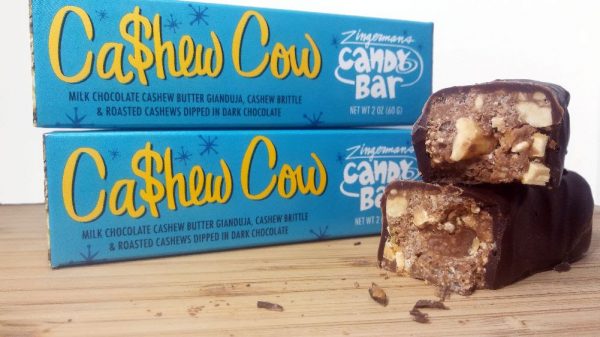
The very catchily named Ca$hew Cows have a homemade cashew brittle (made from cashews, sugar, butter, and a hint of sea salt) base, blended with a mix of milk chocolate, cashew butter, and some crisped-rice on the inside, along with pieces of cashew that have been roasted in butter and sea salt. All of which is again dipped in that very dark chocolate. You get a really nice texture, a touch of crunch from the rice, and a really lovely modest, mouth-filling flavor that never strikes me as overly sweet. A great way to boost your energy in the afternoon and/or end your evening. If you want to make them an elegant dessert, simply slice the bars into half-inch thick slices and serve them on a beautiful plate with toasted nuts and dried fruit.
How good are they?
Jamie LeBoeuf, long time confectioner, Candy Manufactory production manager, and a Staff Partner this year and next says:
For me, the Ca$hew Cow and Peanut Butter Crush bars have some substance and a satisfying texture to them. Where the Original Zzang!® and Wowza have the airy, sweet nougat, and the What The Fudge has the dense, sweet fudginess to them, the Ca$hew Cow and Peanut Butter Crush present a totally different texture. They are not quite as sweet as other candy bars. I love the mild, buttery flavor of cashews. The big cashew pieces and cashew butter have lots of protein and nutty richness, plus the crisped rice cereal keeps them from being too dense and heavy. The little hint of salt brings out the cashew flavors and brittle bits add some roasty, caramelly sweetness. I like to think of them as breakfast bars. When I skip breakfast and need a little mid-morning snack, a Ca$hew Cow mini is just the thing to hold me to lunch time.
And Dane Peterson at the Deli describes them as:
10 out of 10. Best candy bar on the planet. Better than any other candy bar. “It is ELITE” The cashews are roasty, toasty, and glowing. He even loves that it sticks to your teeth slightly because then he can taste it for like 20 minutes, he is literally praising God for the existence of this bar.
Come by the Candy Store on Plaza Drive (inside the Coffee Company) to get a Ca$hew Cow at the source! Or grab one at the Deli, Roadhouse, or any number of other spots in town and around the country.
Want more of Ari’s picks?
Sign up for Ari’s Top 5 e-newsletter and look forward to his weekly curated email—a quick roundup of 5 Zing things Ari is excited about this week—stuff you might not have heard of!
We’re matching donations throughout March up to $40,000!
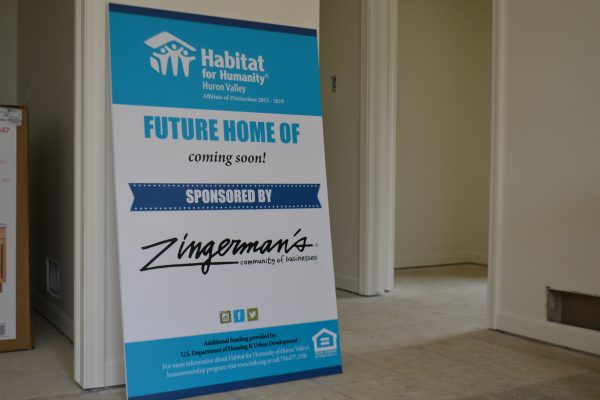
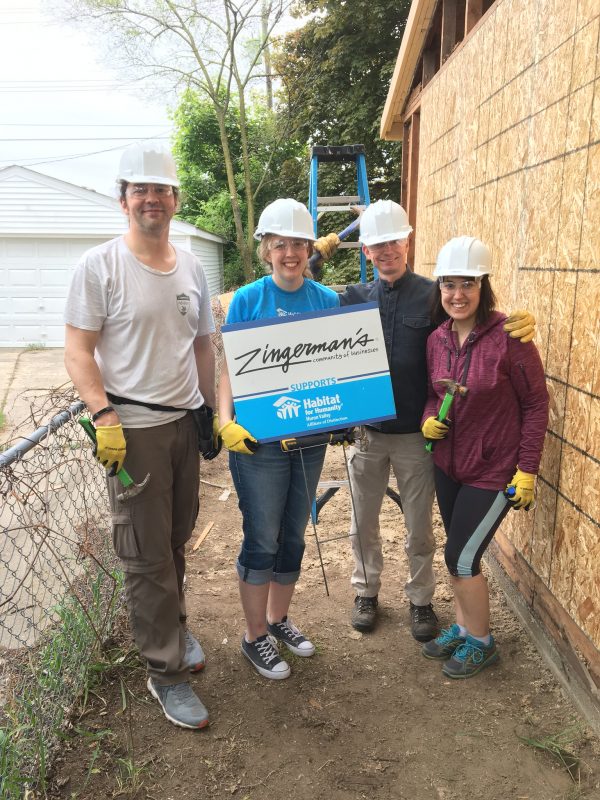 We’re celebrating our 40th anniversary on March 15th. If home is where the heart is, clearly our heart is in Ann Arbor. Four decades and eleven businesses later, we have remained and expanded in the area. To recognize the community we’ve called home since 1982, we’re sponsoring another Habitat for Humanity of Huron Valley home in Washtenaw County.
“At Zingerman’s, we’ve always been passionate about the work being done at Habitat. They are a tremendous organization giving people a fair chance at the security and joy of homeownership.” — Melaina Bukowski, Zingerman’s Community Giving Coordinator
Established in 1989, Habitat for Humanity of Huron Valley (HHHV) enriches our neighbors to build better neighborhoods through our volunteer, donation, partnership, and ReStore efforts. HHHV works to enrich Washtenaw County through a legacy of affordable homeownership for families and individuals of low income. In over 30 years, they’ve built or renovated more than 260 homes and provided more than 6,500 Home Improvement Projects. They’ve also engaged with more than 11,000 residents and community partners through community development activities and served roughly 1,000 through the Habitat Education Program.
“I can’t imagine a better way to celebrate Zingerman’s 40 years in Ann Arbor than to partner with Habitat for Humanity Huron Valley. As a member of the Habitat board, and as a volunteer on several build days, I’ve had the opportunity to meet Habitat homeowners and hear first-hand how Habitat has transformed lives and neighborhoods.” — Maggie Bayless, ZingTrain Founding Partner
Our Goal & How We’re Participating
Our goal is to raise $80,0000 for our local Habitat affiliate. The Zingerman’s Community of Businesses (ZCoB) will match cumulative donations in March, up to $40,000. Those funds will support the cost of rehabilitating two homes or building one new home. Zingerman’s staffers have assisted with Habitat builds before. They looking forward to working on the house(s) the community contributions will make possible.
“The ZCOB and HHHV have been close partners for over a decade. We are pleased to elevate our commitment towards an organization rooted in the basic premise that everyone deserves the right to affordable housing. As a member of the board of directors for Habitat, I am proud to be a part of two organizations whose generous spirits create actionable outcomes for deserving, hard-working humans trying to make a bigger difference not just in the local community but the world as well.” — Steven Mangigian, Zingerman’s Coffee Company Managing Partner
How You Can Participate
Donations can be made at h4h.org/zingermans. Donors can leave a public message with their contribution on the website, if they so choose. Funds will go directly to Habitat for Humanity of Huron Valley. We’re also accepting cash donations at most Zingerman’s locations.