
Tag: ZINGTRAIN
 And what they taught us about our business and ourselves!
Who writes about the weather in January? It’s winter. White stuff falls from the sky and it’s uncomfortably cold. What’s to write about?
And then we had a crazy big snowfall. Right on its heels came this Polar Vortex phenomenon (what?). And pretty soon, and rightly so, the weather was all we were talking about.
And since I usually write about what’s on my mind in these newsletters, that’s what I decided to do. I went around Zingerman’s and asked people from various businesses and levels of the organization.
Ari Weinzweig
Co-Founder, Zingerman’s
THE TRUTH IS OBVIOUS. OR THE OBVIOUS HOLDS TRUE.
To state the obvious, I learned that when things like that happen, it’s really hard to function. And that people who are living in hardship or on the edge have a much harder time. And if those people are trying to function in settings where they don’t have a lot of empathy and support, it becomes even more challenging.
In terms of whether I learned something about myself, not surprisingly I thought about your question in terms of managing one’s self. Like just about everyone else in the world, I have plenty of challenges that I deal with on a day to day basis and a new challenge like that can add disproportionate amounts of stress to the mix. If you’re doing the work of managing yourself on a day to day basis, and surrounding yourself with the right people in a supportive environment, then the new stress becomes somewhat easier to handle. It’s like if you get sick – which is never a good thing – but if you’re already in great shape because you exercise and eat right then the toll the illness takes on your body is easier to get through.
Oh, and I have new respect for people from Alberta.
Amy Emberling
Managing Partner, Zingerman’s Bakehouse
OUR WORK ETHIC & VALUES
I learned that we have a really strong work ethic at the Bakehouse. There was no question that the work was going to go on. And despite the weather and the roads, people made it in to work. Even the late shifts. And the very early shifts. One of our night shift people left work at 1 am and didn’t get home until 7:30 am.
We had Bakehouse deliveries round the clock despite the weather. My first thought in the morning was – Is everyone okay? The first thing I did was check my phone.
At a personal level, and as a partner at the Bakehouse, the experience led me to ask myself – is that perspective (the work must go on) really the best? Are those our values? Do I really want to put the Bakehouse employees in danger?
Coming out of it, I have a huge feeling of gratitude that all of the people that work at the Bakehouse are safe. And I want to think about what we will do as a business if we face something like that in the future? It’s a large discussion but we can at least set up a system of people helping each other – giving someone a ride if they are uncomfortable driving in this weather, for example.
Anya [Boss o’ the Baristas]
& Allen [Managing Partner]
Zingerman’s Coffee Company
WHEN THE GOING GETS TOUGH, THE TOUGH GET CREATIVE.
Anya: The intense snow and cold brought us problems that we’ve never encountered before and it was surprising how smoothly, creatively and cheaply we were able to fix things. The staff worked together, considering difficulties that would occur and pre-emptively preparing for them. This included trading shifts for people who lived further away so that they would not have to travel on unsafe roads and coming up with delivery plans if trucks couldnt fit into our loading dock. No one panicked and when trouble arose, we just made it work.
Allen: We didn’t really think twice (or even once for that matter) about whether we were going to be open or not. And it was a good thing too because I believe we provided a third place for some people that really needed one. We had some customers who camped out at the Coffee Shop all day. We learned some interesting mechanical things – s&$% behaves a lot different at those temperatures – like truck batteries and HVAC. Also, it presented us with some great opportunities – we got some languishing projects done and took some great Facebook photos!
ZingTrain Staff
AS AN ICE-BREAKER AT OUR WEEKLY STAFF HUDDLE
I learned that:
- I need to be more flexible. I’m a planner and crazy situations like that make all your plans somewhat pointless and that’s frustrating but in the end it all works out anyway.
- Our clients are very dedicated. If they came in from Cleveland during a snowstorm for their ZingTrain session, how could I not make it from across town? I also appreciated how much everyone really pitches in and helps each other out at times like these. We just got together and made it all work and I really appreciate being part of an organization like that.
- The systems we put in place are for a reason and when we encounter a challenging circumstance like the vortex, the reasoning behind our systems become clear to me.
- We don’t do a lot of the “Not my problem” or “Not my job”. We all help each other out!
EJ Olsen
Zingerman’s Marketing
Despite being Great Lakes born and bred and with deep family roots Up North and in Canada, I am less and less tolerant of sustained bouts of “real” winter as the years pass. I find myself daydreaming of beaches and clear, blue water. Or, heck, even rainy and mid-40’s would be better than the Antarctic Hammer we endured this week. I think I’m still numb…
Mike White, Retail Manager
Zingerman’s Delicatessen
WITH ENOUGH LAYERS & ENOUGH PATIENCE, EVERYTHING IS JUST FINE
This weather has brought our typical, slow season to a very dramatic start. Plenty of things ran through my head, so-slow-we-should-send-everyone-home-but-we-need-people-to-shovel, or we-can’t-give-great-service-if-they’re-are-no-guests-to-serve, or if-every-guest-buys-a-wheel-of-parmigiano-we-still-won’t-make-plan. But that’s why I mentioned patience earlier. It could be easy to get caught up in those sort of reactions if it weren’t for patience, if it weren’t for that moment: In the midst of snow covered darkness a group of guests come in from the cold. Their first, hopeful words: are you open? A bread salesman: yes. They say, warmly: thank you.
In moments like this it’s easy to show gratitude, to know and share that feeling with our guests. When the storm stripped away what we hold so dearly, our sales and our 3-steps and our interest in food being overcome by our interest in warmth, we are left with the core of our interactions. And there, right there all along, is that gratitude.
When we are patient we will know when to act, and more importantly, why to act. In that way, I’d like to keep those moments from the storm alive throughout the slow season. And that in every interaction we know our gratitude is honest.
Tag: ZINGTRAIN
(…AND OUR ANNUAL SEMINAR SALE!)
On Track November 2013
I have a nine month old son. He has a high chair. Nothing fancy. A chair. A food tray/table. Two restraining straps – one for his lap, one for his shoulders. The first few times I put him in the chair, I ignored the straps with a sigh about the litigious world we live in. Then one day I walked into the kitchen where I had left him for less than a minute to find him sitting on the food tray, facing the back of the chair with a big grin on his face. Look what I can do, Mama. I was terrified and secretly proud of his creativity. My little Houdini. He’s been diligently strapped in ever since. This weekend, I had friends visiting and wanted to show off his escape artist skills. I put him in the chair. No straps. All of us watching expectantly. Nothing. It wasn’t until I stood behind him and lured him with his favorite toy that he realized he was unrestrained and got around to demonstrating his skills. In a mere 10 days of being strapped in, he had stopped trying to escape.

Well, the whole episode had me thinking about leadership, creativity, rules and restraints, particularly in the context of an organization going Open Book. Not that I think leadership is like parenting at all, even though you may find yourself feeling like a parent sometimes. It’s more that up until the moment your organization decides to go Open Book, the covert or overt message that the employees have been getting through their entire careers, whether at your business or another, is this : It’s not their job to think like an owner. And then one day your business decides to go Open Book and suddenly it is their job to think like an owner. As a leader in your organization, it is important for you to know that it’s going to take some coaxing, some coaching, some teaching and a little rewarding to help your employees break the habit of not being expected to think or act like an owner.
It’s hard work – on both sides, the leaders and the staff. And it takes patience. A lot of patience. When I was a manager at Zingerman’s Deli and had just started a huddle, I mapped out what I saw as the developmental stages of our huddle. As the leader of the huddle, having the stages helped me with the patience bit – it was a way to mark our progress on the way to becoming a successful huddle.

Here are the stages I came up with. As you read through them, I’d love to hear what stages you’ve seen in your huddle or if any of these stages particularly resonate with you:
Stage 1.
Line owners overcome their fear and make a forecast, any forecast.
If you think about it from a line owners point of view, and keep in mind that they’ve been discouraged from thinking like an owner for years, you’ll realize that making a forecast at all is a pretty big step. How on earth am I supposed to know how many dollars worth of bread we’re going to sell next week? To sit in the presence of their team and have the courage to forecast at all is a great, great beginning. In the first few huddles, as a leader, it’s your role to gently coax line owners into making forecasts, to create a safe environment and to reinforce the idea that it’s not about being right, it’s about participating. And learning together.
Stage 2.
Line owners make forecasts using historical data, experience and current events.
The next stage is where the line owner gets into making the forecasts and starts looking for data to support the number. What did we do this week, last year? Was there a football game on that Saturday? What was the weather like? Have we raised our prices since then? This is progress!
Stage 3.
Line owners answer your questions about their forecasts (you being the leader).
This is more of a stage for the huddle leader than the line owners. When you realize that some line owners have started doing their homework before coming to the huddle, start asking leading questions in the huddle. Why did you make the forecast you did? What’s going on in the city this week? It’s a way of encouraging line owners to really think through and stand behind their forecasts and to set an example for other line owners who are stuck in Stages 1 and 2.
Stage 4.
Line owners ask and answer questions about their own and each other’s forecasts.
When just about every line owner gets to the point where they’re thinking about and getting data to support their forecasts before they come to the huddle, you’re at stage 4. At this point, they’ll be asking each other questions. And giving each other ideas and suggestions. They’re discovering that becoming a competent line owner is contagious!
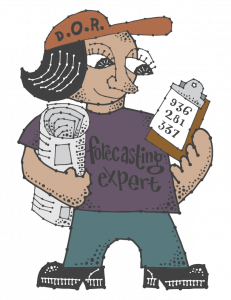 Stage 5.
Line owners realize that they can affect the forecast and are responsible for achieving it.
For me, this was the most exhilarating stage. It’s when line owners realize it’s not just about historical data and events and weather and schedules – they can affect the forecast. They can rally the team to push a particular product. Change retail displays. Make extra signage. Create a special promotion. The leaders role at this stage is to help with the tie out (are we ordering more bread if you’re forecasting that we’re going to sell more? does the increased forecast in dollars tie out with the forecasted increase in loaves sold?) and to follow up during the week and help the line owners execute the ideas they came up with during the huddle.
Stage 6.
Everyone participates in the forecasting work and helps the line owners achieve the planned targets.
The huddle, at this stage, takes on a life of its own. And the business is truly being run in the huddle. The leader’s role at this point primarily becomes sharing information and perspective that the front line staff may not have and helping to keep the huddle focused on the ultimate goal of the year end targets.
There’s the six stages, then. As I review them and reminisce about those heady times when we started a Bread huddle at the Deli, I have a word of caution for you. The work is never really done. The stages are not really linear. The line owners in the huddle don’t actually move in tandem – even as one line owner is reaching Stage 6, another line is transitioning to a new owner who is barely at Stage 1.
OUR ANNUAL SEMINAR sale:
Get $250 off all ZingTrain 2-day seminars! Register using the discount code GUSTAV (in honor of one of Ari’s favorite Anarchists)
Buy now. Pick later.
Not sure which seminars to take yet but don’t want to miss out on GUSTAV? Purchase an Open Seminar Seat.
Discount code valid from now until December 31st, 2013.
Stick with it. Create markers for your progress. And remember, it’s going to take some coaxing, some coaching, some teaching and a little rewarding to help the line owners break through their habitual restraints.
Stick with it. And even though the team won’t move in lock step when you first start huddling, the overall progress of the group as a whole will be palpable, and inspiring!
Stick with it. And soon the group will be coming up with and executing ideas that blow your mind and take your business to a whole new level. Within a few minutes of realizing he was restraint-free, my son was trying to step up and stand on the food tray! What will your team do?
– Gauri Thergaonkar,
Community Builder at ZingTrain
Tag: ZINGTRAIN
…OR THE THREE M’S – MAKING METRICS MATTER!
On Track September 2013
Zingerman’s is an Open Book business.
I love working in an Open Book business. I believe that it is a way of operating that respects and harnesses the true potential of every single employee in the business. I also believe that although it can be a more challenging way to operate, the rewards – both philosophically and to the business’ bottom lines – are well worth the effort.
The core of Open Book is education and execution.
Educate each and every person in the business about the key business metrics – financial or otherwise – and review the status of the metrics in an accessible manner on a regular basis. Here at Zingerman’s, we call that keeping score. The metrics are displayed on a whiteboard, called the Department Operating Report (DOR). Each metric is “owned” by an employee who is responsible for that particular metric meeting its goal. Each DOR line owner reports on their metric in our weekly staff meetings called Huddles. They’re fun, fiesty meetings and the work of running the business gets done in those huddles.
All of which is splendid but would not lead to much if the business did not enable each employee to make and, more significantly, execute decisions about the metrics they own. Enabling, a very positive word in this context, is about giving employees decision making power and the resources they need to execute their decisions. But it is also about much more than resources and decision making power. It is about trusting each employee to (at least want to) make the decision that’s best for the business and coaching them in a constructive manner when they make mistakes – which they will. At Zingerman’s, we don’t just enable each employee to impact the metric they “own”, we expect them to.
If education and execution are the core of Open Book philosophy, choosing the right metrics and defining them clearly are what its success hinges on. And that is what I really want to talk about in this edition of OnTrack : how to go about defining your metrics clearly.
At Zingerman’s we have three bottom lines – great food, great service and great finance, and that’s what our metrics are based on. What metrics do you use to define the success of your business?
Years ago, when we started practicing Open Book, we realized the efficacy of our huddles could be vastly improved if we made sure that the metrics we had chosen were clearly defined. Why, you ask? Here’s a list of reasons :
- It’s efficient – if you aren’t discussing what the metric actually means every week, you have more time to discuss how to improve it!
- A clear definition provides an outline for the Line Owner’s report in the huddle each week.
- It is a crucial part of the education piece I spoke of earlier
- It creates an archive of consistent data that can be used to come up with business plans and targets in the future.
- What is the metric?
- Who owns it?
- What is the calculation?
- Where does the information come from?
- Why is it important?
Did we?
– Gauri
Tag: ZINGTRAIN

Frequently occurring stages of a great relationship:
At ZingTrain, delivering great training is our raison d’etre. However, building great, long-term relationships with the people we deliver great training to is what makes us feel happy and fulfilled. So much so, that we created my job – Community Builder – as a full time relationship building job. And I’m such a nerd (read ex-engineer) that I documented the 5 stages of an awesome, long-term, mutually-extremely-fulfilling relationship with ZingTrain. Here they are for you to peruse.
- Two or three or five key folks from your organization come to a ZingTrain seminar.
- While at the seminar, you buy some books and training DVDs to help bring the experience home with you.
- Fired up by what you’ve learned, and armed with specific tools and techniques, you begin to implement change at your business. You call or email us from time to time to tell us how it’s going. Many of you join us for our monthly call-in webinars.
- Some months later, with implementation of the new ideas going well, you find that you’re ready for more inspiration and come back for another seminar with a few more key players in your business. Or perhaps you bring a larger team for a private seminar, based on our regular content but customized to take advantage of having so many of your folks in the room at the same time.
- We’re now officially BFFs and recognize that something is very remiss if we don’t hear from each other at least once a quarter—ideally more!
And here is Room 214, one of the clients that inspired the documentation of the aforementioned 5 stages! I asked Jason Cormier, co-founder and co-owner of Room 214 in Colorado to tell you about Room 214 and how we got to the BFF stage!
Gauri Thergaonkar: Tell us a little bit about your business.
JasonCormier: Room 214 is a digital marketing and social media agency that helps companies connect with the people that matter most to them – from new leads to current customers and indus- try influencers.
My best friend and business partner, James Clark, and I started the company in 2004. His background, starting from the mid 90’s, was public relations and mine was web development. We actually went to high school together and eventually were dorm roommates our freshman year in college at Colorado State. Can you guess the room number?
James and I had a unique opportunity to be partners in a previous start-up company with three others in 2003. Our job was to build the brand and reputation of this new company, in addition to driving leads and sales. James and I were experimenting with how online content was getting indexed in search engines at that time. We had also taken a huge interest in Google’s new Adwords advertising platform – and developed a system for generating tons of leads via the web.
In the end, the collective partnership and business model wasn’t sustainable, but James and I realized we could take what we learned and apply it for almost any company interested in using the Internet to grow their business.
Room 214 was born the following year, and by the time the phrase “social media” was being kicked around in 2006, we were already knee-deep in it with podcasting, blog development and YouTube. By 2007, with only five employees, we were the fastest growing company in Colorado.
Today, we have around 30 employees. Although we’ve had our fair share of challenges – we’ve stayed clear from outside fund- ing and have enjoyed annual profitability since we started.
GT: How did you hear about ZingTrain and what was it that you heard that made you want to come to a seminar?
JC: We heard about ZingTrain from a close friend and trusted ad- visor to our agency, Bill Flagg. Bill has had some great business success over the years, and is invested in many local (Boulder) companies through his company – The Felix Fund (He changed its name to Felix Fun! after coming to a ZingTrain seminar!) He’s the kind of guy who actively pursues bettering himself as a businessman and individual. When he goes to a seminar or event, his advice might be something like, “yea – just buy the book… or look at the PDF summary they put together.” In the case of his experience with ZingTrain, he told us “you just have to go.”
This was last year (2012), and to be honest with you James and I were feeling like the business was in a rut. The same opportunities were present, but we were feeling like we were on a tread- mill. As a business owner, it’s never a good sign when you dread coming back to work from a vacation. Both of us were lacking in our excitement – and knew we needed to seriously shake things up if we were going to keep it real. Essentially, we needed a vision.
GT: What seminar did you come to?
JC: First, four of us attended the taster seminar – The Zingerman’s Experience. Then we followed up a couple months later to attend the Fun, Flavorful Finance seminar which is all about Open Book Management.
GT: What did you think about those seminars?
JC: All we could focus on was how quickly we could get the hell out of Michigan so we could begin to actually implement everything we were learning. Those seminars were true game changers for our agency, unlike anything we’ve experienced in the eight years we’ve been in business.
GT: What happened next?
JC: We went all in with open book management, starting with the creation of our own 5-week training program (2 hours per week) to get every employee up to speed on what we had learned. We created a 2020 vision for the agency, and had all our employees participate in creating shorter-term visions specific to their business units.
The rubber met the road on “214 Day” (February 14), when we had our first weekly, agency-wide huddle that included our monthly scoreboard with designated line owners. We developed a 6-month plan to begin with and are soon to engage in similar plan-building to cover the remainder of this year. Our first full annual plan will be developed later this year for 2014.
GT: What do you think people should know about ZingTrain and Zingerman’s?
JC: One thing that really sticks in the minds of all who attended the ZingTrain seminars from Room 214 is that we actually got to see how the principles were being applied in real businesses (the Zingerman’s Community of Businesses). I think that is a huge part of why Bill said you just have to go.
It’s one thing to sit in a great training seminar and get inspired, but there is an entirely different value that comes with touring businesses, observing real practices and talking to people that actually work within the model you are learning about in real time. That’s powerful.
Another thought that comes to mind is the eye-opening experience these seminars facilitate. When you see and learn about how things could be done, compared to how your company is doing them now, you get a jolt of awareness that compels you to act.
Of course, there are similar attributes like any other incredible training experience. Once you leave, it’s up to you to make things happen—whether that’s dragging your boss to the next ZingTrain seminar or dragging your employees to internal trainings inspired from the same concepts.
On a final note, even after only having implemented open book management since February–it’s difficult for me to consider how we ran our business the way we did for so long. I believe everyone in the agency now, James and I included, know they are part of something really special here. Not because it’s a different way, but because it’s a better way.
– Gauri
Tag: ZINGTRAIN
Parking Lot Resurfacing July 22 & July 23
At long last, our poor bumpy parking lots here at Zingerman’s Southside are getting a facelift!
When we’re done, your visit Zingerman’s Bakehouse, Creamery, Coffee Company, or ZingTrain will be a much smoother ride.
Where will I park?
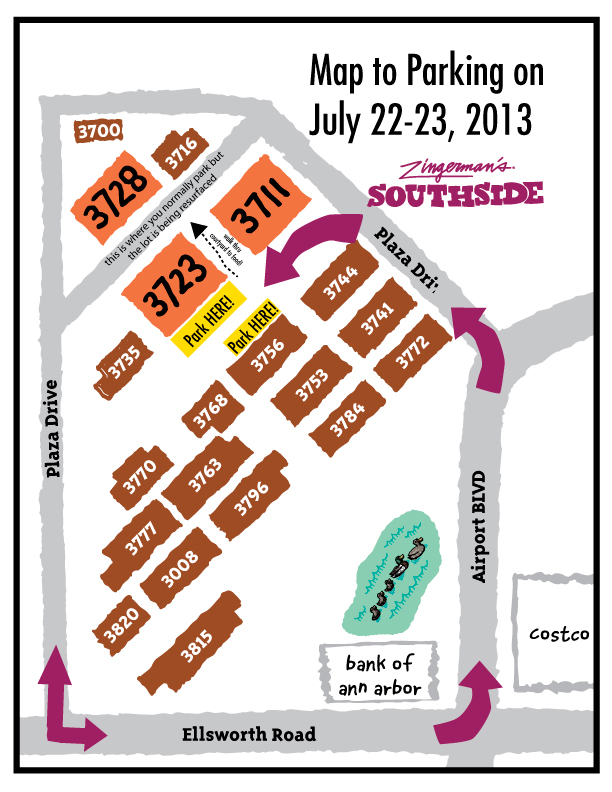
No problem! We’ve shifted parking temporarily to an area behind the Zingerman’s Southside businesses, easily accessible through our picnic area.
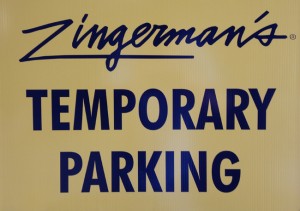
Just follow the yellow Zingerman’s Temporary Parking signs:
We’ve even created a map to help you find your way:
When is this happening?
The work is planned for Monday, July 22, and Tuesday July 23, and the construction crew tells us the tentative plan is for our parking lots to reopen on Wednesday, the 24th. Temporary parking will be in place as long as needed.
If you have any questions about the temporary parking arrangement, please DO NOT hesitate to call us!
- Zingerman’s Bakehouse: 734-761-2095
- Zingerman’s Creamery: 734.929.0500
- Zingerman’s Coffee Company: 734-929-6060
- ZingTrain: 734-930-1919
More information on getting to Zingerman’s Southside Without Getting Stuck in Traffic.
See you soon!
Tag: ZINGTRAIN

Webinar: Ari Weinzweig on Managing Ourselves
Join us for a conversation with Ari Weinzweig about an essential component of being the best leader you can be – Managing Yourself!
In Book 3 of the Lapsed Anarchist series (due: Fall 2013), Ari writes about Managing Ourselves.
Here is his lead in to the subject:
When all the big business stuff is said and done—missions and visions written, strategies and systems set, values and cultures established—our long term success will still really come down to this: the effectiveness with which we manage ourselves will almost always make or break the rest of the work we do. While it’s true that a once in a lifetime quality breakthrough or a quickly implemented stroke of genius might bring us success in spite of ourselves, ultimately, I would argue that about 98 times out of a 100 the effectiveness with which our organizations operate is all, really, about the way we work within ourselves. The better we manage ourselves, the better we, and everyone around us, will do.
Space is limited, so please reserve yours! Register here.
Date: Wednesday, July 10, 2013
Time: 4:00 PM – 5:00 pm Eastern
After registering you will receive a confirmation email containing information about joining the Webinar.
Please join us!