Martin’s Handmade Hard Pretzels at the Coffee Company
A Taste of Pennsylvania Dutch Country in Washtenaw County
Sometimes we take things for granted. Or maybe it’s that we’ve subconsciously sloughed something off because our early-in-life encounters with it were wholly uninteresting. Even I, who’ve been investigating artisan food for many years now, still forget to consider what, once upon an unremembered-by-most time, came before the now-standard commercial offering.
If you look hard enough, though, you can almost always find a high-quality example of what most of the world has long experienced as ordinary.
While soft pretzels at the Bakehouse are always appealing to me, I never really gave much thought to the standard, crunchy hard-crusted pretzels that I—and maybe you?—grew up with until now. In my mind, I classed them as industrial snack foods. Sometimes they come in looped circles, other times in long, thick-as-a-cigar sticks, or in small bits of straight two-inch-long sticks.
Like everything else we eat, the commercial version I grew up with is a pale comparison to the original. The difference is night and day! Ed Levine, the man who started the first nationally known food blog, New York Eats, writes of these traditionally made pretzels, “Martin’s Pretzels—a fixture in the City’s Greenmarkets since 1982—are to machine-made pretzels what a BMW is to a Yugo.” Half the people who I have invited to try them come back to tell me they ate the whole bag in a single sitting. Then they come back and buy more. In fact, it’s safe to say I’ve bought more bags of pretzels in the months since we got these in at the Coffee Company than I have in the last few decades. They’re very good! In the context of what I wrote above, I would say that they’re truly unordinary in the best possible way.
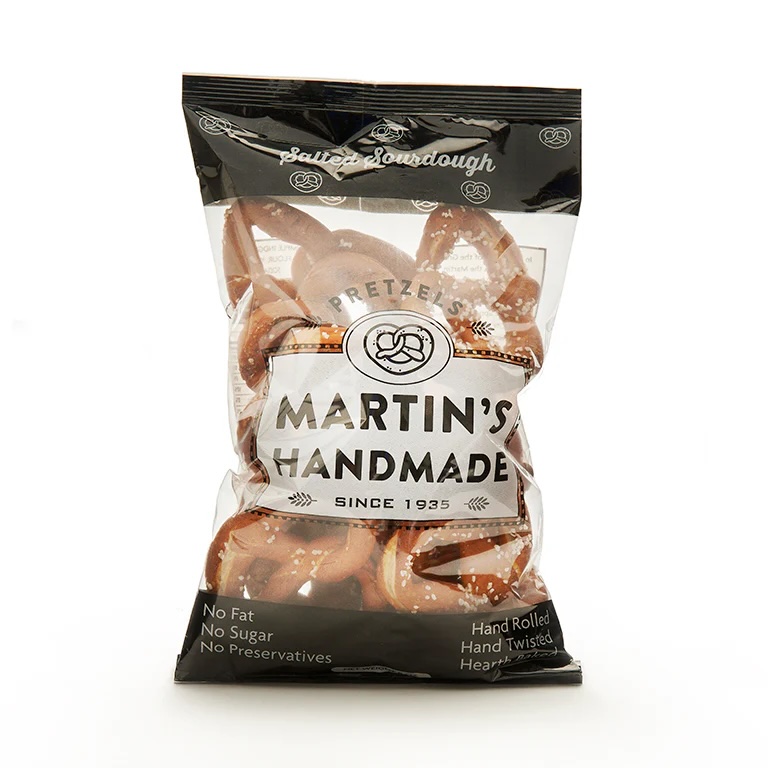
Martin’s Pretzels are crafted much the way a hard-crusted pretzel would have been made over a hundred years ago. The Martins are Conservative Mennonites from Pennsylvania’s Lancaster County. They are old-guard pretzel bakers keeping the handmade tradition alive just as they have since the middle of the 20th century. The first contributor to their high quality is a simple secret-recipe sourdough that, like so many of the breads at the Bakehouse, is made from just flour, water, yeast, and salt. The folks at Martin’s use no preservatives, no sweeteners, and no fat. Like the sourdough breads at the Bakehouse, this old-style sourdough takes longer, but delivers loads more flavor. From there comes hand shaping, rolling, and twisting.
Machine-made pretzels are produced far more quickly than anything human hands could ever manage. Automated lines can shape and bake thousands of pretzels an hour. A good pretzel roller at Martin’s is ridiculously slow by industrial standards. Instead of hundreds or thousands a minute, the men and women at Martin’s each twist only about 10 to 12 pretzels per minute, working by hand. In their view, speed, when it comes to pretzel production, can be deadly. That deliberate pace means the density varies through the pretzel, and tiny air bubbles in the dough are baked into the finished product. No two twists are exactly alike. Like you and I, every Martin’s pretzel is unique. And, fortunately for us, also delicious.
Longtime pretzel baker Alfred Milanese says, “Martin’s are the Rolls-Royce of the pretzel world.” Julia Child used to stock them at her house! I love the crunch, the dark bake, the irregularity of the hand-done texture, and that almost-but-not-quite-too-much touch of coarse salt the bakers broadcast onto the twisted raw dough before it goes into the oven.
The Martin’s Pretzels are awesome, eaten right out of the bag, on their own. Wonderful with good beer. With cheese—Zingerman’s Pimento Cheese and Zingerman’s Liptauer Cheese! With a down-to-the-wire NCAA Tournament game on TV. With a smile. And a deep appreciation for the Pennsylvania Dutch traditionalists who make these special pretzels possible. I’d agree wholeheartedly with what the folks at Martin’s say: “There is no way to imagine the difference between machine and handmade pretzels without tasting.”