The Extraordinary Nature of the Unordinary
A judge’s call to action, a hip hop band’s act for justice, and other unordinary actions
Four years ago, Rabbi Lauren Holtzblatt, the same thoughtful and widely respected rabbi who officiated at Ruth Bader Ginsburg’s funeral in the fall of 2020, wrote in The New York Times,
Words matter. Every letter in the Torah is believed to have significance, and every word is essential. … There is a deep spiritual practice in combing through phrases, repetitions and words. We find meaning to justify each phrase; each phrase justifies its meaning.
Coming from a different place and different perspective, and in their own dub-centric way, the message on the second cut of the powerful new album from my friends at Indigenous Resistance says something similar:
Sometimes we can’t trust our own language.
That’s why it’s necessary to be hyper-vigilant when it comes to our own terminology.
Sometimes words, combined in just the right construct, can make a concept come clear in a completely new way. Other times, we look deep within a single word itself, understood differently, to gain clarity, meaning, and improved understanding.
This is one of the latter: a better understanding that’s beginning to come to me as I ponder the uncommon, if not super-intriguing, word unordinary.
In an era when ever more “urgent” breaking news dominates the headlines, when social media makes the world seem to rush past us faster by the day, it would be easy to miss writer David Whyte’s ideas about the importance of the “unordinary.” I almost did. It would have been my loss. As Whyte writes, “Unordinary is worthy of a lifetime’s dedication and a lifetime’s journey; and yet, in such an extraordinary way, unordinary is always, always, always, just a single step away from my ordinary, everyday life.”
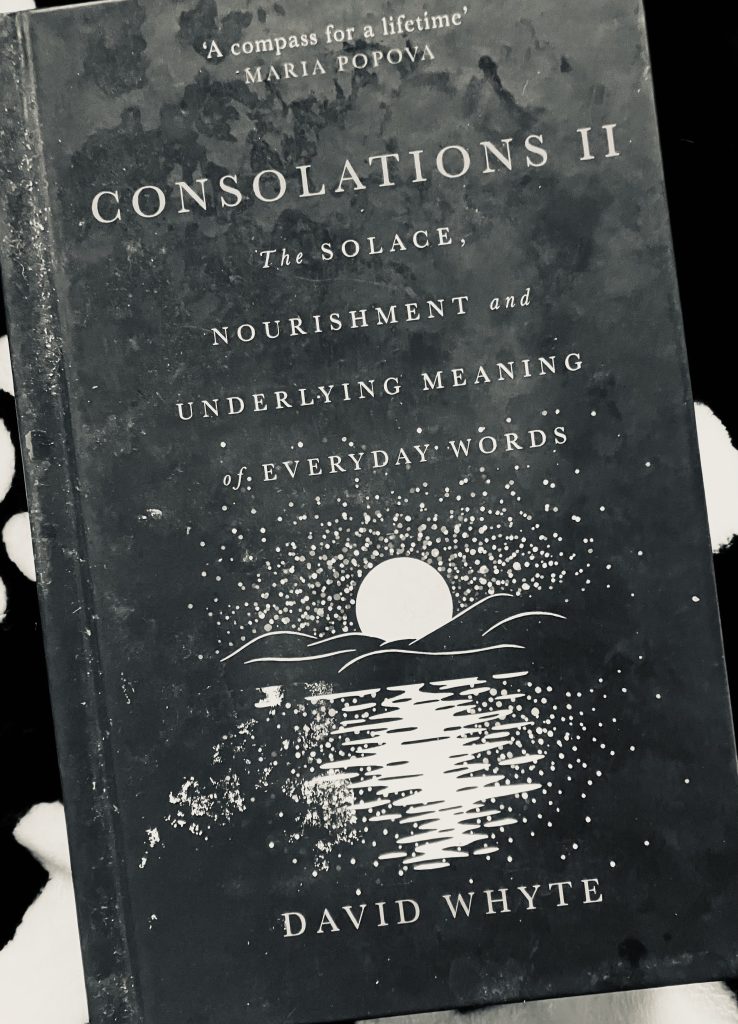
The gentleness of this whole concept feels like an invitation to those of us who are intrigued—to slow down, lean in, listen to our hearts, and let it settle. The last piece of my own understanding of the impact of the unordinary clicked only as I was finishing the final bits of this enews. It happened when I was literally looking through a different lens, starting to shoot photos of the cover of Whyte’s book for this essay. I’d had the title—Consolations II—ensconced in my head for weeks. But through the camera lens, it was the subtitle that suddenly caught my attention. Under Consolations II, in much smaller white-on-black letters, I really read the subtitle for the first time and let it sink in: “The Solace, Nourishment and Underlying Meaning of Everyday Words.” Sure enough, it struck me—solace, emotional nourishment, and slowing down to attend to everyday things is what “unordinary” is all about.
Early last summer, I wrote a piece about how much difference ordinary people like us can make in the world. I stand by that belief—resistance is most powerful when it’s done by everyday people. If I were to change anything in that original essay, though, it would be my use of the word extra-ordinary, as in “ordinary people doing extra-ordinary things.” Writing now, I find I have a deeper respect for—and understanding of—another way of saying what I was trying to say back then. Speaking up peacefully for dignity and democracy is awesome, but it’s not, I would now say, an extraordinary action. Anyone who’s willing to be a tiny bit bold can do it. It remains special, but I would say now, instead, that it is inspiringly unordinary.
Before you (or even my own cynical self) decide I’m splitting linguistic hairs when there’s real work to be done in the world, let me say this—the shift in how I understand that one word is already changing the way I work. New understandings, I have learned over the years, bring new ways to stand in the world. This is no exception.
In 1921, Polish-born semanticist Alfred Korzybski offered one of his most memorable lines: “Definitions create conditions.” Which means that new definitions—of the sort I’ve been immersing myself in here—create new conditions. Change the definition of a word and, not surprisingly, you do things differently, too.
All of which brings me back to unordinary. It’s a word I’ve long known, but rarely used. What follows is an exploration of a new understanding of unordinary—and the wonderful new conditions that this different definition could well create.
In David Whyte’s Consolations II, “Unordinary” is the 48th of the 52 short pieces—each with a single-word title, one for every week of the year. It begins,
UNORDINARY is a word that belongs to our future, a word that could open up a different understanding of what it means to be singular, what it means to be communally human, and above all, what it means to be here, in this difficult world; all of us, every one of us, trying to live an extraordinary, ordinary life.
If, as Whyte writes, unordinary belongs to our future, then I’d say that future is already here, present in the midst of the everyday, ready to make a difference right now. We all have the ability to do meaningfully unordinary things right now. As Whyte writes, our unordinary is “something to be uncovered and perhaps at times, even unleashed.”
Last week, on February 17, conservative Judge J. Michael Luttig delivered a talk to the New York City Bar Association titled “America’s Time of Testing Has Come.” It was a very clear call to action—not only to the lawyers in the room, but to all of us who are paying attention around the country. Luttig spoke that evening directly, in a way that David Whyte might call “unleashed.” It was down-to-earth, direct, powerful, and compelling. And at the same time, it was deeply impactful and also wholly unordinary—there was nothing about the way Luttig addressed the audience that evening that many hundreds of other retired judges couldn’t already have done too.
Judge Luttig’s talk in New York laid out the challenge we all face right now in February 2026:
We must, finally, summon the courage that has eluded us in our all-consuming fear. Americans must summon from deep within the courage that was once our Founders’ courage. …
The time has come again, as it has come before, when the “appalling silence of the good people” is now “betrayal.”
We must stand, raise our voices, and speak out against what we are witnessing in America today. We must “break the silence of the night.”
For, as Dr. Martin Luther King, Jr., warned, “In the End, we will remember not the words of our enemies, but the silence of our friends.”
If we but find the courage to speak truth to power now, today, as did the Founders and our ancestors when their time of testing came, the United States of America will endure forever as the beacon of freedom and liberty to the world. America will once again be the envy of the world.
It would be hard for me not to take Judge Luttig’s call to action to heart. In an interview with Ali Velshi on MS Now a few days later, Luttig took a historian’s view of current events. To his mind, it’s clear that we are all being tested, but the tide is turning in the right direction. He cited the recent Super Bowl halftime show, the demonstrations in Minneapolis, along with the Supreme Court decision about tariffs, as evidence that the momentum for democratic direction is growing, sharing that:
For the first time in 10 years … I have confidence that America is going to prevail and long endure … I have not just hope, but I have the belief that we have come to the turning point and that America and Americans are going to answer the call from our founders and ancestors.
If history is calling, then I, for one, am ready to pick up the phone—to find the kind of courage Judge Luttig calls on us all to show. Once we do, the real question becomes how we will continue to both live our daily lives and, at the same time, find small but significant ways to make a meaningful difference. That question is part of what I’ve attempted to explore in the new pamphlet, “Why Democracy Matters: A Deep Understanding of Democracy in Our Everyday Lives.”
I realized in writing this piece, the inverse of Alfred Korzybski’s now classic statement is also true: Conditions can create definitions.
Sure enough, the social conditions in which we are living in the U.S. these days have me thinking about new definitions. As author Ursula K. Le Guin said in the fall of 2014, “Any human power can be resisted and changed by human beings. Resistance and change often begin in art. Very often in our art, the art of words.” Resistance. Art. The art of words. Unordinary actions taken by dozens of people—like Judge Luttig—by people like you and me answering the call to stand up for democracy. There’s no need to wait to be “extraordinary.” Unordinary is in each of us.
Unordinary is ordinary people doing something that matters—simple, available to all, but powerful in its intent. Becoming a federal judge, as Judge Luttig did, is extraordinary. Speaking out about what is ethically authentic? Unordinary. Any of us can do it.
In trying to play a small positive unordinary part in this work, I find myself returning again to Timothy Snyder’s slim and powerful book, On Tyranny: Twenty Lessons from the Twentieth Century. Each lesson is a modest but meaningful call to action. Lesson #9 reads:
Be Kind to Our Language. Avoid pronouncing the phrases everyone else does. Think up your own way of speaking, even if only to convey that thing you think everyone is saying. Make an effort to separate yourself from the internet. Read books.
This essay is, in its own way, an effort to take that advice. My new engagement with “unordinariness” is an attempt to understand a familiar word in an unfamiliar way, a way that regrounds me in the face of what could otherwise start to seem a paralyzing power grab by those who aspire to authoritarianism.
The idea of unordinary came clear to me in the context of a creative musical collective I stumbled upon last week called System Ali. A hip hop band from Israel, made up of both Arabs and Jews, speaking up and speaking out together about the injustice of the government’s actions. I was only half paying attention when their rendition of “Let My People Go” started playing.
Usually, I choose music on purpose. But sometimes, if I’m focused on something else, I tune out and just go with whatever starts playing on my phone. Something about System Ali caught my attention, though—I’ve replayed that unordinary moment a couple hundred times over the course of the last of couple days, so much so that I can hear it in my head even with no music actually playing.
It all starts with a gentle Arabic drone in the background. Soon it was joined by a wailing, Eastern European shtetl-style accordion in the foreground—two musical lineages that rarely share the same stage. A violin. More accordion. Then a sudden, unexpected shift into a bolder, more aggressive rhythm when band members began to rap, each in the language of their choosing—Arabic, Hebrew, Russian, English, Amharic, Yiddish. I kept listening, going from one song to the next: hip hop grooves layered with Arabic scales, Gypsy inflections, jazz phrasing, the polyphonic singing of Ethiopia, and a little rock and roll energy to boot. Wow. Arabs and Jews, immigrants and natives, all making music dignity-centered together in one ensemble.
System Ali’s songs deal with life under the definition of minorities in Israel, without hesitating to tackle the painful and sensitive issues in an honest, critical, quintessentially authentic way. As I said, System Ali is a mixed race, mixed religion, mixed gender group—which means the racism, separation, and fear that are so abundant in the region are nowhere to be seen, nor heard, in their work. Their album is an action towards building an alternative, wholly unordinary, reality.
To Judge Luttig’s point, they are not being silent: The band members sing about George Floyd, Black Lives Matter, the Nakba (the expulsion of so many Palestinian people from their land in 1948), the pain and loss and endless heartbreak that all peoples have experienced in the course of the history of their region. Without question, they challenge all of us who will listen to learn, and to be better at accessing our own unordinariness in the interest of making the kind of positive difference that both they and Judge Luttig have called on us to. On “Let My People Go,” the opening vocal sallies start—first in Arabic, then in Russian, and then move on to Hebrew and a little English—passing from one band member to the next with force, power, and feeling:
My heart is on fire
This situation is infuriating
Right to left so much pain
We want to live
But How?
Without an ability
Without an essence
I’m surrounded East to West South to North
I’m not about politics I’m all about myself
Because there’s a never-ending war in our home
I found myself thinking, Wow! System Ali is amazing. Diverse voices, diverse languages, diverse backgrounds, all playing together in a powerful, grounded, and meaningful way. It was really something so unusual to see—diverse bands singing protest songs are not easy to find in the region right now. The members of System Ali have taken a deep breath, answered their own call to action, and are speaking out—with unity in diversity—when so many others are staying silent.
It’s all so unordinary, in an absolutely wonderful way, that it’s gotten my attention. I’m not the only one. Journalist Ben Shalev, writing for the independent paper Haaretz, says,
An emotional declaration is in order. … let me put it this way:
“I think I saw what I would like to see as part of the future of Israeli music and its name is System Ali.”
I’ll add to Shalev’s statement: I would like to see a future in which the values of System Ali are very widespread. Not just of music in the Middle East—but the future, period. In our companies and communities, as well as our countries. Diverse, dignity-centered, and direct. Not afraid to speak up against war, indignity, and injustice. Eager to honor difference and put pain in the context of art, rather than inflict it aggressively onto others. Able to come together collaboratively to create one-of-a-kind art that makes a positive difference in the world!
In their song “I Can’t Breathe,” the band urges,
Don’t accept the lie,
don’t drink the poison.
Forgetting is a habit
The big learning of unordinary for me is about embracing that the diverse, ethically-based, inclusive, and encouraging reality that System Ali is creating with its music could actually be the norm. In a sense, what’s odd isn’t them—it’s the sad reality that a group of Arabs and Jews playing socially conscious, peace-focused, dignity-driven, and difference-making music together in one band that easily could and should be so ordinary we barely even notice anything beyond their tunes is, instead, so rare.
As I pondered the music of System Ali, it seemed an ideal example of what unordinary might be. It’s a way to live Timothy Snyder’s call to be kind to our language as an act of resistance against the numbing drama of authoritarianism.
Here’s a bit more about how I’m thinking about it. Extraordinary is when someone makes something rare, difficult, or almost impossible take place. It’s stuff that takes both a very special skillset and hard work. Olympic athletes—extraordinary. Michael Jordan—extraordinary. Climbing the Himalayas—extraordinary. Being a brain surgeon—definitely extraordinary. Timothy Snyder’s and Ursula K. Le Guin’s writing. I appreciate them as such. They are special. Definitely not ordinary.
The more I played with the idea of unordinary, the more it resonated. I began to see that, while the quality of our food may indeed be particularly special—extraordinary when we do it really well—most of what we do in our business practices, seen through my new lens of understanding, is definitely unordinary. They aren’t, I’m realizing, especially extraordinary at all. Anyone who wants to could do them. It takes neither a particularly special skill nor years of intensive formal training to learn to be kind. Kindness. Compassion. Dignity. Diversity. Humility. Empathy. Inclusion. Any eight-year-old could have their hand at them. Vision-writing. Extra-miling. Open-book management. Open meetings. Consensus. Also wonderful, but still, not really “extraordinary.” We have no special ingredient that makes us more able to do what we do than any other American organization.
All of those processes are really important to us, and I recommend them wholeheartedly to you too, but the truth is that anyone who decides to could do them. In that sense, I would now describe them as “unordinary.” Yes, uncommon, but not because of a rare ability that’s uniquely abundant in and around Ann Arbor. They’re hard to find because they’re not the norm—most people color within the same behavioral lines their colleagues do. They’re not the norm because, in current conditions, it may take a bit more attentiveness to take positive, dignity-based action. And, at the same time, they are absolutely unordinary.
As is so often the case, now that I’ve been thinking more and more about what it means to be unordinary, I’ve started to see evidence of it all around me. Just to give some context to the rest of the conversation, I’ll share a couple of examples here.
Unordinariness is what caught me a couple of days ago in this article about the late Reverend Jesse Jackson, who passed away last week. The headline of an article by reporter Madeline King in the Chicago Tribune conveyed the concept: “Neighbors remember Rev. Jesse Jackson as a ‘quiet reminder that greatness can live right next to you.’” All the stories illustrated the point further:
Although he worked alongside the Rev. Martin Luther King Jr., … to his neighbors, he was a friendly face who made others feel seen. …“Jackson was the type of neighbor to compliment your baby as you push her in a stroller and then stop by your house to celebrate her law school graduation decades later,” West said. … “He was absolutely wonderful,” Speller said. “Very personable, genuine, generous with his time.”
All of what’s being said about Jackson is wonderful and uplifting. Yet, in a way, it describes what any human is capable of. What made it remarkable was the authenticity he brought—it altered the energy of the moment—but at its core, it reminds us that this is something anyone could do. Once again, it’s wholly unordinary.
Unordinariness is, I realize, nearly all of what draws me to the writing of Wendell Berry. Berry’s actual writing, many say, is exceptional. The content, though, when it comes down to it, in this context, is more upliftingly unordinary than anything else. Rereading with this lens, there’s little Berry advocates that exceeds the normal bandwidth of any caring, thoughtful human being who might be living on the land.
Something similar, I realize, is also true of Peter Block’s writing. It is beautifully unordinary. In Community: The Structure of Belonging, he shares, “Being powerful means that my experience, my discovery, even my pleasure, are mine to create.” Extraordinary? Not really. Inspiringly, insightfully, unordinary? Absolutely. He goes on, “The shift toward citizenship is to take the stand that we are the creators of our world as well as the products of it.” It’s moving. It’s accurate. It’s definitely unordinary! It’s the choice that, in comparably unordinary ways, Judge Luttig and System Ali have both made. And that any of us who decide to step up as Judge Luttig has called on us to do, can make too.
I’m writing this and sharing my musings as one way to offer clearer language to use in the abundant, unordinary instances of life where that might really matter to folks. Why? Because with clearer language, we communicate more effectively, we think more clearly, and we make better decisions. We can embrace unordinariness and all that goes with it, and deal with it differently from the extraordinary work that goes into the work of Olympic athletes and trained virtuoso musicians.
To my eye, System Ali sets the pace. It’s wild how much they have done with their work. And will do. As Yonatan Kunda, one of the band’s vocalists and lyricists, explains, “This band is not about molding or combining everyone into one thing … It’s about keeping those [cultural] differences and embracing them for their individuality and uniqueness.” Muhammad Aguani, another lead member from Jaffa, shares, “When I’m with the band, I feel like I’m with my family,” he says. “I respect them and I’m proud of them. I love them very much.”
Looking from the outside, the members of System Ali seem able to turn normal, healthy disagreement into the kind of creative growth we all want. They run their band practices standing or sitting, but always facing each other in a circle, the better to facilitate mutual respect. They talk a lot about each band member’s need to protect, nurture, and grow within their own bayit, which means “house” in both Arabic and Hebrew. As Aguani adds, “We fight a lot. What he’s saying may make me angry, but then I write another verse.” What I’m learning from them now is to continue to lean into the unordinariness of the moment, and the magic that can be made from it. They are a reminder that no matter how bleak headlines may look—in a business or a bigger entity like a country—there is always positive, wonderfully unordinary resistance beneath the surface.
Ben Shalev, a journalist for Haaretz, describes the way the band works together while allowing each member to remain fully themselves. Writing about the “conglomerate” that is System Ali, he notes that each rapper has “a separate, distinct identity.” One “looks and sounds like a Russian revolutionary,” while another, dressed in a jogging suit, “resembles an assistant trainer in a Golden Gloves boxing club in Jaffa’s Gimel neighborhood.” The band members themselves put it more simply. As one member explained:
We wear whatever we want because we want to and it is who we are. And since we are all different people, we wear different things. And that’s it. Liba, she wants to wear a dress and me, I like to wear jeans and a t-shirt and Enchik has his sporty look. So what? It’s all good, man!
What catches my attention most, though, are these poignant lyrics from the song “Voyna” (“War”). This version is the one I’ve had on repeat. At about the two-and-a-half-minute mark, bass player Yonatan Kunda sings these lines:
All that is left is the shock
Spinning around the block of our souls like a hawk
As our ministers mop up blood with theoretical talk
They can’t hear anything or feel anybody
On the left, and to the right, all the kings are conned
In this political ping pong
We are nobody’s pawns
We are singing the 23rd Psalm
In the persistence of resistance
In the rock of the song.
We’re the screech of the chalk of the white and blue
There’s smoke rising from a fire no one ever knew
In our hearts,
We’re building this house anew.
Tears fill my eyes as I type up those song lyrics. Kunda sings with a fervor, and the music is so compelling that it reminds me that all the people you and I work with are also capable of calling up this same kind of passion—of choosing to be unordinary, of speaking out from the heart for what we believe, but doing it always with dignity and respect for everyone around us. While System Ali is terrific, they are not, in this new context, extraordinary. I actually wish we were in a situation in which so many other bands were bringing together diverse musicians to sing about peace, dignity, and gentle justice for all. Their work makes a difference. It’s Judge Luttig’s call to action come alive. Wholly, wonderfully, lovingly unordinary. Creative, caring, difference-making work we can all, in our own ways, do in our organizations every day.
The American-born Kunda, it turns out, spends a lot of time at the Yaffa Youth Center teaching young kids poetry, in both Hebrew and Arabic, as well as playing music, offering the positive impact of unordinariness:
It’s the beginning of the end of the problem when we create music together.
Take unordinary action
P.S. In Arabic, the word for apricot is mish mush. In Hebrew, it’s mish mish. In my world right now, an apricot is an invitation into the dignity and democracy that System Ali, Judge Luttig, and all the other good people I mentioned above are advocating. I was wearing my apricot-embroidered Carhartt jacket when I ran into long-time customer Jonathan Sugar wearing his! We both smiled. Check out all the apricot shirts, hoodies, hats, and jackets—Underground Printing ships your order straight from its Ann Arbor store to your home, and all the proceeds are donated to Democracy Now!—a non-partisan, non-profit!