“Take Your Time” & Learning to Lean into Loss
The death of a close friend and Cornman Farms’ final season
Musician Jamie Doe writes,
There are moments in life for which we cannot prepare. … Reacting in all our messy humanity to the shock of a world made new, in each case we confront a profound dislocation that upends fragile certainties.
This past week, for me, was one of those moments. It has left me trying hard, but not always succeeding, to handle some pretty profound dislocation and newly fragile uncertainties with grace and dignity.
Not many leaders I know, other than those who work with loss professionally, took their jobs in order to help guide their organizations through the grieving process. And yet, if one is in a leadership role for any length of time, it will almost inevitably, at some point, become a significant part of one’s work. That work, for me at least, is far, far harder when I, too, am grieving the losses at hand as I am here, not just supporting others as they struggle with the loss of a loved one.
To add to the challenge, grief generally shows up at wholly unexpected times. This week, it happened twice on what had begun as a rather innocuous day. By evening, though, I found myself dealing with two very different losses at once—the closing of a business and the death of a close friend.
While they are very different kinds of loss, the reality is that:
- Both events evoke a sense of grief and loss.
- Each of us is impacted differently by different losses; there is no “right” way to grieve.
- Dealing with grief—individually or collectively—is pretty much always difficult.
- Grief is not something to be disposed of as quickly as possible, nor, as neuroscientist and grief expert Mary-Frances O’Connor has taught, is it something we are meant to “overcome.” Grief, O’Connor says, can be especially difficult after a death that was wholly unexpected.
- As historian Yuval Noah Harari has written, there is no hierarchy of emotion. What one person is overwhelmed by, another may be oblivious to.
- Similarly, some people in the organization may be deeply affected. Our role as leaders is to help navigate during this time as well.
These are certainly not the first losses I’ve experienced in my life, nor, I know, will they be the last. While it would be understandable to approach each of the two on its own, given how different they are, I’ve chosen to address them here together since the reality of life is that they occurred within days of one another.
To be clear, I don’t like going through grief in any form. I’ve learned, though, to find ways to work through it anyway. And although it’s often hard for me to remember while I’m going through it, I’ve also learned that letting myself grieve loss is part of living and caring deeply. Hiding it—as I was raised to do as a kid—definitely does not help. Over time, engaging with grief effectively helps us to become more complete people. As author Elisabeth Knübler-Ross explains,
The most beautiful people we have known are those who have known defeat, known suffering, known struggle, known loss, and have found their way out of the depths. These persons have an appreciation, a sensitivity, and an understanding of life that fills them with compassion, gentleness, and a deep loving concern.
Even knowing that, as is often true for me when I experience significant loss, I’ve still been a bit in denial in recent days. Denial, I know, doesn’t alter the realities of the losses I’m beginning to grieve, but it does offer me a gentler runway into what I know will be an emotionally challenging time. Writing this piece is one way I know to wade into it all. Typing, quietly, can bring the tears.
Still, I’ve learned to lean in, to feel the pain, experience the sense of loss, and slowly, over time, to figure out how to go forward in positive ways. As spiritual leader Ram Dass reminds us,
No one can bypass the process, and everyone will have different karma around it. Grieving has to run its course. Just allow that pain of being human, and let it transform you. … It forces us to grow, to adapt, to learn resilience and compassion.
This work with grief is, in a sense, a journey that we have navigated many times over the course of our 44 years at Zingerman’s. Still, each time through is different. I haven’t really experienced either of these specific situations before, so I have a lot to learn in the coming weeks, months, and years.
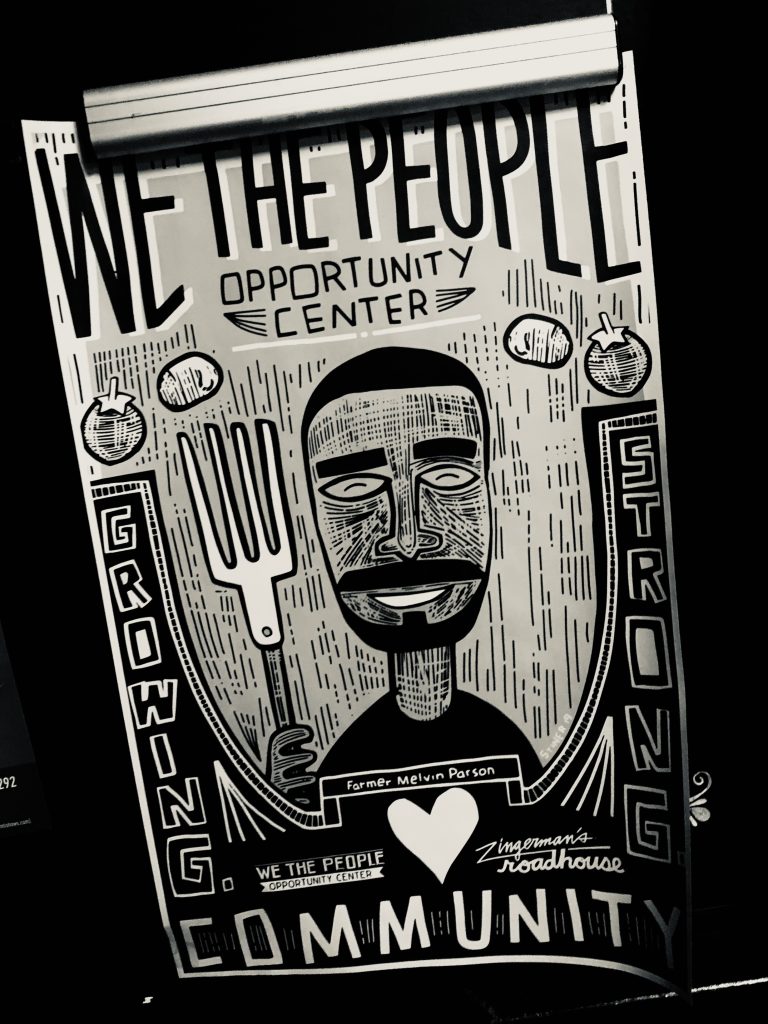
Writer Naomi Shihab Nye reminds me, “You are living in a poem.” In a sense, that gives me some solace, since poetry is one of the most positive ways people know to engage with the emotions of loss and grief. The poem being written right now, week by week, is about the decision to close Cornman Farms this coming fall, and, at the same time, the unexpected death of my good friend, Melvin Parson, founder of We the People Opportunity Farm and an amazing human being. The loss, in both cases, feels especially profound in the community—here in Washtenaw County and within the Zingerman’s Community—because both Cornman and Melvin were loved by so many.
Thinking about it all as a poem, I might title it then with the three-word suggestion I got from my Irish friend Aisling Rogerson, founder of the Fumbally Café in Dublin, who is herself navigating the deep loss of her partner, Manchán Magan, last fall. When I shared with her this past weekend that I felt neither emotionally prepared for the losses I was facing nor experienced in dealing with them, Aisling offered me a simple but wise message:
take your time
Xoxo
What follows, then, is only an entrée to what will surely be many years of learning to live with these new losses. As Mary-Frances O’Connor reminds us, “Grief never ends.” We do best when we own it, lean into it, and learn from it. The poem I have found myself living in—unexpectedly, this month of March 2026—could also draw on the essay I wrote last month (Magic and Loss) about Manchán’s painful passing at the far-too-early age of 55, and might be entitled. “More Magic and a Lot More Loss.”
As I wrote last month, one of the hardest parts of leadership life for me, at least, is that magic and loss nearly always coexist. While some in the organization will be mourning, many others will simply be going to work as usual. So while some of us are deep in grief, others may likely be, at the same time, really excited about our new work with Little Kim, and about nearly half a dozen potential new businesses that we’re in conversation about (no, of course, they won’t all work out). Others still will be jazzed about the wonderful weddings and other critical events for families at the Greyline, Roadhouse, Miss Kim, etc., and by crafting amazing wedding cakes from the Bakehouse’s Cake Studio. Grief, after all, does not make all the good things go away. Learning to work with both the ups and the downs at the same time is not an easy leadership task, but it is clearly a critical one.
These two stories of loss are very different, but since they arrived at almost the exact same unexpected time, my mind keeps moving back and forth from one to the other—reflecting on the amazing work that contributed to Cornman’s long run in Dexter and my friendship with Melvin and the way he contributed positively to so many people’s lives through his work with We the People Opportunity Farm. Both have been big parts of my life for many years. Experiencing the two losses in tandem has made this week particularly hard for me. Perhaps, though, the seeming coincidence of timing is less accidental than I imagined. The work that each of them contributed to our community both began, I realize now, in the same year. Cornman Farms opened its doors for the first time formally in May of 2014. And, later that summer, Melvin Parson began laying the early groundwork for what would become the deeply respected nonprofit, the We the People Opportunity Farm.
Forty years ago, in March of 1986, writer Judith Viorst released her now classic book, Necessary Losses. A few years later, as I was struggling with various forms of loss, the book was very helpful to me. This week, I find myself going back to it to help handle these two losses I’m working through. It’s filled with wise and insightful observations like this one:
… The people we are and the lives that we lead are determined, for better and worse, by our loss experiences
Which means that my own life, and the lives of the many thousands who loved both Cornman Farms and my good friend Melvin Parson, will be changed forever by the loss of each.
Over the years, Cornman Farms has been the site of many hundreds of beautiful farm weddings, private parties, fundraisers, and more. Its origin story goes back many years and includes our renovation of the 1834 farmhouse and 1837 barn (which won “Barn of the Year” from the Michigan Barn Preservation Network in 2015). I’ve heard stories from so many glowing brides, grooms, and parents about the love and care, attention to detail, and deep deliciousness of the amazing weddings they held at the Farm. I know, too, that our two managing partners, Kieron Hales and Tabitha Mason, have given a great deal of care to the decision to close—and that they take their responsibilities to clients and the Zingerman’s Community of Businesses very seriously. I could go on for many pages, but for the moment, I’ll just appreciate them for all they’ve done and are still going to do in the months ahead and beyond. Love letters and notes of appreciation have already begun to come in the last few days, and I’m sure that in the coming weeks and months, ever more folks will share stories as well. Closing Cornman will not cut off the memories. As the Irish writer and also good friend Gareth Higgins taught me many years ago, “You never know where a story will end, especially when you’re in it.”
It would be disingenuous for me to say that it wasn’t hard for me to hear about Cornman’s decision to close. Over our 44 years, we’ve had a pretty good track record. That said, Paul reminded me after we wrote the 2009 vision 32 years ago now, that if we were going to open a lot of businesses in the ZCoB, some would do well for a while, and then, years later, not so much so. We had a remarkable and very successful run for many years at Cornman Farms. Since COVID, though, the market for weddings seems to have shifted in ways that have made our work harder to make financially viable. And as Tabitha and Kieron have been reminding me and others here, not every business is meant to last forever, and even their deep, deep dedication and countless hours of hard work can’t make up for a large number of missing dollars in sales. During its 11 years of hosting amazing weddings and events, I am confident that Cornman has treated every guest’s event with dignity and grace and created a host of memorable events that will live in spirit for decades to come. I’m also confident that same heartfelt good work will continue until we wind down this coming fall as Cornman honors every single 2026 commitment with the same love, passion, and positive energy we’ve worked at since day one.
The first email I can find in my archive from Melvin Parson is a lovely one sent in the summer of 2013—one that, in hindsight, shaped a relationship, a friendship that grew ever stronger over the years. And really, reading that email again now, in the spirit of Naomi Shihab Nye, it very poetically shapes what things will look like going forward as I work through the grief and loss emerging from Melvin’s decision to take his own life. As another grief expert, the contemporary writer David Kessler, beautifully says,
Death can end a life
but it cannot end love or connection.
Our relationships don’t disappear when someone dies.
They change, but they still continue.
Even though Melvin and I were just getting to know each other at the time, the email really set the tone for the many years of friendship that were to follow:
Hello my friend
I just sent you an audio message and realized that I didn’t even say hello so please forgive me.
How are things? Hope all is well and that life continues to present to you challenges which offer up the opportunity to continue to grow as a person mentally, spiritually, and emotionally.
Take care my friend
Melvin
Melvin’s words remain true to this day. Melvin’s passing is leaving many of us, me included, with just what he suggested all those years ago when we were just getting to know each other. Opportunity that, to be honest, I didn’t want and don’t welcome, to continue to grow mentally, spiritually, and emotionally.
At the time he sent that email, Melvin was in the early stages of imagining the nonprofit for which he would soon become widely known, and that would benefit so many in the community. In March, 11 years ago now, many hundreds got this first formal email from Melvin. I can hear him saying all this with his big, welcoming, soft smile—beaming:
I believe that growing food grows communities. I want to use farming as a vehicle to create a different outlook for my community.
Last year was my first ever undertaking in growing vegetables. I inherited a 3’ x 20’ raised vegetable garden that had been tended to by a sweet woman named Verna. Sadly, Verna passed away last year and somehow I was chosen to grow vegetables in her stead; mind you I had no experience gardening. However, I was a gamer, so off I went preparing the soil; getting my hands dirty and loving every minute of it!
I dedicated my first experience with growing food to Verna. This vision has led me to form We The People Grower’s Association. This year will be our inaugural growing season, and we need not only seeds, but seed money to get started.
I don’t just want to grow food. I want to create a sense of empowerment in the community and educate the community about food sustainability, nutrition and other essential skills which promote a healthy outlook upon self and those about you.
…
Our motto is to Grow Food and Get Strong.
Your donation would be used to buy seed, seedlings, hand/ tools, compost and to cover miscellaneous costs. Throughout the season you will literally be able to watch your donation grow–grow into food, grow into wellness, and grow into a community.
Thanks for Your Help,
Melvin
And sure enough, he made every single thing he suggested in that email into a meaningful reality. Many talk a good game, but Melvin made things happen.
Melvin came into the world on New Year’s Day 1964 in Detroit. He was raised for much of his childhood by his grandparents, and he told me more than a few times over our years together how his grandmother had gotten him to be a big reader as a kid. Unfortunately, Melvin got in with the wrong crowd. Addiction and arrest followed. He was incarcerated for 13 years, and at some point down the road, became deeply engaged with the recovery community. When he and I met, he had been sober for quite a while and would regularly attend meetings. And he would always, always generously volunteer to talk to anyone I met who was trying to get sober—best I could tell, he was really never too busy to help someone who was struggling. In the years after incarceration, he moved to Washtenaw County, as he would tell me, to be in “cultural soil” that was better suited to what he wanted to do. He earned a bachelor’s degree in social work from Eastern Michigan University, and he would later win a wealth of awards and recognitions for his work with We the People. Shy and lover of solitude that he was, he never liked going to the ceremonies, but he would show up, share his story, wow folks there, and, in the process, win even more people over to his cause at We the People.
Being introverts, Melvin and I were quite adept at hanging out in the same space, each doing our own thing. He LOVED the Bakehouse’s Obama Buns—they were one of his regular treats, and we would meet up many a weekend out at Zingerman’s Southside, where he could pick one up. I remember when he first reconnected with his son, and then when he became a grandfather. We would chat on the phone and text regularly. It was rare, I think, that we went more than a couple of days without connecting. When we did, it seemed one or the other of us would reach out to make sure the other was okay. Since neither of us went anywhere on holidays, we would almost always speak by phone on Thanksgiving, Christmas, and the like. Judith Viorst writes, “Close friends contribute to our personal growth. They also contribute to our personal pleasure, making the music sound sweeter …. the laughter ring louder because they are there.” Melvin, for me, was most definitely one of those people.
Doing things well and receiving widespread recognition for his work does not mean Melvin’s life was easy. Yesterday, March 10, was the anniversary of Harriet Tubman’s death at the age of 90. It’s often said of her that she was “an organizer, a strategist, and a liberator,” and I would say the same descriptors apply to Melvin. He did all three with remarkable aplomb. Founder of the Elect Black Women PAC, Ruby Dennis-Powell observes that Tubman repeatedly chose to take risks for what she believed. As Dennis-Powell says, “She could have stayed safe in the North. She could have built a quiet life far from the violence and terror she’d survived. But she came back … Again and again and again.” From the outside looking in, it seems that Melvin did much the same, making himself emotionally vulnerable over and over again by expanding the scope of his work, by helping so many vulnerable people, by trying to raise money to support the work, and by living his values openly in a world that wasn’t always open to them.
Yodit Mesfin Johnson, friend and former director of NEW Center, knew Melvin well for many years and shared an important perspective that most people around him might never have seen:
Men like Melvin, a sensitive, brilliant, unconventional Black man, do not move through this country untouched. They move through a gauntlet.
This world does not know what to do with men who feel deeply. Boys like mine—who adored Mel—are taught early that softness is dangerous. Grief is weakness. Need is shame. Wonder is childish. Tenderness makes you vulnerable to ridicule, abandonment, or harm. … A man like Melvin, who felt the world around him deeply, was also resisting the script every day just by being himself. I see so many brothers doing this. That resistance is costly. It means feeling too much while having too few places where his full emotional life could be received without judgment.
He told us he was tired. Soul tired. He just wanted to be with his grandmother again. To be free.
Visionaries like Mel suffer from seeing too clearly. He could see the hypocrisy too sharply. He noticed the performance. The emptiness. The cruelty dressed up as normal life. Dignity and kindness were his antidote for this cruel world.
Over and over again during the years I knew him, I saw Melvin make it possible for people who doubted they would ever reenter mainstream society to feel better about themselves and to learn to make their way through the world with confidence and support. I met many of the amazing interns who came through We the People over the years, watching and trying to help from the sidelines as he gave them the support and guidance to move forward in a world that was often not very welcoming. Shihab Jackson worked on the farm for nearly two years. After Melvin’s passing, he shared the enormous significance of seeing someone like Melvin, having come out of incarceration and overcome serious substance issues, making his own way so positively in the world:
It can’t be understated how important and impactful it was to see myself in somebody else and vice versa. We got to witness that and be a part of that journey with him.
The Iranian-born American writer Azar Nafisi says there are books to read “in times of mourning and resistance.” To my sense of things, Judith Viorst’s Necessary Losses is one of those rare books. It taught me to lean into a lifetime of loss—none of which, until I read Viorst, had I ever really talked about: the loss of my father through divorce when I was a kid; the death of my uncle, whom I loved deeply, from a heart attack at age 48, just a week after we opened the Deli; the ending of relationships; the failure of projects at work. Viorst wrote, “Losing is the price we pay for living. It is also the source of much of our growth and gain.” Right now, wrapped up in the losses of the moment, it’s hard to feel excited about the gains that will eventually come—but Viorst’s wisdom has proven true for me many times before, and I’m confident it will again.
Viorst, who just celebrated her 95th birthday on the 2nd of February, was born in Newark. She got a BA close to home at Rutgers and then also graduated from the Washington Psychoanalytic Institute. Her first books were very popular and also very humorous. Necessary Losses was a serious turn in a different direction, but it turned out to be a classic. Viorst is unhesitatingly clear in how grief and loss like this work:
Throughout our life we grow by giving up. … no matter how clever we are, we must lose … It is only through our losses that we become fully developed human beings. … In fact, I would like to propose that central to understanding our lives is understanding how we deal with loss.
Looking back now, it’s my belief that Melvin, Tabitha, and Kieron have each, in their own way, shown real grace in difficult moments. I hope that going forward, I can learn from their good work.
Why am I sharing all this?
- First and foremost, to pay homage to the work that Kieron, Tabitha, and Melvin have contributed to the quality of life of many thousands of others. I, too, have benefited enormously from knowing them and from their deep dedication to doing what they believe in.
- To, once again, acknowledge grief when it comes in ways that impact not just me, but many thousands around me, and really, directly or indirectly, our entire organization.
- To help, imperfectly of course, create an organizational ecosystem where grief is something we can share productively, rather than hide it in some corporate closet.
- To remind myself—and maybe you—that great people doing great work still won’t always work out the way we want.
- To help myself to process these “necessary losses” that I know I find so painful. Writing is one way I’ve taught myself to slowly start to come to terms with the hard realities at hand, but each of us, of course, can and will come to our own conclusions.
As we piece all this together, Viorst gives me an artistic framework within which I can put the feelings that come up around all this:
We each are artists of the self, creating a collage—a new and original work of art—out of scraps and fragments of identifications. The people with whom we identify are, positively or negatively, always important to us. Our feelings toward them are, in some way, always intense.
Tabitha Mason, Kieron Hales, Cornman Farms, and Melvin Parson will all have prominent places on whatever I, and many thousands of others in our community, create. Their work will continue to be celebrated, I’m confident, for many years to come.
Working through hard times
P.S. I’m increasingly excited about the two days we’ll get to spend with my good friend Gareth Higgins later this month when he and I co-teach about stories and beliefs at ZingTrain. In fact, I reference Melvin, his good work and our friendship, a number of times in the book, The Power of Beliefs in Business, which serves as one of the framing texts for this terrific two-day session.