Beliefs Grow Deeper
Making a healthier organization in the process
When you know what to look for, the impact of beliefs on everything we do and experience is impossible to miss. Unfortunately, most of the world isn’t looking.
Fifteen years ago, I was still a member of the latter. I was going about my days with no idea of the power of beliefs in business or in my life in general. I realize now that I could easily have missed the opportunity altogether. It’s only because of my lifelong beliefs that a) there’s always more to learn and and b) we can learn from anyone and anywhere that I was even open to the opportunity. At the time, learning the self-fulfilling belief cycle seemed like a small thing. All these years later, I can see that small learning lifted up every aspect of my life.
To be clear, my life was already pretty good back when I began learning about beliefs; understanding the impact our beliefs have and realizing that we can change our beliefs if they aren’t contributing to the reality we seek, simply made my life, my leadership, and my work significantly better still. The benefits are already big, and they continue to get bigger all the time.
In the 1967 book, Conversations in Maine, activist and author Grace Lee Boggs writes that “we are creating the ideas for the next historical moment in history.”
The work with the beliefs is, without doubt, one of those ideas.
Scientist Bruce Lipton, in his book, The Biology of Belief, sums up some of the impact of beliefs work quite well:
I was exhilarated by the new realization that I could change the character of my life by changing my beliefs. I was instantly energized because I realized that there was a science-based path that would take me from my job as a perennial “victim” to my new position as “co-creator” of my destiny.
To be clear, what I have learned about beliefs over the years, and what we have put to work here at Zingerman’s, is just as available to anyone else who’s interested as it has been for us here. What follows is my appeal to anyone who’s even the least bit intrigued to examine, explore, and experiment with what the understanding of beliefs can mean in your own life. Beliefs, to be blunt, are a big deal. And in the chaotic, challenging world in which we’re living, we could use and benefit from that work now more than ever.
This focus on beliefs is the understanding that as the “root system of our lives,” they are a critical part of any personal or organizational ecosystem. No one would suggest farming without attending to the roots of the plants we’re planning to grow. This work, though, is hardly mainstream. I don’t think I’ve seen or heard anyone on national news suggesting that more attention to the role of beliefs would help to bring countries and companies together far more effectively and ethically. And yet, I will suggest, working with beliefs can have a really big impact (at no really no financial cost whatsoever!).
The Irish poet, mystic, and writer John Moriarty was one of the few people I’ve come across who understood the import of beliefs many years ago. Of course, insightful and way out of the mainstream thinker that he was, the power of beliefs was only one of many things he understood with amazing insight.
In 2007, Lilliput Press published a posthumous collection of essays by Moriarty, entitled A Hut at the Edge of the Village. In a comment that seems well-suited to my anarchist orientation, Moriarty makes a statement in the book that can guide us all, both in our companies, our communities, and our country. It seems as true today as it was when he wrote it many years ago:
When culture is in woeful crisis, the insights rarely come from parliament, senate, or committee, they tend to come from a hut at the edge of the village. Let’s go there. There is tremendous, unexpected hope waiting.
The import of beliefs, I believe, is one of those insights. Help and hope are both waiting.
If you don’t already know John Moriarty’s work, let me be clear: it is not your everyday writing. Moriarty wrote a lot, but he was not cranking out page-turning mystery novels. Martin Shaw, who wrote the foreword for A Hut at the Edge of the Village, says of Moriarty’s work, “His writing is a massive thing to approach. Out where the buses don’t park.” The great Irish writer of the 21st century, Manchán Magan, who passed away at the age of 50 this past fall, would say that Moriarty’s work was where he would turn any time he felt clueless about how to go forward. Moriarty, Manchán says, is “Ireland’s most underrated deep thinker, a philosopher of the ditches and bog in the hedgerow, a druid or a mad Gaelic shaman.” Moriarty’s writing is weighty, the kind of stuff that makes you take pause, consider, go back, reread, and reconsider. A bit at times like listening to someone describe a waking dream, Moriarty brings together ancient Irish culture, pre-modern Christianity, Native American traditions he learned while teaching in Western Canada, and his own insightful sense of the world. Moriarty (and Manchán for that matter) is the sort of thinker and writer who just might get you to change some of your long-held beliefs.
I never had the honor of meeting John Moriarty in person, but I’ve read enough and heard sufficient stories from those who did to know that he was a very special human being. When he was interviewed by Andy O’Mahony of RTÉ Radio 1 in Ireland in 1985, O’Mahony, who had been doing interviews professionally for 25 years at that point, introduced Moriarty, saying: “My guest tonight is the most remarkable person I have ever met.” In Moriarty’s obituary in 2007, The Guardian called him, “A mystic and prophet in the Old Testament meaning of the word, his was an inspiring vision of a world and a culture that is truly healing.” Martin Shaw says that when you read Moriarty, “there is a continual emphasis on how we move from seeing to beholding the world around us. This move is the key to spiritual progress and mythic deepening. It changes everything.”
All of which is, I believe, also true of the work about beliefs that follows. It has, absolutely, significantly altered both the way I see the world and the way I behave, and it has definitely been a key to spiritual progress and mythic deepening. And when it comes to my work, my leadership, my life, and my sense of the world, it has absolutely changed everything!
So, what’s the main message here?
Simply that starting to share the way beliefs work in our lives more widely, and then doing thoughtful and meaningful self-reflection, will make a big difference. Since so few people understand that they even have beliefs about things like asking for help or women in leadership, awareness alone is a positive step forward. Understanding that we can change our beliefs in order to get different outcomes might be even more surprising to many people. As far as I know, the work is not taught or talked about in business schools, but it could not be clearer to me that making beliefs work a regular part of our days can make all the difference. And in that sense, we don’t need to wait for others to make our world right. We can get to work today and make better organizational health and resistance to autocracy wherever they might appear in effective daily realities. Per Grace Lee Boggs’ comment above, this is one of those ideas that can prepare us to think more effectively in the uncertain historical time in which we are living.
Over the last month or so, the impact of beliefs—built up over the last 10 or 12 years—has been front and center for me. So much so that I wanted to bring it in from the edges toward the center, where, I believe, anyone who’s interested in engaging with the power of beliefs can benefit big time, whether the tourist buses park there or not! As you’ll see in the various stories below, beliefs seem to keep showing up for me almost everywhere I turn. A keynote to a large group of physicians, an aha moment for a good friend who has decades of experience in business, the history of Ukrainian Easter eggs, and a young Czech writer’s efforts to make the music world a much more positive place to be. In short, it sure seems like everywhere I turn, I see the impact of the beliefs we work on here. I take the length of the list as a sign that the work is gaining momentum.
This string of belief-centered stories started a couple weeks ago, when I flew down to Atlanta to give the opening keynote to 1000-plus people at the Association of Academic Radiologists annual conference. The topic for the one-hour talk was, of course, “The Power of Beliefs.” After I spoke, I had a lot of one-on-one interactions where folks shared how impactful the work was for them. One attendee was in tears. Curious, I gently asked if he’d be willing to share more about what had been so meaningful about the learning. He shook his head to show me he didn’t want to get into it, and just said, “It really helped me a lot with something I’ve been struggling with.”
Later that evening, I did a book event at my friend Michael Shemtov’s Atlanta coffee shop, The Daily. Michael interviewed me for an hour or so, and then the group of attendees turned the gathering into a lively and engaging conversation. We talked primarily about the new pamphlet, “Why Democracy Matters,” but I touched on all the various books and pamphlets I’ve written, including The Power of Beliefs in Business. A week or so later, Michael messaged me to say how much he enjoyed the conversation. “The biggest takeaway I had was that you can’t get positive outcomes from negative beliefs. I’ve been telling everyone I talk to!”
The following Sunday, I taught Welcome to the ZCoB, our new staff orientation class, as I do regularly throughout the year. At the end, we have everyone in the class share their biggest learning from the session. The most common answer that morning? You guessed it. The work around what I’d taught them about our Self-Fulfilling Belief Cycle (more on this in a minute).
Two weeks later, I spent a couple of days co-teaching here in Ann Arbor at ZingTrain with my friend, the Irish writer and story activist, Gareth Higgins. Our topic? The impact of stories and beliefs on our leadership, our lives, and our work. As it has been the other two times we taught it (the seminar debuted at ZingTrain at the end of 2024), the work, for many, is literally life-changing. During the seminar, Gareth referenced John Moriarty a number of times, including sharing a story about a guy walking past John Moriarty on a back road in Connemara who, out of habit, asked, “How are you?” As Gareth tells it, “Moriarty stopped and kept the chap for 10 minutes talking about the metaphysical/cosmic/quantum physical/poetic aspects of that reality!” Which in turn reminded me to go back and restudy some of Moriarty’s work. Fascinated by the philosopher’s free thinking, I pulled out my old books and started to sift my way through the many videos that are up online.
While I was mulling over Moriarty’s writing, one of the attendees from the seminar that Gareth and I had co-taught texted me a week later to share:
Wanted to let you know that I used the “This I Believe” exercise in a tough meeting that was very heated with emotion. I started everybody off with a three-minute hot pen on everything they believed about the situation, positive and negative. Then I had them start—their positive responses and add three more. We each shared one of our positive beliefs and found a lot of common ground. I told them that was the mindset we needed to enter this meeting and share our thoughts with each other. It really helped to diffuse the emotions and get everybody in the right mindset.
I was happily surprised to hear how quickly what we’d taught only the week before was having a positive impact on an already healthy organization, trying, as it always has, to get better still.
Following Gareth’s lead, I took a deep dive back into John Moriarty’s work. In a tape titled with what Moriarty said many times was his goal in life (“Seeking to walk beautifully on the earth”), and recorded long before I’d given an iota of thought to the power of beliefs, Moriarty was talking through a version of the belief cycle in action:
Beliefs aren’t just movements in my mind that don’t leave my mind. Beliefs are actions. Beliefs about the Irish, they became actions in Drogheda. ….Nazi German beliefs about Jewish persons, they became actions, so beliefs are actions.
(Drogheda is a reference to the events in September 1649, when Oliver Cromwell’s English forces killed between 2,000 and 4,000 innocent Irish in the town in an act of angry revenge. If you’ve heard American leaders use the phrase “no quarter” in recent weeks during the war in Iran, situations like Drogheda are what they’re talking about—the idea of taking revenge and acting out their anger by killing everyone they could get their hands on.)
As you can tell, the presence and impact of beliefs kept growing bigger and bigger. Which is why, to be honest, I’m writing about it here. All of these stories about how much difference the work around beliefs has made makes me want to share it again here in the hopes that it might help a handful or two of others.
How does all this belief cycle stuff work? In a nutshell, for those who aren’t yet familiar with it, it goes like this:
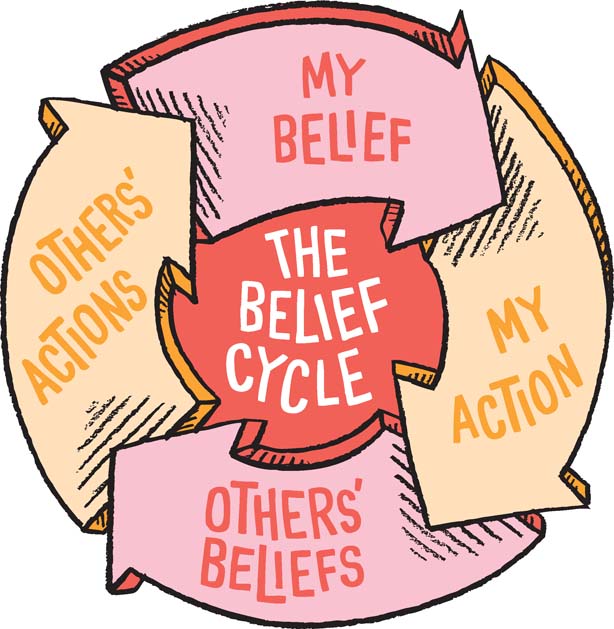
Starting at the top (thinking about the illustration as a clock, we’re at 12:00), we all have thousands of beliefs. Beliefs about everything from books to bread, ways to work to days of the week. Based on our beliefs, we take action (at 3:00). And it turns out every action we take, other than an instinct like ducking if a ball is thrown at us, is based on our beliefs. Based on our actions, the people around us form beliefs of their own (6:00), and based on their beliefs, they too will take action. AND … here’s the big insight for me: 95% or so of the time, their action will reinforce the original belief. As late 19th-/early 20th-century psychologist William James once wrote, “Belief creates the actual fact.” Adding to that short synopsis, between 12:00 and 3:00, there’s what I call a filter—scientists would call it confirmation bias. We all filter out what does not support our beliefs. And we take in what does support them. Which is why, I learned, the saying, “I’ll believe it when I see it,” is backwards. It ought to say the inverse: “I’ll see it when I believe it.”
The beautiful thing about the beliefs work for me is that the learnings keep coming. Here’s one I stumbled on last week, something that helped explain why so many people are impacted so quickly by the belief cycle.
In a 2010 article entitled “Learning By Doing: A Theory Of Learning Which Advocates Reading How-To Manuals, Only After Extensive Hands-On Direct Experience, And Then Only When There Is Need For Help & Guidance,” Professor Henry Gurr explains how humans generally learn best by doing, and only really by doing when there is a relevant situation in which try out the learning at hand. Gurr was a huge fan of and advocate for the writing about quality done by Robert Pirsig’s 1974 Zen and the Art of Motorcycle Maintenance: An Inquiry into Values. (I wrote a bunch about it a few years ago.)
Gurr’s “real job” (his quotes, not mine) was in experimental nuclear and neutrino physics, as well as a university professor and physics teacher. Gurr’s beliefs were so impacted by Pirsig’s book when he read it in 1995 that he essentially built the rest of his life around it, devoting years to retracing every bit of the Minneapolis to San Francisco motorcycle journey that’s the focus of the book. Later, Gurr applied Pirsig’s beliefs about quality to learning processes. Gurr writes,
Learning by doing at its best. You learn faster this way!! And you remember more this way!!! … And as you are doing this, of course => Watch How Your Mind Works!
I realized that one of the reasons the beliefs work connects with people is that it’s almost always “learning by doing.” It’s not just an academic exercise. Everyone has beliefs that are helping them already.
One of Gurr’s main areas of study was what he called “Flashes of Insight.” The realization that a very high percentage of really important learning comes up quickly, essentially out of the blue, not from the long-term linear approach to learning that’s encouraged in our educational system. By contrast, epiphanies of the sort Gurr is focused on often emerge quickly in moments we weren’t expecting them. This is, I’m sure, what happened that morning in Atlanta when the physician who thanked me with tears in his eyes—I doubt he came to the conference expecting that to happen.
A “Flash of Insight” is absolutely what happened to me when I learned this work 15 or so years ago. I was reading Bob and Judith Wright’s book Transformed. There were plenty of good learnings to be found. I like the Wrights’ work and have benefited from other insights of theirs in the past. Still, I was not expecting to have my world changed while I was reading. But sure enough, out of the blue, on page 109, I came across the visual model—the self-fulfilling belief cycle that we have now been teaching here for over a decade.
It was one of those situations akin to what John Moriarty once described about coming upon a door where we didn’t expect to find anything.
And now … a door, and we lift the latch. And how strange is it to stumble on the path that takes us to that door. And how strange it is to lift that latch. And how strange it is to hear that voice. And how strange it is to discover we were always so near home.
It sounds silly to me to say it now, but the truth is that I had never thought about the impact our beliefs have on our lives. This is, I realize too, what happens to a whole host of people when they hear me teach it too. Once one has the “Flash of Insight,” everything suddenly shifts. Things that were confusing for ages now appear in a way that makes total sense. In a talk given four years ago next week at the University of South Carolina Aiken, “An Explanation of Best Available Theory of ‘How Our Mind Works,” Gurr said, “Spontaneous insight comes out of unconscious broad brain processes, and you only know it when you have the flash of insight or mental arrival.”
For me, the flash of insight was just how HUGE this new learning was. Once I grasped what the self-fulfilling belief cycle was all about, it almost immediately became clear how hugely impactful the idea was. I started studying and realized it was even more impactful than I’d initially imagined. Which in turn brought more flashes of insight, more studying, more flashes, more insight. The belief cycle, I could suddenly see, was everywhere. I studied and had more flashes of insight, more reflection, studied more, and over the ensuing few years, it turned into a 600-page book, The Power of Beliefs in Business.
What I realized that week is that so many of the people who learn the belief cycle model for the first time experience the same sort of “Flash of Insight.” Why? Because, to Henry Gurr’s good point, nearly everyone who learns it can immediately apply it to a real-life practical situation they’re struggling with. Unlike many learnings that begin with an academic explanation that only later might be applied to real life, the belief cycle is at work all day, every day in all of our lives.
John Moriarty used to say, “The quest for the greater world is a request for a greater vision of the world we already live in.” The beliefs work, I believe, allows us to do just that. It opens the door for anyone interested to make a positive difference in every part of their lives—to self-manage more effectively, reduce stress, increase influence, and enhance enjoyment.
What can you do to make the work on beliefs come alive in your organization?
It’s more straightforward than many might think:
- Start teaching the belief cycle to everyone in your organization The reality is that so few people even know that they have beliefs, that just sharing the model alone can be a big eye-opener!
- Bring up beliefs in conversations. Rather than getting stuck in arguments and thoughts, as I learned how to do so well growing up, you’ll see that conversations start to shift in good ways when beliefs are woven in. What long-standing belief of yours is causing problems? What beliefs are really benefiting? Which beliefs might need to change?
- Gently highlight areas of different beliefs. This is a way to show folks what you’re talking about. No judgement. It can be done with grace by simply asking questions: What do you believe about this situation? What do you believe about yourself? Where did those beliefs come from?
- Remind everyone that beliefs can be changed. Secret #43 is “A Recipe for Changing a Belief.” The new “Why Democracy Matters” is a written reflection of my much-changed beliefs on the subject.
- Consider writing a Statement of Beliefs. I believe ever more strongly that the work on a Statement of Beliefs can be as positively impactful as doing a long-term vision. The good news is that we can do both!
With beliefs in mind, I was happily surprised to get this seasonally timely learning on the history of Ukrainian Easter eggs, or pysanky, from the wonderful writer Darya Zorka. You can read her whole essay here. I thought it was a fascinating example of how beliefs play out in quiet ways in our lives, more often than not, without people even realizing it. As you’ll see, the social beliefs about the eggs changed significantly over time, but the belief that the eggs themselves were incredibly meaningful was so deeply held that it outlasted a whole host of very significant social changes.
Pysanky are no ordinary Easter eggs. As Zorka writes, “Ukrainian pysanky are among the most extraordinary Easter eggs in the world.” In ancient Ukrainian societies, the sun was seen as the most important of all the gods. And because birds were the only animals that could fly closer to the sun, they—and their eggs—were believed to have magical powers. When Christianity came to Kievan Rus in 988, the importance of eggs shifted from the sun to Jesus’ resurrection. In other words, the belief supporting the import of pysanky changed, but the import of the beautifully decorated Easter eggs was unchanged. When the Bolsheviks took power and the Soviet regime tried to eradicate Ukrainian culture, pysanky were banned. It was Ukrainians who lived, metaphorically, at the “edge of the village” in remote communities in the mountains. Their devotion and their belief in the import of pysanky kept the tradition going even when they risked going to jail for making them. In 1991, the Soviet Union fell and Ukraine regained its independence. And as Zorka writes, “When the Soviet Union collapsed, pysanky began their revival. Right now, it is one of the most cherished Ukrainian traditions and is deservedly recognized as the cultural heritage of humanity.” Bottom line? Over the course of history, beliefs changed plenty of times, but the pysanky stayed a critical component of Ukrainian culture.
The fact that we can build momentum around the power of positive beliefs and that those beliefs can make a difference was reaffirmed for me this past weekend when I read the enews from Filip at Start Trak. The founder of Z Tapes in Prague, which puts out music from an array of little-known Eastern European artists (he’s Slovak), Filip writes quite insightfully about the music world. And this week’s column is all about choosing positive beliefs. Writing about record reviews and music journalism, Filip encourages us all to begin our work with positive beliefs:
When I look around, I see a lot of negativity surrounding me in music-related topics. The critique or negativity is appropriate, as many things suck. Streaming, AI in music, major labels, shipping costs, social media platforms, living costs, and more. The reasons to be sad or discouraged are so many that you might think there is not an inch of positivity in the music world. I must admit that often, I contribute my negative thoughts to the pool of negativity. … However, I would love for us to take a step back and start thinking more positively.
Instead of writing a post about the streaming situation, you could write one promoting your friend’s music. Instead of feeling hopeless and seeing everything around you crumbling, think about how you can contribute to making the lives of other musicians better. Buy a tape or music on Bandcamp and write them a nice note. You could send them an email expressing how much their music means to you. You could start a blog or write for a blog like ours to share your passion for music.
In Night Journey to Buddh Gaia, John Moriarty writes, “A graffito on a gable in Spain reads, ‘How sad to be young and not want to change the world.’” He adapted it to: “How sad to be any age, nine or ninety, and not want to change the world.”
The work around beliefs, I am confident, is one way to make those changes happen. The fact that the changes are coming from the metaphorical huts at the edges of our villages rather than national headlines only reaffirms my belief that this is the route to positive change. Who knows how many great doors might open. The work around beliefs, as I said up top, has already improved my own life and our organization enormously. It has the power to do the same for countless others. There’s so much to learn, so many flashes of insight to have, so many epiphanies to experience, so many beliefs to be changed for the better. The immensity of the opportunity leads me to something John Moriarty used to say,
When people ask me are you happy, I’d say that isn’t quite the question. The real question is, am I still growing? Have I become a finished creation? Am I dead or am I still growing? Is my life still an adventure, an adventure full of trouble, full of joy, full of pain, full of cataclysm? Am I still living dangerously? So, “Am I still growing?” is the real question.
I realize that I can say with confidence that, thanks in great part to the impact of beliefs work, my answer to that last question is an adamant, “Absolutely!” Take a little time, explore the work around beliefs, either some of what I’ve written, or elsewhere, and examine what it might mean in your own life. Let me know what you learn.
A bundle of beliefs
P.S. The Power of Beliefs in Business book, as well as the various single essay pamphlets from the book, and our Statement of Beliefs are all on ZingermansPress.com and ZingTrain.com.