Turning Setbacks into Successes
Learning to lean in and muster more resilient leadership
Last week, I wrote about how a random connection to a cover version of a 30-year-old Nirvana song led me to explore and learn from the life and work of the extraordinary musician and artist Abe Partridge. Had I clicked on a different song that day, the whole thing would have turned out entirely differently.
With this week’s topic, it’s the total opposite. I didn’t stumble upon the recent Supreme Court decision on the Voting Rights Act and Louisiana by accident; to the contrary, I was watching the case closely. Even if it might have been nice to be able to tune it out, what was at stake is enormous, and my desire for denial is nowhere near that strong. It’s an issue that’s close to my heart and, I believe, of huge ethical import to the health of the country. All of which means that when the Supreme Court ruled as it did, I, like many people I know, found the word “setback” at the forefront of my mind. It did not go away the next day. In fact, the more I thought about the situation, the louder the voice in my head kept blaring, “SETBACK!”
Again, I’m far from the only one who sees it this way. On May 3, the L.A. Times headline got straight to the point:
After Voting Rights Act setback, Black Americans brace for a renewed fight
The Packard Foundation’s headline was equally dire:
U.S. Supreme Court Ruling Is a Devastating Setback for Voting Rights
And the nonprofit Campaign Legal Center observed:
A 6-3 U.S. Supreme Court decision in Louisiana v. Callais has eviscerated Section 2 of the Voting Rights Act (VRA) and opened the door for states to enact discriminatory voting maps and laws.
This decision—which contradicts the text of the Voting Rights Act, the will of Congress and the Constitution—is one of the most consequential setbacks for our multiracial democracy in a generation.
For six decades, the VRA has served as the backbone of federal protections against racial discrimination in our elections—an essential guardrail ensuring that every American, regardless of race, has a meaningful opportunity to participate in the political process.
These statements are, I know, reflective of my own personal beliefs. But given that we at Zingerman’s have openly, freely, and passionately committed to the project of working toward an ever more diverse organization and community (it’s written into our 2032 Vision, among other documents—email me if you’d like a copy), it would be pretty much impossible for me not to see this ruling as a massive step backward, as those headlines indicate.
So what do we do when faced with a significant setback? After all, we don’t need the Supreme Court in order to encounter one; barely a day passes without setbacks of some sort showing up at our doorstep. Having reflected on all this in recent days and weeks, I think it’s quite clear that the people who do the best in any organization are those who are most adept at handling the setbacks—both large and small—that come their way. Positive psychologist Seph Fontane Pennock writes,
Whether [your] goals stem from desires for fitness, entrepreneurship, or some other domain, they all have one thing in common: a road paved with uncertainty, sacrifice, and setbacks. As such, it is key that you learn to foster a sense of resilience within yourself to ensure you overcome these setbacks to aid your rise to greatness.
Indeed, as monumental and overwhelming as the current national malaise feels, I keep bringing myself back to the wisdom of psychologist and author Angela Duckworth, who says in her groundbreaking book Grit, “Do not let temporary setbacks become permanent excuses.” Whether it’s destructive, despair-evoking Supreme Court decisions or—on a much less consequential scale—food orders that don’t show up, setbacks are inevitable when you’re trying to build a regenerative organization or get a great meal on the table for a party of 10. Yes, there’s a lot we can do to try to avoid them: teaching everyone to think like a leader, open-book management, helping people learn visioning, developing new forms of democratic governance. Nevertheless, setbacks will continue to arise. And to Duckworth’s well-taken point, the feelings of frustration that they provoke are fully reasonable and understandable. What we do next, though, is up to us. As she writes,
Everyone gets discouraged. Everyone cries, sometimes. But some of us cross the Rubicon. When we do, we can say without reservation: Setbacks don’t discourage me for long.
Which explains, in part, why Duckworth is who she is: a remarkable and important—if openly imperfect—writer and teacher who has contributed greatly to the quality of life of thousands of students and readers around the world. She’s a major 21st-century philosopher whom I am grateful to call a friend (I’ll be speaking at her Wharton class next winter), someone who can give a globally recognized TED Talk while still speaking openly about her own anxieties and uncertainties, and a person who is now skilled at overcoming setbacks—and who, through her brilliant work, is helping others (like me) surmount ours as well.
It’s critical to keep in mind that how we view our setbacks—how we frame them—can make all the difference. Writer Rebecca Solnit has said that trying to decide where a story begins is like dipping a cup in the ocean. Similarly, my friend Gareth Higgins, the Irish author, taught me that “you never know where a story will end, especially when you’re in it.” In other words, the way we center a setback in our own history will vastly alter its impact. We have the power to turn setbacks into normal and expected—if also still sometimes frustrating and frightening—aspects of our personal and organizational constructs.
The late British sculptor Phyllida Barlow made setbacks an essential part of her art, saying,
I am interested in the cycle of damage and repair. There is something about that edge where those two things coexist: damage and repair. And nature gives evidence to that in extraordinary ways where you see the rotting tree, but you also see the new green shoots springing out of it. … In the collapse of a monument, there is a tragedy, a triumph, a beauty, and also an immense grief. The monument has this extraordinary range of emotive qualities.
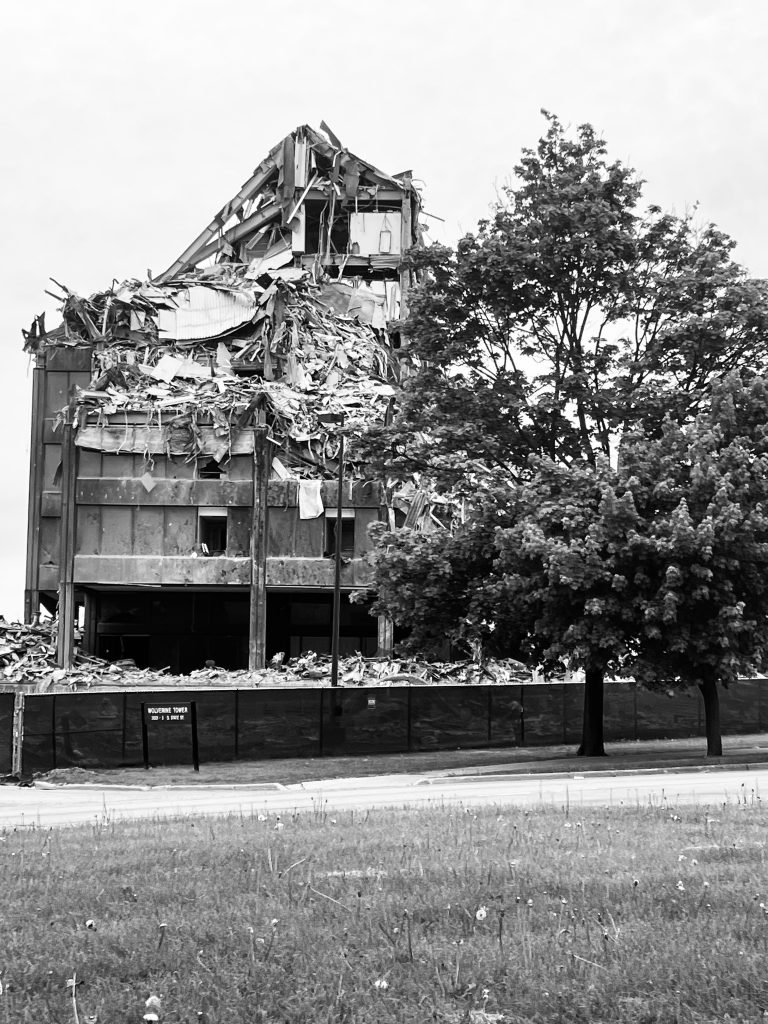
I love Barlow’s notion of existing at the confluence of collapse and rebirth. By chance, I just happened to catch sight of a real-life example of this phenomenon right here in Ann Arbor. The other day, I was driving from my house to the Bakehouse; it’s a route I take at least 10 to 20 times a week, so it’s easy for me to make the 12-minute drive on autopilot. I was about 80% of the way to the Bakehouse when I came over a slight ridge in the road and—whoa—on the left was something that made me think one of Phyllida Barlow’s followers had come to town to do some serious large-scale sculpture. At first, I thought I was seeing an art installation of a half-torn-down house. But when I looked closer, it was actually a building, Wolverine Tower, partway through the process of being demolished (as shown in the photo up top). Creative art or collapsed ruin—as Barlow suggests, the two don’t actually appear all that different. It’s our own beliefs, vision, and values that shift the equation.
Along these same lines, the Belgian artist Erik Pevernagie writes about failure—another version of collapse and setback—as a source of positive potential in the notes for his painting The freedom of new thinking:

Through the freedom of new thinking, we can transcend boundaries and break down cultural, social, or intellectual barriers. It even lets our failure be seen as a stepping stone to success rather than a setback.
The most powerful art does often seem to emerge from the artist’s willingness and ability to remake their personal hardship into work that resonates with and inspires others. This, I think, is a lot of what hit me so hard about the music of Abe Partridge, who left the Baptist ministry and “lost his mind” before embarking on his creative journey.
So what, then, can we do to increase the odds of transforming our own setbacks—of which there will undoubtedly be plenty—into successes? The late longtime San Francisco 49ers head coach Bill Walsh writes in his leadership book The Score Takes Care of Itself:
When you stand and overcome a significant setback, you’ll find an increasing inner confidence and self-assurance that has been created by conquering defeat. Absorbing and overcoming this kind of punishment engenders a sober, steely toughness that results in a hardened sense of independence and a personal belief that you can take on anything, survive and win.
This is the quality that Angela Duckworth calls “grit.” As I mentioned, Duckworth’s ideas have had a big influence on me, on the culture of the ZCoB, and on the world of work at large. She writes:
Grit is passion and perseverance for long-term goals.
One way to think about grit is to consider what grit isn’t.
Grit isn’t talent. Grit isn’t luck. Grit isn’t how intensely, for the moment, you want something.
Instead, grit is about having what some researchers call an “ultimate concern”—a goal you care about so much that it organizes and gives meaning to almost everything you do. And grit is holding steadfast to that goal. Even when you fall down. Even when you screw up. Even when progress toward that goal is halting or slow.
It seems fairly evident to me that anyone who possesses grit, as Duckworth describes it, is likely to do well when dealing with setbacks. Those who lack it, on the other hand, may struggle mightily. Which isn’t to say that there’s anything wrong with feeling down when we find ourselves facing a setback. As Duckworth explains, this is universal:
Don’t think that gritty people never feel discouraged.
Do use times of doubt as an opportunity to consider what you truly want and believe.
In a sense, we at Zingerman’s know these things already, as an ecosystem whose members have, both individually and collectively, become quite adept at handling setbacks. Here are some of the ways I believe we work to achieve this:
Teach and practice visioning. When we know where we’re going—and when that destination is a goal we consciously chose and committed to, and genuinely believe in—it’s much more likely that we can stay the course when we falter.
Build connections, both across the organization and outside it. People who feel isolated have a much harder time dealing with setbacks. Connections support us in staying calmer and more focused, and make us better able to get ourselves back on track.
Teach beliefs. The Belief Cycle framework helps folks to process things in much more positive ways. It’s a stumble, not a surrender.
Teach hope. This allows us to see multiple possible paths toward our desired outcome.
Have open meetings. Let staff see the struggles we have as leaders, to normalize them as part of leadership!
Be vulnerable. Show others that we have doubts and pain, and own those feelings. This is so much of what recently drew me to Abe Partridge’s work. When he started painting and playing music professionally, he opened himself up in amazing—and meaningfully effective—ways. From the stage, Partridge began to reach out as he never had previously: “I played, in front of 7,000 people, songs that I wrote in the darkest part of my life.”
On a related note, Angela Duckworth shares,
I make a point to tell undergraduates that I go to therapy, was lonely, cried a river. … We are not invincible people … we are human beings, and it is okay to tell people when you are not okay.
Build emotional resilience. The more that new staff can see leaders in the organization model the sort of resilience we’re after, the more likely they are to practice it, too. Greater resilience always leads to better handling of setbacks when they occur. We start this teaching early on—see “Secret #49: Why (Paul or) I Still Teach Orientation for New Staff Members.”
Build patience into the culture. Patience is one of the most important assets for overcoming roadblocks. For example, as the heirloom bean folks at Rancho Gordo in California explain:
A lot of us who cook also garden, and as spring arrives, there’s this funny pressure to hurry up and get things into the ground. It’s anecdotal, but one year we didn’t get our seeds in until almost July. We thought we’d roll the dice and see what happened, but we were prepared for losses because we were so late. Guess what? When the soil is ready, magic happens.
Lean into the inner life of our ecosystem. This is about training ourselves not to force things or “make something happen” when the greater ecosystem in which we’re working is not yet ready. We even see a version of this dynamic play out in the natural world, when industry attempts to impose its will on the land. As photographer and regenerative expert Camrin Dengel observes,
Many land stewards across rural America are rising up. They are collectively pushing back against extreme industrialization and fighting for the survival of rural economies. Working with the land, rather than presiding over it, has become its own form of resistance.
Embrace the ritual of the routines we depend on. Without the foundation of our working routines, it’s almost impossible to create the kind of stability, continuity, and long-term commitment we need to turn setbacks into ultimately positive contributors to organizational health. Stewart Brand, founder of the Whole Earth Catalog, says,
Treat the boring task as a ritual, alive with aesthetic nuance and a welcome respite from the clamor of thinking. Find your own contemplative practice.
While the above approaches are part of what we do at Zingerman’s, author and speaker Amy Shoenthal has developed her own effective four-part cycle for managing setbacks:
Establish. What was the setback that happened?
Embrace. Make peace with the challenge.
Explore. Why did the setback occur? What could we have done differently? What are others doing?
Emerge. Where will we go from here?
Shoenthal’s formula provides a simple but valuable framework—one that today’s young people might especially benefit from adopting.
Like all things, how we respond in such moments is, of course, shaped enormously by what we learn as kids. In a recent essay in The Atlantic provocatively titled “Let Your Kids Fail,” Russell Shaw, head of school at Georgetown Day School in Washington, D.C., writes, “Too many parents, probably unwittingly, are conditioning their kids to be afraid of losing. But experiencing failure and learning to recover from it are prerequisites for long-term success and, crucially, for mental health.” Shaw is suggesting here that we would be wise to work to develop a sort of “setback immunity” in our children:
I’ve come to believe that failure works in a comparable way—that it is in a child’s best interest to be exposed early to manageable setbacks, so they can develop what we might call “failure immunity,” the psychological antibodies that allow them to face future disappointments without falling apart. This requires practice—specifically, practice at encountering obstacles and pushing through them. You can’t develop perseverance if you’ve never had to persevere.
And Shaw reminds us that this effort starts with us as parents or leaders: if we don’t model this perseverance, and stay open about what we’re grappling with, we’re going to have a hard time getting the young people around us to cultivate it.
To pivot slightly: David Lorimer once wrote a beautiful piece about the late Irish poet and philosopher John Moriarty. In it, he describes how Moriarty became increasingly convinced that, as the world evolves, “[t]he next big revolution in science … will be epistemological. That is, it will entail the very notion of knowledge itself, of how we know.” I believe this epistemological revolution could also include how, fundamentally, we think about setbacks. Rather than blaming ourselves or others when things go awry—rather than falling apart or giving up—we’d undergo a revolution in our heads and hearts that would allow us to see setbacks as golden opportunities for learning and growth.
Or, well—if you want to take a pass on all that—one can always write a poem. That’s right: when setbacks have us feeling out of sorts, poetry is another terrific tool to help us step back, look through a different lens, and see the scenario in a fresh light. In his lovely introduction to collagist Keith Waldrop’s book Light While There Is Light, poet and novelist Ben Lerner leans into the import of poetry in difficult situations—like when we suddenly find ourselves facing a setback and are totally unsure of how to move forward. He quotes Wallace Stevens, who pointed out that “[p]oetry is a means of redemption.”
All of which challenged and inspired me to sit down to try to write a poem about setbacks! I make no claims to poetic excellence—only to what I’ve been learning from my poetic collaboration with Michael Dickman: that the point isn’t to get into the poetry hall of fame; it’s to increase understanding, to open new doors, to push pause and start to see things in new ways. It’s way more important, I’ve learned, to write poetry than it is to be right. And it seems Keith Waldrop took much the same approach: Lerner shares that, as a professor, Waldrop “pretty much gave everybody an A.” You know what? It works. Here’s the poem I wrote to help me handle the national setback that’s been so prominent in the news over the last few weeks:
“Positive Poetic Setback: Spring 2026”
It’s not, I suppose, a surprise.
When I say it aloud,
Might as well be proud.Setbacks suck
Still, I can’t, I won’t,
I definitely don’t.
Let them stop me in my tracks.
Setbacks are significant.
But they are not legitimate cause to claim, “I can’t do it.”Setbacks … It’s like the Stooges sang circa 1969
“No Fun, My Babe, No Fun!”We lose our footing, breathing isn’t easy;
The world seems awhirl.
But still, setbacks are not defeat.So sit back
Sit up
Sit straight.
Breathe deepGet centered.
Lean in.Get back on track
Set the setback aside, for a collage that’s yet to come.Breathe deep. Reread your vision. Or, better still, sit down and write one.
Reflect, redirect?Timothy Snyder, historian, Yale, recently removed to Toronto, says
“The politics of inevitability is a self-induced intellectual coma.”That we go that way,
Though,
is anything but inevitable.When it comes down to it, still, we get to choose
Setbacks can slow us down, but
Inevitability is not inevitable.
And we can, I’m confident, do better.So, setback? Sure?
Stop?
No way. I know. We have more to do.Breathe deep. Double down.
Ready. Set. Back up off the ground. Get going.
Finally—to come full circle—I’ve had music on my mind ever since writing last week’s piece on Abe Partridge. And this week, I got caught up in a cryptic, ancient-sounding set of instructions for how to build one’s own musical instrument, from the liner notes for South African dark folk band Inekt’s new album, Hálgrem. It struck me as a great metaphor for creating the kind of organization we believe in—an organization that’s true to its essence, that brings beauty to staff and customers alike, that helps today but is built to last well into the future. An organization where setbacks happen, but where determination, resilience, and resolve overcome obstacles every day:
Do not carve the frame in haste, for the body will remember the hand that shaped it. Take wood that has listened long to wind and shadow, and bend it gently, as one persuades rather than commands. When the hollow is made, stretch the skin across its face while it yet holds a breath of life, for dead hide lies silent, but living skin will answer when called. Draw it tight, though not to pain, and bind it fast, whispering to it as it dries, lest it forget its former song. Set the neck as one joins bone to body, firm and without doubt, and thread the strings as veins laid careful, each one knowing where it must sing. Then leave it awhile in stillness, for such an instrument must come to itself, and will not suffer to be hurried. And when at last you pluck it, do so as you would greet an old companion returned from a long and troubled road—for it is not merely made, but awakened, and it will remember whether you were kind.
Naturally, I tried to dig deeper to uncover the origins of this mysterious text, but, frustratingly, I got nowhere. It was, one could say, something of a setback. No surprise, though—I’m definitely not done digging. I’m sure I will learn more.
So if you were looking for a quick answer on how to deal with setbacks—such as the recent Supreme Court decision—I admit this essay is not that. It is, though, an invitation to reach out—to me, to others, to folks who can offer insight and support on the questions that matter most: how we build our organizational ecosystems. How we train ourselves to handle setbacks with grace. How we go forward, owning the struggles but not getting stuck in them. Our communities will remember if we’ve been kind, and people will absolutely notice the difference.
When we struggle and slip into deep self-doubt, we shift all the energy in the room—down and out, and not for the better. But when we’re able to rebound effectively, positive outcomes can emerge. Every time a setback plucks at our heartstrings, think of it as if we’re about to “greet an old companion returned from a long and troubled road.” And while setbacks surely do still suck, they don’t need to stop us in our tracks. As Southern California writer Eleanor Brownn puts it,
A comeback is a setback that did its homework, learned the lesson, and then moved forward.
Just last week, Brownn posted this clip of Lyndon Johnson’s last recorded interview—done 10 days before his death in 1973—in which he reflects on his work to get the Civil Rights Act passed in the 1960s. Johnson experienced many setbacks during that arduous battle, but he also knew that they were not the end. There is also, per Keith Waldrop, light while there is light.
Last night, the wisteria in our backyard—a plant that represents longevity, romance, good luck, and resilience—bloomed in an abundance we have never seen in 25 years of living in the house.
There is hope. In Brownn’s words, “Walk gently and be brave.”