Why Democracy Is Way More Punk Rock Than You Think
A pamphlet, a presentation, and a host of practical ways to make it work
Joe Strummer, co-founder of the legendary English punk band the Clash, once opined, “Everybody has a story to tell.” What follows is a small bit of mine.
Next Friday, June 5, at 4 p.m., I’ll be speaking here in Ann Arbor about the new pamphlet, “Why Democracy Matters,” for LeadersConnect. (If you’d like to come to the talk, and enjoy some Roadhouse snacks, here are the details. I’d love to see you there.)
Thinking back, I realize I’ve been writing about food and cooking for something like four decades now. Democracy, though, is a different story altogether—it’s been just three or four years, at most, since I had the courage to put thoughts about it in print. Today, they form a 120-page pamphlet. So if, as I wrote last week, hope came calling to me many years ago—in the spirit of Peruvian writer Maria Vargas Llosa’s belief that the subject selects the writer, not the other way around—then it’s reasonable to say that democracy tapped me on the shoulder only fairly recently.
Twenty years ago—even five or 10, for that matter—I could not have begun to tell you anything of what I’m going to say next Friday. Democracy was something I certainly knew a little about, and believed was a good idea, but it was a concept and construct to which I’d really given next to no serious thought. And now, in these last few years, it’s suddenly shifted to become front and center for me, both personally and organizationally.
I’ve learned a lot in the process. As the opening lines of the new pamphlet state,
Not long ago, the acclaimed American and Canadian scholar Henry Giroux put forward his belief that, “Americans have forgotten what democracy is about.”
I, for one, am guilty of what Professor Giroux has posited. In some ways, despite having graduated with a degree in Russian history, I now find myself wondering if I ever truly understood democracy at all.
I really don’t think I did. As you’ll hear next Friday afternoon (or read in the pamphlet), my understanding of the subject has come a long way—which has deeply benefited my work as a leader, and also, I believe, the health of our organization.
Leading an organization of any sort is, in my many decades of experience, nearly always challenging. When the greater ecosystem around us is in a state of stress and upheaval, that work becomes all the more difficult. In such circumstances, I know myself well enough to recognize that it would be easy for me (and maybe you) to give in to either denial or fear. These feelings are normal, to be sure; it’s what we do about them that matters most. I meant what I wrote last week about a resurgence of hope; still, it would be silly to say that anxiety does not currently abound in the American consciousness. One friend from the south of France emailed me the other day, opening his note with, “Unfortunately, you now live in a crazy country, as you may well know already.” True enough. The key for me, though, is to stay centered anyways. Lately I’ve been reminding myself of these words from musician, poet, and performer Henry Rollins:
This is not a time to be dismayed. This is punk rock time. This is what Joe Strummer trained you for. It is now time to go. You’re a good person, and that means more now than ever.
Rollins, I believe, is right: being a good person is a big deal, all the more so when many national leaders seem overtly intent on benefiting only their own bottom lines. And he’s also right to imply that there’s merit to doing a deep study of Joe Strummer’s life and work.
Part of the “training” Strummer offered us half a century ago is this inspiring call to action: “People can change anything they want to, and that means everything in the world.” Which means that, as hard as things may look or feel at any given point in time, we still have the power to make a difference!
In that positive vein: if hope, as I said last week, is on the horizon, then I see democracy, too, as being on the comeback trail. As the headline for longtime journalist Bill Kristol’s column in The Bulwark read last weekend: “Don’t Count Democracy Out Just Yet: We’ve overcome bigger challenges before.”
Whether or not Kristol will be proven correct is, of course, mostly up to us. Again, I’m with Henry Rollins: “Voting is completely important. People in America think democracy is a given. I think of it as an ecosystem, and what gets in the way of it is politicians and apathy.” As I often note in my conversations about democracy, though, it’s not what happens in Washington that’s most essential. Instead, we can focus first on our own spheres of influence: our workplaces. The way the corner store is run, I’ll suggest, can be just as consequential as what happens in the halls of Congress, and how people work at the local factory sets the precedent for what transpires in world capitals. It’s a concrete manifestation of writer Wendell Berry’s wise words: “The leaders will have to be led.”
One can’t—I know from my work on The Power of Beliefs in Business—make anyone change their beliefs, including politicians and global leaders. But that doesn’t mean we can’t try, right? You never know which individual or what small action might have a ripple effect that will alter history. Or when the river of history will shift in a direction that one would never see from the other side of the upcoming bend. Here are a few examples that come to mind, from micro to macro:
Five years ago this past December, a suggestion from an hourly holiday Mail Order warehouse staff member at a monthly Zingerman’s-wide huddle led us to change the qualifying period for purchasing a Community Share—and owning a piece of the ZCoB (Zingerman’s Community of Businesses)—from two years’ employment down to two months. Today, over 300 ZCoBbers own a share!
Forty-eight years ago this month, my new friend Frank Carollo unexpectedly started teaching me how to cook the line—a step up from the dishwashing job I’d taken the previous month in order to pay rent and not have to move home to Chicago. Frank could have stayed focused on his own work and, as is common in so many workplaces, ignored the new dishwasher. His small act of generosity changed our history. It’s a pretty straight line from me learning to line-cook to Paul and I opening Zingerman’s nearly four years later.
Seventy-two years ago last weekend, on Saturday, May 22, 1964, President Lyndon Johnson came to Ann Arbor to deliver an inspiring (and unanticipated by all but his inner circle) commencement address at U of M. It was one of those mid-spring Michigan days that feels much more like midsummer—a sweltering 90 degrees and sunny. Those in attendance had little idea ahead of time what Johnson was going to say, but it turned out to be a significant speech. He opened with a couple of so-so jokes but then fairly quickly moved into the heart of the content, announcing for the first time the creation of what he called “The Great Society.” His words, remarkable in 1964, sound all the more so today, and seem worth quoting at length:
The challenge of the next half century is whether we have the wisdom to use [our] wealth to enrich and elevate our national life, and to advance the quality of our American civilization.
Your imagination, your initiative, and your indignation will determine whether we build a society where progress is the servant of our needs, or a society where old values and new visions are buried under unbridled growth. For in your time, we have the opportunity to move not only toward the rich society and the powerful society, but upward to the Great Society.
The Great Society rests on abundance and liberty for all. It demands an end to poverty and racial injustice, to which we are totally committed in our time. But that is just the beginning.
The Great Society is a place where every child can find knowledge to enrich his mind and to enlarge his talents. It is a place where leisure is a welcome chance to build and reflect, not a feared cause of boredom and restlessness. It is a place where the city of man serves not only the needs of the body and the demands of commerce but the desire for beauty and the hunger for community.
Immediately after the ceremony ended, LBJ’s speechwriter Richard Goodwin remembered, there “was an instant of silence” as people took in the progressive nature of what the president had just said. In a sense, I would suggest that all of us leaders, all these years later, are in a position to make comparable declarations of our own—to put ideas and values out front for everyone to see. While Johnson was a powerful politician and Joe Strummer an edgy punk rocker, their messages were not so dissimilar. Each was, in his own way, speaking to what I write below about dignity: People matter. Values matter. We can do right and do pretty well at pretty much the same time. This is, as I’ve come to see it, what democracy means to me.
Indeed, from the ZCoB’s Community Shares to LBJ’s Great Society, democracy is ultimately about empowering individuals and then working together to help make great things happen that benefit the whole. It’s about creating workplaces where new staff members who may not hold high-level titles have a voice and an impact on how the organization runs. About fostering environments in which—to quote the title of a 70-year-old essay by Trinidadian historian C. L . R. James—“Every Cook Can Govern.” About building organizations where leaders are working to do the right thing for the group, not just to get more cash into their carefully hidden accounts. It’s not about division; it’s about dignity. It’s not about politics; it’s about people.
If you’d interviewed me spontaneously about democracy four or five years ago, I truly wouldn’t have had a clue what to say. Fortunately, I’m a good learner. What I’ve come to understand and believe in recent years has raised my hope level, increased my sense of purpose, and given me a much clearer sense of what we can do—and, in our case, are already often doing—to make democracy a reality inside our organization. Yes, yes, of course I will absolutely be voting in November, but I can say with confidence that what’s in the new pamphlet—and what I will discuss next Friday—is, again, not about politics. It’s about what people like you and me can do every day and what we can help make happen within our organizations.
Yes, the government and who’s in charge matter. Yes, national systems matter. But they are, I see now, more the end than the means. To civil rights activist Bayard Rustin’s point in the opening quote above, democratic countries start with democratically inclined companies. Democratically oriented schools. Democratically aligned churches. Democratically run book clubs. The bottom line is the bottom line for a reason: the more we practice democratic constructs in the day-to-day, the easier it will be to enact them on a much larger scale later. It only makes sense. Today, it seems we are mostly electing people who have never worked in democratic settings and putting them in charge for the first time on a really, really major scale. But no matter what skill we’re learning, it’s way wiser to start on the metaphorical bunny hill than in the big time.
Now, with all that as background, let me return for a moment to the man we now know so well as Joe Strummer. He was born John Graham Mellior in Ankara, Turkey, in August 1952; his father was in the British Foreign Service, so the family traveled a lot. His mother was the descendant of Scottish crofters and became a nurse. (Strummer also had an Armenian great-grandfather who lived in India, and his great-grandmother was actually a Jew from Germany.) At the age of nine, he was sent to boarding school in England; his parents divorced not long after, and he wasn’t close to either of them. Six months or so after President Johnson delivered his commencement speech in Ann Arbor in May 1964, a 12-year-old Strummer (still, of course, going by John Mellior) heard the Rolling Stones play “Not Fade Away.” As he said later, “I never paid attention to anything in school after that. Music was everything!”
His brother, who was a year older, eventually became a reclusive neo-Nazi and killed himself in the summer of 1970, which deeply affected Strummer. Then, in the early ’70s, Strummer began getting heavily into music, and in 1974, he joined the 101ers. The Clash formed a few years later. This July 4 will, of course, mark the 250th year of American independence, but it’s also the 50th anniversary of the Clash’s first public performance, at the Black Swan Club in Sheffield. Their debut album, The Clash,came out the next year, in 1977 (though only in England—the American label was too anxious to release it!), and their fifth, Combat Rock, hit record stores in the spring of 1982, a couple of months after we opened the Deli. The odds are high that we had it playing on the boom box during setup some mornings that summer!
While we know them best for their music, the Clash were absolutely also about purpose and values. When Strummer died suddenly of a heart attack in December 2002, Jon Pareles of The New York Times called him the “Political Rebel of [the] Punk Era.” He wrote songs with all sorts of meaningful messages, including one of my favorites, “Spanish Bombs,” about the Republican forces fighting Fascism during the Spanish Civil War. Journalist Alexander Billet wrote in 2021 that “[t]he Clash’s importance lies not in their ‘genius,’ but in their decision to participate as artists in a chaotic and bleak world while never forgetting art and music’s capability to map a different future.”
The Clash lived these principles throughout their career. They gave up royalties on the album Sandinista to keep retail prices down. When a series of shows in a Manhattan club were way oversold and the fire department threatened to shut them down, the band offered to stay in town longer to make the shows happen—and they opted not to get paid for those extra performances. In the spirit of such democratic engagement, one of Strummer’s biographers, Gregor Gall, writes,
Strummer was seldom explicit about what listeners should then do—his songs tended to be more informative and inspirational than instructional. But he was nevertheless always clear that activism was positive and necessary to effect change.
With this in mind, I’ve been working in recent years to reframe my own beliefs about democracy—to adopt a totally different, radically more down-to-earth approach. To see democracy not as politicians in pinstripes pulling backroom shenanigans, but as pure punk rock. Forget formal judicial gowns and gavels; think about sneakers, sound, great guitar riffs, deep passion, and putting one’s heart and soul out there in ways that benefit everyone—with powerful words and peaceful action.
In fact, what Joe Strummer said about the Clash’s music strikes me half a century later as a pretty accurate description of how I view democracy:
What matters is how much spirit you put into it and how much intelligence you put into it. Does it have any meaning? You know, will it communicate to other people? When you really communicate to other people, that’s when they say that you’re the greatest rock and roll band in the world. Because all we’re doing, really, is trying to communicate something. Sometimes we don’t know what it is. Sometimes we do. But it’s nothing to do with an A minor seventh chord. All we try to communicate is, number one, “You’ve been brainwashed since the day you were born,” and number two, “You’ve got to do a lot of work to even do any of your own thinking.” We’re trying to communicate that destiny is within our hands independent of any other outside agency.
Unlike with so much modern-day political chatter, Strummer always spoke from the heart. “He sang every word like he meant it,” says one of the folks interviewed in the 2007 documentary Joe Strummer: The Future Is Unwritten. To be effective, it seems clear, democratic work must be based on exactly this sort of authenticity. In the film, someone else remarks that Strummer always “asked you to explore the very meaning of authority.” Trying to seize authority—in art, in life, in government—never truly works, at least not in the long term. And systems set up to support the consolidation of power and money by those “at the top” are the opposite of democracy and of anarchism. As Strummer explained:
Authority is supposedly grounded in wisdom, but I could see from a very early age that authority was only a system of control. And it didn’t have any inherent wisdom. I quickly realized that you either became a power or you were crushed.
Bono, the famed frontman of U2, went to a Clash concert in Dublin in 1977, when he was 17. “It’s not bad to have the Clash as your first rock show,” he says with a smile in the documentary. The impact far exceeded what anyone could have imagined. Years later, he said, “the Clash were the greatest rock band” in the world. Speaking of that early punk era, Bono adds, “There was a moment there where the world stopped. I mean, everything just stopped. 1976, 1977. Suddenly, ideas became more important than guitar solos, and a certain integrity became more important than driving a Rolls-Royce into a swimming pool.”
History may not repeat itself exactly, but this does sound eerily similar to where we are today. Next year, 2027, will mark a half century since Bono had his epiphany that a shift in values was taking place in society. So, again, if hope is on the horizon, then maybe—on the anniversary of Bono’s teenage revelation at that Clash show in Dublin—ideas and integrity are about to become more important again. You never know what will happen, or who will spark it.
The approach to democracy I’m describing—essentially, let’s do it ourselves in the workplace without waiting on Washington—is not, I know, commonly practiced. My hope is that sharing more of what we do here at Zingerman’s and offering some helpful resources (see below) might have some small impact. The risk is really low, but the potential benefit is large.
This reconception—this sort of positive move forward—involves pivoting away from the idea that democracy, by definition, means only fair voting for representatives. As I said, I will be voting in November, and I hope you will, too. But a big piece of my learning is that voting is just one version of a democratic construct, and a pretty limited one at that. In reality, there are many dozens of small ways to practice democratic constructs each day. Working on the new pamphlet made me realize that we are already doing dozens of things daily to make democracy happen. Do we do them perfectly? No, of course not! It’s like what many observers say in documentaries about the Clash: even when it didn’t work out, the band always tried to do the right thing and went at it from the heart. Same here!
In his lovely little book of poetry and prose A Small Porch, Wendell Berry writes,
It must be clear enough by now that I am a reader who reads for instruction. I have always read, even literature, even poetry, for instruction. I am a poet, and so I have read other poets as a poet, to learn about poetry, and just as important, to learn from poetry.
This process is, I believe, akin to the challenge of democracy. For instruction, we have to look for living examples out in the world—because they don’t teach the punk rock version in school.
With regard to our own work here in the ZCoB, Yale historian Jason Stanley—author of several acclaimed books, including How Fascism Works and How Propaganda Works—once wrote to me:
I am so glad you are a voice for this approach to the workplace! It is so vital to get people accustomed to not being bullied and bossed around. Workplace democracy is one of the central and most important topics in democratic political philosophy. It’s where the battle over authoritarianism is fought—if you get workers used to being subordinated, and bosses used to subordinating, you are basically done, you have at least laid the groundwork.
So what do we do here to play our part? You may well know the list already, but here’s a start, and there’s much more to be found in the pamphlet. Needless to say, none of these practices are perfect, but each makes a positive difference:
- Open-book management
- Bottom-Line Change
- Open meetings
- Staff ownership (Community Shares)
- Using consensus at the partner level for decisions
- Offering appreciations (working on the pamphlet made me see that this 30-year-old practice we do almost daily is incredibly democratic)
- The constant effort to use our Collaboration Compact, and to work more effectively together—as Strummer used to say, “Without people, you’re nothing”
- Our Training Compact
- Our Stewardship Compact
- Our commitment to “Start with Yes!”—after all, cool stuff can originate anywhere
To be clear, I don’t share these because we’ve mastered them, but rather because it’s the effort that goes into them that matters. The Clash, too, worked incredibly hard to get where they did. In Strummer’s humble words: “We aren’t particularly talented. We try harder.”
Finally, the bottom line on democracy—and my own biggest epiphany—is that it’s all about dignity. In “A Revolution of Dignity in the Twenty-First Century Workplace,” I explore my realization that dignity is, in fact, a prerequisite for democracy. (That essay is also in the democracy pamphlet.) For now, though, here are what I see as the six elements of dignity:
- Honor the essential humanity of everyone we work with.
- Be authentic in all our interactions (without acting out).
- Make sure everyone has a meaningful say.
- Begin every interaction with positive beliefs.
- Commit to helping everyone get to greatness.
- Create an effective application of equity.
As I got close to wrapping up my work on the pamphlet last winter, I saw that dignity—defined in this way—really is democracy. While voting may well be an important tool, it alone isn’t enough to sustain a democracy. That requires care and commitment, ethics and equity, generosity, kindness, empathy, and compassion. As Strummer says, “In fact, punk rock means exemplary manners to your fellow human beings.” So if we want to work toward democracy in any setting, large or small, we can start by:
a) Practicing the six elements of dignity personally—all day, every day, with everyone we deal with; and
b) Ensuring that our systems are congruous with, and supportive of, making those six elements happen!
If we do this well enough—if always imperfectly—then that’s democracy. Everyone’s humanity is honored; each of us can be authentic without imposing ourselves on others; we all have some meaningful say; we believe the best about everyone, even when we disagree; we help each other get to greatness (within our shared values and ethics, of course); and there’s some reasonable level of equity, since democracy cannot, by definition, be about enriching only the few.
Before anyone responds that they’re not yet sure how to do all this, I’ll call upon the words of the amazing writer Anne Lamott, who teaches anyone who will listen, “We need to write before we are ready.” The point isn’t perfection; it’s pushing forward. Don’t wait. Get others involved and get going. Have fun. Break some guitar strings and start over. Because, as Lamott points out, “Perfectionism is the voice of the oppressor, the enemy of the people. It will keep you cramped and insane your whole life.”
My personal commitment? To work harder than ever to embody the six elements every day. In hindsight, this is seemingly very much what Joe Strummer did in his own punk rock way for so many years. No need for heroes—just day-to-day good work. As Henry Rollins reminds us:
You can be thunderous in your own life, and being cool to the eight people around you? It rubs off. Goodness is viral.
Consider a small act of kindness to a line cook, a phone call to check in on a friend who’s not feeling well, a box of ripe apricots gifted to someone who’s passionate both about fruit and about fighting (peacefully) for more democratic constructs, a thank-you note to somebody you haven’t seen in six months (or six years). American-Canadian poet John Mark Green suggests how much such apparently “minor” gestures might matter:
Exquisite beauty
is often hidden
in life’s fragile,
fleeting moments.
If you’re still feeling down, or frustrated, or fearful—we each have our own ways of dealing with things, and one that works for me is going back to Strummer’s credo: “Don’t forget you’re alive.” And anyone who’s alive, no matter what we’re struggling with, can make a meaningful contribution! Democratic practice, in this context, is as down to earth as it gets. As the Clash frontman also said,
Punk rock isn’t something you grow out of. Punk rock is an attitude, and the essence of that attitude is “give us some truth.”
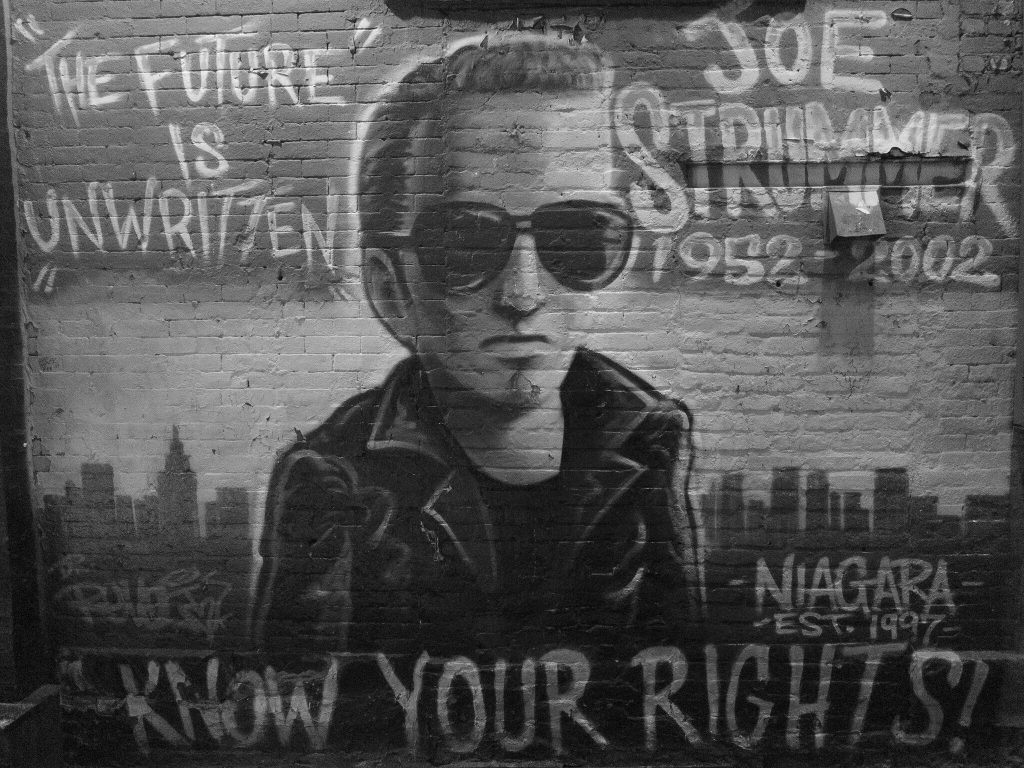
So put on London Calling or whatever music revs you up, and let’s get to work. Strummer once declared, “The future is unwritten.” It’s up to us what we make of it!