The Annals of an Awning
Covering Zingerman’s Deli with history
What’s so exciting about an awning? A whole lot, as it turns out—especially when a rich legacy of creativity and ingenuity is woven into its sturdy fabric.
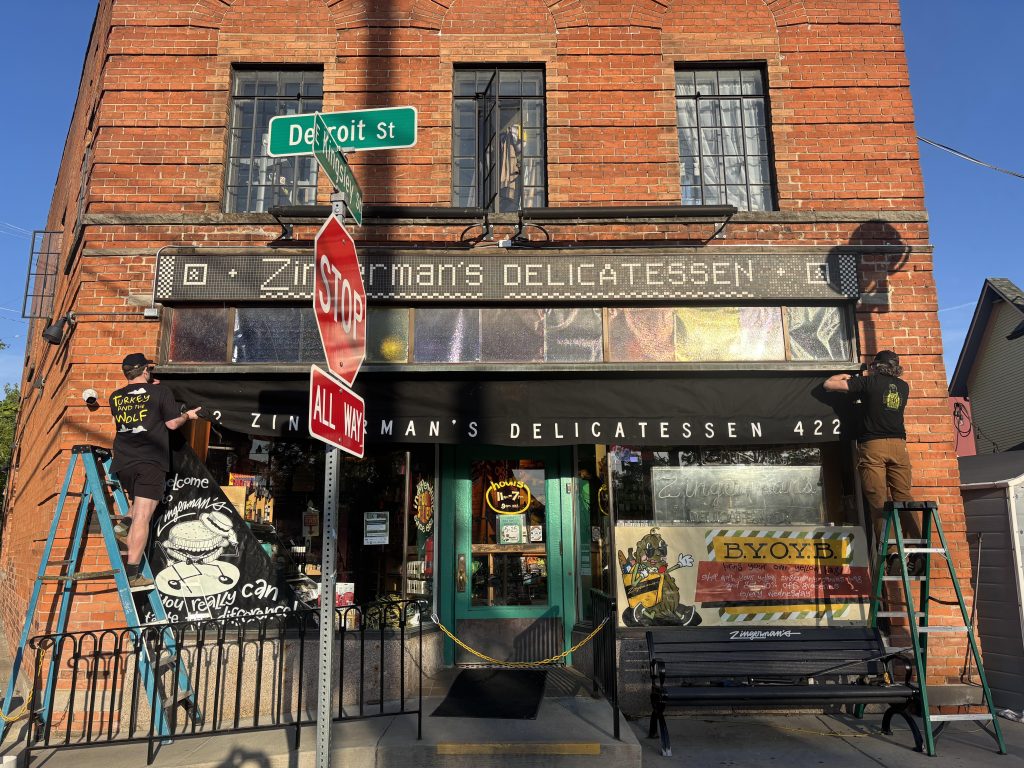
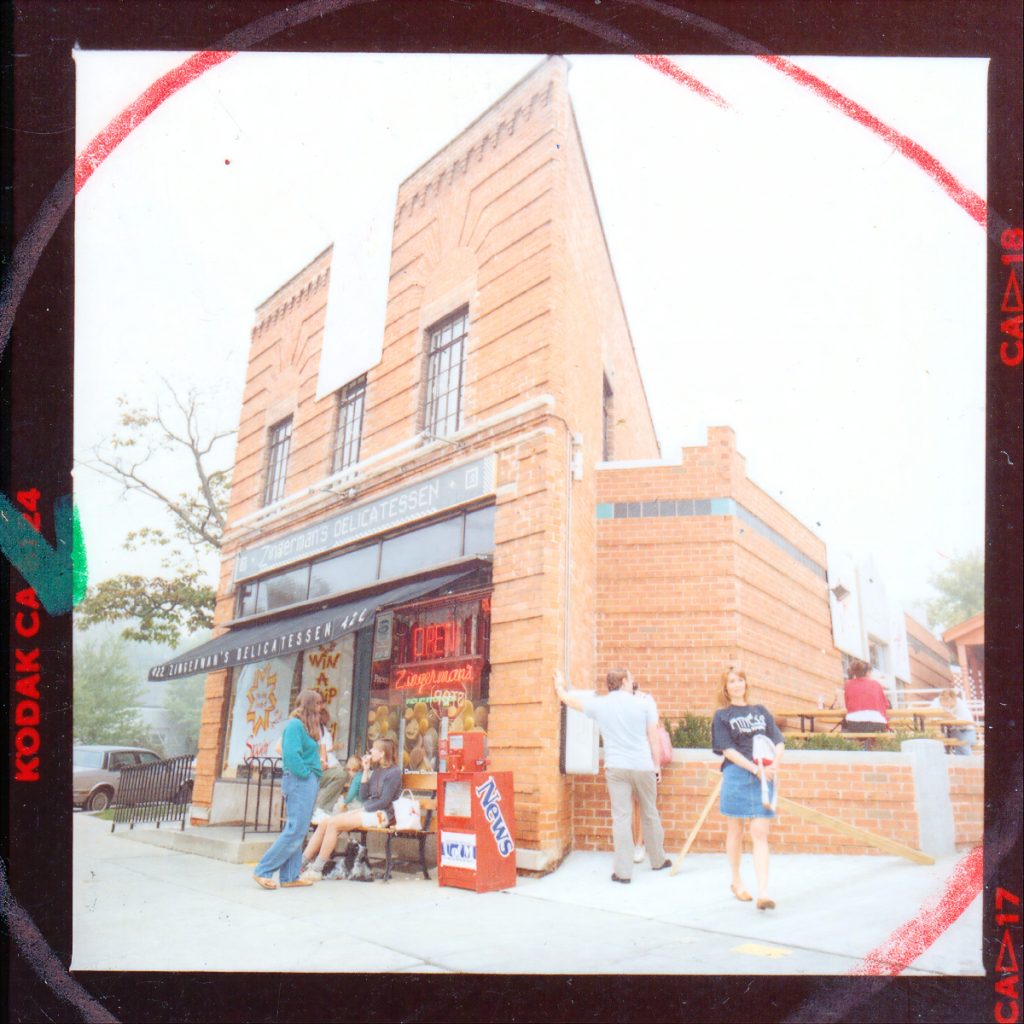
Such is the case with the classic black awning that hangs above the entrance to Zingerman’s Delicatessen, at 422 Detroit Street in Ann Arbor’s Kerrytown Historic District.
Even a gem needs polishing sometimes, and in recent years, the original Deli awning—installed in the late ’80s—needed more than that: it was weathered, tattered, and ready to be replaced. A local awning company had been contracted to produce a new one, but for various reasons, both logistical and aesthetic, that project fell through. (The company’s offer to provide a high-tech, motorized, remote-controlled awning seemed a tad at odds with the building’s 1902 origins.)
Enter Nick Jaroch, a sign painter and merchandiser at the Deli for nearly two decades. With quiet, persistent curiosity, Nick had already discovered that the white letters on the old awning (“422 ZINGERMAN’S DELICATESSEN 422”) had been hand-painted—but by whom? Seeking some answers, he turned to Deli team member Felix Muno, whose father, Steve Wallag-Muno, was an early graphic artist at Zingerman’s. Steve’s and his wife Monique’s handwriting was the basis for our signature “Muno” font, and he’s also responsible for the unique tile mosaic on the Deli’s facade.
“I was like, ‘Oh, do you think your dad knows anything about this?’” Nick recalls with a laugh. “And Felix said, ‘Yeah, I know about it. My grandma Rose sewed the awning, and she painted it.’”
Eureka.
“When I heard that, I thought, oh my gosh, this is crazy, and I’m glad the other awning didn’t work out,” Nick says. “We’ve got to make a new one, and we’ve got to paint it.”
Nick was equally intrigued by the awning’s vintage mechanical hardware. (If you’ve ever seen an old-school shopkeeper at sunrise or sunset hooking a piece of equipment to an awning to hand-crank it open or closed, you know the Edward Hopper vibe that we’re talking about.) In the Zingerman’s spirit of preserving history, he said, “We’ve got to save that, too.”
Now it was time to rally the troops.
Nick knew that Fiona Powell, a Deli front-of-house staffer, did some sewing, so, naturally, she was his first ask: “I said, ‘Hey, have you ever sewed an awning before?’ She was like, ‘No, what? I’ve never done that.’ So I said, ‘Are you willing to try? We’d love it if you could do this.’ And she was like, ‘Okay, I think I could.’” Done.
In true DIY fashion, Fiona was provided with the necessary supplies. And on the morning of Sunday, May 16, Nick and Rodger Bowser, head chef and co-managing partner of the Deli, took down the old awning so Fiona could use it as a model. They also disassembled its hardware.
But there was no time to waste, as Rodger hoped to have the new awning up within two weeks. After all, it isn’t just a charming decoration; it serves a critical practical purpose.
“It provides substantial shade and cooling to the store,” Nick explains. “The folks in the Specialty Foods department were like, ‘Yeah, we really need that back.’ And it keeps water off the entryway when it’s raining out.”
Fiona managed to sew Awning 2.0 in the span of a week, and Nick and fellow Deli artist Lulu Maturo quickly got down to painting it. “I had already climbed up on a ladder with tracing paper and traced the existing letters [on the original awning],” Nick notes. “Then I redrew them, and I made a stencil that I could transfer onto the new awning.”
Which still left the pesky issue of that vintage iron hardware. “Rodger and I took a look at it and noticed little parts and pieces were broken,” Nick says. “We would need some new bolts and things, but it was all stuff you can repair or replace.”
Figuring out the full functioning of the mechanisms, however, took a bit of legwork, as there was no company name or maker’s mark stamped on any of the gear—only a number. Undeterred, Rodger used this number to track down a 1936 patent for a tension awning arm secured by Henry C. Heiser for the Astrup Company of Cleveland, Ohio—once upon a time, the largest awning maker in the country.
The patent “provided a whole schematic” for the system’s operation, Nick says. “It explained everything and showed us how it all goes together. It was like finding the manual for it.”
Nick and Rodger used this 90-year-old “manual” as a guide to repairing the damaged parts. And on the evening of Tuesday, June 2—just over two weeks since the old awning had come down—Rodger, with the help of Specialty Foods Manager Trevor Murray, installed the new one in its rightful place.
Reflecting on the entire process—completed with remarkable speed and skill—Nick says, “The idea was that we wanted it to look the same, and we wanted to restore what was there. We looked at it, and we thought we could do it, and we did.” Without the aid of any newfangled automatic technology, to boot.
So the next time you pass by the Deli awning, remember that it’s much more than just a 20-foot-long piece of fabric overhanging a beloved storefront. Contained within its handsewn threads and hand-painted letters is a vital sense of history; a deep-rooted ethic of resourcefulness, craftsmanship, and teamwork; and a passionate commitment to honoring the past while looking ahead to the future.
And that’s what Zingerman’s is all about.