Reading Is Resistance
Starting to see why studying widely can create freethinking
Those who know me will certainly not be shocked to hear that, the other day, I ordered a new black T-shirt. If you know me well, you might just laugh out loud. Nevertheless, acknowledging the abundance of black T-shirts I’m already fortunate to be able to choose from every day, I’m eager for this new one to arrive so I can start wearing it. The message emblazoned on it sums up the theme of this essay: “Reading Is Resistance.”
For those who are ready to buy one, the shirt comes from the Amherst, Massachusetts–based Restless Books, co-founded in 2013 by Ilan Stavans, Annette Hochstein, and Joshua Ellison. (I wrote a lot about Stavans’s amazing work in an earlier essay about translation.) I look forward to spreading the message; I’m a believer. While it’s easy to think of reading as, at best, a pleasant pastime or simply a way to gather information, I’ve come to see that there’s much, much more to it than I once understood. When we read widely and well, Iranian American author Azar Nafisi writes,
Our reward is the discovery of the many hidden layers … that do not merely reflect reality but reveal a spectrum of truths, thus intrinsically going against the grain of totalitarian mindsets.
This is a reality that has become ever more evident to me in recent weeks and months. While many of us struggle with how to engage productively with what feels like an increasingly negative world, one practical response is to take a deep breath, sit down, and begin reading a good book. Per Ilan Stavans and co.’s T-shirt, reading is resistance!
In On Tyranny, his now classic—and highly recommended—little handbook on how to push back against autocracy, historian Timothy Snyder suggests that we would each do well to “make an effort to separate yourself from the internet. Read books.”
As you likely know, I certainly didn’t need Dr. Snyder’s prompt to start reading. Reading books has been central to my life for so long now that I can’t even remember how young/old I was when I started. That said, I do recognize that in recent years, as social media and cell phones have become ever more widely used, I have become more and more a member of a book-reading minority. In that context, I hope Tim Snyder’s succinct statement successfully shifts some beliefs—if even a few folks begin reading books more regularly, it will be a positive thing.
Of late, though, I’ve started to realize that the impact of the sort of thoughtful reading Snyder is suggesting has far greater significance than just its ability to improve individual lives. Reading is, I’ve now come to see, a meaningful act of resistance—resistance against the status quo, against the inclination to abandon books, against the inclination towards autocracy. Rather than falling into following along with the crowd, reading inspires the sort of freethinking that every democratically inclined organization and/or community requires.
Even today, I know I’m not alone in reading a lot. Heck, if you made it this far into this essay, you must like reading, too! And there is hope out in the world. The other evening, mostly because I happened to be sitting six feet away from her while I was processing all this, I asked Clara Bixler, a 19-year-old host at the Roadhouse, what she was reading. I had no idea what she was going to say; it could easily have been, “Nothing”—it’s not something we’ve discussed before, and I’ve certainly had people tell me they aren’t reading anything when I ask them.
Her answer? “Michelle Obama’s autobiography.” How is it? “Awesome.”
Clara’s response beautifully illustrates Peter Senge’s description of human nature in The Fifth Discipline: “People are born with intrinsic motivation, self-respect, dignity, curiosity to learn, joy in learning.”
Of course, as the news reports all too frequently of late, the drive to read is not the modern-day norm. Last summer, The New York Times cited a study from University College London and the University of Florida that found Americans’ rate of reading has declined roughly 3 percent a year for the last 20 years.
The numbers are not encouraging, but there’s no time like the present to turn things around. In the larger context of the world, what’s at stake is not just reading for the benefit of the reader. Rather, it seems ever clearer to me that democratic constructs—whether in companies or countries—really depend on it. Regular reading builds the sort of empathy, curiosity, and culture of learning and creativity that we need to run the kind of caring, healthy organizations we’re out to create. As advocate Luis González Martin wrote last fall,
Democracy depends on reading, but not in the abstract. It depends on the kind of reading that slows us down, unsettles us, and teaches us to think beyond ourselves. At a time when noise travels faster than nuance and democratic life feels increasingly fragile, the simple act of engaging deeply with a text becomes a form of resistance. Reading ambitious, critical, reflective reading remains one of the few spaces where citizens can rehearse complexity, recover attention, and cultivate the inner freedoms that public freedoms require.
What goes wrong, then? Well, to a great extent, Peter Senge says, the problem lies with the pervasiveness of hierarchical thinking in Western society:
The forces of destruction begin with toddlers—a prize for the best Halloween costume, grades in school, gold stars—and on up through the university. On the job, people, teams, and divisions are ranked, reward for the top, punishment for the bottom. Management by objectives, quotas, incentive pay, business plans, put together separately, division by division, cause further loss, unknown and unknowable.
In his famous 1949 novel, 1984, George Orwell writes, “Who controls the past controls the future. Who controls the present controls the past.” One way that autocrats take charge is, indeed, by managing information—including the suppression or even outright banning of certain books and materials that offer alternative pasts, presents, and futures out of sync with the autocrats’ preferred story. As I learned in my time studying Russian history, this sort of thing has been going on in Russia for the greater part of the last 500 years. Officially sanctioned reading materials supported the tsars, and then their successors: the Bolsheviks, Lenin, Stalin, and beyond. Opposition writings were banned, and their authors often went to prison or were pushed into exile. Today, it’s Vladimir Putin and his people who manage the information, cutting off the internet where they can, kicking unruly writers out of the country, et cetera, but the theme remains pretty much the same.
One way to take back the past, present, and future is to read. In the process, we lean into and learn about alternative angles on the world. When we read, we are increasingly able to pursue new perspectives, think things through more effectively, enhance empathy, and compound compassion. In the presence of autocratic leaders at any level, Timothy Snyder reminds us, “reading good books is important.” Their import is being seen right now in Ukraine. As Snyder posted on Instagram last month, “A lesson from Ukraine: In moments where life meets death, they don’t put books down. Reading is resistance.”
Wider, more extensive reading has international implications and, it’s become quite clear to me, can change lives. As business thinker Verne Harnish, author of Scaling Up, taught me years ago, “Leaders are readers.” In Competing for the Future, Gary Hamel and former University of Michigan professor C. K. Prahalad write, “Every manager must face a cold hard fact: Intellectual capital steadily depreciates. What you, dear reader, know about your industry is worth less right now than it was when you began reading this book.” Which makes me think back to the implications of the 3 percent annual decline in American reading rates. While depreciation lowers effective tax rates, it does not itself pay the bills. At some point, one needs to reinvest in order to grow and go forward. And if we work at it, we can make Clara Bixler’s affinity for thoughtful books our organizational norm.
That might require a shift in beliefs for some folks out in the wider world. To those who say they “don’t have time to read,” I’ll suggest it’s more a matter of beliefs and practice than any sort of existential battle with time management. (There are, of course, many exceptions—parents of newborns, people working two or three jobs, and others in similar situations have particular challenges.) As Sam Keen writes in Inward Bound, “We are seldom too tired to do what we really want to do.”
In fact, the day this e-news hits your inbox, the Roadhouse leadership team will have held its monthly “Leaders Are Readers” discussion. Each month, one of the restaurant’s managers picks an essay from the many books and pamphlets I’ve written. Everyone reads it. The leader who chose it presents their own experience and learnings from the reading, and the group then shares thoughts for another 20 minutes or so. Five-plus years of doing this has certainly increased the significance of reading in the leadership team’s work. Some members of the group were, of course, already regular readers, but the regimen of the program means that everyone is reading at least something relevant to their management work every month. This month’s reading? It’s from Part 4 of Zingerman’s Guide to Good Leading: “Secret #40—The Power of Beliefs in Business.”
The Roadhouse reading program has been of great benefit to the business, deepening shared understanding of our philosophies, building energy, and engaging everyone in creative conversation. The risk is low; the upside is high. Hope levels rise, ideas are more effectively communicated, learnings are lived out, philosophies are put into practice far more successfully. And as author Stewart Stafford says, “Time spent reading a book, even a bad one, is never wasted.”
Stafford points out,“It’s bitterly ironic that [Americans] place astronomical value on the increasing age of inanimate paintings, antiques, cars, wines, and memorabilia while failing to appreciate and adequately compensate for the priceless life experience and wisdom that comes with human maturity.” Reading well, widely, and wisely is one way to shift the balance by bucking up the latter. To some extent, I know that since you’re reading this, I’m preaching to the already converted. But still, it’s always productive to gain clarity on what matters and why.
Given all this, it’s not surprising that the vast majority of effective leaders I’ve come across are indeed readers. Last week, I wrote about how writing has changed my life, and from the many emails I got back from you all, I’m not the only one who’s had that experience. Writing well requires regular reading. As Stephen King observes in On Writing, “If you don’t have the time to read, you don’t have the time (or the tools) to write. Simple as that. Reading is the creative center of a writer’s life. I take a book with me everywhere I go, and find there are all sorts of opportunities to dip in.”
This is true, I believe, whether one is working to generate social resistance or study radiology. As Timothy Snyder says, “Resistance can also be about reading, wherever you are, in a bomb shelter or not, because good books liberate us from the obvious and prepare us for the real. It might seem like, at the edge, where life meets death, we should put the books down; this is not what one sees in Ukraine.”
What I have come to realize in recent weeks is that books and reading are one of the things (and no, certainly not the only thing) that are helping people in Ukraine to stay grounded despite the gravity of their situation. Snyder, who has visited Ukraine many times during the war, shares, “The last time I went to the front I rode with soldiers who were bringing books to other soldiers.” There’s actually a program that allows people like you and me to support the Ukrainian cause by buying books to be sent to troops on the front lines.
On the website Positive News, Sally Howard and Geetanjali Krishna wrote a lovely essay last week about the work being done in Ukraine, well out of the international spotlight, to rewild sections of the Ukrainian steppe and return them to being the kind of ecosystems they were before the Industrial Era eroded them. As the authors point out, “That an act of restoration could continue, and even bear new life, under such conditions [of war] says something worth sitting with about where human beings choose to place their hope.”
What I want to suggest here is that reading widely offers us the same sort of productive act of resistance as rewilding the steppe. There’s no giant drama, no destruction, no dramatic overnight highlights to feature on headline news. And yet, slowly but surely, the work at hand brings healthy diversity back into play, helping the ecosystem—whether in our brains, in our organizations, or on the Ukrainian steppe—to return to its natural, lively, creative state.
Reading, of course, doesn’t happen in a vacuum. We can benefit in big ways if we weave it into our larger personal construct. As Jamaican musician Ziggy Marley suggests, “You have to figure out first what kind of human being you want to be. That’s the foundation.” Reading, I believe, helps us to do this, bringing us into contact with an ever-wider range of ideas from which we can pick and choose, all à la carte, as we care to do. Autocracies require followers; we want freethinking. To quote author Haruki Murakami: “If you only read the books that everyone else is reading, you can only think what everyone else is thinking.”
In The Gutenberg Elegies: The Fate of Reading in an Electronic Age, author Sven Birkerts writes about what he refers to as “deep reading,” suggesting that “slow and meditative possession of a book” can change lives. “If literature is to survive,” he says, “it must become dangerous.” Ed Simon, an English professor at Carnegie Mellon, adds, “More importantly, if we’re to survive, then we must become literate, again.” Simon notes that “printed books are a zone of resistance against the neon god of the algorithm.” I agree.
You might well have seen the news that, after Ukrainian long-range drones destroyed a series of oil refineries, military storage depots, and weapons plants in Russia in recent weeks, the Russian military responded (again) by raining down hundreds of missiles and drones on civilian areas. A few weeks ago, they struck the oldest historic monastery in Kyiv. Just last week, Russian missiles targeted 20 different sites across Ukraine, killing 31 and wounding over 100. One of the spots that was hit was the warehouse of a well-known company called BookChef in Kharkiv; 800,000 books were destroyed.
In many autocratic settings, books are banned one at a time. For those outside direct Russian rule, Putin seeks to achieve the same outcome through this sort of mass destruction. That the missiles fell on the warehouse is not a coincidence, Snyder explains:
Since the war began in 2014, and especially since the full-scale invasion of 2022, book publication has been self-defense. Russia targets Ukrainian publishing houses, archives, libraries, and museums, and in occupied zones Russians collect and burn Ukrainian books. Genocide is about eliminating a people, and it includes the attempt to eliminate their ability to think for themselves, as themselves, in their own language.
Ukrainians defend themselves in many ways, as soldiers and as civil society, and also by reading and writing and talking about books. Ukrainian culture, including book publishing, is undergoing an extraordinary renaissance.
It seems clear from expert assessment that neither the monastery nor the warehouse full of books was an accidental target. Rather, they were attempts to hit Ukraine where it hurts. In a destructive and aggressive way, I suppose the Russian military was (unintentionally) paying tribute to the power of the Ukrainian book business—since, as I’ve now learned, ever more Ukrainians have been doing exactly what Timothy Snyder advises: they are reading regularly, and in increasingly large numbers.
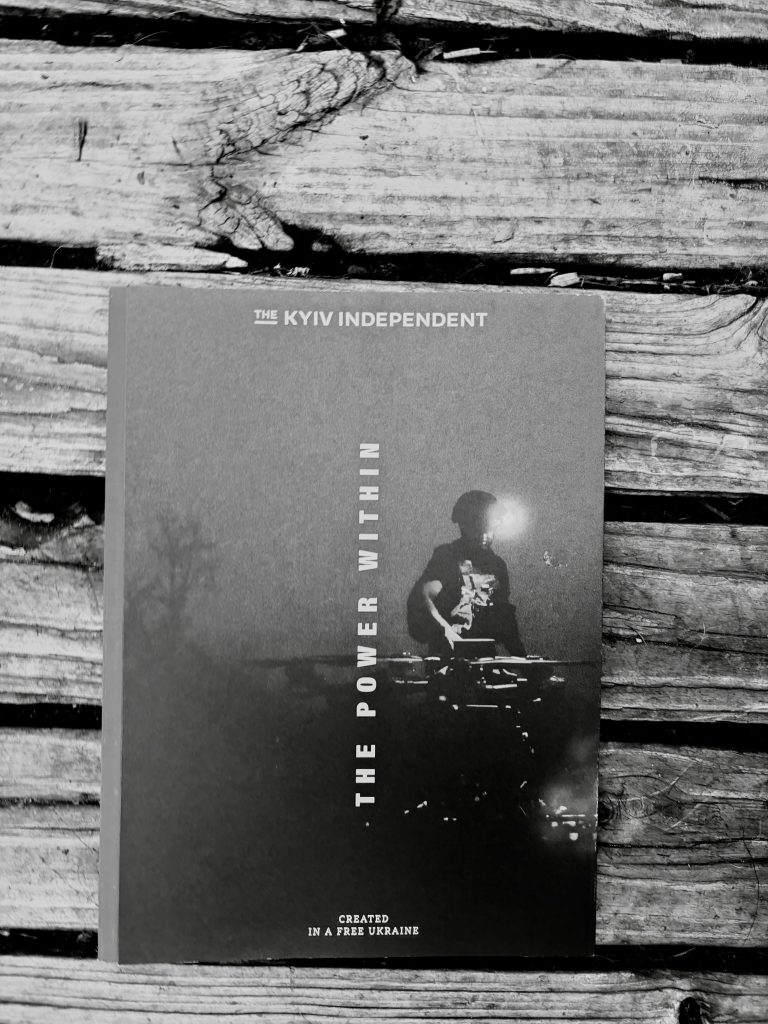
Last winter, the team at Ukraine’s terrific English-language online newspaper, The Kyiv Independent, put out their first book, or what they’ve called a “bookazine.” Its title describes something we likely all agree we need to call on: The Power Within. The headline of the essay on page 114, written by a young Kyiv-based journalist named Dinara Khalilova, caught my attention:
Looking for answers in wartime, Ukrainians turn to books.
Despite Russia’s ongoing war against Ukraine, the country’s publishing houses are seeing an uptick in sales, while dozens of new bookstores have opened in Ukrainian cities.
Even I, avid reader that I am, had begun to sort of quietly accept the constant barrage of generalizations that “no one reads anymore.” And yet, under pressure of war, Ukrainians have shown that reading is one of the core elements of their daily resistance.
Upon reflection, it makes sense. Fighting back against invasion is, after all, only partly about weapons and ammunition. One needs to hold course spiritually, intellectually, and creatively, too, when there is pressure all around to abandon one’s cause. And while the war is awful, it has not stopped Ukrainians from living life. Or from reading. Khalilova’s piece sets the scene:
In downtown Kyiv, trendy bookstore cafés are bustling with people enjoying coffee, reading, working on laptops, or socializing. Remarkably, many of these establishments, such as the 1,500-square-meter Sens bookstore on Kyiv’s main street, Khreshchatyk, have emerged only recently—during Russia’s full-scale war against Ukraine.
Surveys in the country show that daily reading levels have doubled since 2022, and book sales are up significantly. Natalka Kuzmenko owns a nonfiction bookstore (in Ukrainian, a knyigariya) in Kyiv, on Zolotovoritska Street, called Zbirka. The store’s name translates to “Collection” in English. The backstory? After serving a term in the military, Kuzmenko says,
At some point, I was faced with a choice: buy a used 2013 BMW 3 convertible or open a bookstore. I chose the latter. … Three months later, the Zbirka bookstore appeared at 2a Zolotovorotska Street, with a parking space. By the way, we won this space from a sex shop that also wanted to rent it. The spiritual won out over the physical.
The whole store seems to be a thoughtful exercise in creating the kind of business I would almost certainly be shopping at if I lived in Kyiv. As journalist Vera Labich shares about Zbirka,
Every book is more than just a printed text. Each publication on the shelves has its own special story, intertwined with human destinies, art, and accidental discoveries. The bookstore offers such areas as art and design, architecture, culture and history, sociology and psychology, photography and books about photography.
Owner Kuzmenko’s own philosophy—her point of view, we might say—and not national sales statistics shape which books show up on the shelves: “I have a story about every book on my shelf.” In that sense, she sure sounds a lot like us here in the ZCoB (Zingerman’s Community of Businesses), carefully curating product selection for quality. “The key difference,” she goes on to say, “is freedom of choice, a curatorial approach to book selection, and the ability of the owner to make decisions about the values, principles, and mood of the place.” Kuzmenko references the French writer Roland Barthes, who “explains that the value of a photograph is given by the recipient. What may be ordinary for you is extremely important for someone else.” This is also true for books!
Speaking of Ukrainian culture, Kuzmenko says,
We have to develop 10 times faster than the enemy in all spheres, and books are one of the most effective tools for obtaining information. In Ukraine, we have a 10-year war that has [actually] been going on for centuries. We must know our past, be able to critically perceive reality, and plan for the future.
It’s fascinating to me how the Ukrainian resistance to Russian aggression has become intertwined with reading. Kateryna Ivanova owns a bookstore in Lviv called Knyzhkovyi Lev, or “Book Lion.” She says, “The moment you buy a book, you feel safe. You’re doing something aimed at the future, which means that you will have a future—as much future as you need to read all those wonderful books you are buying now.”
Putting things in context, journalist Bohdana Neborak observes,
Despite rising prices and financial constraints, people turned to books for self-care. … They allow you to devote time to yourself and your imagination, spend time with yourself, and then discuss what you read with loved ones. … The consumption of culture gives this sense of living fully. We can see how reading can create and sustain communities—and this is terribly important, especially in the fragile and vulnerable times of war.
Before the war, 90 percent of the books sold in Ukraine were written in Russian. That ratio is now well on its way to being reversed. UkraineWorld reported last fall,
Bookstores today have become hubs of civil society—spaces for meeting and for reflecting on the heavy experiences Ukrainians are going through together. Russia is trying to erase Ukrainian identity, among other things, by burning books. Yet despite the shelling, publishers keep printing; despite the haunting air raid sirens and blackouts, people keep reading. Culture lives—and resists.
The significance of this is big. Few Americans realize that Russia’s relationship to Ukraine is very much like other colonial relationships: Russia has been attempting to eradicate native culture for centuries, at various points banning the language, arresting poets and writers, and even killing musicians who played the traditional Ukrainian bandura. In this context, most Ukrainians understand that until the government in Russia really changes, any peace agreement will result only in a short-term period of quiet until the Russian military comes back with a new effort to conquer their country. Sens owner Oleksii Erinchak says, “Sooner or later, the Russians will return and try to influence our cultural sphere. The stronger we make Ukrainian culture, Ukrainian books, and Ukrainian identity, the better prepared we will be for [future] confrontations.”
In an interview with UkraineWorld, Erinchak explains,
When the Armed Forces of Ukraine pushed the Russians away from Kyiv, Sens began to grow as a bookstore. It became clear how many people were drawn to culture, to books, to seeking information, identity, knowledge—to uniting around literature. At first, it was meant to be a small passion project in my own neighborhood. But eventually, it turned into something I’ve dedicated almost all my time to for nearly four years—and I have no plans to stop.
All of which has led me to a conclusion I hadn’t planned to reach: wherever autocracy threatens, doomscrolling is destructive, but active reading is a really constructive response. It can clearly help to effectively build the sort of caring, empathy-focused communities upon which the kind of freethinking, dignity-based cultures we value can be created.
Of course, how one goes about reading is relevant, too. As Azar Nafisi notes, “Poor reading, like poor writing, is imposing what you already know on texts. You should go into reading to discover, not to reaffirm what you know.” I learned this long ago from the late-19th-century anarchist author and scientist Peter Kropotkin’s admonition in Memoirs of a Revolutionist: “One must have some question addressed to the book one is going to read.”
Ironically, it’s only in recent weeks that I recognized what now seems remarkably obvious to me—that reading is used as resistance in what might be the most autocratic scenario anywhere: incarceration. Vikki Law, author of Resistance Behind Bars, writes,“Books can be a lifeline to people in prison.” Malcolm X details his own experience in his legendary autobiography:
I have often reflected upon the new vistas that reading opened to me. I knew right there, in prison, that reading had changed forever the course of my life. As I see it today, the ability to read awoke inside me some long dormant craving to be mentally alive.
Ashanti Alston, who has a new book coming out later this summer entitledAnarchist Panther, had a parallel experience. Alston was 13 when the Black rebellions happened (see Zingerman’s alum and Yale professor Elizabeth Hinton’s book America on Fire for more on that subject), including in his hometown of Plainfield, New Jersey. Alston had seen his older brother reading Malcolm X’s autobiography and was greatly influenced by what was going on around him, so he joined the Black Panthers when he was 17. Arrested in 1974, when he was 22, he spent 11 years behind bars. There, he ended up reading extensively, in the process changing much of his thinking and aligning for the first time with anarchist belief systems:
I learned about anarchism from letters and literature sent to me while in various prisons around the country. At first I didn’t want to read any of the material I received—it seemed like anarchism was just about chaos and everybody doing their own thing—and for the longest time I just ignored it. But there were times—when I was in segregation—that I didn’t have anything else to read and, out of boredom, finally dug in. … What anarchism helped me see was that you, as an individual, should be respected and that no one is important enough to do your thinking for you.
Stewart Stafford posits, “An artist’s legacy is not just a body of work; it is the archaeology of their lives and of life itself.” Which makes me realize that—because what we read contributes so much to the quality and construct of our lives, because it does so much to change our beliefs and hence also our behavior—the reading list we leave behind is a major part of our legacy.
Once upon a time, many years ago, we had a ZingTrain attendee from Florida who spoke about creating an organizational culture in which everyone actively contributes. “I coach high school basketball,” he said. “What we tell the players is that there are about 60 possessions in every game. Three of those possessions are almost always the difference between winning and losing. The problem is we don’t know which three!” Moral of the story—treat every play like it’s one of the few upon which the fate of the team will hinge. In the context of this essay, the challenge, of course, is that none of us knows which vital book that might be. The next one we open could be enormously impactful. As Malcolm X writes, “People don’t realize how a man’s whole life can be changed by one book.”
With all that in mind, if you happen to see me wearing my “Reading Is Resistance” T-shirt, give me a high sign! And please let me know what you’re reading and learning from. Ilan Stavans, the writer and translator I mentioned up top who also co-founded the immigrant-author-focused Restless Books—from which my new black T-shirt will soon arrive—grew up in a Jewish family in Mexico City before moving to New York as an adult. He sums up the power of reading well:
I invite you to open these and other books and travel to unforeseen places. Yes, I invite you to do something humans depend on more than ever: the intimate art of reading. May the new year make us less suspicious of one another. Reading is the antidote. In the act and art of reading, we all become immigrants.