Beginning to Build Tomorrow’s Breadwinners Today
How an insight from Peter Drucker can help us craft high-hope futures
Peter Drucker, the amazingly insightful, Austrian-born American author of nearly 40 books on leadership and management, passed away just a week shy of his 96th birthday in November 2005. As context for those who aren’t familiar with him, the Drucker Institute at Claremont University in California refers to him as the “Father of Modern Management … a visionary whose ideas reshaped management, business, and society.” I would agree on all counts. Within the 20th century—and, really, even into our own era now, almost a quarter century after his death—Drucker was and is the voice of leadership thinking.
On the surface, to someone who knew of his work only casually, Peter Drucker would probably seem very much mainstream. With his business attire; slow, serious delivery; deep voice; and heavy Austrian accent—and as the author of a host of big-selling business books—Drucker did not come across to most passing observers as someone operating on the intellectual edge. The truth, though, I believe, is that Peter Drucker was
a) way ahead of his time, and
b) a remarkable, progressive, caring, compassionate, and radical thinker.
To wit, Drucker would regularly remind everyone he taught and coached that, while they should, of course, consider the impact of any decision they were making on their own organization and on themselves, it was imperative that they also take into account the impact that decision might have on the world at large over the long term. It’s a message I certainly take to heart, a belief that underlies all of what follows here.
Born in Vienna in 1909, Drucker stumbled onto the writing of Danish philosopher Søren Kierkegaard when he was only 19. To give you a sense of what Drucker was all about, he began studying Danish simply so that he could read Kierkegaard’s at-that-time-still-untranslated writings. By 1933, he was a lecturer in the German city of Frankfurt. When the Nazi government fired all the Jewish professors on staff, Drucker decided he could not and would not be complicit in the abuses of the autocratic regime. He left for London a couple of days later.
Drucker came to the US in 1937, securing positions as a journalist for Harper’s Bazaar and The Washington Post. His first book, The End of Economic Man: A Study of the New Totalitarianism, came out in 1939. (A signed copy of the now-very-hard-to-find first edition is currently selling online for $8,800.) Winston Churchill wrote a review of the book after it was released, declaring that “Mr. Drucker is one of those writers to whom almost anything can be forgiven because he not only has a mind of his own, but has the gift of starting other minds along a stimulating line of thought.”
Drucker would go on to teach, write, advise, and speak at high levels for more than 60 years. Whatever he believed in, he would diligently put in the effort to make it happen; he grappled with ideas and philosophies the way a world-class athlete would approach working out. Drucker would regularly commit himself to studying new subjects—and rather than a typical cursory review, he would immerse himself in each for at least two or three years at a time. Although the public at large didn’t know it, over his lifetime, Drucker also became a deep student of Japanese art. And, amazingly, he actually seemed to increase his energy and impact as he got older—of those 40 books Drucker wrote in the course of his life, roughly two-thirds were published after he turned 65!
Librarian and journalist Bruce Rosenstein devoted much of his own career to in-depth study of Drucker’s work. Back in 2002, the night before Drucker—already 92 at the time—was to give a keynote at the Library of Congress’ annual conference, Rosenstein conducted a four-hour-long interview with him. That interview would become the basis of Rosenstein’s 2013 book, Create Your Future the Peter Drucker Way: Developing and Applying a Forward-Focused Mindset. In the book, Rosenstein distills Drucker’s worldview into a framework that he calls “10 Elements of the Future”—a set of guidelines we would be wise to adopt in the interest of getting to a more positive future ourselves.
The first three items on the list especially caught my attention:
Mindset. The best way to approach the future is to keep it in mind as you go about your daily life and work.
Uncertainty. The future is essentially unknown/unknowable, uncertain, and unpredictable. You can’t assume that it will be similar to today.
Creation. Despite and because of its unpredictability, the future must be built and created.
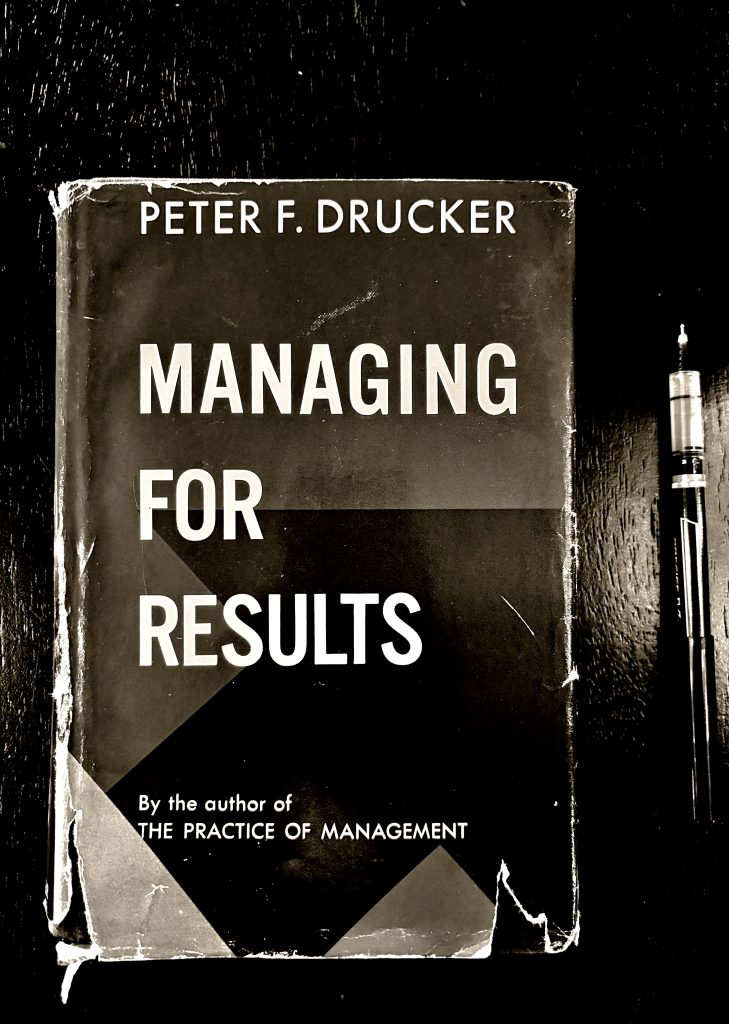
Reflecting on these three elements brought me back to Drucker’s 1964 book, Managing for Results (published about four months before President Lyndon Johnson delivered his commencement speech at the University of Michigan, in which he announced the Great Society). By the time I was ready to read Managing for Results, it was a good 20-plus years after its release. Fred Andrews of The New York Times would later write that, with its publication, Drucker had “chiseled a management guide for all seasons.”
One of the aspects of the book that captured me back when I first read it—and that has stayed with me ever since—is what I would now refer to as a “framework”: in Chapter 4, entitled “How Are We Doing?”, Drucker identifies 11 categories into which the products and services of any organization can be placed. He later named this construct “the Product Portfolio Analysis.” For years, though, when using it here in the Zingerman’s Community of Businesses (ZCoB), I’ve just called it “the Drucker Categories.”
Drucker’s framework is one of the best ways I know to create, and stick with, the sort of successful long-term outlook I wrote a lot about last week. It’s also about embracing the reality that what we believe has a huge impact on what we do and on what others around us will do—that no matter how much we want to control things, we can never know what the future will hold. And with that uncertainty in mind, it’s not helpful to hang around waiting for others to figure things out for us. To the contrary, as Drucker reminds us regularly, it’s up to us to create the future we want.
The 11 categories for products, services, ideas, et cetera, that Drucker details in Managing for Results are intriguing as well as both intellectually and emotionally challenging. We use them here in parts of the ZCoB as a way to gain clarity and alignment around where we stand and where we’re going as a group. Indeed, they offer the kind of clarity that can help any organization move forward far, far more effectively than it would be able to without it.
Three of the categories are what Drucker calls “breadwinners”—and while all 11 matter, the three breadwinners would likely account for the bulk of a business’s sales. (I’m not, to be clear, suggesting that the other eight categories aren’t worthy of attention—they absolutely are. Intellectual food for another essay’s worth of thought!) Here’s a look at the three, along with what Drucker believes a wise business leader would do to manage each:
Today’s Breadwinners – They account for substantial sales volume and still make a solid contribution to the bottom line. That said, they are unlikely to grow much. They’re definitely of value today, but, like a 15-year veteran on a basketball team, they’re not the future.
Recommendation: Drucker wisely advises that, although it makes sense to continue selling these products and they still deserve some attention, because long-term growth is limited, it doesn’t make sense to continue investing a lot of marketing resources in them.
Yesterday’s Breadwinners – They often still have significant sales volume, but because of increased costs, greater competition, and reduced margins, they no longer make a contribution to profit. Emotionally, this can be hard to make peace with. As Drucker writes, “Everyone in the company ‘loves’ yesterday’s breadwinner; it is the ‘product on which this company was built.’”
Recommendation: Cut back significantly the amount of resources devoted to them, even while one may continue to sell them for the near term.
Tomorrow’s Breadwinners – Also known as “Future Breadwinners,” these likely already have some current sales, but—more importantly for me—in Drucker’s words, they show “great promise for significant growth.” They’re akin to talented rookies waiting to make it big—a lot of potential, but potential that has yet to be proven on the field.
Recommendation: Tomorrow’s Breadwinners generally receive far less support and resources than they should. In order for them to reach their potential, we’ll almost certainly need to (seemingly) “overinvest” in the present to create our preferred future.
Up for a bit of homework?
You might, if you’re inspired, carve out a few minutes to reflect on your own organization’s work, and which of your products and services fall into what categories. Better still, engage in a bit of collaborative conversation with key folks in your business and see what you all come up with! As Drucker writes in the book, the challenge “is not how to do things right but how to find the right things to do.”
Of the three types of breadwinners, the third is my focus today: a Future Breadwinner, the way I imagine it, is an opportunity to make a hugely positive difference in our organizations, and in the world around us. What we choose will have an outsized impact on our ecosystems. Tomorrow’s Breadwinners are what we want to place at the center of our work and our lives two, three, four, or 15 years down the road.
While much of the business world tries to guess, speculate about, or forecast what will happen in the future, my approach is far more proactive. It’s driven more by passion than prediction. Rather than react to what others do, it’s our role as leaders in an organization to decide—with input from others, of course—what our Future Breadwinners will be. After we make that decision, we begin to engage with the huge amount of work it almost always takes in order to bring them to their full potential. Doing this, in my experience, demands a lot of time, a lot of effort, and a willingness to stick with an idea, as my longtime business partner Paul Saginaw says, “long after the initial glamour has worn off.”
But how do you decide what goes into which category? It’s not easy. As Drucker explains,
Identifying result areas requires business judgement. It requires decisions regarding the basic economic structure of the business which the “facts,” no matter how copious or how accurate, do not yield. Moreover it requires decisions of considerable risk, decisions that will—and should—upset a good many people, should go against their ingrained habits, should provoke lively discussion and dissent. … These disagreements are important. They bring out searching questions about the company, its products, its policies, direction, in the minds of the people who are closest to what really goes on.
What makes a Future Breadwinner? Identifying one is not merely a prediction of where the market will go—nor is it simply a means to make a lot of money. While, yes, it would be great if we get the market to go our way, and yes, it would be wonderful if we can earn enough money while doing so to pay the bills and start a savings account, for me, those are only part of the desired outcome. They are not, though, the initial drivers.
Here’s my take on the characteristics I want in a Future Breadwinner:
It’s something we believe in strongly. We must have a deeply held belief in the products or services on the table, and a driving passion for helping get them to greatness. After all, if we’re going to work hard for months and years to turn them into a big part of our future, it only makes sense that we’d choose Tomorrow’s Breadwinners that are extremely meaningful to us. Things that matter not just because they bring in money, but because we believe in them. They provoke passion and the kind of pursuit of craft I wrote about a couple of weeks ago—work we would do simply because we believe in what we’re doing.
At Kobe Bryant’s funeral in February 2020, Michael Jordan fought through tears to share this about the NBA star he called his “little brother”:
He used to call me … at like 11:30, 2:30, 3 in the morning. … At first, it was an aggravation. But then it turned into a certain passion. This kid had passion like you would never know. It’s an amazing thing about passion. If you love something, if you have a strong passion for something, you’ll go to an amazing distance to go get it.
Without that sort of internal drive for greatness, I wouldn’t want to work intentionally to make something a Future Breadwinner. Life is too short to expend that much time and effort on anything we aren’t really radically committed to.
It has significant sales potential. For something to become a Future Breadwinner for us, it must, by definition, have the potential to sell in quantities that will make a significantly meaningful difference to the organization. To be clear, this doesn’t mean it’s something we can sell to everyone—this work is actually the exact opposite of making oneself part of the mainstream. Rather than trying to be all things to all people and traveling safely in the middle of the road, when choosing Future Breadwinners, we want to work with what Seth Godin calls “the minimum viable market”: the least number of people we need to connect with effectively in order to make our living. As Seth says, “You don’t need everyone. But you do need someone.”
It’ll become something the organization is known for, say, four or five years into the future. You can, of course, adjust that time frame to your own industry and operation as you like. The point, though, is that Tomorrow’s Breadwinners are a big deal! They are what we care deeply about, what the press will report on, what customers will seek us out for, and what we’ll count on to help make our profit and loss statement viable.
It gets everyone on board. Future Breadwinners cannot come to fruition simply through the work of one person. Rather, it takes a collective effort akin to what some might call “a village.” As anarchist Ashanti Alston explained in his 1995 essay “Anarcho-Pantherista,” “Revolution is learning how to bring a large variety of personalities together into a powerful harmony. This harmony must lay down some general direction and get work done. It’s never easy. It’s a struggle. It takes a lot of skill.”
It’s honest and true. A Future Breadwinner must really be what it says it is, and more—not another modern-day example of devious deception, slick social media posts, or false advertising.As Joyce Vance, law professor, author, and former U.S. attorney for the Northern District of Alabama, warned in her Substack, Civil Discourse, this past weekend, “We are living through the death of truth, as disinformation is widely disseminated on social media.” Of course, what might look like impending death in the near term could also be seen, with a long-term perspective, as just a temporary dip, en route to a world where truth is valued even more than ever. In historian Timothy Snyder’s words, “Truth can win—if it finds friends.”
It makes a big impact on the ecosystem. If we’re going to create the breadwinners of the future, for me, it only makes sense that we would want them to have a positive impact on the larger organizational ecosystem. After all, the whole point here is that we are making our preferred future. A future in which we can sell a lot of whatever product, service, or idea we dream about— something we believe in in a big way—and in which the act of building its sales has a significantly beneficial effect on our entire ecosystem. As journalist Aaron Ross Coleman wrote recently about the beliefs of 20th-century poet June Jordan,
If we wanted to find a safe harbor, we’d have to harbor ideas about what the world could be. It was our job to have a prospective perspective—to see into the future, to plan it, and to shape it through words, action, and art.
It builds hope. In his new book, HOPE: On the Mountain of Fear, journalist and author Bankole Thompson writes,
We are living through a moment that tempts us toward despair. The fractures in our democracy feel deeper, the distance between the haves and the have-nots wider, and the public square louder but somehow less truthful.
Hope is not a soft idea. It is not sentimental. It is not passive. Hope is a discipline. And more than that, it is a calling—one that belongs not just to leaders or institutions, but to all of us.
We are called to be messengers of hope.
Indeed, a great choice for Tomorrow’s Breadwinner would be one that offers hope, and that helps us to create the future of our dreams.
So, when we have something that fits the bill in all the above ways, what do we do to make a Future Breadwinner grow as big as we imagine it might?
We get to work on making it happen. The ever-wise and wonderfully kind marketing maven and author extraordinaire Seth Godin says that our work is “to make true stories that spread.” After all, he observes,
The challenge … is in addition to coming up with ideas, which a lot of people want to do, you have to sell them. Which almost nobody wants to do. And selling your ideas is a craft, and it is something at least as much as inventing ideas.
Keeping this in mind, here in the ZCoB, we take these steps with a Future Breadwinner:
We write a vision to describe what success will look like and feel like five, 10, or even 15 years into the future.
We share true stories and heartfelt beliefs that support our vision.
We make it real so that there are living examples and “free samples” of what it will be like when it’s working well.
We stick with it for a long time. Although most everyone might wish for overnight successes, the truth is that meaningful change takes a long time. When we put something on our list of Future Breadwinners, it’s a commitment to at least a couple—but more likely four, five, or even 15—years of work.
We speak about it and write about it. We get the word out in a way that, in itself, becomes art!
In the end, when we pick Future Breadwinners, we aren’t mere prognosticators making predictions about the future. Rather, we become “prophets” who are out to ethically and effectively, slowly but surely, create the future. As philosopher Walter Brueggemannwrites in The Prophetic Imagination,
The prophet engages in futuring fantasy. … The imagination must come before the implementation. Our culture is competent to implement almost anything and to imagine almost nothing. … Thus every totalitarian regime is frightened of the artist. It is the vocation of the prophet to keep alive the ministry of imagination, to keep on conjuring and proposing future alternatives to the single one the king wants to urge as the only thinkable one. The task of prophetic ministry is to nurture, nourish, and evoke a consciousness and perception alternative to the consciousness and perception of the dominant culture around us.
And there is, very definitely, a prophetic element to the choosing of tomorrow’s bread winners—especially when we can come up with effective approaches to carry them all the way through from idea to implementation. How do we do that? When we make the decision to work toward something, we want to develop a plan akin to what Seth Godin titled his talk at a recent Reinvention Summit: “Finding an Elegant Strategy: Doing Work That Matters for People Who Care.”
What you determine to be your Future Breadwinners is, of course, up to you—and the rest of us have to actually buy it, too. Here in the ZCoB, we have some of our own existing write-ups of “the Drucker Categories” to which we’ve already committed.
Before I finish here, though, I will suggest that, on a bigger, broader scale, democracy is a Future Breadwinner. Yes, I know things may seem grim to some right now, but rather than succumbing to current trends, I’ve always believed we can create our own. In his new book, Anarchist Panther, Ashanti Alston quotes the Quran: “After difficulty comes ease.” Which is why I feel confident and comfortable about working to create a positive future: a future in which truth comes back “from the dead” to become an integral element in our success, a future in which what we sell to make a living are products and services we believe in—products and services we take pride in telling the truth about, products and services that build hope and have a positive impact on the world around us.
That, too, is really how I’m feeling about democracy right now. Why?
- People want to be treated with dignity.
- People don’t want to be told what to do.
- While autocracy can hold course for a while, eventually, like an autoimmune disease, it kills the body it is dominating.
- In the long run, democratic constructs are healthier—they bring more voices into the mix, and they’re more creative.
Turning something into Tomorrow’s Breadwinner—whether it’s First Flush Darjeeling (see below) or democratic workplaces—takes all the elements I’ve written about above to make it happen. The pamphlet “Why Democracy Matters” has far more detail, but the main message here is that we—not some higher-up leader, or some politician in Washington—will build our Future Breadwinners. As Bankole Thompson writes,
Too often, we imagine that transformation is the work of the powerful. … But democracy has never worked that way. It has always depended on ordinary people doing extraordinary things.
The same, I would suggest, is true of Tomorrow’s Breadwinners. Bosses might often lead the way with them, but they’ll never work without the backing of everyone in the organization. Tomorrow’s Breadwinners are a way to make ourselves vulnerable, embrace uncertainty, and generate excitement about a better and more rewarding future. It’s not an easy process, but when it’s done well, it can be inspiring and life-changing. It’s about the commitment to creating what we believe in, not waiting for others to do it first. To give the final word to Peter Drucker: “Whenever you see a successful business, someone once made a courageous decision.”