A Call to Generate Generosity Across Our Organizations

Creating cultures in which giving—not getting—becomes the norm
Feeling stressed about the state of the world? Trying to sort out how to lead ethically and effectively through the challenges of the national moment? Getting discouraged sometimes? I know I can certainly slip into any or all of those mindsets on any given day.
Here’s the good news, though. Citing the research of neuroscientist Chantel Prat, Amy Shoenthal, author of The Setback Cycle, says,
People who have gone through more setbacks are better at problem-solving and reasoning. … They’re better at knowing when they are on the wrong track. They course correct more easily. That new path ahead seems a bit less murky when you’ve already worked through the experience of being bumped back to the start.
Which would mean, then, that our current tough times could, in fact, be getting us into better shape to forge the kind, creative, and caring paths forward to which we aspire. I am firmly of the belief that we can make it through and come out the other side of all this to get ourselves into inspiring and uplifting places. As Shoenthal says,
Whatever you’re working through, you have the tools you need to persevere and reach your own creative rebirth. …I am rebelliously optimistic [that] you’ll see setbacks more clearly and emerge from them with a vision of all you can achieve. … To go from wallowing to wondering. To ask yourself, what more might be possible?
One possible path toward a more positive future—at home, at work, or in the world at large—is generosity. As my longtime business partner Paul Saginaw said in his part of the University of Michigan commencement address we gave together back in the spring of 2015,
Generosity leads to joy.It’s simple, and it’s guaranteed. Generosity follows the natural law of the harvest—you reap more than you sow. When you give, you get more back. Minimally, you get a joy buzz. Research tells us that generosity kicks off a “feel-good” hormone in your brain called the “helper’s high” that can last up to two hours … and it’s legal, even outside of Ann Arbor. … I invite you to measure your success not so much by what you gain or accomplish for yourself, but rather by what you contribute to others. I believe practicing generosity is the way to joy. It’s free for the taking. Or should I say … for the giving.
Generosity, I’ve come to understand over our 40-plus years in business, is generative. The more we do it, the better things get.
The current national trend appears, unfortunately, to be very much the opposite: taking as much as possible and turning a blind eye to those who suffer the consequences, as high-end business leaders roll up consolidations. And yet generosity remains a relatively easy and essentially foolproof antidote that anyone, or any organization, can begin practicing ASAP. Through generosity, we enhance the lives of those we give to, our organizations do better, and we ourselves benefit as well. As writer Rebecca Solnit says, “Every minute of every hour of every day you are making the world just as you are making yourself, and you might as well do it with generosity and kindness and style.”
Here’s a bit more nice news to share. This week, on the same afternoon this e-news enters inboxes, the Zingerman’s Community of Businesses (ZCoB) will hold its annual induction of new members into our Service Hall of Fame. In an organization with a culture where both service and appreciation are integral elements, the Hall of Fame recognitions are, I think, one of the coolest things we do.
Four years ago this summer, the winner of the annual Lifetime Achievement Award was the wonderfully amazing and spiritually beautiful Belinda Armstrong. Unfortunately, as is often the case, woven in with the good is also the bad: sadly, Belinda passed away at the beginning of last week. Many hundreds of us here in the Zingerman’s Community are currently mourning her loss.
Belinda began working in the ZCoB back around the tail end of 2012. She had just retired from a long and successful career at Detroit Edison, but she wasn’t really ready to stop working. From her first day here, she served as a model, for me and countless others, of what a generous spirit can be. Belinda was a powerful example of what the world can use a lot more of these days: humility, good humor, care, kindness, and great skill (both in customer service and in production at the warehouse). And, above all, she was a superb embodiment of the spirit of generosity in action. Belinda retired from Mail Order a few years ago (yes, her second retirement!) but continued to come in to work a few shifts here and there.
Liliana Grueber, who works with love and deep daily diligence at the Deli and also serves as a Staff Partner, shared this reflection on Belinda’s passing:
Belinda was always thinking of others and finding simple ways to make someone’s day better. And she was in the Hall of Fame, too. I feel very lucky and honored that I had the opportunity to meet Belinda, work alongside her, and share so many wonderful moments together. Remembering them all still makes me smile. She will be deeply missed, but I know that the joy she brought to so many of us will continue to bring smiles for years to come. Thank you for everything, Belinda. You were a treasure.
In the newly released English translation (from the original Yiddish) of The Jewish Anarchist Movement in America, Joseph Cohen writes,“As anarchists we have one task—we must keep our eyes on the future. … We must look back to the future, with a clearer understanding of our task formed in light of our long years of experience.” In Belinda’s honor, our task seems clear: we have big and very generous shoes to fill, and it falls on me and everyone else here to do so. Our work, I believe, is to strengthen both our culture and our systems so that generosity can stay the norm for many generations to come. In fact, I’ve been thinking that, since we’ve had Gen X, Gen Y, and Gen Z, people of all ages and backgrounds can come together to form the next, non-age-related wave—something we might call “Gen-erosity”!
Or maybe we should think of it as “jen-erosity.” In his 2009 book, Born to Be Good, scientist Dacher Keltner writes about what he calls “the jen ratio,” which, he says, offers “a lens onto the balance of good and bad in your life.” Keltner explains, “New studies are finding that a high jen ratio, a devotion to bringing the good in others to completion, is the path to a meaningful life. … It elevates personal well-being in lasting ways.” Belinda’s jen ratio, I have to believe, was very high. She was always generous and always joyful, and she brought an abundance of both to everyone around her!
Unfortunately, Keltner writes, “in the recent explosion of studies on well-being, signs of a loss of jen in the United States are incontrovertible.” Sadly, that suboptimal state of existence is easily identified right now in the news, where people’s drive to maximize personal gain, often at the expense of others, seems to dominate the headlines. In settings of that sort, each of us is essentially on our own.
It has not, though, always been that way. Ninety-one years ago this week, generosity took a giant systemic step forward in the US when the Social Security Act formally became the law of the land. Historian Heather Cox Richardson shares the story:
On August 14, 1935, President Franklin Delano Roosevelt signed the Social Security Act into law. While he had already put in place new measures to regulate business and banking and had provided temporary work relief to combat the Depression, this law permanently changed the nature of the American government.
The Social Security Act established a federal system of old-age benefits; unemployment insurance; aid to homeless, dependent, and neglected children; funds to promote maternal and child welfare; and public health services. It was a sweeping reworking of the relationship between the government and its citizens, using the power of taxation to pool funds to provide a basic social safety net.
While Roosevelt was the president who secured Social Security’s success in Congress, the idea behind the program originated with a woman by the name of Frances Perkins. In the spirit of Amy Shoenthal’s statement that “people who have gone through more setbacks are better at problem-solving and reasoning,”Perkins had, as a 31-year-old, witnessed the horror of what came to be known as the Triangle Shirtwaist Factory fire in March 1911 in New York City—a tragic event in which 146 garment workers died after being locked into the plant by its foreman to keep them, he believed, from being able to steal shirts. As a much older Perkins would share in a speech in 1964, “It was a terrible thing for the people of the City of New York and the State of New York to face.” After the fire, Perkins became the chair of the Committee on Safety, which led New York to pass 35 different labor laws to protect workers.
As president, Roosevelt was the one who signed the Social Security bill, but it was Perkins—the first woman ever to serve as a US cabinet secretary (of labor)—who had the idea. “The people are what matter to the government,” she said, “and a government should aim to give all the people under its jurisdiction the best possible life.” It was a declaration and a national dedication to centering American society around generosity. And although trends can come and go, as Thomas Sankara, the late president of Burkina Faso—another of whose quotes served as the epigraph for last week’s e-news—once remarked, “While revolutionaries as individuals can be murdered, you cannot kill ideas.”
Perkins is, of course, not the only figure to have pursued national systems that support generosity. Sixty-six years ago this fall, at about two in the morning on Friday, October 14, 1960, then-candidate John F. Kennedy began an impromptu speech right around the time Ann Arbor’s bars were giving their last call. He started with a smile-evoking and very humble, “I want to express my thanks to you, as a graduate of the Michigan of the East, Harvard University.” As he continued on, Kennedy, standing on the steps of the Michigan Union at that early-morning hour, made a spontaneous call to action that, in the coming months and years, initiated what we now know as the Peace Corps. It was, in essence, an appeal to actualize generosity—to create a national culture of giving that would supersede whatever selfishness was, inevitably, still in the air.
I don’t pretend that what I write here has anywhere near the impact or import of what John F. Kennedy said on the campaign trail in 1960. But perhaps consider this essay a call to generous action as well. It may not always feel like it, but we have the power to change our world—and small calls to action, when the stars align and enough people are willing, ready, and able to do the work, can achieve just that.
Peter Drucker, whom I wrote a lot about last week, was widely known for his generosity. Rick Warren, author of the The Purpose Driven Life, once said, “If I summed up Peter’s life in three words, it would be integrity, humility and generosity.” Bruce Rosenstein, the librarian, writer, and student of Drucker’s life’s work, writes of the late leadership guru,
Even late in life, Drucker’s schedule was extremely busy as a writer, consultant, and professor at the Drucker School of Management, at Claremont Graduate University, in Claremont, California, where he taught until his death at the age of 95 in 2005. Yet Drucker often made time for others, sharing his knowledge and being a role model, including helping to advance the careers of former students.
While generosity may seem sort of contraindicated in the US in the 21st century, Native American tribes have, for centuries, had exactly the opposite attitude. For them, generosity was an obvious path—both systemically the norm and culturally valued. In the Center for the Study of Philanthropy’s “The Wisdom of the Giveaway: A Guide to Growing Native American Philanthropy,” Mindy Berry andRebecca Adamson write:
Native communities express their generosity regardless of their social or economic condition. One trait common to many Native communities is the important place held by exchanges, in which givers are respected as much as receivers are honored. Giving is a form of sharing. The focus is on the exchange and on the relationship of the giver and receiver.
Here in the US, for a time, the Black Panthers’ Free Breakfast Program infused some generosity into the culture of the country. Launched in the first few weeks of 1969, what began as breakfast for a handful of hungry kids continued to grow until it turned into many thousands receiving a good meal to start their day. In a piece for History.com entitled “How the Black Panthers’ Breakfast Program Both Inspired and Threatened the Government,” Erin Blakemore writes,
Soon, the program had been embraced by party outposts nationwide. At its peak, the Black Panther Party fed thousands of children per day in at least 45 programs. (Food wasn’t the only part of the BPP’s social programs; they expanded to cover everything from free medical clinics to community ambulance services and legal clinics.)
For the party, it was an opportunity to counter its increasingly negative image in the public consciousness—an image of intimidating Afroed Black men holding guns—while addressing a critical community need. “I mean, nobody can argue with free grits,” said filmmaker Roger Guenveur Smith in A Huey P. Newton Story, a 2001 film in which he portrays Newton.
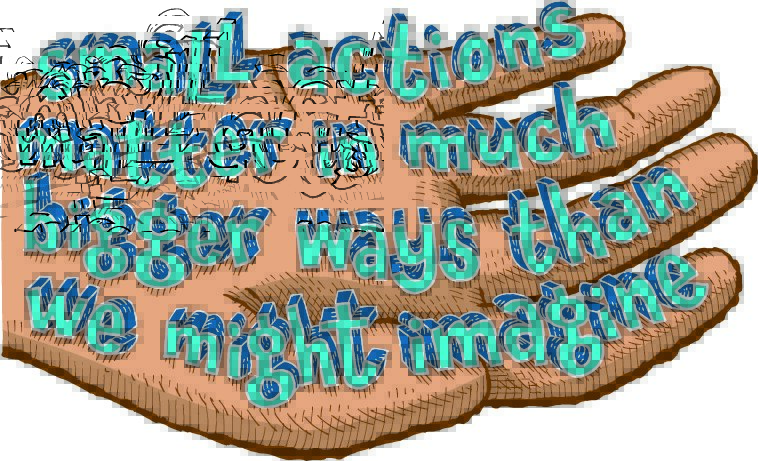
Small actions can, over time, have big implications.
One of the best approaches I know to build a culture of generosity is to weave it into the systems of an organization. Systems inform culture (and vice versa) and offer long-term stability and continuity that can keep generosity generating positive outcomes for many years to come, long after any one individual has moved on. Here are a few of the ways generosity happens here in the ZCoB on the regular:
- The third of our “3 Steps to Great Service” is to “go the extra mile,” or do something for the guest that they didn’t ask for. It encourages us to act generously with every single customer we wait on. And because we apply the “3 Steps” internally as well, the same is true in our daily interactions with co-workers.
- Thanks to the third of our “5 Steps to Handling a Complaint,” everyone who works in the ZCoB is authorized to act generously by making things right, rather than getting stuck (as so many others do) saying “No!” and reading the customer the rules.
- Sharing information. Nearly all our meetings are open, and we’ve been using Open-Book Management since the mid-’90s.
- Our ninth Guiding Principle (written back in 1991) talks about giving back to the community—it’s an obligation we’ve always taken very seriously to return as much as we can to the community that makes it possible for us to be here.
- With the above in mind, we donate approximately 10% of the previous year’s profit to community organizations.
- A commitment to work with positive beliefs (or what my friend Danny Meyer from Union Square Hospitality Group calls “generous assumptions”). That means deciding to believe the best in every case. Three years ago, we made this a job expectation when we formally adopted our Statement of Beliefs.
- Bottom-Line Change is a great way to share both the ability to initiate change and information about impending change, rather than the more typical practice of reserving it only for those who “really need to know.”
- Sharing ownership. We have over 300 staff who now own a share in the ZCoB, and more will become share owners this month! We also have 18 managing partners, each of whom both runs their own business and participates actively in the governance of the organization.
- Our Perpetual Purpose Trust has been a very positive way to give to the greater community, to our own Zingerman’s Community, and to Community Shares owners. By 2032, half the shares in the Zingerman’s brand identity will be owned by the folks who work here, as my and Paul’s percentages gradually go down.
In the above-mentioned The Jewish Anarchist Movement in America, Joseph Cohen observes, “That which is too near is often overlooked and forgotten. And this grand ideal must never be exchanged for unimportant improvements that become goals in themselves.” And, sure enough, it’s easy for me (and others, I assume, here in the ZCoB) to forget about the now nearly 25-year-old program we call our Community Chest.
What is the Community Chest? The original credit for the idea, I believe, goes to Paul, but many others have worked over the years to make it work as well as it does. When it comes down to it, the Community Chest is just another example of a relatively simple and straightforward program to weave generosity into our workplace. It’s an approach that others admire from afar—and that they could pretty easily establish on their own, though very few ever do. While there are, as with all programs, myriad fine details, the main points of the Community Chest are:
- It’s a fund we set aside to help staff members who find themselves in crisis.
- Every ZCoB business contributes based on a formula tied to number of staff and profitability.
- One of our able Department for People folks, Jo Anne Koons, capably manages the fund. Staff in crisis fill out various forms and talk things through with Jo Anne, and then, with the help of a “board” of two partners, she dispenses funds as appropriate. Most often, they’re given in the form of grants; on occasion, they go out as loans.
- In our last fiscal year (August 1-July 31), 58 ZCoBers received assistance, to the tune of a total of nearly $120,000.
You can, of course, scale the numbers up and down to fit the size of your own organization. In the spirit of what I wrote in the new pamphlet, “Why Democracy Matters,” the Community Chest is a low-key way to practice down-to-earth democracy that is super meaningful to those who find themselves facing challenges, and also to those who are able to help them.
Does this Community Chest take care of every person here who has financial difficulties? No, of course not. But it sure does help. Even knowing that it exists, I think, sends a positive message to people, too. Without question, it systemically brings generosity into our organization, and it really does help people who are experiencing critical needs.
Here’s the amazing thing to me, though: in support of the positive beliefs in people that we’ve held since day one at the Deli—and counter to the widely held notion that folks will take advantage of a “free lunch”—the Community Chest has never fully used all the cash it has available! Even during the pandemic, when every indicator would have led me to imagine that we’d be falling short on funds, the normal annual contribution from the ZCoB businesses to the Chest remained sufficient to meet the needs of those who requested assistance. That alone, for me, is an inspiration.
When we do all this well, generosity permeates every part of our organization. Just last week, in fact, the Roadhouse managers read “Secret #46: The Spirit of Generosity” as part of their regular “Leaders Are Readers” program. (Email me if you’d like to see the Bottom-Line Change write-up that led to the creation of the program five or six years ago!) The essay has a list of 22 ways (which I’m sure are not the only ones) to put the spirit of generosity to work in one’s daily life. In a wonderful conversation, many of the managers shared their reflections on the essay, on how they live out generosity every day, and what it means to them. I said nothing, except to appreciate them at the end for creating a culture in which generosity is so deeply ensconced. It was, to be honest, exceptionally inspiring.
We don’t ever get it all right, but we certainly work hard at it. Just to check my cultural reality, I asked Will Edwards, who started seven years ago as a busser back when he was in high school and now works part-time as a server at the Roadhouse, what generosity means to him. “It’s reciprocal,” he said. “When you’re generous, it comes back to you. It just fosters a good environment. People are generous with their time. Everyone is willing to help. Sometimes I worry what it would be like if I had to work somewhere else!”
Generosity, when we put it in place systemically and actively support it culturally, can create the kind of virtuous cycle we very much want to see. Marketing maven Seth Godin spells it out succinctly:
Here’s conventional wisdom:
Success makes you happy. Happiness permits you to be generous.
In fact, it actually works like this:
Generosity makes you happy. Happy people are more likely to be successful.
In Belinda Armstrong’s honor, in sync with Frances Perkins’s powerful work on Social Security, and in the spirit of John F. Kennedy’s speech on the steps of the Michigan Union 66 years ago this fall, we have the power to reverse the current negative national flow. Don’t let the news get you down. Let’s all do a little jen-jitsu and put generosity back into both the headlines and our daily routines, where, I believe, it belongs! As the Marginalian’s Maria Popova puts it, committing to ideals like generosity can, in stressful times, serve as “a spell against resignation, an insistence on surprise over probability, an antilamentation for the possible.”
P.S. If, after all that, you’re still somewhat skeptical about the future, I’ll share this unexpected and uplifting little story. While I was working on my last round of edits the other evening, I hopped up to help run some food (aka carry plates to the table) during the dinner rush at the Roadhouse. On my way back in, I stopped to bus a bunch of plates from a table that had just finished dining. As I started to navigate my way into opening the glass door with my arms full of plates, a six-year-old girl whose name I later learned is Blake jumped up from the table where she was sitting with her parents, ran over, and opened the door for me. In the best possible way, I was blown away. The spirit of generosity remains alive and very well. Perhaps this six-year-old might be the next Frances Perkins. Here’s to good things to come!
P.P.S. One way to act generously would be to consider ordering some of the Apricots for Dignity and Democracy T-shirts, hats, hoodies, and more! Our share of the proceeds goes to Democracy Now!—later this week, we’ll be sending a check for a couple thousand dollars for sales to date. If you’re intrigued, here’s the backstory.