The Underappreciated Value of Taking the Long View
Why being mindful of long-term impact can be so meaningful
This past weekend, the British-born, New York City–based singer-songwriter Fenne Lily entitled her e-news “Something Big That’ll Last a Long Time.” That is, as it happens, exactly what the essay that follows is all about.
“Something big,” to be clear, does not need to be grandiose or headline-grabbing. A more accurate word might be “significant.” As Fenne Lily said in an interview a couple of years ago with The Creative Independent, “Making everything smaller and gradually growing it, and asking for help when you can’t do it, are all pretty good.” I concur completely. Small shifts in the right direction, invested in and developed over the long haul, can lead to bigger and much better things.
One of the many lessons I learned from my good friend Gareth Higgins, the Belfast-born Irish writer, appears on page 64 of his superb and highly recommended book How Not to Be Afraid:
You never know when a story is over, especially if you’re in it.
Here’s an example of exactly that notion—one that’s both highly relevant and also really close to home. One hundred and twenty-four years ago this week, in August 1902, Rocco and Katherine Disderide, along with their four daughters, were putting the final touches in place to open the new grocery they’d decided they would construct earlier that year, at the corner of Detroit and Kingsley Streets in Ann Arbor. The Disderides, then in their mid-40s, had emigrated from their home village in the hills of Liguria, on the Italian Riviera, landing in New York City in 1882. A decade later, they decided to move west to the less congested small “western” town of Ann Arbor, where Katherine’s brother Charles Caramela had already set up shop, selling groceries out of a small house on the same corner.
When Rocco and Katherine came to join him here in Tree Town, they were only the fifth Italian family in town. Soon they settled into what was then called the “Catholic neighborhood” of Ann Arbor; St. Thomas, the local church, was just two blocks away, as it still is today, at the corner of State and Kingsley. They bought a house a few doors to the east of Caramela’s shop, on Kingsley, which meant they had a short 100-yard-or-so walk to work every day.
At the time, Ann Arbor had a population of about 15,000 people, roughly half of whom were either immigrants, like the Disderides, or the children of immigrants, like their daughters. There were about 500 African American families in town, too, though the city, for all practical purposes, was still segregated—a sad reality that would remain for many years to come.
The University of Michigan had opened its doors in Ann Arbor about 60 years earlier, in 1841. I smile now even to write it, but at the time, the school had only seven students and a pair of full-time faculty. Twenty-four years later, by 1865 and the end of the Civil War, U of M had grown to include over 1,100 students, making it the largest university in the country! By the time the Disderides decided to put up their building in 1902, there were nearly 4,000 students on campus. Today, of course, U of M’s student population is nearly 10 times that—and more people probably come to the Deli or Roadhouse to dine on a busy week than there were on the whole campus at the turn of the last century!
A decade after arriving in Ann Arbor—and two years into the 20th century—the Disderides decided to move the building in which Charles Caramela had been doing business further back on the lot, and build a new two-story, orange-brick building in its place. The family would live upstairs and run their store—a literal corner grocery—on the main floor. The location was a good one, since Detroit Street was then the main route one would take to get from the center of town down to the train station. The station had, it seems, been built with the long view in mind, intentionally designed to be what the weekly paper The Ann Arbor Register called “the finest station on the line between Buffalo and Chicago.” All of which would almost certainly have seemed a strategic edge to the Disderides in their decision-making; as local journalist Grace Shackman reflected in 1991, “The depot swiftly became the funnel through which virtually all traffic in and out of the city passed.”
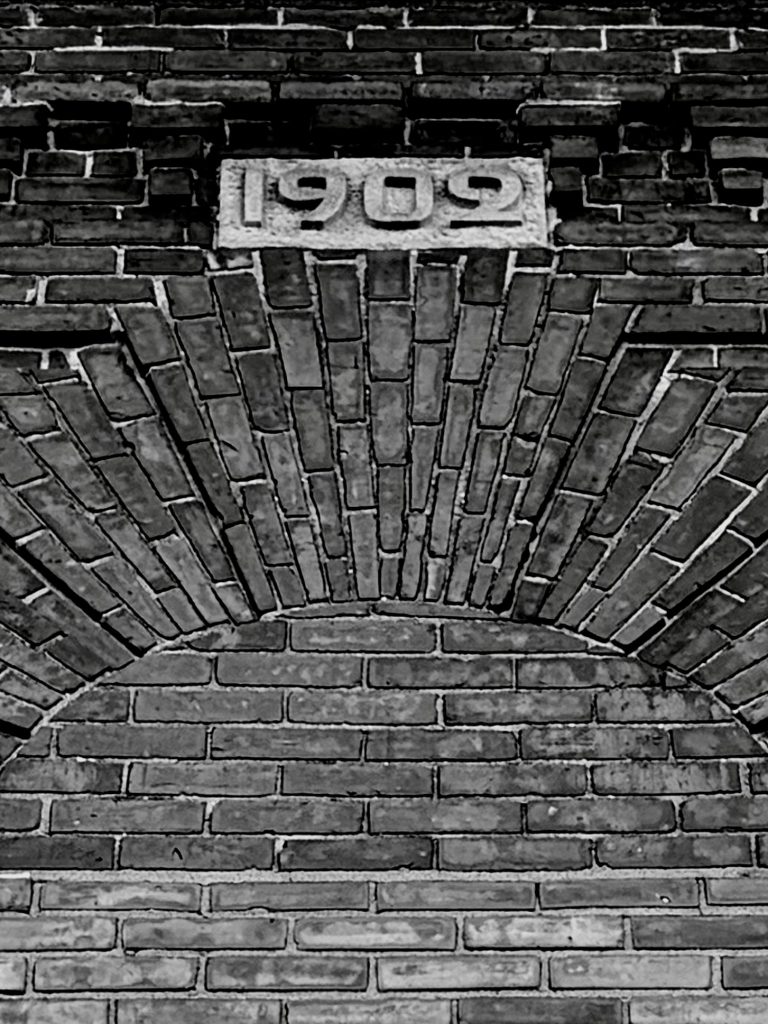
The grocery’s location must have been all the more compelling given that the city had installed a new electric streetcar line running right by it back in the 1890s. The new two-story brick building went up in a miraculous-by-modern-standards three months or so and cost the Disderides a bit less than $15,000 to construct. They had the year, 1902, chiseled into the stone on the facade. The address was 422 Detroit Street.
Though, of course, we can’t know what anyone was thinking at the time, I feel fairly confident in saying that the Disderides had no idea where the story of their new building would “end.” Eighty years after they opened their shop in the first week of August 1902, as most of you will already know, Paul and I opened the Deli in the Disderides’ space.
What has played out in the 124 years since the building was built is not, of course, what the Disderides would have planned in the course of their conversations back in the cold winter months of 1902. It is, however, a fantastic reminder for me of the power of what can be possible with long-term thinking—and the significant impact of sticking with things for many decades rather than mere days or months. Thinking today in 2026 about the 124th anniversary of the Disderides opening their shop shows me how much our lives can change if and when we begin to think and work with a really long-term mindset. As Brian Eno, British musician and co-founder of the San Francisco–based nonprofit the Long Now Foundation, explains, “Civilizations with longer nows look after things better.” I would suggest we can safely say the same about communities and companies, too.
In the same way that the Disderides’ then-new corner grocery now houses a deli that’s known all over the country 124 years later, the team at the Long Now reminds us, “This present moment used to be the unimaginable future.” That is definitely true for me. I could never have imagined the Zingerman’s Community of Businesses (ZCoB) in which I go to work every day 44 and a half years ago, when we opened the Deli in March 1982.
Thinking long-term like this alters almost everything about the way we approach our work and our lives—for the better. As the Long Now folks write,
We believe a world that operates at the timescale of civilization—a world that takes the long-term past and long-term future seriously—would operate very differently.
For me, the idea of long-term thinking does not mean predicting what people will be doing 50 or 100 years from now. Rather, it’s about being mindful of the fact that every action we take today will impact folks far into the future. Gareth Higgins says that the story we tell about ourselves and our place in the world “is the single most important element in determining our happiness and the kind of life we will lead.” When we think long-term, that story will almost certainly bring us far different results than if we were to focus only on what’s right in front of us.
One way I know to make the long view come alive is by using what we’ve come to call visioning: writing out, and actively sharing, the long-term story of success toward which we will work. I think that, from the beginning, Paul and I—and, later, all the other managing partners in the ZCoB—have generally thought more long-term than most people in the business world, but visioning helped give us a tool to do it even more effectively. In fact, when we finished writing our first vision in 1994, it was called “Zingerman’s 2009,” and it described what the organization we were working to create would look like, feel like, and taste like 15 years into the future. Stas’ Kazmierski, who guided us through the process and who, as I mentioned in last week’s piece, taught us the change model that became Bottom-Line Change, would later share that he couldn’t believe we wrote a vision 15 years out. Never having done one before, I had no context, so I simply asked Stas’, “Why? What do other people do?” “Oh man,” he said. “If I can get them to do two or three years, it’s a major accomplishment.”
The implementation of Bottom-Line Change, which I wrote a lot about last week, is a wonderful working example of both the import and the impact of long-term thinking. I can’t think of anyone I remember teaching it to over the last 20 years who told me that it was a terrible idea. The resistance is generally either that, as I described last week, “it takes too long to do,” or that really sticking with it long enough to embed it effectively in an organization’s culture takes far more time than most leaders are ready to devote. The whole process is, in fact, an appeal to more long-term thinking. The short-term decision to make change would nearly always be, “I’m the boss, and I know what’s right. It’s way easier to just do what I want. We let go of that old approach a long time ago. I’ll announce my decision, and everyone else can just deal with it.”
Implementing and diligently using BLC regularly is a clear statement of belief in a positive future. As we see it here, with each BLC process we run, we develop long-term leaders, build collaboration, honor and enhance diversity, seed leadership thinking throughout our community, and enhance our sense of purpose and the effective distribution of power in our organization. It seems clear that with a long-term mindset, using BLC is by far the better way to go. And yet most leaders still opt for the typical command (and pretend-not-to-control) methodology they themselves learned from their own leaders far earlier on in their lives. It may seem “easier” to behave that way, but as Brian Eno says in What Art Does, “We need new means, not old ends.” BLC is definitely one of the former!
In “The Art of Business” pamphlet, I shared my new-at-the-time realization that if we were all to imagine our lives and/or our work as if we were making a painting that people would be looking at 100 years down the road, we would probably pay a whole lot more attention to each tiny brush stoke we were adding. Artist and engineer Paul Kirby wrote for the website the Fuse Pathway, “A brushstroke is a swath of paint … but it’s also the lingering spirit of the painter caught in the act of painting.” Painting, or working, in this way is an approach, a mindset, that I have tried hard to internalize over the years. Every small interaction I have, with a co-worker at the Coffee Company or the cashier at the drugstore—every sentence I write in this e-news and every email I answer—all will become brush strokes in the painting that is my life.
I can say for certain that as much as we were already thinking more long-term here than most, rolling out our Perpetual Purpose Trust in January 2023 pushed my frame of reference out even further into the future. In fact, I’ve been reflecting a fair bit in recent years about the idea of Zingerman’s celebrating its 100th anniversary in 2082. Clearly, I won’t be there, but some of our younger staff could still, quite reasonably, have remained a part of the ZCoB. And without question, I am now much more conscious of how my actions and my decisions will impact our organization on the occasion of that centennial anniversary, even though it’s still 56 years away.
Shifting one’s frame to the long term in this way makes possible a thoughtful approach to what mid-20th-century Welsh writer Raymond Williams referred to as “the long revolution.” As Williams writes, “To be truly radical is to make hope possible rather than despair inevitable.” Which makes solidly holistic sense to me. There’s no overnight quick fix for our most significant issues, but if we can take the long view—while, of course, still trying to alleviate suffering, appreciate the moment, and create opportunity in the present—I believe we can make positive change.
Thinking more about the long view: earlier in the year 1902, perhaps before the Disderides had even fully finalized their decision to build their grocery, the first Rose Bowl game was played on New Year’s Day in Pasadena. The Southern California town, 20 miles northeast of Los Angeles, was, at the time, smaller than Ann Arbor—only 10,000 people lived there, a significant number of whom were immigrants from Mexico and China. The town’s leaders did have a growth mindset, though, and the Tournament of Roses was one creative way they came up with to encourage that growth. Begun 12 years before, in 1890, the tournament was intended from the beginning to attract people to the warm weather and beauty of Pasadena—especially folks enduring the cold winters back east. It included an array of competitions, including donkey racing, tug of war, and jousting, with roses, of course, decorating almost everything in sight.
Football was added for the first time in 1902, when Stanford signed up to represent “the West” and committed to playing Michigan, who would represent “the East.” The game was pretty different back then from what we know so well today. At the time, touchdowns and field goals each counted for five points. It was only five yards for a first down, there were no forward passes, and no substitutions were allowed except in the case of severe injury, so players doubled on both offense and defense. The clock never stopped for them to catch their breath, and each team completed about 100 plays per half! Kicking, tripping, open-handed punching, and more were all still permitted, and most plays were more like rugby scrums than the sort of complex, well-practiced, multi-option offensive attacks we’re so accustomed to today. Unfortunately, injuries were abundant, and deaths were not completely uncommon, since there was no protective gear to speak of and still fairly few rules, most of which were enforced relatively rarely.
On New Year’s Day—which was a Wednesday in 1902—a very-large-for-that-era crowd of about 7,000 came to watch the game in Pasadena. In the fall leading up to that first Rose Bowl, Michigan had had the kind of season Michigan fans still dream about, going 10-0 and outscoring opponents 501-0! The most lopsided score of the season came when the University of Buffalo was bullied to the tune of a 128-0 loss. The U of M team left Ann Arbor at Christmas from the train station on Depot Street, just a couple of blocks down Detroit Street from what was about to be the Disderides’ shop, taking nearly a week before they pulled into the Pasadena station. There was only one Black player on the Michigan team, a young man named Abner Howell who had come to Ann Arbor to attend the university from his home in Salt Lake City. The team’s success continued in the Rose Bowl, where they would go on to beat Stanford 49-0.
Even though the organizers of the game did apparently start with big long-term plans in mind, I don’t think any of them could have imagined that 124 years later, 90,000 people would buy high-priced tickets and travel to Pasadena for the Rose Bowl—and that that first, seemingly one-off Tournament of Roses matchup would go on to become the basis for the extensive list of games now played over the course of New Year’s Eve and New Year’s Day. As Gareth Higgins says, “You never know where a story will end …”
In the spirit of what I wrote in the new “Why Democracy Matters” pamphlet, long-term thinking helps us to move away from living only in the moment and seeking the next easy way to gain immediate gratification, toward thinking through how we can do the right thing for the future. Susan Stokes, director of the Chicago Center on Democracy and author of last year’s The Backsliders: Why Leaders Undermine Their Own Democracies, says, “Democratic decline can be resisted through coordinated action by opposition elites, civil society, courts, and voters.” It’s really only with long-term thinking that constructs like democracy seem worthwhile. Looking for immediate gratification? Autocracy and/or self-centered thinking make perfectly “good sense.”
Many Native American peoples have been thinking about the long view for a long, long time. The Haudenosaunee Confederacy, the Indigenous people of upstate New York and nearby Canada, developed what came to be called the Seventh Generation Principle something like 600 to 800 years ago. Quite simply, as its name implies, it’s a call for leaders making decisions in the impressively democratic Haudenosaunee forms of governance to consider the impact every decision will have on the descendants of the community seven generations into the future.
Anton Treuer (whose brother, David, also a terrific writer, I had the pleasure of connecting with at the Roadhouse a few years back) explains that the Anishinaabe word aanikobijigan connects past and present into a single concept:
It is a word used both for a great-grandparent and a great-grandchild. In a single term, the Ojibwe language connects people across seven generations, reminding us that the past and the future are deeply intertwined.
This teaching … asks us to think beyond ourselves and consider what responsibilities we carry for the generations yet to come.
Modern-day constructs, like Perpetual Purpose Trusts, are designed to develop this kind of long-term thinking. Since PPTs remove the short-term strategy of “flipping” a company for cash from the organizational equation, they guide decision-makers toward the longer view. Just last week, a company in Greenville, South Carolina, called Grady-White Boats announced that after decades in business, it, too, was rolling out a Perpetual Purpose Trust. CEO and President Kris Carroll says the model ensures that “Grady-White and its people-first culture and community support will continue to thrive for many, many decades to come.”
While the decision to commit to a Perpetual Purpose Trust is a major one, super simple shifts can also alter the way we see things. The Long Now Foundation takes the calendar year that the rest of us use but adds a zero in front of it to indicate where we’re headed. In their construct, then, I’m writing this in “02026”—and sure enough, the simple addition of that zero actually does indeed have me thinking that I’m just at the beginning of something big.
In a world being trained by social media to be increasingly fixated on immediate gratification, a renewed focus on the long term has the potential for significant positive impacts. Author Peter Schwartz, whose 1991 book, The Art of the Long View, had a huge influence on me when I read it shortly after it came out, says,
If you look at your life as a tiny, yet influential part of history, then you can begin to know who you really are, and you will start to know that what you do professionally and how you impact the lives of others has more meaning. … We make our decisions about the future based on our own mental maps about how the world works. And we are very much prisoners of those mental maps. … How do we challenge those mental maps that we see about how people behave, how organizations work and how institutions evolve?
Long-term thinking can challenge long-standing beliefs, helping us to see new paths and even to completely reverse our course. The current national campaign against diversity work would seem, to my eye, tragically shortsighted—something Peter Schwartz was able to see all the way back in 1991:
Diversity is the single most important characteristic for thinking about the future. Every time I have been wrong, with no exceptions, it’s because we had inadequate diversity in the room.
Working with nature also benefits from long-term thinking. While social media implies that a mere scroll or swipe can change the world in a millisecond, author Olivia Laing opines,
Gardening situates you in a different kind of time, the antithesis of the agitating present of social media. Time becomes circular, not chronological; minutes stretch into hours; some actions don’t bear fruit for decades.
To be clear, none of this is meant to suggest that we should not also live in the present. I believe the two are actually completely compatible. The 3-10s rule is a wonderful, and very workable, way to do both at the same time. Before we make any decision, it tells us, take time to consider:
How will I feel about this decision 10 minutes from now?
How will I feel about this decision 10 months from now?
How will I feel about this decision 10 years from now?
The simple framework allows us to simultaneously take into account what will happen in the next few minutes, at a moderate distance in the future, and then, again, in a more long-term frame.
Another example of the long view can be found on the other side of the Atlantic: La Junquera, an amazing farm in the southeastern Spanish region of Murcia. It’s been around so long it makes Zingerman’s look like a baby on the business scene. Nearly 200 years ago, in 1829, a local leader by the name of Alfonso Chico de Guzmán bought some run-down land in the region and committed himself to working to make it healthier. Senor de Guzmán began by diversifying crops and implementing more sustainable farming practices, which have continued to improve ever since. In 2015, La Junquera became formally classed as a “regenerative farm,” and in 2029, it will celebrate its bicentennial anniversary. I hope that in 2182, the ZCoB will be able to do the same.
Along similar lines, I was struck by this recent message from Aya Gazawi Faour, founder of Olive Odyssey, which imports high-quality single-farm Palestinian olive oils to the States.
I’ve been thinking a lot lately about what it actually means to build something that lasts.
We use the word “sustainability” often, and usually we mean the land. The trees, the water, the soil, the careful way a place is kept alive so it can keep giving. That meaning matters deeply to us, and it always will.
But there is another kind of sustainability I’ve been sitting with.
A brand is only as alive as the community around it.
Nothing survives on its own. An olive tree doesn’t stand alone; it lives inside a whole system of soil, insects, water, and the hands that tend it. When that system is healthy, the tree gives for generations. When it’s treated as something to extract from, it eventually gives out.
The news, of course, is filled with just that sort of emphasis on extraction, enabled, as we all know, by an abundance of short-term decision-making. Business leaders look for near-term leverage rather than leaning into amazing future possibilities. They may benefit in the moment, but over the long road, the country, our communities, and the entire planet suffer the consequences.
Here in the ZCoB, we’ve certainly erred many times over the years, but we do tend to tilt toward a long-term perspective. To wit, I was reflecting while writing this piece that Paul and I just invested a good deal of money in the Roadhouse renovation, even though we’re now at an age when it would make “conventional” sense to stand back. For us, though, the long term is where it’s at, and even all these years later, we’re both eager to invest in making positive futures for our co-workers, many of whom are much younger and will likely be working at the Roadhouse for a really long time to come.
Similarly, we opened the Bakehouse with our partner Frank Carollo back in 1992 in an out-of-the-way, hard-to-find industrial park on the south side of Ann Arbor. Most people thought we were out of our minds to put a bakery in such a remote spot. Thirty-four years later, thanks to the efforts of a host of managing partners, many hundreds of folks who’ve worked with us, and, of course, a caring, supportive community, what we’ve come to call Zingerman’s Southside is now a destination location, home to the Bakehouse, BAKE!, the Candy Manufactory, the Coffee Company, and ZingTrain.
To be clear, I’m not trying to broadcast that we’re so great—I’m merely saying that this kind of long-term mindset is both workable and one the world would benefit from if far more people kept it in mind. What we do next Wednesday will be impacting people in 2102, when the Disderides’ building celebrates its 200th anniversary. Small decisions today can have an enormous impact a long while later. And as the world-renowned investor Warren Buffett reminds us, “Someone is sitting in the shade today because someone planted a tree a long time ago.”
I’ll leave you with some inspiring insight from the folks at Eno’s Long Now about the difference that having this sort of long-term perspective can make. They envision a future world built on such thinking, a future in which:
Everyone in this world would find themselves in the middle of the story of civilization.
Everyone in this world would understand themselves as someone else’s ancestor.
Everyone in this world would remember that they are part of something larger than themselves. …
Our highest hope is that the next generations will never doubt that we thought of them and built for them.
That’s a world I would like to help make happen. And today is as good a day as we’re going to get to get going!