Success Is Subjective, and Other Intriguing Life Lessons
An agrarianist, an anarchist, and an artist walk into a set a high bar
Earlier this week, British democracy activist and journalist Jon Alexander, author of the highly recommended book Citizens, wrote of our present point in history,
I think this is a moment of choice, and that the choice is less about what future we choose to believe in “out there,” and more about what present we choose to inhabit, in our own bodies and souls, now.
What follows is a look at how three amazing people did just that—how each, in their unique way, chose to inhabit a life of their own distinctive design, and how they each effectively shaped their lives into “success stories” far from the mainstream but close to their own hearts, art, values, and visions.
Each of the three inspires me enormously, not because you or I ought to emulate them, but rather because they remind us that we can all absolutely walk our own way in the world. Each demonstrated that while the road less traveled might appear to many to be something of a wrong turn, it’s often the best route to living a really rewarding life. Inhabiting a present of our own design—one that’s true to our own dreams and desires—may not meet the expectations of the mainstream, but it’s very much a worthy and wonderful pursuit.
By the sort of socially sanctioned standards in which financial wealth is the headline of any “success story,” all three of the folks in this essay were, to a greater or lesser degree, most definitely “failures.” Success, it turns out, though, is terrifically subjective—each of them would have had to decide for themselves whether or not their lives went well. As my friends at the extraordinary Indigenous Resistance write in the illuminating book Searching for the Dub Sublime, their work is “an affirmation of the beauty and unbridled complexity of life.” If, as I wrote last week, our work is to help the people around us become ever more themselves, that, in essence, means empowering everyone to develop their own distinctive definition of success and then supporting them as they start down that path. Because, as psychologist Bill Kavanaugh says, the struggle to sort out our own sense of success is “one of the most beautiful explorations that each individual can make.”
Thirteen years ago next month, on October 4, 2013, journalist Bill Moyers managed to get the then nearly 79-year-old writer Wendell Berry to sit for a television interview on Moyers & Company. While Berry wrote prose, poetry, and fiction with great frequency, filmed in-person interviews, like the one with Moyers, were not really his thing. He regularly shared his perspective that screens diminish our imagination, and he preferred to show up either in person or, through his extensive writings, in print.
Moyers explained to viewers up front what they were about to experience:
In this broadcast, you will meet an effervescent man who still believes we can make democracy work. … A master of the written word, he rarely appears on television. For one thing, when he’s not writing, he’s farming—and that can keep a fellow busy from sunrise to sunset. But we met recently, and after considerable persuasion, he said, “Okay, bring your cameras with you.” This portrait is the result.
Berry’s first few lines in the interview frame what follows here—namely, an exploration of an oft-used but rarely defined-in-detail word, “success,” and its inherent, inspiring, inscrutable subjectivity.
We don’t have a right to ask whether we’re going to succeed or not. The only question we have a right to ask is, what’s the right thing to do?
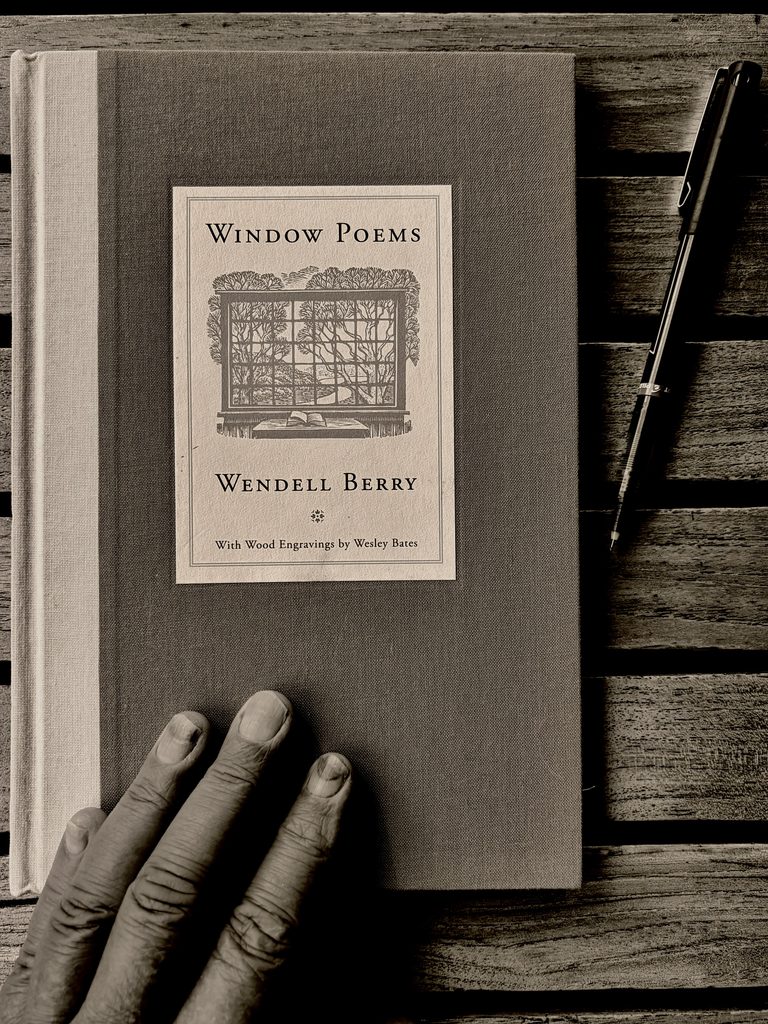
Wendell Berry, as many of you will already know, passed away late last week, just a few weeks past his 92nd birthday. To my sense of things, he was one of the most important and insightful American thinkers of the last 100 years. His loss is a sad one for so many of us who were avid students of his work.
Berry’s thinking helped me to shape many of my own beliefs over the years. As a city kid who knew nothing about farming or what life was like in small-town America, he offered me enormous insight into both. Perhaps most meaningful for me, though, was the way he determinedly lived in alignment with his beliefs. He consistently demonstrated the courage and ethical fortitude to walk his own way, and he regularly turned down opportunities to gain wealth or fame in order to stay true to his convictions. Wendell Berry worked hard for what Wendell Berry believed to be right. He never succumbed to social norms. He didn’t care about making bestseller lists, he spoke in public more rarely than not, and he had next to no affinity for the kinds of awards and recognitions to which most American writers aspire. While so many seem to shift their beliefs when fame or fortune beckon, Berry never did. To the contrary, he earned renown by thoughtfully forgoing all the things that other, fame-centric figures would likely want. As my friend Daphne Zepos, the cheese educator, said of her own experience in the weeks before she passed away in July 2012, Wendell Berry “owned” his life.
On the first of May this past spring, Front Porch Republic published a piece by David Demaree titled “Forsaking Success: Wendell Berry’s Return to Kentucky.” “As one Kentuckian wondered,” Demaree asks, “why would he give up the ‘glitz and glamour’ elsewhere to come back home to farm?” The following two paragraphs sum up one of the foundational stories of Berry’s long, rich, and story-filled life:
A young Wendell Berry made a consequential choice to live out his conviction in the spring of 1964. An assistant professor of English at New York University, he had to return home to Kentucky. The day he formally announced his resignation, Berry’s supervisor called him into his office. The senior faculty member must have assumed that the young Berry—not yet thirty—simply did not grasp what he was throwing away. It was one last appeal from the world he was leaving behind, to not throw away the extraordinary success before him for the obscurity—and fidelity—of Kentucky. His choice, according to Berry, amounted to “intellectual death; cut off from the cultural springs of the metropolis” in the eyes of the literary world. …
Years later, Berry’s advisor, Wallace Stegner, a literary giant in his own right, reflected on Berry’s choice to return to Kentucky in a letter. “That was a move as radical as Thoreau’s retreat to Walden, and much more permanent. I am sure that people told you were burying yourself, that you couldn’t come into the literary world with manure on your barn boots and expect to be welcomed, that you owed it to yourself and your gift to stay out where the action was.” It was clear to Berry and those in his circle that moving to Kentucky was tantamount to forfeiting the promise of literary success. What is more, Berry made a more radical decision than moving to Kentucky while living in New York City. Berry’s daughter, Mary, recalls a meeting her father had with Scribner’s Publishing in New York City between 1962 and 1964. One of the editors apparently told the young Kentuckian, “We’re going to make you famous.” Berry did not bite. Like his move back to Kentucky, Berry confounded his peers and mentor by turning down a literary tide of fortune.
While much of the country is caught up in issues of “right” and “left,” Wendell Berry would develop his own worldview, what he came to call “agrarianism.” Here are the 11 tenets of this philosophy, which he shared in a December 2018 interview entitled “For Love of Place: Reflections of an Agrarian Sage”:
1. An elated, loving interest in the use and care of the land.
2. An informed and conscientious submission to nature.
3. The wish to have and to belong to a place of one’s own, as the only secure source of sustenance and independence.
4. A persuasion in favor of economic democracy; a preference for enough over too much.
5. Fear and contempt of waste of every kind, and its ultimate consequence in land exhaustion.
6. A preference for saving rather than spending.
7. An assumption of the need for a subsistence or household economy.
8. An acknowledged need for neighbors, and a willingness to be a good neighbor.
9. A living sense of the need for continuity of family and community life.
10. Respect for work, and (as self-respect) for good work.
11. A lively suspicion of anything new, contradicting the ethos of consumerism and the cult of celebrity.
I don’t share all this here so that you’ll immediately go online and sign up for some sort of agrarian party membership. Rather, it’s to demonstrate that any of us who are willing to do some homework—to study, engage in self-reflection, and then share what we learn—can come up with our own sense of what success looks like. Success, after all, is a very personal thing. As Berry explains,
Movements leave little room for meaningful dissent. They regard themselves as destiny. Movements are big on tunnel vision. Their vision. So, let us agrarians give thanks that we are not part of a certified and accredited movement. … One reason, I believe, for [agrarianism] being ignored is that agrarianism isn’t just about money. It might get a more respectful hearing if it were. But it is about culture, just as agriculture was about culture. Before it got run into the ditch by agribusiness.
Berry’s story makes me smile because, I suppose, it was his willingness to say no that in large part defined him and his life in the way he wanted to define it. It’s somewhat parallel to our decision here not to open businesses outside the Ann Arbor area, and to regularly turn down offers to open other Delis—in the belief that, as the Beat poet Gary Snyder (a good friend of Berry’s) would say, “excellence is a function of uniqueness.”
Back in the spring of 1991, when Wendell Berry was a few months shy of his 47th birthday, we began the work of writing out our Mission Statement and Guiding Principles (aka values) at the Deli. Since the quality and flavor of the food we sell and serve is where it all begins for us, we started there. Pretty quickly, however, we came to realize that the adjective we were so accustomed to using—“high-quality”—actually had no definitive definition. It was, as one of our English-major associates explained, a subjective word—and in order for it to have any value, we would have to define it for ourselves.
While we could have simply copied our definition of quality food from someone else and been done with the whole deal in a day, that would never have worked here in the ZCoB (Zingerman’s Community of Businesses). We knew we needed to come up with our own meaning—something that was right for us, not something we snagged from a business that seemed sort of similar somewhere else. Our two-part answer, for those who are curious, was:
a) full-flavored (defined further to mean complexity, balance, and finish), and
b) traditionally made.
Those from-the-heart definitions have done wonders for us for 35 years now.
The word “success,” I would suggest, is similarly subjective. We each need to define it for ourselves. Simply saying or doing what others are saying or doing won’t work. What was right for Wendell Berry wouldn’t be exactly right for me or anyone else.
Of course, success is spoken of all too often as if it were some sort of universally agreed-upon American standard. In truth, though, it would seem that one is successful only when one is living out the life that one aspires to lead. And while some people might freely choose, of their own volition, a metric defined most prominently by dollars and cents, I would come back to what Wendell Berry asked in conversation with Bill Moyers: what is the right thing to do?
Here in the ZCoB, we write out what success will be like—crafting an inspiring and strategically sound description of the future that we long ago came to call a “vision,” or, more completely, “a vision of greatness.” (Learning to write a vision literally changed my life. If you want to understand the process, check out ZingTrain’s “Intro to Visioning” workshop coming up next month.) The way we do visioning, it’s an inside-out exercise that asks—again, from the heart—“what success will look like, feel like, and taste like at a particular point in the future.” For me, the willingness to stay true to one’s vision and one’s values—always easier said than done—seems to be what success is. It’s about pursuing what you want!
Wendell Berry, to my knowledge, never imagined himself as an anarchist, but his philosophies could easily be compatible with that school of thought. In an essay written 10 years ago this past spring, titled “Freed Market Anarchists: Meet Wendell Berry,” Robert Kirchner wrote, “Though Berry never describes himself as an anarchist, I find it significant that his most concrete prescriptions for remediating the harm of industrialization are not statist policy measures but agorist ventures.” Which is why—even if, as far as I know, he never wrote a word about her—much (though definitely not all) of Wendell Berry’s belief system would seem to be well aligned with that of activist and author Emma Goldman. In fact, four months after Wendell Berry was born in Kentucky in August 1934, Goldman had an article entitled “Was My Life Worth Living?” published in Harpers Magazine’s December issue. She wrote,
What is generally regarded as success—acquisition of wealth, the capture of power or social prestige—I consider the most dismal failures. I hold when it is said of a man that he has arrived, it means that he is finished—his development has stopped at that point. I have always striven to remain in a state of flux and continued growth, and not to petrify in a niche of self-satisfaction.
Like Wendell Berry, Emma Goldman absolutely lived an exceptional life of her own design. She was only 16 years old when she arrived in the US during the final December days of 1885, one of nearly 400,000 immigrants who had come into the country that year. Six months later, in May 1886, she was stunned in the worst possible way by the trial, conviction, and execution in Chicago of the men who came to be known as the Haymarket anarchists. Anarchism quickly became the core of her philosophy, and she would go on to spend the rest of her life developing her own version of it.
Her belief system quickly caught the attention of a wide range of Americans—by the time she was 20, Goldman was speaking to audiences of over 5,000 people! As historian and public health expert Elizabeth Fee and research nurse and writer Mary Garofolo report,
Goldman was probably the most accomplished, magnetic speaker of her time in the United States. A labor organizer and anarchist leader, she crisscrossed the country lecturing on anarchism, economics, drama, birth control, free love, and women’s emancipation. Everywhere she attracted enormous crowds who became spellbound by her rhetoric.
Emma Goldman would go on to write half a dozen books, dozens of pamphlets, and many hundreds of articles. In 1906, she started the New York–based anarchist journal Mother Earth, which continued to publish for over a decade. British journalist Ally Fogg writes, “If anything is more remarkable than Emma Goldman’s words, it is surely the life she lived.” As many of you already know, Goldman’s good work has inspired me enormously—she continuously developed her own way of showing up in the world, a life path that included learning, helping others, a dedication to dignity, a fight for freedom, and an eagerness to embrace beauty, joy, good food, poetry, art, and positive beliefs about people.
I write much more about her in the pamphlet “Going into Business with Emma Goldman.” And I agree with Ally Fogg when he says, “A hundred years after her masterpiece [Anarchism and Other Essays] appeared, Emma Goldman’s concerns are as current as ever.”
A success story, though? That was for Goldman to decide. In January 1933, when she was 64 years old—having lived in the south of France for a few years after escaping from post-revolutionary Bolshevik Russia, but still banned from the US—she penned a piece titled “Has My Life Been Worth While?” In it, she answered the looming question about success:
Have I wasted my life?
Measured by the ordinary standards of value, my life may be considered wasted. I have nothing in social prestige, wealth and power—that holy alliance commonly called success—to show for my struggle of forty-three years.
But then, I had never aspired to those treasures. I am therefore spared the bitter disappointment of those who had considered them fixed and unchangeable for all time.
Station, power, wealth—how inadequate they have proved! How useless and insecure!
The mighty of yesterday now standing before the world as the most successful failures of our age.
“Successful failures” is actually a funny but strangely accurate way to describe people like Wendell Berry and Emma Goldman both: they “failed” on the world’s narrow terms while succeeding mightily on their own. And they’re not, of course, alone. Consider the case of the artist Jean Varda. Born 133 years ago this week, on September 11, 1893, in the Turkish city of Smyrna (today, it’s called Izmir), Varda had both Greek and French ancestry. At 19, ready to make art into his daily reality, he moved to Paris, where he came to befriend the young Pablo Picasso and George Braque. Five years later, when World War I began, he went west to London to train as a ballet dancer. After the war, Varda moved back to Paris and began to develop a unique style of collage inspired by his exposure to mosaics while growing up in Asia Minor: he would break mirrors, scrape off the silver, paint on the backing, and then use the pieces from the broken mirrors in his collages.
In 1939, as the Second World War was about to commence, Varda escaped Europe for New York City. The following year, he continued his westward journey, traveling cross-country and then settling in Big Sur, where he became good friends with authors Henry Miller and Anaïs Nin. Nin wrote about Varda often, including in her novel Collages, where Varda’s art also appears on the cover. In 1946, Varda traveled to North Carolina to teach at Black Mountain College in Asheville.
(Black Mountain itself was created in 1933—the same year Emma Goldman published “Has My Life Been Worth While?”—as an alternative vision of what a successful college could be! The school was owned and run by the faculty, and although it wasn’t an art academy, it operated with the belief that the arts were central to any effective education. It was the first integrated college in the US, in a part of the country where Jim Crow was still very much the norm. There were grades, but no one paid them much attention. The more the students learned about themselves, the more the educational process at the college was deemed successful.)
From the mountains of Eastern North Carolina, Varda again made his way back to California and wound up on a houseboat in Sausalito harbor. There, he hung with quite the creative crowd—folks like Miller and Nin, anarchist philosopher Alan Watts, poet Allen Ginsberg, and a host of other artists, writers, and musicians. A young Maya Angelou was one of Varda’s regular visitors, and she later wrote about him. So was the remarkable wire sculptor Ruth Asawa, who had attended Black Mountain College. So many creative people gathered on and around Varda’s boat, the area came to be called “Guru Alley.” All were individuals who, like Varda, shunned society’s norms and defined success for themselves. They were not, he would later describe, “the sort of rebels who carry pistols—they are rebels against the system, against this American obsession with making money.” In his later years, Varda became known to many as “the last bohemian.” His parties were legendary, even newsworthy.
The Jean Varda Project notes that “Varda created a vision of success that was far more about creative passion than about creating profit.” He was also apparently a talented cook, creating a culinary oasis in an era when American cuisine was a far cry from what it has become over the last 50 or so years: “A bit of dried cod, seasoned with fennel that grew wild on the shore next to the Vallejo [Varda’s boat], was transformed into a memorable meal.”
Like Wendell Berry, Jean Varda resisted ever being part of any sort of movement. He preferred to walk his own path—wherever he went, he seemed to create his own world. Also like Berry (and Goldman), he worked tirelessly, often aspiring to finish at least one piece of art every single day. In 1947, Henry Miller published a pamphlet entitled “Varda: The Master Builder.” In the spirit of what I shared last week about helping people become themselves, Miller wrote,
It is [Varda’s] special quality to see always the potential, and often quite invisible, nature of his friends. He sees them as only the saint or the guru sees humankind. Sees them thus because he himself is all these things, because in the gleam of his powerful, radiant light even the dull flesh of the inconspicuous creature, be it human or animal, reflect his faith and ardor.
Getting clarity on what one’s success might look like—as Berry, Goldman, and Varda ultimately did—is essential work, but that doesn’t make it any less challenging. To return, full circle, to Wendell Berry, these poetic lines from his now 26-year-old novel Jayber Crow do justice to the subject:
“You have been given questions to which you cannot be given answers. You will have to live them out—perhaps a little at a time.”
“And how long is that going to take?”
“I don’t know. As long as you live, perhaps.”
“That could be a long time.”
“I will tell you a further mystery,” he said. “It may take longer.”