A beautiful and delicious bread to brighten your day on August 18 & 19
|
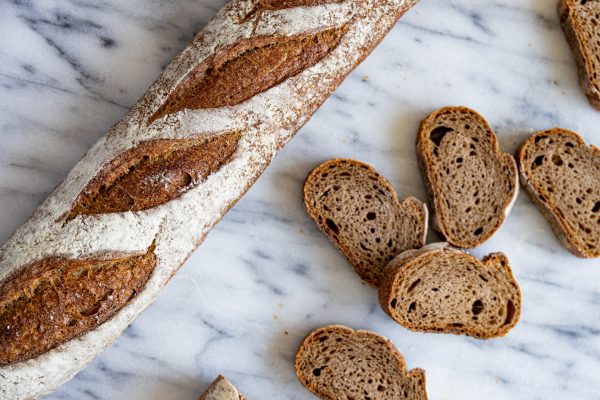
One of my all-time favorite Bakehouse breads will be available this coming weekend! You can buy a Chestnut Baguette (or two) on August 18 and 19 at the Bakeshop and Deli. Feel free to order ahead to be sure there’s a loaf waiting for you. I’ll be picking up a couple for our house! James Beard once said: “Good bread is the most fundamentally satisfying of all foods; and good bread with fresh butter, the greatest of feasts.” The Chestnut Baguettes from the Bakehouse backs up James Beard’s statement in a big way!
Baking with chestnut flour is wholly uncommon in the U.S. in the 21st century, but it’s got a long history in Italy, France, and central Europe where chestnuts were used for almost all sorts of cooking. Chestnut flour was often what people who couldn’t afford the more costly wheat would work with. In Ukraine, chestnuts are considered a symbol of prosperity, fertility, and also longevity.
(The story there, which dates to the 19th century, is yet another example of Russian imposition and acting with anything but grace, followed by creative Ukrainian resistance.) In the Lunigiana region of Tuscany, wheat was grown on the valley floor, so the only flour readily found in the mountain areas was ground from locally grown chestnuts. The region has long been known as “The Land of the Moon and the Bread Tree”—the latter is a reference to the chestnut.
The typical Casola Marocca bread of the area is now enshrined in the Slow Food Presidium. Chestnut flour-based breads were also popular in Liguria (the Italian Riviera), where Rocco and Katherine Disderide, the Italian immigrant couple who built the Deli’s building in 1902 had come from. In that sense, I feel like the Bakehouse’s Chestnut Baguettes have come full circle. Unfortunately, chestnuts in the U.S. fell prey to a massive blight in the early years of the 20th century and were almost totally eradicated. Michigan, I’m happy to say, has been the center of the American chestnut revival over the last decade or so.
To make the baguettes, we work with local chestnut flour from the folks at Treeborn, about half an hour or so west of here in Jackson. We blend that with freshly milled Michigan hard red spring wheat. No commercial yeast is used—just the flour, filtered water, and sea salt—which means that the baguettes are naturally leavened. The finished loaves are lovely, the color, in fact, of chestnuts. The flavor is nutty, full, subtly sweet, with a long, lovely finish that pairs well with an endless list. The baguettes are great with the Creamery’s fresh goat cheese or Manchester cheese. Toast a slice and top with olive oil and fresh Bellwether ricotta and some chestnut honey. If you toast slices on the grill to pick up a bit of woodsmoke, that’s wonderful too. Or just tear off a chunk and eat it as is!
Treeborn is located in the Rogers Reserve, land that was donated to Michigan State University by Ernie and Mabel Rogers in 1990. Determined to right what had gone so wrong in the American ecosystem, the Rogers gifted the land for the express purpose of supporting the revival of the American chestnut. Treeborn today has the only commercial chestnut peeling line in the Western Hemisphere, technology that makes this work possible.
As of the 2012 U.S. Census of Agriculture, Michigan is the country’s leading producer of chestnuts. Maybe when the ZCoB hits its 100th anniversary in 2082, local license plates will say “The Chestnut State.” And this beautiful baguette will be one of the state’s signature dishes, something travelers regularly take back with them to demonstrate what is possible when good people do good work in the world!
|
|
| P.S. If you want to make the baguettes at home, the recipe is in the Zingerman’s Bakehouse book on page 228. |
|
Want more from Ari?
Sign up for Ari’s Top 5 e-newsletter and look forward to his weekly curated email—a roundup of 5 Zing things Ari is excited about this week—stuff you might not have heard of!
Super tasty, traditional Hungarian savory strudel served up May 5-7
|
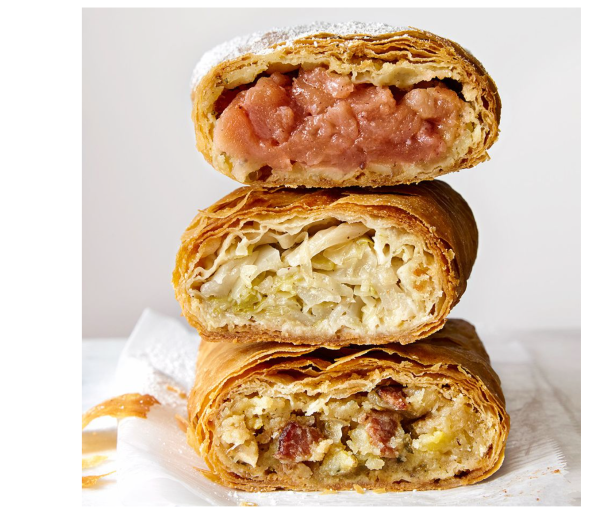
Cabbage Rétes (the middle one pictured above) is a favorite Hungarian flavor we discovered during our time in Budapest ten or twelve years ago. The strudel’s filling has just a few ingredients—cabbage, goose fat, salt, and pepper—but lots of flavor. Why goose fat? Geese are a favorite protein in Hungary, and it’s possible to find all things goose in the meat markets. Goose fat is understandably a commonly used fat. It adds a distinctive roasted poultry flavor to this savory treat.
In Hungary, what most Americans call strudel is known as “rétes” (pronounced “ray-TESH”). Over the last few centuries, there’s been quite an argument going on between Austrian and Hungarian historians as to who should get the culinary credit for the invention of strudel. Quite clearly whoever came up with this amazingly wonderful so-thin-you-can-read-the-paper-through-it pastry filled with most anything you can imagine—deserves appreciation from both sweet and savory lovers. Writer George Lang said that the strudel was actually a legacy of the Turkish influence on the region.
While strudel’s delicacy might reasonably be taken as a mark of something that started in high society, Lang let us know that, “In Hungary, strudel is a village specialty, and even in luxury restaurants it’s always a farmer girl from the provinces who’s hired to make it.” Others have called it “the pride of Hungarian cooks.” Tina Wasserman, author of Entrée to Judaism for Families, suggests that the cabbage rétes was a big part of Hungarian Jewish eating—the use of goose fat in this recipe in place of pork speaks to Wasserman’s write-up.
Speaking personally, the Bakehouse’s Cabbage Rétes is a longtime favorite of mine! Amy Emberling, co-managing partner at the Bakehouse said of the strudel-making process: “The dough is one of those wonders of the baking world that is rewarding to make. It’s like a magic trick!” A slice of rétes makes an easy meal, accompanied by a salad and/or soft scrambled eggs (as I did this week with a bit of fresh goat cheese from the Creamery and sprinkled with some Hungarian paprika). When she first moved here from San Francisco, many years ago, my girlfriend-farmer-life partner Tammie Gilfoyle told me that “the rétes are like God’s gift to the Bakehouse!” In the context of Robert Pirsig’s appeal for us to accept Quality as a universal truth, the rétes could then be a terrific example to prove the point—both subjectively (full-flavored and traditional) and objectively, it’s awesome!
Come by the Bakehouse May 5, 6, or 7, or call to reserve them: 734-761-2095.
|
|
|
P.S. If you want to make this marvelous rétes at home, the recipe is in Zingerman’s Bakehouse cookbook (on page 237)—the book is a great gift for Mother’s or Father’s Day, made even better maybe by pairing it with the new pamphlet on Zingerman’s food philosophy. Amy, Corynn, Lee, and LJ are working hard on getting a second Bakehouse book, entitled Celebrate Every Day: A Year’s Worth of Favorite Recipes for Festive Occasions, Big and Small, out this fall! Stay tuned!
Want more from Ari?
Sign up for Ari’s Top 5 e-newsletter and look forward to his weekly curated email—a roundup of 5 Zing things Ari is excited about this week—stuff you might not have heard of! |
|
A world-class dessert handmade here
in Washtenaw County
|
|
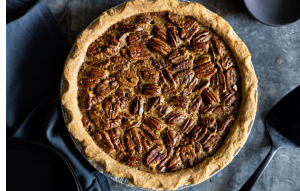
| Pecan pie is hardly hard to find—you’ll see one in nearly every American bakery, or at least on the menu in almost every roadside diner. The challenge isn’t finding one—it’s finding a great one. If you or someone you know has been on the search, I feel super confident that we can help you! My opinion? The pecan pie from the Bakehouse is one of THE best things we bake!
I’m not the only one who holds that belief. Amy Emberling, long-time co-managing partner and a member of our Stewardship Council, wrote in Zingerman’s Bakehouse, “This is my favorite Bakehouse pie, just because I enjoy it and also because it fits our mission perfectly—full flavored and traditional.” Want an outside affirmation? It’s been acclaimed by the Detroit News, featured in InStyle magazine, and was famously carried years ago to Paris by Frankie Andreu’s wife to help him celebrate the Tour de France bicycle team victory! To state it simply, this is a pretty darned exceptional pecan pie from the Bakehouse.
What makes it so great?
As Amy elucidates, “What makes the difference between a good version and a great version is the quality of the ingredients and their proportions.” Muscovado brown sugar is one of the “secrets.” It takes just as long to put this amazing sugar in our pie as it would take to use industrially-refined brown sugar, but the flavor it brings is about 55 times better. Above and beyond the sugar, “Real vanilla and flavorful butter are also critical.” And, the featured element—we use mammoth halves of Western Schley and Pawnee pecans, both of which are known for their good flavor.
As Mississippi-born food writer Craig Claiborne once declared, “Nothing rekindles my spirits, gives comfort to my heart and mind, more than a visit to Mississippi … and to be regaled as I often have been, with a platter of fried chicken, field peas, collard greens … to top it all off with a wedge of freshly baked pecan pie.” Shifting my geographic gears, I was thinking the other day about how in Vermont they often serve apple pie with a slice of room-temperature cheddar laid (not melted) on top. I had the thought to do the same with the Pecan Pie.
I used some of the six-year-old cheddar we have at the Cream Top shop from the Widmer family in Theresa, Wisconsin. It was terrific. The sweet richness of the pie and the creamy sharpness of the cheese make a great match. Alternatively, spread a bit of the Creamery’s handmade Cream Cheese on your plate, then put the pie on top—the creaminess of the cheese, the dark gently bittersweetness of the pie, the butteriness of the crust, and the natural nuttiness of the pecans come together to make a very special way to end a meal!
Want more from Ari?
Sign up for Ari’s Top 5 e-newsletter and look forward to his weekly curated email—a roundup of 5 Zing things Ari is excited about this week—stuff you might not have heard of! |
|
We’re busy ushering in the holidays across the Zingerman’s Community of Businesses with all sorts of seasonal favorites. The Bakehouse is baking loaves of Cranberry Pecan bread and the Coffee Company is brewing up batches of Holiday Blend coffee. The Deli is mixing up their house blend of Hot Cocoa Mix. Mail Order is busy shipping everything from heirloom turkeys to loaves of Chocolate Babka across the country.
While we’re looking forward to sharing all of those treats with you and yours, we also wanted to bring you a few of the dishes that help usher in the holidays for some of our Managing Partners. They’ll be whipping them for friends and family throughout the holidays, and now you can, too. And, since they’re all two-bite recipes, you can share and enjoy more of them!
A Holiday Recipe from the Bakehouse
We first created Espresso Stars for our most beloved BAKE! class, Fancy Schmancy Holiday Cookies, at the suggestion of Nikki Lohmann, one of our BAKE! Instructors. We started the class in December 2009, and have been teaching it every holiday season since, adding more sessions along the way—we now teach the class 100 times between Thanksgiving and Christmas! The combination of coffee, chocolate, and buttery shortbread was such a hit that, for a time, they made it into our regular line-up at the Bakeshop, Zingerman’s Coffee Company, and Zingerman’s Roadhouse.
This recipe can be found in our Fancy Schmancy Holiday Cookies cookbooklet, a bite-sized collection of some of our favorite cookies from the class over the years. I’m excited to share that it will also appear in Celebrate Every Day: A Year’s Worth of Favorite Recipes for Festive Occasions, Big and Small, our second full-length cookbook, which will be released in the fall of 2023. We packed it full with nearly 80 recipes, most of which have never been published, and included a number of guest favorites. We can’t wait to share it with you!
—Amy Emberling, Zingerman’s Bakehouse Managing Partner
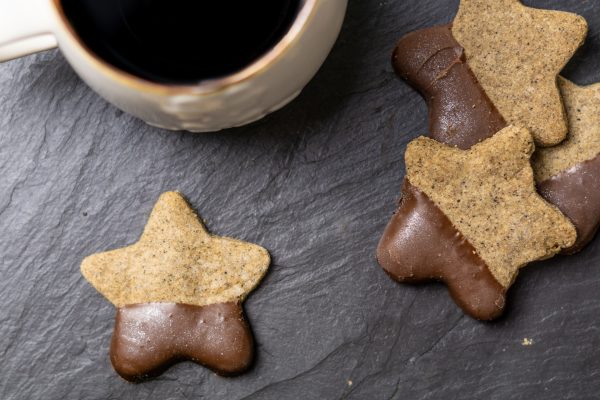
These shortbread cookies are flavored with freshly ground espresso beans from Zingerman’s Coffee Company, making them a rather adult addition to a dessert line-up, both in terms of flavor and the little jolt of caffeine. We like the added help staying awake until the celebratory ball drops at midnight in New York City’s Times Square on New Year’s Day; but if you’d prefer less of a burst of energy, feel free to use decaf beans. (Just don’t be tempted to try and swap in instant espresso powder, which is designed to dissolve; we want both the flavor and the texture from the freshly ground coffee to be front and center.) To make them look as festive as they taste we partially dip them into chocolate, and make the effort to find gold luster dust or gold leaf to garnish them.
Chocolate-Dipped Espresso Stars
Makes 2 to 3 dozen cookies
1/2 cup (110 g) unsalted butter, room temperature
1/4 cup (50 g) granulated sugar
1/2 tsp fine sea salt
1 cup plus 1 Tbsp (150 g) all-purpose flour
2 Tbsp (10 g) espresso beans, finely ground
1 cup (170 g) semisweet chocolate, chopped
Gold luster dust or edible gold leaf (optional)
Make the cookies
- Preheat the oven to 300°F (150°C).
- In a medium mixing bowl, cream together the butter, sugar, and salt until sugar is well mixed in.
- Add the flour and ground espresso beans and mix until the dough holds together. If necessary, use your hands to gently knead the dough together into a ball.
- On a lightly floured surface, roll the dough out to 1/4-in (6 mm) thick. Cut out cookies using a 1 1/2- to 2-in (4- to 5-cm) star cutter. You can reroll scraps and cut out more stars, but take care not to overwork the dough. This cookie will be delicious in many different sizes and shapes. Use what you prefer and what you’re able to find. If you choose a much bigger cutter, leave them a little thicker. If they are large and too thin they will break easily.
- Carefully place cut cookies on a baking sheet lined with parchment paper, evenly spaced about 1 in apart.
- Bake for 30 minutes. The tops should look dry and cookies should be slightly browned. Cool on the baking sheets for 5 minutes, then transfer to a rack to cool completely to room temperature before dipping in melted chocolate.
Garnish the cookies with melted chocolate
- Melt the chocolate slowly in the microwave or over a double boiler until just melted.
- Dip 1/3 of each cookie into the melted chocolate, then place onto a baking sheet lined with parchment paper. If you have gold leaf use a couple of small pieces as garnish and apply them to the soft chocolate. Let the cookies sit at room temperature until the chocolate hardens.
- If desired, lightly brush gold luster dust over the hardened chocolate.
Storage:
Store the cookies in an airtight container, with parchment paper between layers of cookies, at room temperature for up to a week or in the freezer for up to 2 months. Thaw frozen cookies at room temperature before enjoying. If thawing cookies with luster dust, do so gradually, moving them from the freezer to the refrigerator, and then to room temperature.
Tip!
Luster dust is a type of decorating powder used to add color and sparkle to cakes, candy, cookies, and other sweet treats. It’s available in stores that sell cake decorating supplies or online, as is edible gold leaf.
A Holiday Recipe from the Deli
You definitely know it’s the holiday season when you start smelling Spiced Pecans in the Deli kitchen. Every batch is made by hand and bagged right at 422 Detroit Street. We get the pecans from the South Georgia Pecan Company in Valdosta, Georgia, and use a spice blend we make ourselves using Épices de Cru spices.
There is a disco dancing spiced pecan cartoon on our Spiced Pecan bag and a few years back we figured out we could print them with sparkly red ink. Nick Jaroch painted a poster of this pecan guy with glittery pants that is one of my favorite pieces of merchandising ever at the Deli. We like to make big, bountiful displays of these bags all over the Deli. Like hanging tinsel on your tree, it’s festive and fun and you know the holidays have arrived.
—Rodger Bowser, Zingerman’s Deli Managing Partner
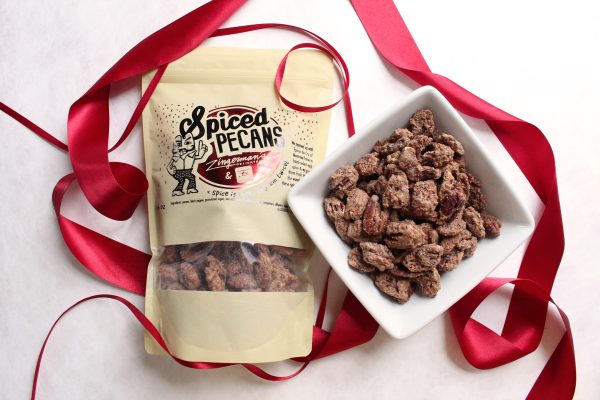
Spiced Pecans with Apples & Cheddar
Pick up a bag of Zingerman’s Deli Spiced Pecans, crisp local apples (like from Nemeth Farms in Milan or Kapnick Orchards in Britton), and a block of cheddar—you can’t go wrong with Nor’Easter Cheddar from Cabot, but the new cheddars from Deer Creek in Wisconsin are also pretty fabulous. Put these three items on a tray and viola! A simple, yet delicious combination that’s sure to win over your kids, neighbors, or a crowd!
A Holiday Recipe from Mail Order
Zingerman’s Mail Order does half its years’ business in the month of December. That kind of surge is as crazy as it sounds. We go from a nicely busy business to a rather insane business. Our staff quadruples. Food and boxes fill our warehouse to the rafters. Trucks and people and conveyors are constantly in motion. The operation runs 24/7. It’s kind of nuts. I’ve known no other version of December for the past two and a half decades, it’s a really strange yet exhilarating way to spend the holidays.
—Mo Frechette, Zingerman’s Mail Order Managing Partner
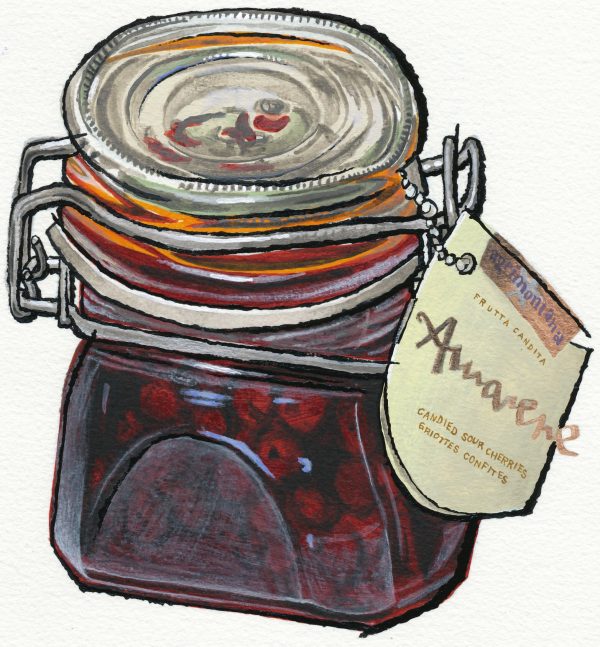 Preserved fruits, candied fruits, fruit cakes—they all say the holidays are here. They’ve been part of festive eating for centuries. For me, outside of jam on toast, I rarely eat fruits like this from January through November. But I crave them in December. Agrimontana’s Italian cherries are the handcrafted, flavorful alternative to the ubiquitous blue and white jars of Amarena cherries you see at cafes. They taste of dark fall fruit, sweetened in their purple syrup. Combining them with chalk white Brabander goat gouda is stunning to look at and, frankly, a blast to eat. I think of Brabander as the milkshake of cheese—creamy, sweet, and easy to eat. Why not have a cherry on top?
Goat Gouda with Wild Cherries
Spoon one or two Agrimontana wild cherries from the jar and drape them on a thick shard of Brabander Goat Gouda cheese.
Originally published in the November/December 2022 Zingerman’s Newsletter