
Tag: MO FRECHETTE
*From time to time, we share the writing of our friends and co-workers on this site. Today’s guest post comes from the blog of Zingerman’s Mail Order Managing Partner, Mo Frechette. You can read Mo’s blog here.
Ancient calendar technology
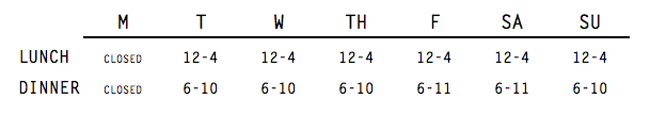
I don’t know when seven day week calendars began — they predate the Romans — but I don’t think it’s a stretch to call them ancient. Or maybe I should say heirloom. Whatever the word, calendars work crazy well. Everyone knows how to use them, the structure is the same worldwide so you don’t need to understand a local language to read one, and they’re super fast to scan and pick out the exact info you’re looking for. When you want to tell people something specific to a day of the week there’s nothing better. So I’m always surprised how many times people choose to ignore them and force customers to wander their word maze to find the information they’re looking for. Like this restaurant:
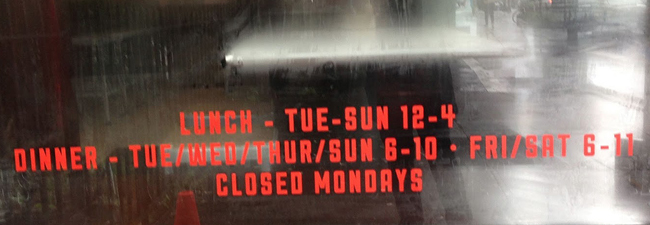
Here’s the same information written as a calendar:
New calendar technology
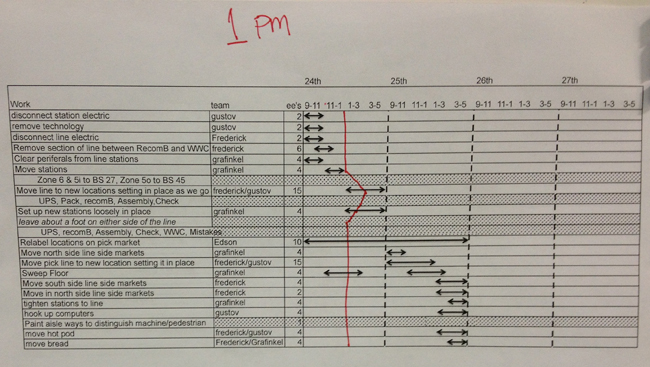
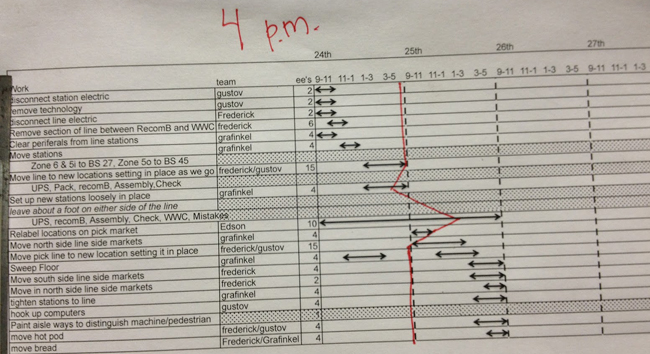
A follow-up to yesterday’s post about calendars. We’ve started testing a project timeline calendar that looks like a bit like a Gantt chart, which is a newfangled calendar technology (meaning it’s a hundred years old, not several thousand). It has a special jagged red line “right now” feature you’ll see below. They key thing is that, like a calendar, time starts on the left and moves to the right. Whenever you need to visually represent time progression that’s the best way to go.
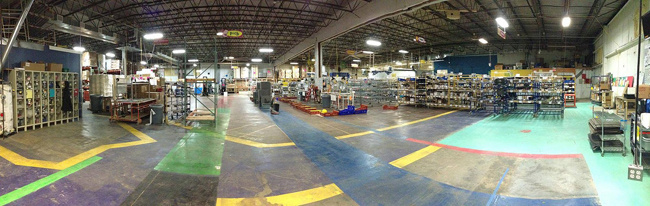
Here’s an example of it (hat tip to J Atlee). It was used to plan and report on our progress as we performed a multi-day rearrangement of our warehouse floor. The red line, where we’re currently at, moved every few hours. Here it shows where we were Day 1 at 1pm (ahead of schedule on the part of the red line that angles a “V” to the right, the rest on schedule):
*From time to time, we share the writing of our friends and co-workers on this site. Today’s guest post comes from the blog of Zingerman’s Mail Order Managing Partner, Mo Frechette. You can read Mo’s blog here.
Drank No. 4: Two styles of gin and which one is best for a gin and tonic
Outside of the Netherlands nearly all gin is made in what’s called the “London style.” Within the London style, though, there are two major distinctions, what I call stewed and steamed.
Stewed gins are made by boiling the botanicals—juniper, clove, and so on— along with the alcohol mash. Tanqueray is a stewed gin.
Steamed gins are made by hanging the botanicals above the alcohol mash so only the vapors, the stuff that’s condensed to become gin, pass through them. Bombay Sapphire is a steamed gin.
Steamed gin is much milder than stewed gin, an observation that’s easy to confirm if you taste Sapphire and Tanqueray side by side.
It’s desperately close to Gin & Tonic Season in case you haven’t noticed. (Like the seasons for white pants and skirts, seersucker and chilled rosé, I abide by a personal rule that all of them kick off on Memorial Day.) In a standard gin and tonic I nearly always opt for stewed gins like Tanqueray. Sapphire, so much milder, gets completely lost.

*From time to time, we share the writing of our friends and co-workers on this site. Today’s guest post comes from the blog of Zingerman’s Mail Order Managing Partner, Mo Frechette. You can read Mo’s blog here.
Sometime in the last decade or so I lost whatever hangup I had about going to restaurants that serve a lot of tourists. I guess it should have happened a lot sooner given that I’ve been part of Zingerman’s for almost two decades and we’ve been a tourist joint almost the entire time. I think I can pinpoint my personal transformation to sometime around the second bite of lunch at Cal Pep in Barcelona. It was a crowded counter swarmed by Americans. I was there with my friend Eric Farrell, now the owner of one of my favorite bars. We did that kind of anxious wait you do in Europe when you stand around not sure if anyone has seen you or if you should be doing something different or just leave. Sometime later a bottle of wine was handed to us, no questions asked; naturally we emptied it. An hour and a half later we closed the place having eaten most of the menu. I’ve never forgotten the food. I’m sure there are technically better meals in Barcelona — I’ve eaten a couple of them — but for sheer force of expression almost no place I’ve eaten at feels quite like Cal Pep.
What was a small transformation has grown into a larger passion. Where once I avoided them or held my nose when I visited, now I’m really drawn to old places that continue to do something great. That said, I like new places, too. They have loads of energy and I learn all kinds of things. They’re exciting like a new rock band is exciting. But with older places there’s almost something else to grasp. It’s not like they have to do everything well, and in fact most of them don’t. It’s kind of like watching old movies; you have to get over the period artifice to some extent in order to enjoy it. Same with old restaurants. Most of the time half the menu will be crap. Order carefully. If they do enough well — or even just one thing — that’s enough for me. The part that makes it worth it is that they’ve done whatever it is so well for so long they wear an elegance that newness can’t share. My friend Dai who owns Astro Coffee (highly recommended) put it well when he recently told me, “When people ask me where to go in San Francisco I tell them Chez Panisse. I mean Mission Chinese is red hot and it’s fine but Chez Panisse has been at it and after 40 years it’s beautiful. You want to know the secret to a great place? That’s it. You just show up and keep making it great—endlessly.”
Here are a few of my favorite old tourist joints — some older than others — that I think are worth it for one reason or other.
Barcelona, Cal Pep
San Francisco, Swan Oyster Depot and, on some nights, the Tonga Room at the Fairmont Hotel
Buenos Aires, La Preferida
Rome, Sora Margherita
New York, Grand Central Oyster Bar
Montreal, Schwartz’s
New Orleans, almost anything…