Inspiration from Those Who Came Before Us
Lessons from a woman who created exceptional design well into her 90s
The artist and master colorist Kenneth Noland—whose 112th birthday would have been last week—studied and worked at the remarkable Black Mountain College in North Carolina for a number of years. Noland was a native of Asheville, the next town over from Black Mountain, so it was geographically easy for him to decide to attend, as well as artistically and ethically appealing. Black Mountain College was the place in the 1930s, ’40s, and ’50s for freethinking spirits like Noland (and me—I’m 80 years too late, but I’m ready to enroll!). There, Noland was greatly influenced by the color theories of the brilliant German American, Bauhaus-trained painter, sculptor, poet, and teacher Josef Albers. While Noland is hardly a household name, within the world of avant-garde art and thought, his work is most definitely noteworthy. The New York gallery Yares Art describes him as “one of the 20th century’s most radical and influential American painters.” (As we come to the end of the month, here’s a link to one of his best-known pieces, April.)
Reflecting on his personal journey as an artist, Noland once said, “For me, context is the key—from that comes the understanding of everything. … Context begins with other artists—seniors and mentors.” In other words, context gives us the historical and social framing for what we’re doing, and seniors and mentors allow us to see what is possible in the long run. Coming before us, they open doors to what we might decide to do with our lives moving forward. We try things, we make discoveries, and, slowly, we figure out our own unique paths. The middle element in that list, it turns out, is especially important. Noland affirms this, commenting about art, “If it isn’t a process of discovery, it shows.”
Noland’s contemporary, the remarkable American textile artist Sheila Hicks, now 91, also trained with Albers at Black Mountain College. Like Noland, Hicks may not be well known in the wider world, but in the places where people pay attention to thoughtful and thought-provoking art, it’s acknowledged that she has had a transformative impact on sculpture through her innovative work with yarn and string. “In the world we live in,” Hicks says, “with so many hard things that we touch, we’re crying for softness. We’re all yearning for something that is warm, welcoming, and soft in the hard, hard world.” Coming to this understanding was part of the discovery process that has made Hicks’ life and art what they are. As she asserts, “To be alive is to discover.”
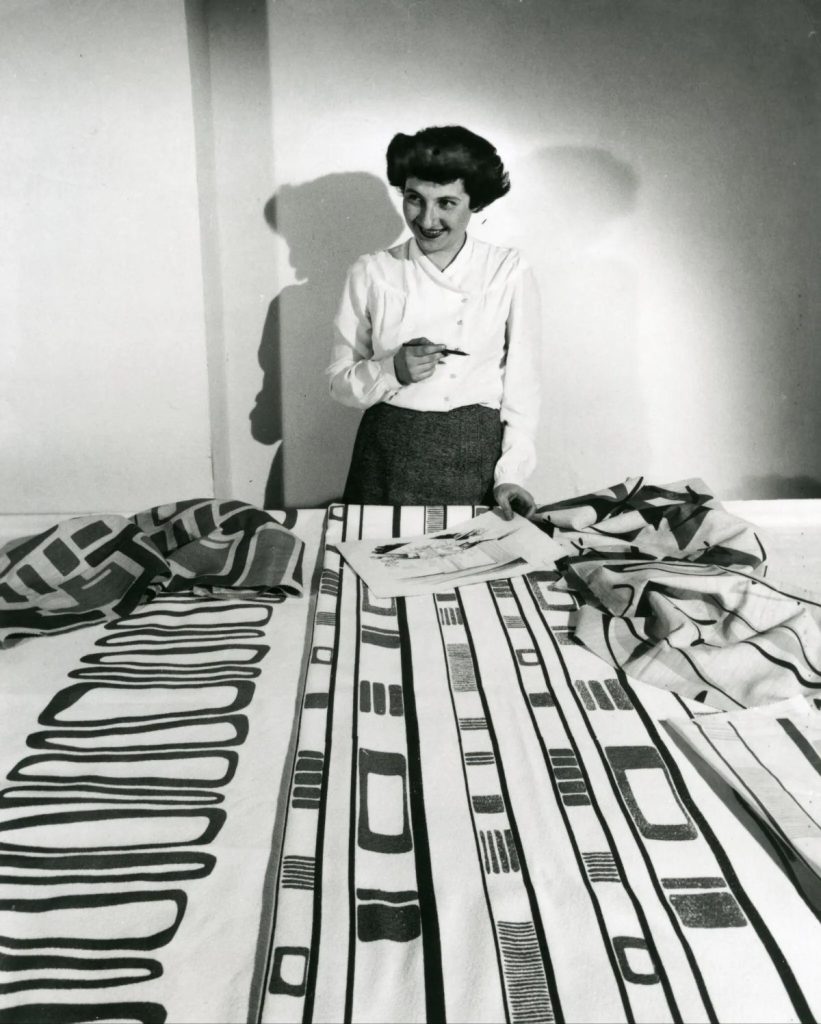
Discovery is certainly a key aspect of what makes my life so interesting. Not too long ago, I discovered another incredible artist, Ruth Adler Schnee. Of course, like Columbus’s “discovery” of America, what I “discovered” was already very well known to others; it was new only to me. Adler Schnee is, after all, hardly a secret figure. In fact, although I wasn’t aware of her until very recently, she remains one of the most highly regarded modern designers. Having spent the past few weeks studying her life and work, I’m so inspired that I’m now intent on adding Adler Schnee’s upbeat, insightful, creative, and caring voice to the “huddle in my head.”
Backing up a bit: Ruth Adler was born to a German Jewish family in Frankfurt in 1923—this coming May 13 would have been her 113th birthday. Her father, Joseph, was a well-known and respected antiquarian book dealer; her mother, Marie, was an artist who’d attended the Bauhaus in its original German home. The Adler family later moved to Düsseldorf, where a young Paul Klee, the renowned artist, was both their neighbor and Ruth’s babysitter! During the Nazis’ Kristallnacht pogrom in 1938, Joseph Adler was arrested and detained at Dachau. Understanding what was at risk, Marie went to the camp gate and, calmly and firmly, talked her way into getting her husband freed. The Adlers had seen enough; there was no reasonable life left for Jews in Nazi Germany. They began the process of immigrating to the United States and eventually came to Detroit—what would now be about an hour or so east of the Deli.
As a teenager, Ruth Adler attended Cass Tech, and then she traveled east for college to the Rhode Island School of Design. After a few years in Providence, she returned to the Detroit area and earned an MFA from Cranbrook Academy of Art in 1946. Two years later, she married Edward Schnee, and in September 1949, the young couple opened a consulting business and a retail design shop in Detroit. Like most startups, the store faced struggles in the beginning, but over time, it moved into a former factory location and developed into a retail jewel of the city. Through the years, Adler Schnee got to know designer Minoru Yamasaki, the man who made the original World Trade Center what it was. Sure enough, Yamasaki called her for help with the color palette of the building’s all-important lobby.
What makes me so intrigued by Ruth Adler Schnee? In large part, it’s the unexpected but exciting alignment between our values—and our parallel approaches to engaging with the world in what I’ve come to believe are the most wonderful of ways. Studying Adler Schnee’s life story, looking at photos of her prolific work, and being exposed to her energy—indirectly, of course, since she passed away in January 2023 at the age of 99—I realize that, for me, she fits well into Kenneth Noland’s category of “seniors and mentors.”
Oprah Winfrey writes that “a mentor is someone who allows you to see the hope inside yourself.” Through her example, Ruth Adler Schnee does that for me. Below are some life lessons I’ve drawn from her legacy. You can, of course, take away your own—and there’s a whole world full of seniors and mentors to glean even more lessons from. Some, like Emma Goldman, have come to me through reading and reflecting—others, like Peter Block, through writing, conversation, and long-standing friendship.
A Dozen Life Lessons Inspired by Ruth Adler Schnee
1. Find joy. Adler Schnee was seemingly very happy to work hard, to create great design, and to find joy in her work all the way through to the end. How can you argue with the names of some of her most famous patterns: “Fission Chips,” “Slits and Slats,” “Pits and Pods,” “Slinky Shadows,” and “Bugs in Booby Traps”? Granted, most of these names came from her husband, but Adler Schnee let them be released to the public when she could have easily objected to their “unseriousness” and said such “silly” names were unworthy of her good work. Over and over again, whimsy won the day. I love it.
2. Live your values—don’t do work you don’t believe in. Rip Ripson, writing in a retrospective on Adler Schnee’s life for the Kresge Foundation, says that Adler Schnee’s “story speaks to the value of inclusiveness, to the entrepreneurial spirit, and to the profound role the arts play in nurturing our souls.” Indeed, these were her values, and she embodied them each and every day.
3. Go where you want, but start with what you have. No matter where she was, Adler Schnee found ways to create and design from virtually nothing. She never wallowed in whatever hardship confronted her, and she didn’t get stuck on what was wrong. Instead, she poured her energy into constant creativity. As she said, “Patterns, colors, textures, furnishings—everything had a necessary role to play in the larger architectural environment of a space.”
4. Pursue your dreams regardless of what others tell you. It’s deeply moving to read how, at the age of 14, Adler Schnee had the courage to attend the Nazis’ so-called Degenerate Art exhibit in Düsseldorf so she could see the modern art she was already obsessed with. “I just loved what I was doing, and I wasn’t scared,” she told the Detroit Metro Times in 2000. “My parents absolutely did not want me to go to that exhibit.” (This dynamic may sound familiar to any parents of teenagers.) But yes, she went anyway!
5. Don’t get caught up in limiting beliefs that society has set for “people like you.” Stereotypes are an obstacle that can keep us from achieving what we’re truly capable of, and Adler Schnee overcame them time and time again. As a young, freethinking Jewish woman in Nazi society—and as a woman in a world that was, like so many then and still now, dominated by men—she never let the barriers halt her progress. She shared later, “When I studied architecture, the field was not open to women … and I found myself, all the time, to be the only one that was interested in that. But that didn’t seem to stop me.”
6. Pay attention and seek beauty. As Adler Schnee reminds us, “We all make our own environment in which we are comfortable, and beauty is a great part of it.” She also emphasized that finding beauty is much easier than many of us have been led to believe. “You just have to look at things. Everything is designed. My biggest criticism of American education is the schools don’t teach children to look and to see things, because design is all around us. You just have to go outside and look.”
Nancy Villa Bryk, assistant professor of historic preservation and museum practice right here at Eastern Michigan University, writes of Adler Schnee:
I learned she drew her designs from the life she saw around her. She could see beauty in the most ordinary things: layers of sediment rocks, cordwood stacks, a field of weeds, railroad tracks.
7. Align with essence. Adler Schnee was, it seems, very assuredly herself throughout her long life. She brooked no bullshit, but she did so from a place that was always joyful and true to who she was. As Ana Gavrilovska writes in the Metro Times, “Adler Schnee’s radiance has never dimmed. Asked during an interview what inspires her, Adler Schnee answers simply: ‘Everything.’” She said this something like 25 years ago, but I’m smiling now as I read it again for about the 18th time in the past few days. This sense of being inspired by everything is pretty much where I have arrived myself.
In a 2017 post on Adler Schnee, the blog Fishink wrote:
Now at 93, she continues to work most of the year from her studio in Southfield. She still designs custom fabrics for Knoll Textiles, where she holds a 20-year contract, and with Anzea Textiles, an upholstery company. “I do the work because I love it.” … She believes the best lesson to learn about creativity is being observant. “You have to look at things, see things,” she says. “Everything around us is a design that can be put on paper.”
8. Learn from the edges. Remember that Nazi art exhibit in Germany that Adler Schnee’s parents didn’t want her to attend? When she went as a 14-year-old, the experience altered her entire sense of the world:
The exhibit was supposed to back up the Nazis’ claim that modern art was degrading German culture. Once I got to see the art, I was beside myself. I had never seen colors so brilliant and so unusually put together as in the Kandinsky paintings. It was as though I had been introduced to a new world. And I came home just totally transported by that.
9. Push for greatness. Never settling or falling into complacency is another lesson I take from Adler Schnee’s long, productive working life. She “could spend several years on some designs, reworking until she was satisfied to the best degree,” Gavrilovska writes in the Metro Times. “How did she know when a design was finished? ‘Well, you’ll probably laugh at this, but somehow it sings to me,’ she says. She laughs when I tell her I find that wonderful, but it even makes a kind of aesthetic sense; some of her patterns have a decidedly musical quality to their appearance.”
10. Find ways to turn your vocation into a living. Adler Schnee’s store gradually developed into a Detroit institution for those in the know when it came to modern design. In an artist’s statement for a commemorative monograph published by the Kresge Foundation in 2015, she writes of how she managed to transform her personal passion into a viable career:
Good design is my life. It must be discernable to the observant eye. But recognition comes slowly. … Sixty-eight years ago, when I first thought of designing abstract-patterned drapery fabrics in brilliant colors, there was great opposition by purist architects and the public. This pursuit did not provide a living to support our family. I returned to architectural design, my other love. Within the heart of my clients’ culture, I could create aesthetic unity, which addressed their human need for space.
11. Design for both medium and means. Anarchist philosophy has taught me that whatever I (or you) want to do well, our ends must be aligned with the means we use to make them an effective reality. For example, yelling at people to be kinder is, of course, incongruous and doesn’t work. To her credit, Adler Schnee lived and worked in harmonious alignment with the kind of caring, creative, useful design she was crafting.
12. If you love what you do, and you don’t want to stop, don’t! In the Kresge Foundation monograph honoring Adler Schnee, Gerhardt Knoedel, director emeritus of Cranbrook Academy of Art, writes:
The miracle of Ruth Adler Schnee is that at 92 years young, she is a beacon of inspiration to all who refuse to accept a notion of “retirement.” No doubt that is because at an important moment in her life, the road forked and she took the less expected alternative, leading to future happiness and fulfillment in the field of textile design.
If you know me at all, you already know how driven I am by her example of continuing to work rather than retiring just because it’s what you’re “supposed to do” at a certain age.
As I’m sure you can tell by now, Adler Schnee is, for me, a source of both inspiration and aspiration—a practical artist and businessperson who showed you could do great work and enjoy life enormously at the same time. Someone who, in Oprah’s words, helps me see the hope I have in myself.
The British writer Paul Kingsnorth says in a 2021 essay, “This is our faith: that breaking boundaries leads to happiness.” Ruth Adler Schnee certainly broke a lot of them. As a woman, she succeeded as an artist and a businessperson in a male-dominated world. As a German Jew, she overcame anti-Semitism and escaped Germany—though many of her extended family did not and instead died in the concentration camps. Having lost these relatives in the Holocaust, she still remained impressively positive, engaged with the world and its most urgent challenges.
By sheer coincidence, I received an email Monday morning from a former ZCoB (Zingerman’s Community of Businesses) staffer that, to me, affirms what is possible when we allow people—like Ruth Adler Schnee, like you and me, like anyone we just hired in the last couple of days to work the summer—to grow fully and successfully into themselves. We’re always better off for it, and so is the world around us. Here’s a small part of what I thought was a mind-blowing note:
Hi Ari, I am a former ZCoB employee and someone who spent lots of time in Ann Arbor. I’m sure you’ll remember me but I still wanted to make sure I introduced who I am as I’ve added to that. I am now set to graduate from Michigan State University this coming Friday, May 1st.
I wanted to reach out and say thank you. During my time at Zingerman’s I received words of wisdom and support from yourself and many others. I honestly don’t know if I would have made it this far without the Zingerman’s community. I had an opportunity to learn from intelligent, creative, driven and confident individuals. I spent just under four years of my time learning so, so much. I just want to say thank you for being a part of it and most importantly continuing to be an inspiration for me. I hope you’re well and I look forward to seeing you again soon.
As I said in my response, yes, of course I remember her! Like Ruth Adler Schnee, she was and is an inspiration to me and many others, and I’m honored that we contributed in some small way to helping her see the hope inside herself.
Finally, Dor and Tay of Good Food Jobs, one of my favorite weekly e-news reads, write:
There is … a spiritual energy in the world that tells me something I believe is true: that everything is in balance. When we see the too-muchness, or the not-enoughness, at any given time, it is rightfully distressing. I think that’s our call to notice where we may be able to play our own small part in the balancing.
I would suggest that the story of Ruth Adler Schnee demonstrates this balance—a life filled with joy, beauty, hard work, and so much more. Now I feel ready to really get down to work myself; there are so many great things still to be done. I’m going to start by having someone more skilled than me make “Fission Chips” my screen saver! A little joy will surely follow.
Explore the art of business
P.S. Anyone looking for the beautiful Apricots for Dignity and Democracy T-shirts, tank tops, hoodies, hats, etc., can find them all here thanks to the good folks at Underground Printing. And you can learn the backstory of why the apricot became a powerful symbol here. A great gift for Mother’s Day, Father’s Day, or really any day!