The Cacao Connection: Conexión Chocolate Visits Zingerman’s Candy
Local. Ethical. Sustainable. These words guide the bold mission of Conexión Chocolate, an award-winning Ecuadorian specialty chocolate maker that works hand in hand with the country’s small farmers of fine-flavor cacao.
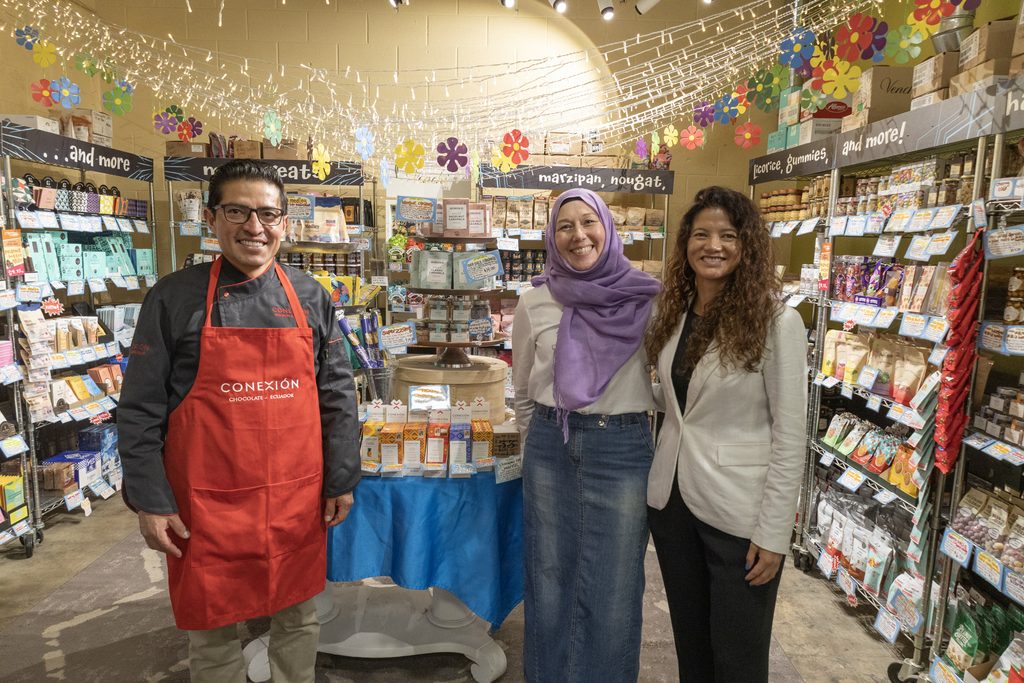
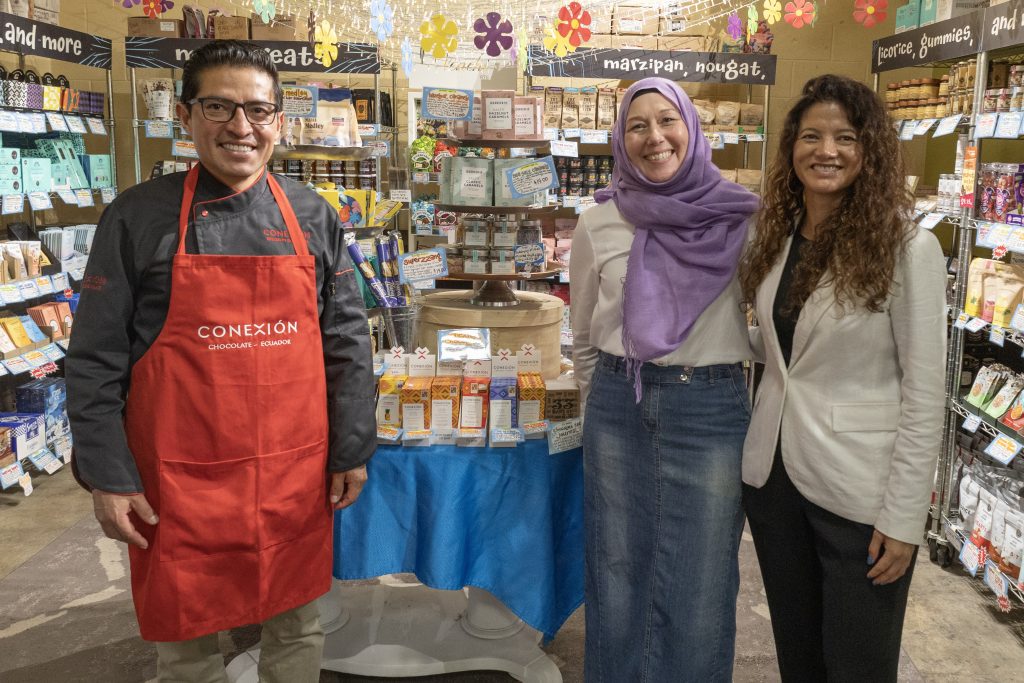
The company’s founder and owner, Jenny Samaniego, and operations manager, Mario Remache, paid a special visit to Zingerman’s Candy Manufactory on Saturday, April 25, for the store’s first-ever “Meet the Maker” event. Located at 3723 Plaza Drive, the Manufactory is one of Zingerman’s Southside Shops, once aptly described by a guest as “the Diagon Alley of Ann Arbor,” in a nod to the magical district from Harry Potter.
A full house showed up for the 90-minute talk and tasting, which was hosted by Manufactory Production Manager Jamie LeBoeuf, whose own J. Patrice Chocolate Studio already possesses a strong connection to Conexión.
“We’re currently using Conexión’s Abundancia couverture in all of our milk chocolate products, and we’re working to use more of their couverture in the future for our dark chocolate and white chocolate as well,” LeBoeuf noted in her opening remarks. (“Couverture” refers to a high-quality, professional-grade chocolate that contains a higher percentage of cocoa butter, often used in candy and pastry making.)
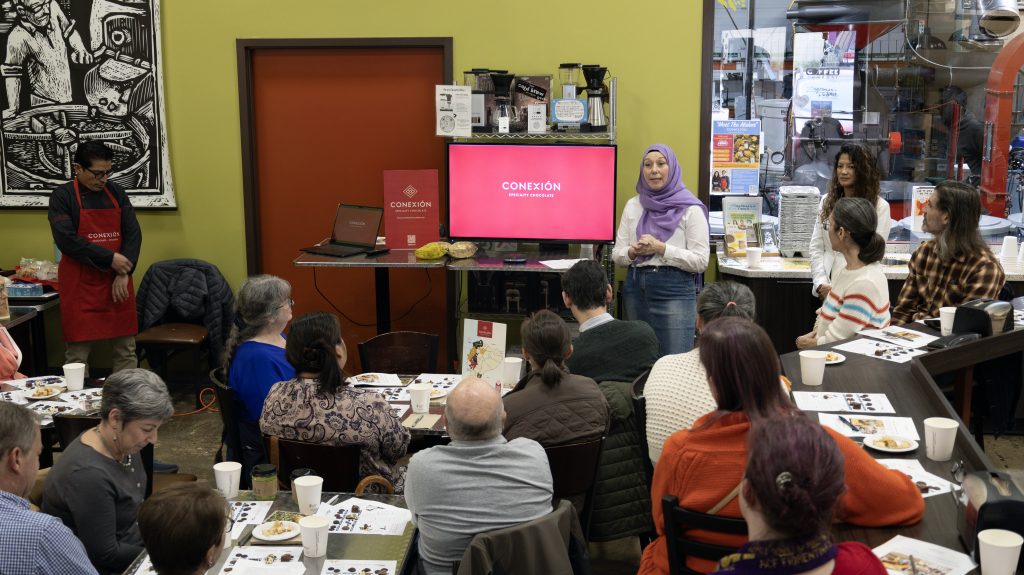
Samaniego then delivered a powerful presentation on the global cacao industry and her unlikely personal journey into the realm of chocolate. After studying hospitality in her home country of Ecuador, she traveled to New York City in the early 2000s and began working for a restaurant distribution company that did business with Anthony Bourdain, the late chef, author, and TV personality. It was Bourdain’s sous-chef at the time who introduced Samaniego to a New York–area chocolate maker.
“I knew zero about chocolate or cacao, but he said, ‘You look like a nice person,’ and he hired me anyway,” she recalled with a laugh. “It was an amazing experience, because I was able to really learn everything from the ground up. I learned about sourcing, about cacao genetics. And for me, being from Ecuador and understanding how the supply chain works over there, everything just got connected.”
Samaniego eventually launched her own operation, Porcelana Chocolates. And in 2016, she returned home to Ecuador with a passionate purpose: to become a direct bridge between the nation’s cacao farmers and the wider world. Accordingly, she renamed the company “Conexión.”
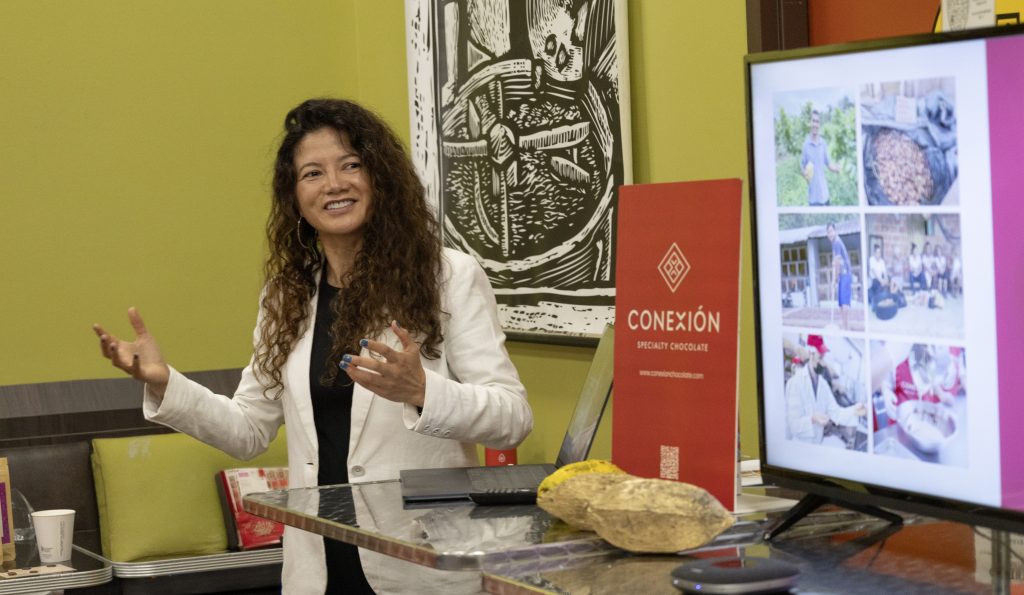
Ninety percent of the five million tons of cacao produced globally each year are traded as a “faceless bulk commodity,” Samaniego explained. This industrial focus on volume strips beans of their genetic identity while subjecting farmers to the price volatility of the international marketplace.
Conexión exists to combat this commodification and break the corporate chocolate monopoly. Based in Quito, Ecuador’s capital, the company works closely with four cacao cooperatives and more than 4,500 legacy farming families to preserve the country’s pure Arriba Nacional variety, from harvest to couverture. Only 5% of the cacao grown worldwide is considered to be “fine flavor,” and Ecuador’s crop belongs to that rarified class.
Samaniego has also assumed an ambitious public advocacy role, empowering farmers with information and training, and launching the first Cacao and Chocolate Summit in 2019. The event, whose seventh edition was recently held in Quito in December 2025, gathers producers, chocolatiers, investors, and researchers to support a more sustainable, inclusive future for the cacao industry both in Latin America and elsewhere.
“We really want everyone to know what’s happening behind all the chocolate they’re buying,” she said, emphasizing the vital importance of transparency and traceability.
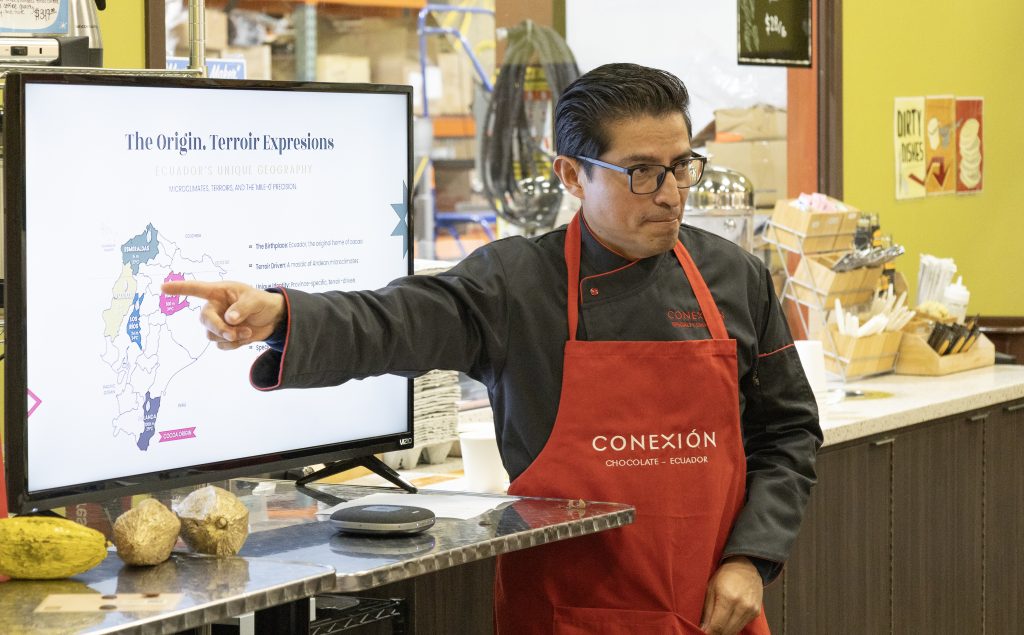
Guests at the Candy Manufactory had the opportunity to sample Conexión’s premium chocolate during a tasting led by Mario Remache, who worked as a chef in Europe before coming back to his native Ecuador and joining Samaniego at the company.
“In the massive chocolate industry, they say, ‘It’s chocolate—it tastes like chocolate,’” Remache said. “No. No way. Cacao from different regions has totally different flavor profiles. That’s the richness we have around the world.”
Remache put this richness on full display, sharing five Conexión couvertures—the dark chocolates Esmeraldas (70% cacao), Manabí (70%), Los Ríos, and Ecuador (55%), plus the milk chocolate Abundancia (40%)—as well as two of the brand’s own chocolate bars.
Along the way, he guided attendees in the delicate process of exploring the chocolate: examine its surface texture, smell its aroma, snap it in half next to one’s ear to hear the sound it makes, and then place it on the tongue and let it dissolve. Fruity, nutty, woody, savory—just as with wine or coffee, each cacao variety offers a unique tapestry of flavors.
As a point of comparison, guests also tasted a handful of mass-produced chocolate chips, whose waxiness and artificial sweetness—the result of industrial mixing and chemical additives—stood in stark contrast to their single-origin, heirloom counterparts.
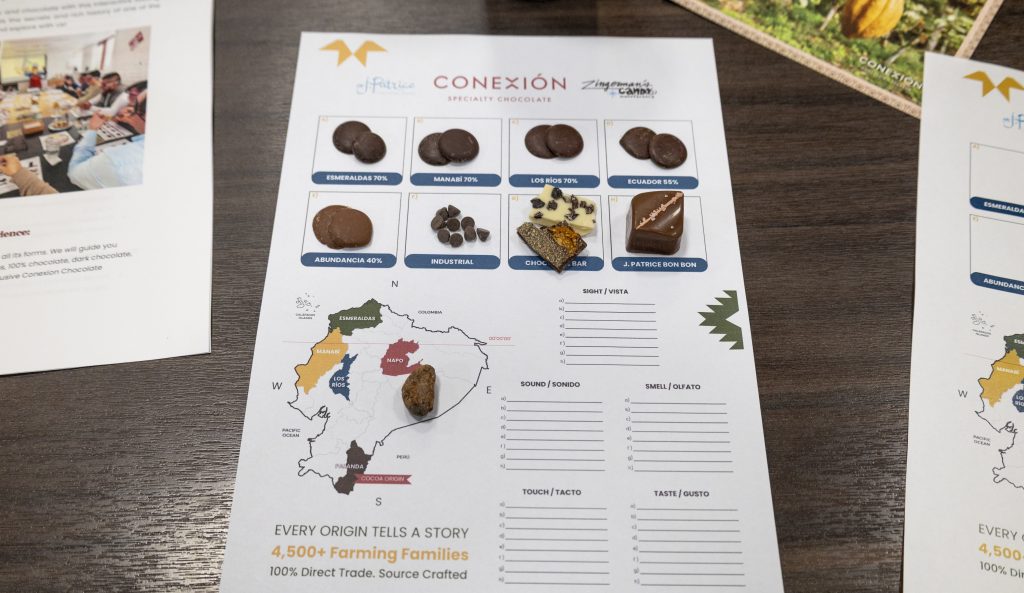
For a final treat, LeBoeuf shared one of her handcrafted J. Patrice bonbons—a delicious pink Himalayan sea salt caramel made with the Abundancia from Conexión.
“The caramel really brings out the caramel flavors of the Abundancia cacao,” LeBoeuf explained. “And there’s a little bit of sea salt on the outside that also enhances the cacao flavors and opens up your palate.”
Beyond Ecuador, Conexión operates a warehouse in Traverse City, Michigan, which provides direct distribution and support for the company’s Midwest partners. One of those partners may soon be Zingerman’s Candy Manufactory.
“We’ll be transitioning in the next few months,” LeBoeuf said after the event. “We’ll be using the Ecuador 55% that we tasted tonight, and also the Abundancia for milk chocolate. When you work with such high-quality chocolate, and when you’re trying to give farmers really great prices, that translates to us having to pay a little bit more for it. But we think it’s worth it, and our customers clearly think it’s worth it.”
As for Samaniego, whose path to chocolate was a circuitous one, she now can’t imagine doing anything else with her life.
“Making chocolate is my passion,” she said. “I love the equipment, the post-harvest, the genetics, the flavors, the people. But how do we keep all this going in the future? I once heard, ‘Without cacao, there is no chocolate.’ For me, there’s no chocolate without farmers.”
Conexión is doing the good work to ensure that these farmers survive and thrive for generations to come—all while producing some of the finest chocolate you’re likely to find anywhere.