Anyone Can Make a Difference
We each have the power to make change every day
Fifty years ago this coming fall, a then 30-year-old Neil Young stepped out onto the stage at the famous Winterland ballroom in San Francisco. The night was designed as a celebration—the final concert performance of the Band—and Young was one of an array of musicians who came to participate and pay tribute. The evening was recorded by filmmaker Martin Scorsese and later released as The Last Waltz. Young, acoustic guitar strapped over his shoulder and harmonica mounted atop it, performed one of his best-known songs, “Helpless.” At points during the song, the film cuts to show Joni Mitchell singing backup vocals from offstage. It’s an awesome piece of music—musical history captured on celluloid for the ages!
While I love Neil Young’s work and could happily listen to “Helpless” over and over again without getting tired of it, the truth is that its title is the exact opposite of how I see our presence in the world. As a song, it’s terrific. As a worldview, it’s the worst. We all have much, much more power and influence than we might often imagine.
As a reminder of this, Juneteenth, celebrated both here in the Zingerman’s Community of Businesses (ZCoB) and around the country, is a day to commemorate the hard work it takes to make freedom a daily reality—and how attaining freedom requires action by the many, not just a handful of good deeds by politicians half a world away. At the Roadhouse last Tuesday, we hosted a great Juneteenth dinner to celebrate the new Ella E. Hall Recipe Book, put together with grace and dignity by University of Michigan Professor Jessica Kenyatta Walker. The event was a way to honor African American history, to bring people together, and to raise a bit of money for the Special Collections at the U of M Graduate Library. Happily, the dinner sold out at over 100 seats. Elizabeth Hinton, ZCoB alum and now professor of Black history and law at Yale, spoke eloquently to the group.
Then, on Saturday, we were one of the sponsors of the “Community for All” Juneteenth event held at Washtenaw Community College. Dr. Blair LM Kelley—whose book Black Folk: The Roots of the Black Working Class I love and who has a new book out about Juneteenth entitled Black Freedom: A Visual History of Juneteenth and Emancipation Days—was the keynote speaker. Both gatherings were inspiring examples of Richard Rohr’s wise words, “The best criticism of the bad is the practice of the better.” And the people who attended, of course, were anything but helpless.
June 19, as many of you will know, became a national holiday three years ago this month. There are also 11 other national holidays on the calendar, and many people have a range of religious celebrations to add to that. In addition to all those formal commemorations, some of us have our own personal days of significance: anniversaries, births, birthdays, and the like. June 27—coming up this Saturday—is one of mine. It’s a day that reminds me that we are not what the title of that classic Neil Young song implies. Thetruth of the matter is that we actually have an enormous and inspiring opportunity to make a big difference every single day. And we need neither permission nor politicians to do it. If we believe, and we’re willing to do the work, we can make great things happen, both in our workplaces and in the world around us. It’s easy to feel helpless, but the reality couldn’t be more different. Sure, of course, we all feel down sometimes, we get frustrated, we have hard moments—as I wrote a few weeks ago—when we feel like our work doesn’t matter, but we still have the power to step up and take positive action to impact any situation.
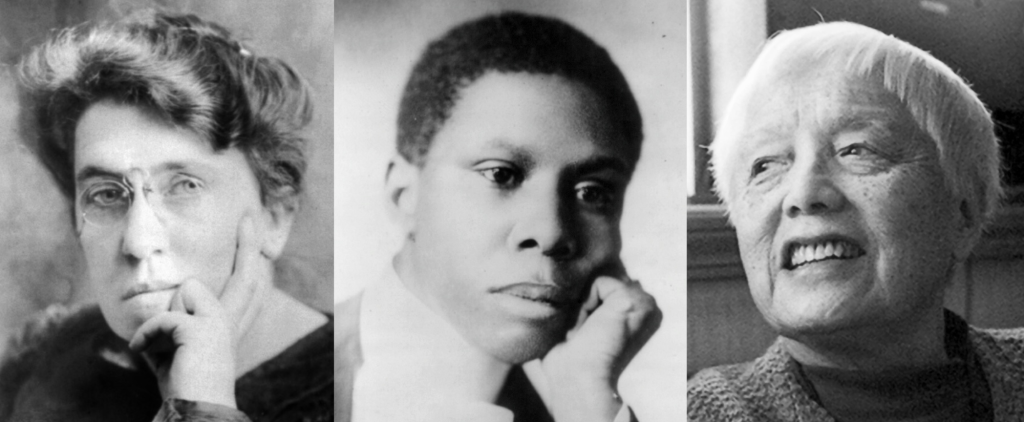
Why is June 27 so important to me? It happens to be the birth date of three people from whom I have learned a lot—people who started with nothing, but who went on to make a major difference in the world. Not by stacking up big bank accounts, but by working toward what they believed in.
Emma Goldman was born in Kovno, Lithuania, within the Russian Empire, on June 27, 1869.
Paul Laurence Dunbar was born in Dayton, Ohio on June 27, 1872.
Grace Lee Boggs was born in Providence, Rhode Island, on June 27, 1915.
The most contemporary of the three—she lived to be 100 and passed away in the fall of 2015—Boggs once wrote,
History is not the past. It is the stories we tell about the past. How we tell these stories—triumphantly or self-critically, metaphysically or dialectically—has a lot to do with whether we cut short or advance our evolution as human beings.
What follows is my effort to use history in a way that advances our evolution as human beings, or, as Boggs once put it, helps us become “more ‘human’ human beings.” It’s an entrée into how these three special people have inspired, and continue to inspire, me every day—especially when the calendar comes around to June 27.
While the three were, of course, very different from each other, all of them made amazing things happen in the world, really with next to no resources other than the creativity, care, determination, and hard work that every human can have at their disposal. One was an immigrant who came to a strange country alone when she was just 16. One was the son of previously enslaved parents. The third was the daughter of restaurant-running immigrants. All three made a remarkable mark on the world, and all of them remind me how much each of us can make happen if we put our hearts and minds into it.
Which is why, every June 27, with them in mind, I rededicate myself to doing the right thing, to going after what I believe and not succumbing to social pressure to conform. To setting aside any feelings of helplessness and taking a step forward to try to make a positive difference in the world. After all, if they can do it, so, too, can any of us. We have much to gain by learning from them—not to copy what they did, but to get closer to where we’d like to be. As all three of them seemed to understand, what we do today has an enormous impact on what happens tomorrow!
To put things into context, in an interview on the podcast PoliticsGirl last week, historian and author Timothy Snyder said,
The only thing we bring to what comes after is what we are now. That’s all we bring. And so if we are joyful and cooperative and effective and we understand that we can win, then when we get to the place which is and feels like a victory, we’ll be much better off.
Snyder’s sense of the world has been a good guide for me in recent years. And his opening remarks on PoliticsGirl were a necessary reminder that whatever might be going on in the world, our work is still to do the right thing. Right here. Right now.
Studying anarchist belief systems many years ago taught me the truth of what Snyder is saying. The means we use must, by definition, be congruous with the future we are working to create—or, as Emma Goldman put it, “The means used to prepare the future become its cornerstone.” Joyful, cooperative, effective, dignity-centered, democratic futures are born out of current effective practices of joy, cooperation, dignity, and democracy.
While I long ago dedicated myself to doing these positive things every day, regardless of what’s happening around me, next week is one in which I’m especially motivated to keep it up. These three historically meaningful birthdays—all, by sheer coincidence, on the 27th of June—call me back to the import of creative thinking, practicing the good in the face of fear, and being true to ourselves, to our values, and to our strongly held points of view.
These June 27 babies inspire me with their work, inform me with their insight, and encourage me to try to do more. All came from humble origins—backgrounds that meant they had to overcome an array of disadvantages. They had no legs up, no opportunities to “start on third base,” no trust funds or wealthy relatives to get them going. All three read and wrote extensively and shared their work widely. All three pushed the boundaries of the status quo and saw that better things were possible despite the current state of the society in which they lived and worked. All three made a BIG difference and continue to have a significant positive impact even years after their passing. This is why, each year, June 27 drives me to push myself to do similarly impactful work. Because every one of us really does have the power to make such a difference. No need to wait for others to step up—we can do it!
Of the three, I have written the most about Emma Goldman. (You can get my whole take on her life story in the pamphlet “Going into Business with Emma Goldman.”) Born into an Orthodox Jewish family in the town of Kaunas, in Lithuania (at the time part of the Russian Empire) in 1869, she grew increasingly frustrated with her stepfather’s refusal to support her education. Finally, fed up, she decided to leave home for the U.S. in 1885. At the age of 16, she sailed the Atlantic with one of her older sisters, landed in New York City, and gradually made her way to Rochester, New York, where their other sister was already living. Goldman married an American named Jacob Kershner but divorced him fairly soon thereafter and, a few years later, left Rochester with her sewing machine, $5, and a train ticket to New York. On the first day she arrived back in New York City, she met another young Russian Jewish anarchist émigré, Alexander Berkman, at the then famous Sach’s café. He took her to hear German anarchist Johann Most speak, and from then forward, Emma Goldman was immersed in anarchism. Radicalized by the unjust outcomes of the Haymarket incident, she began speaking out publicly. And by the time she was 20, Goldman was regularly speaking to audiences of four or five thousand!
Like both Dunbar and Boggs, Emma Goldman wrote a LOT! From the time I first stumbled on them back when I was just starting as a freshman at U of M, her essays, pamphlets, and books have been hugely influential for me. Her commitment to live true to herself, the way she stood up for the rights of the individual, her advocacy for freethinking, her work for women’s rights—all are an inspiration. She started her own publication, Mother Earth, in 1906 to spread the word—a journal that published for nearly 15 years. She toured the country as a speaker throughout her life, including half a dozen visits to Ann Arbor!
Emma Goldman showed me, too, that one could push for positive change while still enjoying the finer things in life—she loved to cook, eat good food, and drink good coffee; went to the theater; and always advocated for art. She was one of the rare people who promoted both inner development and social change, and who understood that change was possible for each of us as individuals and also for us together as a collective. J. Edgar Hoover, the FBI director, once called her “the most dangerous woman in America.” Personally, I think she was just a hundred years ahead of her time!
Even in challenging situations, Goldman demonstrated that one could remain positive and hold to positive beliefs. In a radio broadcast from Barcelona on September 30, 1936, during the Spanish Civil War, she said, “I have faith in humanity. I have infinite faith. I know the governments come and go. But the intrinsic quality of human feeling and the sense of human justice remain forever.”
The Irish-born anarchist poet and author Lola Ridge (whose mother’s name also happened to be Emma) wrote a poem about Emma Goldman in 1920, shortly after she had been expelled from the U.S. and sent back to Russia, then just a few years past its 1917 revolution. (Any affection Goldman had for Lenin and the Bolsheviks ended quickly—see her 1923 My Disillusionment with Russia). Ridge’s poem, titled simply “Emma Goldman,” is a touching tribute:
How should they appraise you,
who walk up close to you
as to a mountain,
each proclaiming his own eyeful
against the other’s eyeful.Only time
standing well off
shall measure your circumference and height.
Goldman lived out her later years in Toronto (where Timothy Snyder is now teaching), forbidden by the American government from returning to the U.S. to live, as she so badly wished to do. She died in Toronto in May 1940, six weeks shy of her 71st birthday.
My second June 27 luminary, Paul Laurence Dunbar, was born in Dayton, Ohio, in 1872, just seven years after the end of the Civil War, to parents who had both previously been enslaved. He began writing poetry and prose at an early age, and by the time he turned 20, his first book had been published. Even though he was the only Black student in his Dayton high school class, Dunbar quickly became the president of the school literary society, the editor of the school paper, and also the official class poet. One of his classmates was Orville Wright—yes, the one of flying fame—who would later finance some of Dunbar’s publications.
In 1893, Dunbar published his first book of poetry, Oak and Ivy, which featured one of the techniques for which he later became well known: writing in dialect. At the time, he was working as an elevator attendant, and he would sell copies of the poetry book to interested passengers. He published his next book, Majors and Minors, two years later, in 1895, and the following year released what would become his most famous work, Lyrics of Lowly Life. As Samuel Tower wrote in The New York Times, “The book won him a national reputation and enabled him to pursue a literary career for the rest of his life.” In 1900, Dunbar was a member of the graduating class at Howard University.
In his short story “The Faith Cure Man,” Dunbar offered a line that seems right for our own time, too: “Hope is tenacious. It goes on living and working when science has dealt it what should be its deathblow.” To Timothy Snyder’s point: no matter how dire things may seem, if we work with kindness, care, dignity, humility, and determination—and stay true to our values—anything is possible.
Dunbar’s influence continued long after his death. To this day, he is widely seen as the Black writer who most represents that late-19th-century period of history. In Chicago, where I grew up, Dunbar High School is named after him. And here in Ann Arbor, in 1923, the Dunbar Center was established in the same neighborhood where the Deli now sits, created as a community gathering place for members of the Black community—all the more important in an era when segregation was still the norm in town. In the spring of 1975, the U.S. Postal Service issued a commemorative stamp of Dunbar. More recently, New York Times journalist Sam Sifton used an 1896 Dunbar poem about the Civil War as the lead-in to his Memorial Day essay last month. And here is part of Dunbar’s classic poem “Sympathy”:
I know what the caged bird feels, alas!
When the sun is bright on the upland slopes;
When the wind stirs soft through the springing grass,
And the river flows like a stream of glass;
When the first bird sings and the first bud opens,
And the faint perfume from its chalice steals—
I know what the caged bird feels!
Maya Angelou used the first line of that same poem as a prompt for her famed 1969 autobiography, I Know Why the Caged Bird Sings, and it’s now being quoted by present-day Palestinian rappers in Gaza. Compared with Goldman and Boggs, Dunbar lived by far the shortest life, dying in 1906 at the age of 33. Poet Nikki Giovanni called him “a natural resource of our people. … There is no poet, black or nonblack, who measures his achievement. Even today. He wanted to be a writer and he wrote.”
Finally, Grace Lee Boggs was born in Providence, Rhode Island, in 1915, the same year Emma Goldman turned 46. (Goldman was out on a national speaking tour at the time, campaigning, controversially, in support of women’s right to birth control and reproductive freedoms.) Boggs’s parents were immigrants from China who opened a restaurant. As she would later acknowledge, “I think being born female on top of a Chinese restaurant gave me an idea of a lot of things in this world that need to be changed.” Boggs went to Barnard for undergrad, then on to Bryn Mawr, where she earned a PhD in philosophy in 1940. But even with an advanced degree in hand, she had a hard time finding work. As had been true for most of U.S. history, it was not an easy period to be an Asian American. Boggs shared later, “Even department stores would say, ‘We don’t hire Orientals.’” Fortunately for the world, she persevered, turning a challenging situation into a lifelong commitment to creating positive change. Upon her passing, President Obama praised Boggs for “her leadership in the civil rights movement [and] her ideas that challenged us all to lead meaningful lives.”
In 1953, Boggs married autoworker activist James Boggs, and the two lived the rest of their lives near here, in Detroit. Jimmy Boggs died in the summer of 1993 at the age of 74, while Grace lived, actively and creatively, until 2015, when she passed at the age of 100.
Grace Lee Boggs was deeply committed to community, to democracy, to dignity, to the development of what she referred to as “more human human beings.” Like us, she loved ideas, and yet, at the same time, she was also about doing the down-to-earth work to make those ideas come alive. “We can begin by doing small things at the local level, like planting community gardens or looking out for our neighbors,” she once said.
A great deal of what draws me so strongly to Boggs’s work is that she developed her own proactive approach to making positive change happen. She didn’t just critique—she created. And though she never seems to have thought of herself as an anarchist, in a lot of ways, her philosophies were very much aligned with that school of thought. In the book The Next American Revolution, she writes,
All over the planet more and more people are thinking beyond making a living to making a life—a life that respects Earth and one another. Just as we need to reinvent democracy, now is the time for us to reimagine work and reimagine life. The new paradigm we must establish is about creating systems that bring out the best in each of us, instead of trying to harness the greed and selfishness of which we are capable. It is about a new balance of individual, family, community, work, and play that makes us better humans.
All three of these folks—Goldman, Dunbar, and Boggs—were, as you can tell, remarkable individuals. And every year on June 27, I reflect anew on just how remarkable they really were. In their own distinctive ways, each did what contemporary Canadian photographer Steve Carty refers to in the title of a recent essay: “Photographers Have to Believe in Possibilities That Do Not Exist.” While none of the three were photographers, all of them believed in possibilities for better things. Rather than being constricted by the realities of the status quo, they imagined more positive futures for all. And to be clear, they didn’t just believe; they worked hard to transform what they believed into daily reality. All three had singular points of view. All three found ways to keep moving forward in the face of adversity. All three connected and collaborated, advanced their own creativity and supported that of others, and stood up for dignity. And all three inspire me, to this day, to do better and work harder in everything I do.
The good news for me is that this energy, this spirit that got its start on June 27 is not confined to historical figures. Intriguingly, and encouragingly, the new album Voice of the Revolution from the hip-hop group the Neighborhood Kids repeats many of these themes in its liner notes:
This project is an encapsulation of the time we live in, as well as a spotlight on connections throughout the history of the world. Our music has always intentionally aimed to give a voice to the voiceless …
This piece of art is intended to make you feel an array of emotions, as well as remind us that we are not alone. The world feels like it’s on fire while everything goes on as business as usual in the midst of chaos, but this project is a glimpse of hope that we CAN change the world together.
This album was made entirely for the people and by the people. We want this to be experienced as you would a movie, a play, or a book. The intention for this album is for us to stand for something bigger than ourselves, and for you to be inspired to stand up with us as well. Together, we are the Voice of the Revolution.
The good news, too, is that this spirit stretches across all age groups! This past weekend, theologian Richard Rohr, now 83 years old, wrote,
… [T]he threshold of spiritual energy [is] where what we believe becomes what we do. When that power is released, there is no stopping it, for love is a force that cannot be contained. … Hope is the catalyst. … Hope lets us literally see the presence and action of the holy in our everyday lives. This is not an imaginary desire viewed through rose-colored glasses. It is the solid evidence of the power of love made visible in abundance.
To my mind, all three of these incredible human beings born on June 27 did very much what Rohr is describing. They believed in their work and in their ability to make a difference. They had hope for a brighter future. And they were willing to stick their necks out and put themselves at risk—literally—to advocate for their beliefs. They remind me of what is possible—of how effectively each of us can stand with our face to the social wind, and can walk our own path when the rest of the world around us seems determined to stay on the safe one.
Author George Saunders (to whom my heart goes out—his beloved 14-year-old pup, Guin, just passed away last week) says, “It takes a monumental spirit to write about the genuinely good, in a time when the superficial bad can sometimes seem to be winning.” Saunders is speaking specifically about fellow novelist Ann Patchett here, but I think he’s correct in a more general sense, too. Staying focused on what’s possible in the face of pain is no small achievement. And yet, really, that’s what the three figures who anchor this essay each found a way to do. They didn’t ignore the issues at hand. To the contrary, they tackled them head on—and in a way that put forth positive options for moving forward.
Do these three creative humans, all born on the same day but in different years, remain relevant at the start of the second quarter of the 21st century? I would say so. In an interview with Boston Review about her 2011 book, Emma Goldman: Revolution As a Way of Life, editor David Johnson remarked to author Vivian Gornick, “I wonder whether the time of the Emma Goldman-type leader has passed.” Gornick’s response is very much akin to my own:
No, it’s not passed. … It’s not passed as long as we have a future, as long as we’re alive.
The way I look at it, the next great leader could be you. Or your co-worker, your cousin, your kid, your significant other, or the kind next-door neighbor. As Emma Goldman, Paul Laurence Dunbar, and Grace Lee Boggs all demonstrated abundantly, we have the power, right now, to move ahead and make a difference. What happens today, tomorrow, the next day, or in the next decade is up to us. Whether it’s in our companies, communities, or countries, we have work to do. As Goldman wisely observed, “Revolution is but thought carried into action.”
Of course, June 27 is just one day out of 365 that I happened to settle on. If you have an important day of your own, let me know. And if you don’t, give some consideration to creating one, or two, or three. Maybe it’ll be the 12th of November, the day Neil Young was born in 1945. Speaking of which—to come back to where I began—the truth is that Young himself has never acted as if he were “helpless.” Rather, he has consistently used his music and his platform to encourage people to take positive action. Six months ago, he posted a message on his Neil Young Archives site that feels like sound input for any of us—a call to keep pushing forward and working every single day to help make ourselves, our organizations, and our communities just a bit better than they were the day before. Young reminds us:
Something has to change. … We know what to do. … Use your love of life, your love of one another, your love of children, yours and theirs and ours. Peacefully. Now.