Three Decades of Believing in (and Practicing) Bottom-Line Change
A down-to-earth way to put democracy to work in our workplaces
One of the most common questions people ask me when they see the new “Why Democracy Matters” pamphlet is something along the lines of, “What can we possibly do in the face of the powers that be in Washington?”
I will suggest that the answer, per what I wrote in the pamphlet, is surprisingly simple: stop worrying about Washington. Yes, very definitely vote—it makes a difference! But democracy, I came to understand in the process of writing the pamphlet, doesn’t really start with what happens in capital cities. It begins, instead, at “the bottom.” With you and me. Right here, right now, with what we do inside our own ever-imperfect organizations. What we do there will eventually manifest in what men and women in Washington do. After all, as Wendell Berry reminds me, “The leaders will have to be led.”
Small steps—stuff you and I can start doing the day after tomorrow—may seem insignificant to some. But I’ll say with certainty that they add up to make a meaningful difference. As Wendell Berry writes in his 1972 classic Think Little, “The citizen who is willing to Think Little, and, accepting the discipline of that, to go ahead on his own, is already solving the problem.”
Teaching people how to actively participate in the organizations they are part of, I believe, helps them learn to think for themselves. Instead of falling back into helplessly looking to those “at the top” to tell them what to do, frontline folks begin to think—and act—like leaders. Making this happen in our organizations is a practical example of what is possible when we “think little,” which, over time, can have a big impact on our companies, our communities, and, ultimately, the entire country. To wit, while I was working on the democracy pamphlet, Jason Stanley, author of How Fascism Works, wrote me a note:
Workplace democracy is one of the central and most important topics in democratic political philosophy. It’s where the battle over authoritarianism is fought—if you get workers used to being subordinated, and bosses used to subordinating, you are basically done.
What follows is a look at one longtime practice here in the ZCoB (Zingerman’s Community of Businesses), now also widely implemented by an array of ZingTrain clients around the country—a practice that, I came to see in the course of writing the pamphlet, is in fact a concrete example of democracy in action. It’s called Bottom-Line Change, or, as we say around here for short, BLC.
BLC is certainly not a glamorous, headline-grabbing part of our work, but after 30 years of doing it, I’ll say with confidence that when we use it well, it’s very effective. It’s one of maybe 20 or so different things we do that help make democracy happen here every day, always imperfectly, in the ZCoB. BLC is about teaching people the leadership equivalent of “fishing” for themselves, rather than just bringing them a fish. They learn to lead change, build buy-in, incorporate input from others, and participate in planning, rather than anxiously letting change happen to them.
Last fall, Atlantic staff writer David Frum observed, “Authoritarians seek to make you feel that everything is hopeless, because your hope is dangerous to them.” Bottom-Line Change is the opposite: it’s beautifully hope building—an opportunity to effectively provide people both with hope and with a tool to help them lead change, learn leadership, and transform themselves and the world around them in the process. And process is the point. BLC is a five-step organizational recipe, a framework, and an eminently repeatable one at that, which we’ve relied on to great benefit for over three decades now.
My friends at the extraordinary global anarchist arts collective that is Indigenous Resistance have a chapter title in their book Searching for the Dub Sublime that encapsulates one of the key messages I hope to convey about Bottom-Line Change: “Creation Is the Way.”
While complaining can feel good for a few minutes, mostly it just produces cacophony; it’s creating that leads to positive outcomes. BLC can help us create the kind of future we want to be a part of. In their powerful new video, IR reminds us of the song “Listening / Honor Song” by Native American activist, poet, musician, and writer John Trudell, in which he says:
Our resistance, our struggle
Is not sacrifice lost
It is natural energy
Properly used
Natural energy properly used is, indeed, what I believe Bottom-Line Change is all about. People want to make a difference, people want to be part of something greater than themselves, people want to learn to lead. BLC helps teach them how to do all that and then some.
Leadership coach and author Benjamin Hardy writes, “A true creator never stops pushing their boundaries.” BLC is a systemic tool to do just that! And who doesn’t want to live a creative life? Part of what I love most about the way we use BLC is that anyone can initiate it. They may not be the ultimate decision-maker, but in the spirit of down-to-earth democracy, that doesn’t mean they can’t lead the way. With BLC in regular use, we have no need for a suggestion box—we just coach people into leading the change work they’re inspired by.
While learning to lead creatively sounds good, the truth is that for most frontline staff—stuck working their whole lives in hierarchically run companies—taking the lead on organizational change is not something they’ve been taught. Instead of leading, they’re left out. An American Psychological Association poll conducted last fall found that more than six in 10 American adults reported feeling lonely and emotionally disconnected; more than half felt isolated. And at a much more extreme level, frontline staff can be kept down in ways that mirror what happens to Ukrainians living under Russian occupation. Last month, journalist Dinara Khalilova published an article in The Kyiv Independent with the headline “What I realized about life under Russian occupation as a war crimes researcher.” The quick summary is that Khalilova realized a lot. “After these conversations,” she notes, “I keep returning to one of the most overlooked and, in my view, cruelest effects of occupation: it deprives people of the right to choose who they are and how they live their lives.” As one Ukrainian woman living in Kherson shared, “It feels like you’re just trapped—like you can’t breathe, like you’re deprived of communication, of everything, really.” Khalilova writes,
Under occupation, reality becomes dominated by fear. And fear erodes trust. Some people collaborate with Russian authorities and report neighbors they suspect of supporting Ukraine or having ties to Ukrainian forces. Since danger can come from anywhere, people isolate and start to suspect everyone around them. It feels like nowhere and no one is safe.
While occupation is obviously far more extreme than what we’re experiencing here in American business, the themes are consistent with what many people say when they feel trapped in autocratically run companies. BLC alone is not enough to fix all that, but it is a very good way to help get things moving in a more positive, more purposeful, and more connected direction. Used well, the process gets people talking to peers in the workplace. It helps them see that reaching out is possible, that positive engagement can emerge from it, that you have agency and influence over your own life—and that, as poet Mark Nepo titled his book, “You don’t have to do it alone.”
Bottom-Line Change is an approach that any democratically inclined organization can employ to help people build confidence instead of confusion, foster dignity instead of distrust, and teach effective leadership and followership instead of fear. And this isn’t mere speculation; it comes from many years of solid experience.
I was reminded of all this last week while visiting the remarkable catering company Chowgirls in Minneapolis—longtime ZingTrain clients—and listening to more than a few of its leaders discuss BLC’s value. Co-founder Heidi Andermack shares,
My favorite thing about BLCs is getting the ideas out there in a way that conversations can be constructive. It can reduce the amount of debate time where we might not fully understand someone’s perspective or we leave a meeting not clear on what was decided or why we were even talking about something. BLC helps us to focus energies, get everyone on board, and map out a plan—together!
The fact that we’re going through such challenging times in the world right now makes the practice of BLC all the more important. As author and U of M graduate Anand Giridharadas—apparently a Zingerman’s regular during his years in Ann Arbor—declares, “We are living through a revolt against the future. The future will prevail.” Teaching—and actively using—Bottom-Line Change can help the future come out ahead. Giridharadas writes,
I see then that this is both a very dark time and, potentially, a very bright time. It’s important to hold these truths together.
And what we’re trying to do is awesome. It is literally awesome in the correct sense of that word.
The solution within companies, it seems, is much the same as in the country, and “awesome” is how I feel when I watch someone lead their first BLC through to successful fruition. People who learn to lead change in positive ways at work stand a much better chance at creating the larger world they want to see. In that sense, Bottom-Line Change is a way to help make happen what Giridharadas describes in his 2018 book Winners Take All: The Elite Charade of Changing the World:
It is solving problems in ways that give the people you are helping a say in the solutions, that offer that say in equal measure to every citizen, that allow some kind of access to your deliberations or at least provide a meaningful feedback mechanism to tell you it isn’t working. It is not reimagining the world at conferences.
Along similar lines, author Rebecca Solnit writes,
“Unhappy the land that needs heroes” is a line of Bertolt Brecht’s I’ve gone to dozens of times, but now I’m more inclined to think, pity the land that thinks it needs a hero, or doesn’t know it has lots and what they look like. … Lone hero narratives push one figure into the public eye, but they push everyone else back into private life, or at least passive life. …
[By contrast,] ordinary people generally behave magnificently, taking care of each other and improvising rescues and the conditions of survival, connecting with each other in ways they might not in everyday life and sometimes finding in that connection something so valuable and meaningful that their stories about who they were and met and what they did shine with joy.
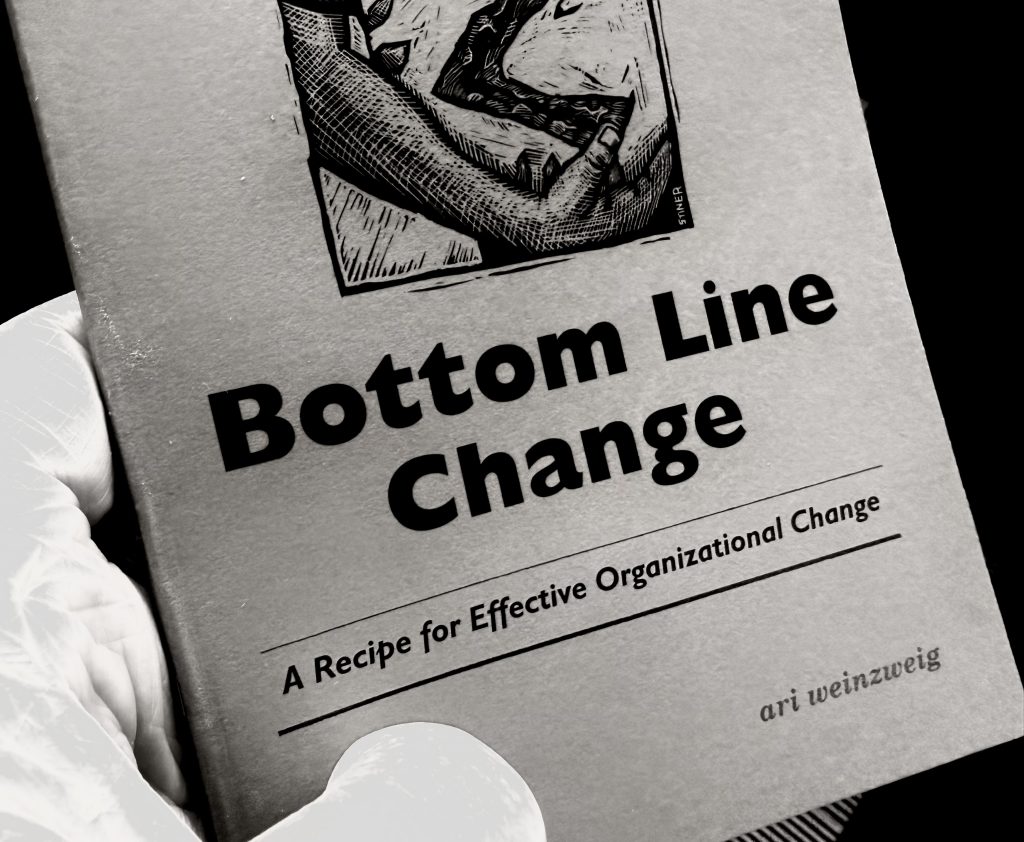
The details of the Bottom-Line Change process can all be found in the pamphlet “Bottom-Line Change.” In a nutshell, we adapted the approach from what we learned back in the mid-’90s from the amazing Stas’ Kazmierski. At the time, Stas’ was working for a nationally recognized consulting company called Dannemiller Tyson, whose offices were a couple of blocks up the street from the Deli. Later, he would go on to join Maggie Bayless as a co-managing partner at ZingTrain before retiring in 2013. Sadly, Stas’ passed away in the spring of 2017. To this day, he is deeply missed. I think of him every time I begin work on a new BLC!
Dannemiller Tyson was co-founded by a woman named Kathie Dannemiller, known at the time for her innovative and progressive organizational-change processes. When we opened the Deli in 1982, Kathie was just shy of her 53rd birthday and a leader in her field. She had worked in the upper levels of the administration at U of M for many years, before going out on her own to co-launch Dannemiller Tyson. Like Stas’, who was roughly 15 years her junior, she had learned a lot from Ron Lippett, the man who did the initial work to develop the visioning practice we now know, rely on, and actively teach almost every day.
The foundation of BLC is based on the universally true change formula first developed by Richard Beckhard and David Gleicher back in the early ’60s. Kathie Dannemiller famously carried it forward right around the time we were working to get the Deli going. The equation, as we learned it, looks like this:
Dissatisfaction x Vision x First Steps > Resistance = Change
The formula is super helpful, whether the change you’re trying to lead will happen at home or at work. Here in the ZCoB, we like to assign numbers to each factor to assess the situation. If the left side of the formula falls short—i.e., the right side is greater than the left—change will not happen. If I’m the change leader and I encounter that scenario, my task is to either increase dissatisfaction with the status quo, improve the inspirational nature of my draft vision, and/or make the steps in my action plan more exciting until they multiply out to be greater than the natural resistance.
In a 1999 essay entitled “One Brain and One Heart – Unleashing the Magic in Organizations,” Kathie Dannemiller and Mary Eggers write,
The power of truly being able to experience becoming “one brain and one heart” gives undeniable alignment and strength to any organization, and this … change methodology is based on helping organizations, across all levels, all disciplines, all locations, all ages and tenures, become connected around “one brain” (all knowing the same things) and “one heart” (all feeling connected around common yearnings).
And this is, indeed, what we hope and believe BLC can make happen.
When you write out the five steps to Bottom-Line Change in a simple, linear fashion, they look like this:
1. Write up a clear and compelling purpose for change.This is the “why” that’s driving us to make changes in the first place. The bottom line is that if people aren’t unhappy with the status quo, change is unlikely to happen. As early-20th-century Detroit anarchist Jo Labadie said, “Discontent is the mother of progress.”
2. Draft a positive vision of the future and develop leadership agreement on what’s described in that vision.I’ve written extensively on vision elsewhere—here’s a link. In short, a vision is a detailed description of what change will look like after it’s been successfully put into place.
These first two steps of BLC are essentially ways to get people on board. As Anand Giridharadas writes, “The lifeblood of any free society is persuasion: changing other people’s minds in order to change things. But America is suffering a crisis of faith in persuasion that is putting its democracy and the planet itself at risk.” Over two centuries earlier, English philosopher William Godwin wrote, “If you cannot bring over the hearts of the community to your party, expect no success from brute regulations.” You get folks on board both (a) through the compelling nature of your content and, of equal import, (b) by allowing people to give their input on drafts. Even better still would be (c): in as many cases as possible, make changes to the drafts based on their feedback. I can hardly remember any instances in which I could not include some aspects—if not all—of other people’s input.
These first two steps are also, to be clear, pretty much as far as the change leader can get on their own. The other steps, by definition, require the input of others—BLC is really a team sport!
3. Put together a microcosm of folks to direct the sharing of info about the impending change. This, in my experience, is the most underutilized and/or misunderstood part of the BLC process. All it’s intended to do is answer the questions “Who needs to know about the change?” and “What’s the best way to tell them?” The microcosm is the key to making it really work. It should include people chosen from all the various parts of the organization—someone new to the group and a senior staffer, a part-time person and a full-timer, a manager and maybe a colleague working the coffee counter. You get the idea. The microcosm can use their diversity of perspective and cultural expertise to develop a plan to tell everyone impacted about the impending change. Dannemiller and Egnor write,
If you want to shift the whole system at one time, you must be able to think the way the whole system thinks. A microcosm is a real subset of the larger group that represents all the “voices” of the organization. Working with groups that mirror the “whole” allows us to work with the “whole system” at a different level. The microcosm contains the essential “DNA” of the whole organization. The microcosm creates a perspective that combines and represents all the voices, rather than working only with segmented voices such as the “leader as expert.” The segmented voice will never be representative of, or as accurate as, the “whole voice” represented in a true microcosm.
4. Using the rollout plan the microcosm came up with, share info with the larger group about the change. After they ask their clarifying questions, have them develop an action plan to implement it. Unlike a top-down organization, in which the bosses alone make the action plan, this is where the people who will do the actual implementation work create an action plan to enact the change.
5. Begin implementing the change. Regularly check progress, adjust the plan as needed, learn from mistakes, and celebrate successes.When BLC is done well, by the time you get to this step, nearly everyone will be impatient to get going (a far cry from the surprise and shock that are usually the case in top-down companies). Ironically, this is where most organizations begin their change work: they simply start taking action. And then, I’ll suggest, they actually work their way backward, awkwardly and uncomfortably, through the other four steps of BLC, until someone asks what we ask in step one: “Why are we doing this anyway?”
Probably the most commonly voiced concern about using BLC is that “it takes too long.” What I’ve come to understand is that when people say this, what they really mean is that it takes too long for them to be free to simply announce the decision they want to make. What I would also note is that, while it’s true it takes far longer to arrive at a decision, once you do, implementation will almost certainly be far faster and far more effective. As Rebecca Solnit writes, “Slow change can be radical change.” When you take time to involve people, improve the quality of the vision, and build buy-in, the decision and the plan make everything more effective. Solnit points out, “Describing the slowness of change is often confused with acceptance of the status quo. It’s really the opposite.”
People love stories of historical turning points, shocking social wake-up calls, sudden conversions, and big breakthroughs—the sort of stuff about changes that happen in a flash. Movies promote them with tales of love at first sight, dramatic speeches that shift everything, trouble that can be terminated by offing one bad guy, and other easy fixes and definitive victories. Old-school radicals also love this notion, picturing the kind of revolution that they imagine will transform everything suddenly—even though a change of regime isn’t really a change of large-scale culture and consciousness. I love dramatic stories, too, but I think they tend to mislead us about how change happens.
BLC shifts the focus of change away from institutionalized power and back onto the import of ideas and the people who have them. Why? Because, by definition, it’s an idea—a dream, a vision, a desire to make things better—that gets every BLC going. Everybody who initiates one imagines how things can be better! As Rebecca Solnit writes in her new book, The Beginning Comes After the End: Notes on a World of Change,
Ideas have power, and while those who support them often dismiss that power, those who fear them recognize they can change the world. … Ideas are seeds in that they are beginnings; if they succeed, they do so as they take on more tangible and concrete forms.
Teaching BLC to everyone in the organization helps people to change their own story, to paint a picture of a future where they are neither dictators nor downtrodden but, rather, important participants in a democratically egalitarian organization. Each of us can then become one more imperfect, important, and intelligent voice in a collection of diverse voices. Rather than being victims of bad bosses, or lucky beneficiaries of good ones, people begin to learn to lean into leadership—to go after what they believe in and work, as every leader does, at getting people to rally behind their ideas. They also learn to listen to others—since BLC is never just about getting our own way; to the contrary, it’s about hearing other people’s input and working to assimilate their perspectives (where it makes sense) into our original proposal.
The individuals who put forward their ideas and make the bold leap to lead a BLC benefit in big ways, too! Benjamin Hardy says,
Changing your story can change your life! Your identity is the story you tell about yourself, and the story you tell about yourself determines your behavior, and it determines your outcomes. So how you see yourself and how you explain yourself, ultimately, is the thing that shapes your behavior, and your behavior over time is what creates your habits and creates your outcomes.
If you want to change your life, you have to start by changing your identity. To do that, you have to start by changing your story.
Is it awkward for a frontline staff member to initiate a change in this way? Of course! It’s still awkward for me. But you need to start learning to lead somewhere. To quote Danish philosopher Søren Kierkegaard: “To dare is to lose one’s footing momentarily. To not dare is to lose oneself.” And in a servant leadership–focused organization like ours, the leader’s job shifts from being the one to make all the change happen to, instead, being someone who supports, guides, and aids the staff member in leading their change. In that sense, BLC creates a peaceful, small-scale version of what a Ukrainian musician by the name of Katja says about her people’s fight against the Russian invasion: “The people who we know, our fathers, our friends, they are fighting for what they love.”
Part of what people learn when they begin to lead BLCs is that there is always resistance. As James Belasco and Ralph Stayer explain in Flight of the Buffalo, a book that was one of my early leadership influences, “Change is hard because people overestimate the value of what they have—and underestimate the value of what they may gain by giving that up.” When you start to understand how to honor, work with, and caringly get past resistance, you are indeed learning to lead. And people come to understand what you and I already know: per Frederick Douglass, “If there is no struggle, there is no progress.”
So, to sum up, what do you get out of using BLC? I could probably come up with an abecedary of reasons (that’s one for each letter of the alphabet!), but in the moment, let’s just go with a short list:
- By getting more and more people involved before the change is rolled out, the odds increase significantly that we will have a healthier, more holistically sound decision and far bigger buy-in.
- By teaching staff how to start a BLC—rather than waiting for their boss to do everything for them—everyone in the organization is learning to lead.
- When people learn to effectively lead a change they care deeply about, it can have a hugely emotional impact on their confidence. Their beliefs about themselves become more positive, and they’re more likely to do it again in the future.
- BLC is a systemic way to make diversity a reality—it’s designed to weave as many diverse perspectives as possible into the conversation.
- BLC touches on all six elements of dignity I wrote about in “A Revolution of Dignity”:
- Honor the essential humanity of everyone we work with. The hierarchical model of change takes into account only the voices of bosses. BLC, by contrast, makes it possible to bring many voices into the conversational mix.
- Be authentic in all our interactions (without acting out). When we work with BLC, we’re making ourselves meaningfully vulnerable by declaring to the world (at least to our world) what we really want. And we’re doing it in a way that’s not critiquing others, but rather is a positive statement about what we believe—from the heart and the head—is right.
- Make sure everyone has a meaningful say. This is at the crux of the whole recipe. Again, it’s designed to weave in as many people’s perspectives as possible.
- Begin every interaction with positive beliefs. In his 2010 book, 23 Things They Don’t Tell You About Capitalism, Korean economist Ha-Joon Chang writes, “If we assume the worst about people, we will get the worst out of them.” BLC is based on the opposite belief—we assume the best about people, and we believe everyone has insight to offer.
- Commit to helping everyone get to greatness. Instead of elevating the boss to greatness at the expense of everyone else, this is about trying to find ways to help the greatest number of people get the most out of their workplace.
- Create an effective application of equity. BLC is not a stand-alone solution for existential equity, but it isn’t an insignificant start either. By definition, getting more people into the mix spreads power and influence throughout the organization.
All this has helped me to understand that putting Bottom-Line Change to work within the ZCoB is one very real, very down-to-earth, ever-imperfect but inspiringly effective demonstration of democracy in action. I wasn’t thinking about it that way when we first learned it from Stas’ 30 years ago, but today, in 2026, it’s very clearly the case!
In a world that feels more topsy-turvy than ever, what Rebecca Solnit writes in The Beginning Comes After the End seems exceedingly helpful. She shows that, despite the widespread despair by which we’re surrounded, a great deal of positive change has in fact taken place on a national level. I can certainly say that’s true here in the ZCoB, too. Solnit also highlights how much the ability to lead change matters:
Our world has changed more than almost anyone imagined, in ways both wonderful and terrible, often in ways no one anticipated. … Stability is not an option, but participating in directing change might be, if we recognize it.
Bottom-Line Change is one way to help make this sort of positive approach to change possible. Its roots took shape in the middle of the previous century, but I believe ever more strongly that it is a tool—a democratic tool—especially well suited to the 21st. As Solnit says,
It’s the past that shows us the possibilities, how the world has changed, how power can appear in places and among peoples assumed to be powerless and irrelevant, how the most foundational things can be transformed.
P.S. If you’d like to learn about Bottom-Line Change in an uplifting online class, ZingTrain has a session scheduled for the third week of September!