Tag: CAMP BACON
Getting a bit jaded by election politics? Ready for a fresh perspective? Like history, love to laugh, appreciate good food? This article is for you! Adrian Miller will be presenting at this year’s 7th Annual Camp Bacon®. His subject: “Pork: The Perennial Dark Horse Presidential Candidate.” I’m forecasting it will help put some of those less-than-inspiring presidential debates out of your mind. And I guarantee you will know a lot more about pork and its historical presence in the White House over the past 216 years.
I first met Adrian many years ago at the Southern Foodways Alliance symposium in Oxford, Mississippi. Paul, Alex and I flew down the year before we were going to open the Zingerman’s Roadhouse. This was fall of 2002, and the theme that year was BBQ, something we were pretty sure was going to be a key piece of our menu. And as high as my initial expectations might have been, they were exceeded. The food, the people, the learning, and inspiration were all exceptional. I heard Adrian speak at the symposium that year, and then again a few years later after he’d joined the board of SFA. He caught my attention with the depth of his historical knowledge, and I laughed almost as much as I learned.
That trip was, in hindsight, a life-altering event. It was the beginning of a nearly 15-year long relationship with an amazing non-profit, and a connection with a region of the country of which, honestly, I’d previously known relatively little. Southern Foodways does fantastic work to bring together people of all backgrounds to study, share, and learn from the traditional foodways of the American South. They’ve put subjects on the table like race and food, the changing face of the South in the 21st century, the role of women, pop culture, and much more. I’ve been to just about every symposium since.
It was with all of those fantastic foods and great people in mind that we decided to create Camp Bacon® as a fundraiser for SFA seven years ago. It seemed an appropriate way to help return the generosity of spirit that we’d encountered there, and to help raise a bit of money to fund further work so that others around the country could benefit as well. If you don’t know much about SFA, by all means log onto southernfoodways.org and do some scoping. The oral histories, the short films – it’s all amazing! You can’t help but be engaged by their exceptional work.
You can also come to the 7th Annual Camp Bacon® this year and hear what Adrian Miller has to say. You might actually have already heard him—he’s been the guest speaker at two of our 11th annual African American Foodways dinners at the Roadhouse. I’ll never ever forget the feeling the night he did his “Black Chefs in the White House” event on the same exact evening of President Obama’s first inauguration. When we’d set up the event nearly a year earlier, neither of us had much thought that then Senator Obama was likely to be nominated, let alone win the general election. What a wonderful and inspiring evening! You might have read his great book, Soul Food: The Surprising Story of an American Cuisine, One Plate at a Time. If you like food and history, it’s highly recommended!

PORK: THE PERENNIAL DARK HORSE PRESIDENTIAL CANDIDATE | By Adrian Miller
Adrian Miller is an attorney, food writer, and former Special Assistant to President Bill Clinton. Adrian’s first book, Soul Food: The Surprising Story of an American Cuisine, One Plate at a Time, won the 2014 James Beard Foundation Book Award for Outstanding Reference and Scholarship. Adrian’s next book on African American presidential chefs will be published in Spring 2017.
Our presidents, from George Washington to Barack Obama, have had their share of food fights. I don’t mean that they actually threw food at other people, but they have figuratively and self-consciously used to create and maintain their public image and wrest control of it from others when necessary. It’s astonishing how fervently the American public believes that what a president likes, and dislikes, to eat somehow opens a window on the presidential soul. This is why in recent presidential memory, we’ve learned how much Ronald Reagan loved jelly beans, how much George H.W. Bush hated broccoli, when Bill Clinton jogged to a McDonald’s, how George W. Bush loves his barbecue and how Barack Obama likes to gulp down a good beer. The stakes can be high when using food to craft a presidential persona because it all comes down to getting votes, and pork has played a pivotal role in such endeavors.
You think I’m exaggerating? I offer as Exhibit 1 the case of President Martin Van Buren who was successfully tarred by his political enemies as a French food-loving elitist who used golden utensils. President Van Buren’s presidential rival, William Henry Harrison, drew a sharp contrast to the incumbent president by promoting himself as someone who loved “hog, hominy and hard cider”— a meal combination that appealed to the masses of common people. Harrison’s negative political campaign was so successful that he beat the incumbent Van Buren and won the presidency. It was the most serious case of political indigestion in presidential history. Though Harrison used pork for electoral good or evil, depending upon your perspective, pork has not received as much presidential press as other proteins. That’s mainly because pork has lost significant status in American meals since colonial times, mainly due to the growing popularity of beef.
Pork had some early advantages over beef in terms of making a regular appearance on the dining tables of European colonists. Pigs are lower maintenance animals to raise than cattle. One can feed them almost anything, they can forage for themselves in a variety of environments, they have a lot more offspring than cattle, and almost every part of their bodies can be used for some purpose after butchering. For these reasons, though beef was more highly prized, pork was more regularly utilized by colonists. Thus, in the seventeenth and eighteenth centuries, pork had a well-earned reputation for being a subsistence-level meat, a consistent source of protein even in lean times. This doesn’t mean that all pork products were considered to be poverty food. Wealthy colonists relished eating hams and pork shoulder as premium cuts of meat, and such preferences gave rise to the expression “eating high on the hog.” This was reference to where these cuts of meat were located on the pig as compared to bacon, ham hocks and the feet. It’s no wonder that pork cemented its “common person” status in the American public’s imagination, and that politicians recognized the benefits of larding their public image with references to pork. After all, the masses were mostly eating pork, or could relate to eating pork, and that’s where the votes where.
In terms of its culinary and political reputation, pork started to wane in the nineteenth century. Let’s first look at pork’s culinary status. Though beef was an uncommon treat on American tables before the 1800s, it became more widely available and cheaper thanks to advances in cattle ranching, industrial butchering and commercial transportation. Beef also became the food of successful elites—an edible example of social aspiration. This only further marginalized pork’s status as a poverty or subsistence food. As Harvey Levenstein wrote in Revolution at the Table:
“The supremacy of beef provided grist for the mills of those who complained that the middle-class American diet was too restricted… The beef and potatoes syndrome was reinforced by a disdain for pork, almost universally available in antebellum days. Here too, the middle class followed their social superiors, who shunned fresh and salted pork and deigned only to eat an occasional slice of smoked ham. Although its low price induced them to consume much more pork than it did the rich, in middle-class eyes pork ranked far below not just beef, but lamb, poultry, and game as well.”
Flip though the indexes of the existing cookbooks written by presidential chefs, and the latter point made by Levenstein is painfully true. Pork dishes usually get a few lines compared to the other meats. Even the presidential barbecue book authored by Walter Jetton, Lyndon Johnson’s barbecue-in-chief, only has a few pork recipes. Presidential food is at its best for state dinners at the White House, and beef is the overwhelming centerpiece of such meals. Pork makes an occasional appearance, but it is something that is eaten more frequently during the president’s private meals in the executive residence, out of the public spotlight.
In the nineteenth century, pork’s reputation also took a political hit because it was associated with an unseemly political practice known as “pork barrel politics.” In its earliest incarnation, the pork barrel was literally a wood barrel full of salted pork that was stored for use as needed. Though many associate its use with feeding enslaved people on plantations, the pork barrel was also used on many farms and also to feed military personnel. According to the Oxford English Dictionary, the pork barrel became a metaphor in the 1870s for the pot of government money that is set aside to pay for public projects. Soon, an odious practice arose in the U.S. Congress and state legislatures where elected officials were promised, in exchange for their votes, that money would be appropriated to pay for projects in the district they represented. The logic is that by pleasing their constituents with such projects, the elected officials would get re-elected. This was very sound logic, for many elected officials enjoyed lengthy political careers based on their ability to spend government money in their district. Thus, “pork barrel politics” was born, and symbolized government abuse and waste. In time, people dropped “barrel” and “politics,” and “pork” became short hand for bad government.
Despite the negativity thrown its way, pork has been able to rise to the culinary occasion. The following is a compilation of several great moments in presidential pork history:
January 1, 1842
President Martin Van Buren begins annual tradition of serving roast pork at New Year’s Day receptions.
Circa December 1890
Famed Kentucky cook Dollie Johnson, an African American woman, begins making sausage rolls (small sausages encased in pastry)—a favorite of First Lady Caroline Harrison.
Early 1920s
President Warren Harding grubs on knockwurst sausage and sauerkraut at stag parties he hosted at the White House for his buddies.
February 21, 1929
President Herbert Hoover changes the regular White House breakfast to bacon and eggs from the sausage and wheat cakes served in the Calvin Coolidge administration.
March 1934
“Winks,” President Franklin Delano Roosevelt’s Llewellin setter eats all of the ham and eggs breakfast set out for the White House residence staff. Winks soon left the White House to “spend more time with his family.” This event, along with others, cleared the way for Fala to become FDR’s favorite dog.
May 8, 1939
President Roosevelt, Eleanor Roosevelt, Crown Prince Frederik and Crown Princess Ingrid of Denmark dine on hot dogs for lunch.
June 10, 1939
President Roosevelt, Eleanor Roosevelt, King George VI and Queen Elizabeth of Great Britain dine on hot dogs for lunch.
Circa December 1941
President Franklin Delano Roosevelt and British Prime Minister Winston Churchill dine on sweet and sour pig’s feet at the White House. Churchill was not too pleased with the “texture” of this delicacy.
Circa 1967
A ham prepared for a White House residence staff dinner went missing. Mary Kaltman, President Lyndon Johnson’s White House Food Coordinator informed White House Chief Usher J. B. West of this predicament. At first, the employees were suspected, but no one was implicated in the crime. A few months later, an awful smell emanated from the staff dining room, but no one could pinpoint the source. Eventually, the White House engineers removed the paneling from one of the dining room walls to discover a decomposing ham bone. Those involved quickly surmised that some rats must have dragged it off the table and absconded with the ham.
December 1, 1975
The organizers of the annual Salley (South Carolina) Chitlin Strut sent five pounds of uncooked, frozen chitlins (pig intestines) to President Gerald Ford.
2000s
President George W. Bush regularly gets takeout from his favorite Texas barbecue joints for the ride on Air Force One from his ranch in Crawford, Texas back to Washington, D.C.

The authentic Jewish answer to bacon?
The first time I went to Montréal, many years ago, I was somewhat shocked to discover that corned beef and pastrami were almost nonexistent on deli menus. The cornerstones of American deli eating were pretty much persona non grata. When corned beef or pastrami did show up on menus it was almost as an afterthought, listed down in a corner somewhere, clearly not important enough to earn itself a prominent placement. Instead there was simply something the locals referred to both reverently, and at the same time, matter of factly, as “smoked meat.” Smoked meat was it. Menus featured smoked meat sandwiches, smoked meat Reubens, smoked meat hash, smoked meat on, or in, just about anything else you can think of. (One well-known spot even served smoked meat egg rolls.) Montréal is indisputably THE smoked meat city.
Corned beef, smoked meat, and pastrami all have their origins in poverty. The core of Eastern European Jewish cooking in the second half of the 19th century and in the early years of arrival in New York and the rest of the United States was mostly one of poverty. Rye bread (much more affordable in northern and eastern Europe than the comparatively costly wheat), herring and mamaliga (essentially, Romanian polenta), were a few of the staples of Eastern European Jewish eating. Most Jews arrived in North America with little in the way of finances. Corned beef and company were what poor people could afford to purchase. When it came to cuts of meat, brisket (for corned beef and smoked meat), and navel plate (for pastrami), were all at the bottom of the list of desirability. In their natural state, all are tough, fairly fatty, hard to prepare, and far from graceful on the table. To make either cut tender enough to serve, takes a good deal of effort. Long curing and long cooking combine to make otherwise stringy, tough meat as tender and tasty as can be. Low cost, a lot of work, wonderful flavor. Perfect products for people on limited budgets.
Legend has it that what’s now known as Montréal smoked meat started with the Lithuanian tradition of curing beef brisket. It’s pickled like corned beef, then lightly spiced and lightly smoked, à la pastrami. Look at it as a continuum: corned beef on one end—not smoked, not spiced; pastrami on the other—heavily smoked and very spicy; smoked meat somewhere in the middle—a little smoked, a little spicy. At its best, like corned beef and pastrami, it’s pretty darned delicious. Schwartz’s in Montréal was always my favorite. I ordered mine “fatty,” old-school. Just a stack of fairly thickly sliced smoked meat between two slices of rye with yellow mustard. The bread, to be honest, wasn’t anything to write home about. But the smoked meat was marvelously memorable.
Every time since then that I went back to Montréal, I made my pilgrimage to Schwartz’s to eat some smoked meat. And every time on the way home, I’d lament that we simply could never find a Montréal Smoked Meat to sell in Ann Arbor that even came close to Schwartz’s. USDA regulations made it impossible to import the real thing. And the folks in the States who were making it, while their offerings were okay, they just didn’t have that “man I want more right now!” kind of flavor and texture.
Until now! Finally, I feel like we have a smoked meat on hand at the Deli that makes me want more. That stands, as it should, with our pastrami and our corned beef. The third leg in the deli world’s triumvirate of terrific cured sandwich meats. Thanks to the Fuchs family who own the venerable Wagshal’s in Washington, DC, I can now eat smoked meat as much as I like.
Bill Fuch’s seems to have had much the same experience I had in Montréal—while visiting the city for work, he too fell in love with smoked meat. Over the years he’d go back and forth and never found anything at home in D.C. that even came close to what’d he’d get when he was up in Quebec. Finally, he decided that he was gonna figure it out for himself. He spent close to three years testing recipes. I think he succeeded! What the Fuchs family are making at Wagshal’s is darned delicious. So much so that we now have it regularly on the Deli’s menu.
The Wagshal’s smoked meat starts solely with prime beef—Bill’s adamant that that’s the only beef good enough. They dry-age it for over a month, which reduces the weight drastically and intensifies flavor significantly. Dry-aging is what we do at the Roadhouse—a good four or five weeks—to achieve that same effect. Up until 50 years or so ago, it was the norm with all great butchers and steak houses. Unfortunately, very few places still stick with the old methods. To save money, they switched first to “wet aging” (where the meat is trapped inside plastic and doesn’t lose much weight), or to no aging at all. Everyone in the industry knows it makes a big difference. It just costs more.
After the beef has aged, the Fuchs then coat the brisket in a dry 16-ingredient spice rub, let it marinate for another month, and then smoke it for about 12 hours. The result is excellent! Tender, smoky, a bit spicy, but in a mellow sort of way. Really, it’s pretty fantastic. It’s got plenty of fat on it, just the way I used to order it up in Montréal. If you were really old school, you’d stand back by the meat slicer and grab any fat that got trimmed off and pop it right in your mouth. As with prosciutto, bacon, or Iberico bellota ham, the fat is where the flavor is!
I still want to go to Montréal—it’s a beautiful city! But all I have to do now to get really great smoked meat is drive the ten minutes from my house to the Deli. Eat a smoked meat sandwich on-site if you like. Put it between two slices of the Bakehouse’s Jewish rye. Or try it on a Reuben, a #13, or any other sandwich on the menu. Alternatively, buy a pound (or two) to take home. If you do the latter, be sure to heat it up before you serve so that all-important fat is soft, tender and succulent the way Bill Fuchs and a half a million or so people in Montréal love it best! Fortunately, now we won’t have to fly all the way to Montréal to get it!
SMOKED MEAT MIGHT JUST BE THE JEWISH EQUIVALENT OF BACON!!
When I was a kid growing up in a kosher home, the only bacon they let us have was “beef bacon.” I’m not even sure which cut was used for it, but I don’t remember it being anything remarkable (which I suppose says a lot). Although it was probably meant to pacify poor, deprived Jewish kids eating in kosher kitchens and living in a bacon-centric society, it didn’t work. Beef bacon was a sad ruse, a façade, a phony. I know now it was a bit like sending someone to a tanning parlor when they really longed to go the beach in Baja—nothing like the real thing and about as compelling as a trip to the post office.
But while eating this new arrival of Wagshal’s Montréal Smoked Meat and, at the same time, working to get ready for this year’s Camp Bacon®, it dawned on me that they could have given us a better alternative. One that might not have totally erased the drive to be intimately up close with cured and smoked, salty, slightly sweet bacon, but may have actually made the grade. See, a nice warm, really fatty, thick delicious, moist slice of this Montréal smoked meat provides, I would argue, the same sort of enticing, ethereal, nearly erotic, eating experience as bacon does. It’s simultaneously smoky, fatty, slightly salty, rich, a teeny touch sweet, warm, melt-in-your-mouth marvelousness that all of us expect from great bacon.
It is, of course, a completely different product. Beef brisket vs. pork belly. Sliced hot out of the steamer instead of sizzled on the grill. And yet, I’m telling you, it brings that same sort of culinary buzz. That “wow, man, I could eat this stuff all day! can I have another piece please!” sort of impact that bacon brings. The good news is that unless you’re on a pork-free diet, you don’t have to choose—you can have both! One next to the other! In fact, now that I’m writing this, I think I’m going to have to test out a smoked meat sandwich with bacon on it. There’s a lot to be said, especially here in Ann Arbor, for the beauty of cross-cultural experiences!
I first met Mark Essig while I was speaking in Asheville. I’d done some ZingTrain work for our long-time client Laurey Masterton, who sadly passed away a few years ago. We still miss her. Laurey had arranged on that trip for me to do a dinner around the then recently released Zingerman’s Guide to Better Bacon. As part of the brief, bacon-based talk I did for the dinner guests, I referenced one of my favorite learnings from the research I’d done for the book. I’m fascinated by professions that no longer exist. Ice harvesting is one of them. Another is droving. It’s so obscure you’ve likely never heard of it. But up until the advent of the railroads in the second half of the 19th century, it was the process to get hogs from the small farms where they were raised—usually only a handful per farm—to the city where they could be slaughtered to provide pork to the nation’s growing urban population. Since the pigs weren’t going to make the journey on their own, they needed the porcine equivalent of a chaperone. The men who did that were known as drovers.
In the moment, the point of this story is that wherever I went to present on bacon, I’d tell the story of the drovers. Not surprisingly, barely a soul had ever even heard of them. Not shocking given that they’d been essentially extinct for well over a hundred years. Anyway, when I spoke in Asheville that winter’s evening, a tall guy, to my right, raised his hand and mentioned to me that he was very interested in the drovers! He was doing research and wanted to share information. Excited to find someone else who was interested in obscure history, I invited him to speak at the spring’s Camp Bacon®. It was our second annual gathering, then as now, a fundraiser for the Southern Foodways Alliance and Washtenaw County 4H. Andre Williams came and played his marvelous 1956 hit single, Bacon Fat, that year (look it up online—it’s a great piece of music!). Mark came as well and gave a fantastic talk on the drovers.
Five years or so later, Mark’s research hit the bookshelves. Lesser Beasts; A Snout-to-Tail History of the Humble Pig is a fantastic piece work on the history of the pig, from prehistoric times all the way through to the present. It’s well-researched, well-written, and super informative. As you probably know, I’ve been paying close attention to culinary history, and pigs in particular, for over three decades, and I learned a LOT from it. If you like to read, you’re intrigued by pork and love to learn, add it your list ASAP. It’s a great Mother’s or Father’s Day gift for any pork-loving parents in your life. To add a little outside credibility to support my claim, the Atlanta Journal-Constitution called Lesser Beasts, “Splendid…Essig surveys the 10,000 year partnership of man and pig, a tumultuous affair full of accusation, fire and litigation… A pleasure to read.”
To whet your appetite, check out the excerpt below. It’s a just small piece of the book but it’ll hopefully pique your curiosity. If you’re really intrigued, Mark will be presenting at this year’s main event for the 7th Annual Camp Bacon® on Saturday June 4th. He’ll also be speaking at the Thursday evening Bacon Ball (June 2nd), our annual pork-focused special dinner at the Roadhouse.
Oh yeah, if you want read more about the drovers, you can also grab a copy of the Zingerman’s Guide to Better Bacon as well. A couple of good books and some good bacon can be a marvelous way to spend a nice spring day!
MARK ESSIG, AUTHOR OF THE AMAZING LESSER BEASTS; A SNOUT-TO-TAIL HISTORY OF THE HUMBLE PIG TO PRESENT AT 7TH ANNUAL PORK FEST
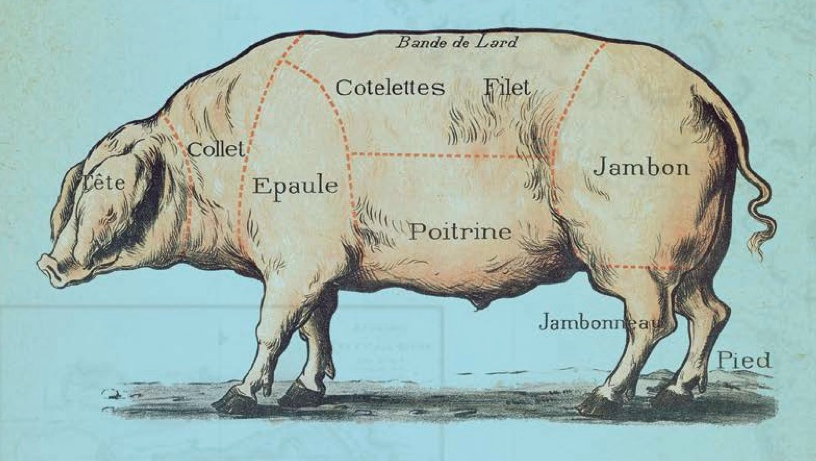
Excerpted from Lesser Beasts: A Snout-to-Tail History of the Humble Pig by Mark Essig. Available from Basic Books, a member of The Perseus Books Group. Copyright © 2015.
An enormous pig, belly up, is wheeled into a banquet room in one scene of Federico Fellini’s Satyricon. Trimalchio, the host, accuses the cook of roasting the animal without first gutting it and orders him whipped as punishment. The guests call for mercy, so Trimalchio demands, “Gut it here, now,” where upon the cook swings an enormous sword and slashes the pig’s belly. The guests recoil in horror, but the steaming mass that pours forth is not the pig’s viscera but cooked meat. “Thrushes, fatted hens, bird gizzards!” one character calls out. “Sausage ropes, tender plucked doves, snails, livers, ham, offal!” The dispute with the cook has been all in fun. The guests applaud, then grab hunks of meat and begin to gorge themselves.
Fellini’s film, released in 1969, stays true to its source material, a work by Petronius written not long after the death of Christ. In depicting Roman dining, Petronius satirized but did not exaggerate: there was no need to embellish the extravagant reality. The dish portrayed in the film, a medley of meats hidden within a whole hog, was known as porcus Troianus, or “Trojan pig,” a nod to another great act of concealment. Petronius also describes a whole roast pig served with hunks of meat carved into the shape of piglets and placed along its belly, “as if at suck, to show it was a sow we had before us.” Another feast featured what appeared to be a goose and a variety of fish, all carved from pork. “I declare my cook made it every bit out of a pig,” the host exclaims. “Give the word, he’ll make you a fish of the paunch, a wood-pigeon of the lard, a turtle-dove of the forehand, and a hen of the hind leg!” Why he should do so is left unexplained.
In cuisine, culture, and mythology, Romans delighted in concealment and disguise, metamorphosis and transformation, and in this they could hardly have been more different from the Jews. The Roman Empire formed a vast, cosmopolitan civilization that embraced and absorbed dozens of cultures. Few identities— whether of meats or of people—remained fixed. Trimalchio, in Satyricon, is a former slave who has won his freedom and then attained great wealth. A man calling himself a Roman citizen might have been born in northern Europe, Africa, or Asia Minor. Jews, by contrast, were dedicated to marrying among themselves, defending their small homeland, and preserving their ancient ways.
The differences between Romans and Jews extended to food. One people defined itself by rejecting pork, the other by embracing it. One called the pig abominable, the other miraculous. One saw the pig as a carrier of pollution, the other as a sign of abundance. Between them, Jews and Romans set the terms that would define the pig throughout the history of the West.
Most people in the ancient world ate vegetarian diets heavy on grains and beans. This was the cheapest way to feed large populations. Rome was different. Although meat was expensive, Rome was rich, and a sizable class of people had enough money to eat it regularly.
Romans ate beef, lamb, and goat, but they preferred pork. Hippocrates, the Greek physician, proclaimed pork the best of all meats, and his Roman successors agreed. There were more Latin words for pork than for any other meat, and the trade became highly specialized: there were distinct terms for sellers of live pigs (suarii), fresh pork (porcinarius), dried pork (confectorarius), and ham (pernarius). According to the Edict of Diocletian, issued in 301 A.D., sow’s udder, sow’s womb, and liver of fig-fattened swine commanded the highest prices of any meat, costing twice as much as lamb. Beef sausages sold for just half the price of pork. After the Punic Wars, the percentage of pig bones in Carthage doubled, just as it had in Jerusalem under Roman occupation: Romans kept eating pork even in arid climates such as North Africa and Palestine, where pigs were more difficult to raise.
The richest source on Roman cuisine, a recipe book known as De re coquinaria, or On Cooking, confirms this love of swine. Pork dishes far outnumber those made with other meats. The section called “Quadrupeds” contains four recipes for beef and veal, eleven for lamb, and seventeen for suckling pig. Other sections of the book offer recipes for adult sows and boars and nearly all of their parts, including brain, skin, womb, udder, liver, stomach, kidneys, and lungs. Archeology confirms that Romans carved up pigs more carefully and thoroughly than they did other creatures: pig skulls found in Roman dumps contain far more butchery scars than the skulls of sheep and cows, evidence that butchers excised the tongues, cheeks, and brains of pigs but not those of other beasts.
More than half of the dishes in On Cooking are relatively modest—barley soup with onion and ham bone, for example— and within the means of much of the urban population, but others demanded greater resources. Apicius is credited with inventing the technique of overfeeding a sow with figs in order to enlarge the liver, much as geese were stuffed with grain to create foie gras. In Apicius’s recipe, the fig-fattened pig liver is marinated in liquamen—a fermented fish sauce central to Roman cuisine— wrapped in caul fat, and grilled. The recipe for pig paunch starts with this salutary advice: “Carefully empty out a pig’s stomach.” The cook is then instructed to fill the stomach with a mixture of pork, “three brains that have had their sinews removed,” raw eggs, pine nuts, peppercorns, anise, ginger, rue, and other seasonings. Finally, the stomach is tied at both ends—“leaving a little space so that it does not burst during cooking”—boiled, smoked, boiled some more, and then served.
Some of the more elaborate dishes in On Cooking fall under the heading ofellae, which literally means a morsel of food. In one recipe, a skin-on pork belly is scored on the meat side, marinated for days in a blend of liquamen, pepper, cumin, and other spices, and then roasted. The chunks of meat would then be pulled from the skin, sauced, and served, forming bite-sized pieces that a diner could eat by hand while reclining, the preferred posture for Roman feasts. Another of the luxury dishes involves boiling a ham, removing the skin, scoring the flesh, and coating it with honey, a preparation that would not be out of place at Christmas dinner today.
Romans had a taste for blended milk, blood, and flesh that could make even a Gentile shudder. The Roman poet Martial had this to say about a roasted udder of lactating sow: “You would hardly imagine you were eating cooked sows’ teats, so abundantly do they flow and swell with living milk.” (Elsewhere, after a meal, Martial suffers the glutton’s regret and remarks upon “the unsightly skin of an excavated sow’s udder.”) This preference veered into the bizarrely cruel. Some cooks, Plutarch claimed, stomped and kicked the udders of live pregnant sows and thereby “blended together blood and milk and gore,” which was said to make the dish all the more delicious. The womb of this poor sow was eaten as well, with the dish called vulva eiectitia, or “miscarried womb.”
Seneca, the Stoic philosopher and statesman, decried such dishes as “monstrosities of luxury,” and he was far from the only critic. Roman rulers passed sumptuary laws limiting the amount that could be spent on meals and forbidding the consumption of items including testicles and cheeks. But the wealthy flouted such rules because the social hierarchy couldn’t function without feasts: feasting provided the only way to learn who had grown richer and who had lost money, who was in the emperor’s favor and who had been cast out. To curtail extravagance was to deny the very reason to feast.
…
Rome created the most sophisticated agricultural system the world had ever known. Previously, farming had been a local affair. Even in the great civilizations of Egypt and Mesopotamia, production and consumption occurred within a fairly circumscribed area defined by irrigated river valleys and surrounding rangeland. By contrast, imports from outside the Italian Peninsula constituted three-quarters of Rome’s food supply.
Rome brought all of the Mediterranean world and much of Europe within its orbit, pulling in grain from Egypt, cured meats from Spain, olive oil from Syria, and spices from further east. The wheat that satisfied Caesar’s bread dole was mostly imported from North Africa, where it was collected as tax. Grain sufficient to feed hundreds of thousands of people moved around the region by ship and filled large granaries that provided insurance against famine.
Although Romans imported grain by ship, they raised nearly all of their livestock within Italy. They kept sheep primarily for wool and secondarily for milk and cheese. Goats were rare, though sometimes raised for milk. Cows offered dairy products, and oxen pulled plows in the fields and carts on the road. Meat from these animals was eaten, but it was usually a by-product rather than the principal reason for raising them. Archaeologists tell us that most butchered cattle show stress injuries to their leg bones, meaning that they worked hard before ending up in the pot. Beef and mutton came from older animals—ewes and cows whose udders had dried up, rams and bulls who had become infertile, and oxen that could no longer pull a plow.
Only pigs were raised exclusively for food. They were eaten when young and therefore were far more tender than worn-out oxen. A popular saying held, “Life was given them just like salt, to preserve the flesh”—meaning that pigs had no reason for living other than to feed people. Given how much Romans loved to feast, this was no small consideration. According to Varro, Rome’s most important agricultural writer, “the race of pigs is expressly given by nature to set forth a banquet.”
For me, one of the beauties of Ann Arbor is the plethora of powerfully interesting, creative, cool people we have here in town. Many I get to work with, others we buy from, and still others we get to cook for. Fidel Galano is one of the latter. I first met him fifteen years or so ago. We did a day of ZingTrain work, teaching our approach to Servant Leadership at the local EPA office. His official role here in Ann Arbor is as IT Director of the EPA’s National Vehicle & Fuels Emissions Laboratory. We connected during the teaching, and it turned out, he was also a customer. Over the years I’ve happily seen him at the Roadhouse, the Deli, and the Bakehouse, and he’s always told me how great his family’s Cuban cooking is. Fidel grew up in Spanish Harlem. He’s an amazing guy; a highly inspiring success story.
Never one to pass up an opportunity for good learning and good eating, I’ve been suggesting for about a decade now that we bring Fidel in for a special Cuban American dinner at the Roadhouse. Finally, ten years later, it’s happening. In July, the Roadhouse’s annual BBQ dinner will feature Fidel’s family cooking. And, of equal import, it will feature Fidel, the man himself. He’ll share stories of growing up in Spanish Harlem, his mother’s, grandmother’s, and family’s (mostly aunts) recipes, the emotional connection with that cooking in the Cuban & Puerto Rican community, and the significance of pork in his family. I guarantee you will eat well, and leave wishing that you, too, had been born Cuban. The man is about as apasionado (passionate) as anyone I’ve ever met!
Fidel has also offered to speak and serve some amazing Cuban pork at Camp Bacon®. Which means that you have two chances to taste and savor his incredible cooking, and two opportunities to meet the man himself and hear part of his culinary and culturally inspiring story. I have a feeling that Camp Bacon® would be worth coming to just to hear him tell his story, and preach the positive attributes of Cuban pork cooking. Let me just say that of all the great people I’ve interviewed over the last three plus decades, Fidel might just be the most passionate about great pork of all of them! Here’s a little taste of what I’m talking about.
– ARI
Fidel Galano: ANN ARBOR’S KING OF CUBAN PORK
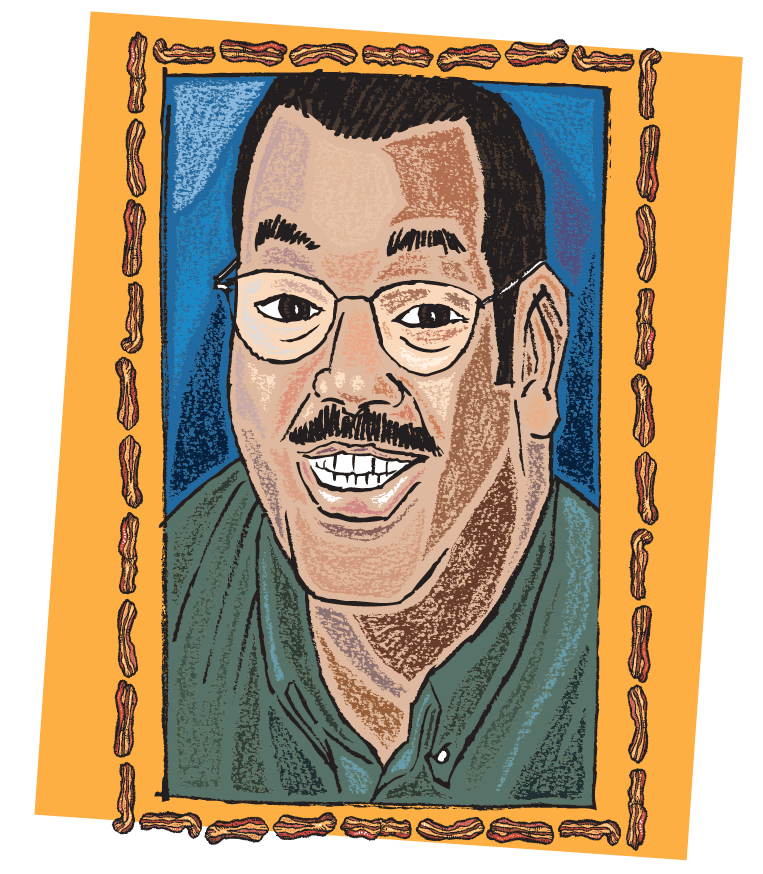
ARI: You grew up in Spanish Harlem?
FIDEL GALANO: My dad was born in Cuba and my Mom in Puerto Rico. I was born and raised in New York City’s Spanish Harlem community. I didn’t learn to speak English ’til I was in 2nd grade, ’til I was maybe 5 or 6 years old, mostly because I did not have to. Everyone in my neighborhood spoke Spanish, including the mailman. I was always trouble, mostly because I was bored—I was unusually smart and articulate for a Spanish kid growing up in the middle of the ghetto. I was smart enough to hang out with the tough kids, and I knew if I could keep ‘em laughing I would be alright. They called me “Fi” (“Fee”). I’m very lucky. I have a great life. I met my wife Nancy when she was 15. Our local priest got my mom to send me to a Catholic retreat when I was 14 or 15. It was a place called Grace House at 108th Street, not too far from home. A real nice brownstone converted into a Catholic monastery and they lock you in for the whole weekend, which seemed like weeks to a teenager. So this priest, Father Bill, he’s responsible for why I got out of the neighborhood. He went all out in trying to keep me from getting in trouble and I have to say he really helped me. Even though he gave up on me for a while and he didn’t believe me when he said I was gonna go back to school. Who would, when you consider I was in and out of school from the second grade on up and I completely dropped out in the 6th grade? Father Bill was blown away by my resilience when, at age 19, I told him I needed to go back to school so I could get my family out of the neighborhood. Years later, after getting a GED and earning a Bachelor’s degree, I invited Father Bill to my business school graduation. Right before taking a group photo at graduation he said, “Fi, you make me believe in God.”
I knew early on that I needed to get out of the neighborhood. A lot of my friends never made it out. I was 19, and Father Bill helped me get my GED. I really couldn’t read, but I took the GED book from his office and I studied and studied and I passed. My friend scored just a few points lower than I did and he didn’t pass. And our lives went in opposite directions. Right after getting a GED I went to college at SUNY Binghamton. I really struggled that first summer as I was taking prep courses. I was failing and thinking about giving up and going back to the City. But then I realized I knew what to do, because I figured college was like working. I’d been working since I was twelve and I knew that work meant get there early, work really hard, don’t watch the clock, and make the boss happy. So going to class and studying was like going to work, and listening to the professor was just like listening to the boss, including making the boss happy. So I applied myself as if I was working a job and I never looked back. In my first semester I got a perfect grade point average. I was featured in a school newsletter and I won an award. I went on to do very well, graduating with honors from SUNY Binghamton’s Thomas J. Watson School of Engineering and given an offer to go to graduate school on a fellowship.
ARI: What about the food?
FIDEL: I can’t remember a time in my life that food wasn’t significant for us. Pork always represented prosperity. When there wasn’t food, specifically pork, it was always because things were bad. We had many hard times. Like when my parents got divorced. All I knew when I was a kid was we got eviction notices and I never knew if we were OK. But one thing I knew is that if we had pork, such as Pernil (slow-roasted marinated pork shoulder) or Chuletas (pork chops) with our staple rice and beans, then I knew that, for the moment at least, we were OK.
In our culture my dad didn’t hug you to reassure you or say anything about what was happening financially and my mother wasn’t gonna tell a seven-year-old kid about her stresses. But the indicators were always there, so if we were gonna have pork, life was gonna be ok. To us, pork was an index to prosperity and social enjoyment.
There are many traditional and religious holidays in both the Cuban and Puerto Rican communities where pork is the main dish used to celebrate. All the Saint’s days, Santa Barbara, San Lazaro, and Easter and Christmas. Lent was one of the only times I remember not having pork during a celebration, and that’s because we could not for religious reasons. So instead we have fish fries with the other fillers we normally had with pork, yucca chips, fried plantains and fried bananas (maduros).
When things were good in general, there was this fantastic, amazing piece of meat: pork. It was made in many different ways. From a Lechón (roasted suckling pig), to a Pernil. The idea that we could make a pork shoulder was soothing and comforting, because it meant things were good. When we were kids and we knew there was a pig cooking, we knew that there’d be all these derivative products coming. In addition to the main dish, the Lechón, we knew that Morcilla (blood sausage made with rice, culantro, cilantro, garlic, and chillies), Pasteles (plantain or yucca root patty filled with roasted pork chunks) and Pastelillos (flour-based flavor-infused turnover filled with roasted pork chunks, capers, and any other goodies you wanted to add), would follow. We knew having a pig was prosperous because so many dishes would be made from one, and everyone in the neighborhood was the same way. We had one African-American family and one American Italian family in the neighborhood, and even they wanted Cuban and Puerto Rican pork dishes.
ARI: Is all that carrying on to your kids here in Ann Arbor?
FIDEL: There’s a real nexus to what exists today. My mother, my grandmother, and many of my Aunts were known for their food, considered amazing cooks that were often hired by others. Their love for cooking was part of them (the soul) and so was maintaining their reputations. When we prepared and cooked food, especially for the holidays, it was to show love to your family and friends. That means you go the extra mile, you give it that extra something that only the heart and soul can give. I inherited their passion and abilities for cooking and have carried on with my family here in Ann Arbor, even though we are many miles and many dollars away from what I had growing up. My kids get just as excited as I used to about Cuban and Puerto Rican cooking. Although we are now economically removed from that poverty that I grew up with, my kids have been exposed to many of the cooking traditions and approaches I grew up on. Especially cooking pork and some of the amazing Cuban and Puerto Rican foods I was exposed to as a boy. So if you talk to my three children, who all grew up in Ann Arbor, are doing great with top educations, and pursuing advanced degrees, they will say many of the things I said as a boy when it comes to Cuban and Puerto Rican food. For example, when I say that I’m making a cultural pork dish, like Pernil, they all get really excited because they know what it means. Not only do they know the main dish will be filled with great flavor and accompanied by other cultural foods (Cuban black beans, saffron rice and fried yucca root), they also know the derivative dishes to follow, such as Pasteles or Patelillos. They love our cultural food, and that is what they crave. They never beg me to take them anywhere or anything like that, even though my wife and I have exposed them to some of the best culinary cuisine. They want me to make food at home! Now that I’ve slowed down a little with cooking, my daughter says, “Come on dad, I’ll do all the work! Let’s cook!” It’s wonderful to see how they’ve tied an emotional prosperity to our cultural pork dishes, just like I tied them to financial prosperity as boy growing up in poverty.
ARI: What are some of the dishes?
FIDEL: To me, roasted pork is the key. You acquire the pork, wash it in white vinegar and prepare it as you need to (family traditions and/or religious traditions). We always cleaned it really carefully. Then we’d strategically poke holes in the meat to get it to breathe the flavors in. Crush garlic, cumin, black pepper, Spanish paprika, and other dry ingredients to create a dry rub. Then we add extra virgin olive oil and wine or vinegar to make a pesto. Cut nice-sized holes, and insert crushed or whole garlic cloves into them along with a heaping of the pesto. When we made a whole pig or a shoulder, there were all these supporting things around it. You had to have slow-cooked black beans, red rice, double-fried plantains and yucca (boiled or fried). Everything has to be supported by the pork, because it is added in some way. We used pork to flavor almost everything, even the beans and the rice. You start with some pork belly where you almost burn it dark brown and then you deglaze it and then it becomes the base flavor of your beans and yellow rice. If you did not have a whole hog, then you make a pork shoulder (Pernil). Pernil is the poor man’s lechón. It’s the shoulder. If you buy it right, you still get the skin and the fat that help make the flavor we want.
I love the Pastelillos. Those are our turnovers. We make them with this dough that’s infused with saffron. You add the saffron to some oil, and then add that to the dough and then you make these discs and you fold them and seal them with the pork filling inside. Oh man! That’s prosperity! There’s no way to make the turnovers without doing the whole pork roast through. You have to truly get a roasted pork shoulder that you loved and you gave it that passion. You chop up the roasted pork and good distribution of dark and white meat. Red pepper, garlic, Spanish olives, whole capers. It’s the recipe I’ve perfected over the last few years. Season with cumin, salt, garlic. One of our secrets: we put sugar on everything. A little sprinkle to give that little extra…
I love Yucca! Especially Pasteles made of Yucca. Of all the starch family, yucca is it for me! During the holidays, my uncle, my mom, and my grandmother would make many things from Yucca, even though money was always tight. Their cooking was so good that people would front them the cash to get a dozen of these Pasteles. So my grandmother and my mother would turn the whole living room into a production environment. My job as a boy was to grate plantains. My older brother was stronger so he grated the yucca. They would make this base using a plantain or Yucca puree with some other ingredients. They take Achote (annatto seeds) with extra virgin olive oil and slowly cook it to release it, slowly strain it to make that reddish oil, and then mix that into the batter of the Yucca, and also to coat the inside of the rice paper or plantain tree leaf. Then you would take a big banana leaf or rice paper, and a couple ladles of the puree and you would make a round section of it. Then you would take that roasted pork and then you would fold it into this square. You would make a square in the leaf or on rice paper and you would boil it in the leaf. You would get this cooked plantain or yucca. Very soft to cut, but in the middle you had this roasted delicious pork. My grandmother would always add fat, because the flavor was in the fat. She would also add raisins, chickpeas and other things depending on how you liked them. That was a holiday thing! Oh man!
When you’re cooking this stuff in your home, you’re feeling like life is good. We knew life was good. We were gonna eat. We were gonna celebrate food. Pork really matters to us. When I think about my youth and what it meant to me, it was always pork as the holiday meat. I know a lot of people today think of Christmas and they think about beef. But I can’t imagine a rib roast at the holidays. It’s gotta be the pork. Without the pork it doesn’t feel like we’re alive. The beef rib roast means nothing to me. What really matters to me and my family is to have that Pernil or that lechón.
You can make Patelillos, Morcilla, and pig ears. My dad used to love pig ears with hot sauce. And Chicharrón (fried pork rinds). That’s where you take pork belly and then make a rind part of it. They’d cut these slices into it to make more surface area. Almost every dish, rice and beans, always had a little pork in it (mostly fat). It is pretty amazing how one product, the pig, leads to so many other products that would not be the same without pork. Pork is amazing. Man! It’s delicious! My grandmother ate pork skin with the fat every time she cooked a pig. She didn’t care. She ate, drank and smoked to the last day of her life. I don’t think she regretted any day of her life when it ended at age 80.
For dessert we used to make Coquito. It’s a coconut egg nog made with Bacardi 151. There was always Bacardi! We used to grate coconut. It was either to make coconut flan or Coquito. All of these things gave you a sense of we’re gonna be ok!!
Today, we’re very lucky. My kids are all doing well. They still have this great emotional connection to the pork and the other cultural foods we make. Pork means life is good! It means we’re doing well! It means it’s gonna be a great holiday! They have the same love of the culture and of the food. I thought this connection would only be for us, for our family that has been exposed to it. But now my daughters’ fiancé, a fantastic American boy who grew up in Canton, is into it. He asks me to cook, too. And my son’s best friend is Jewish and he wants it!
I know that Nancy, my wife, and I have done well. Better than any fictional story could predict. But I would not feel complete without that part of my culture—the food. The food with its flavors and smells link me to the memories that define me culturally. Without the food there is no celebration there is no feeling of prosperity, and there is no sense of culture. The memories of the food link me to who we are. If you abandon that, the food and the memories, there’s a real sadness for us. We love our culture for many reasons, but most of all because it defines us and links us to those that made us and raised us. Our true north is us, as Cubans and Puerto Ricans! Cuban and Puerto Rican culture, and Cuban and Puerto Rican cooking. And pork! For me, I can’t imagine success without the food of my childhood. We yearn it. Very importantly for the Cuban in me, “when you make a Lechón, we all know a Cuban sandwich is coming next!!”
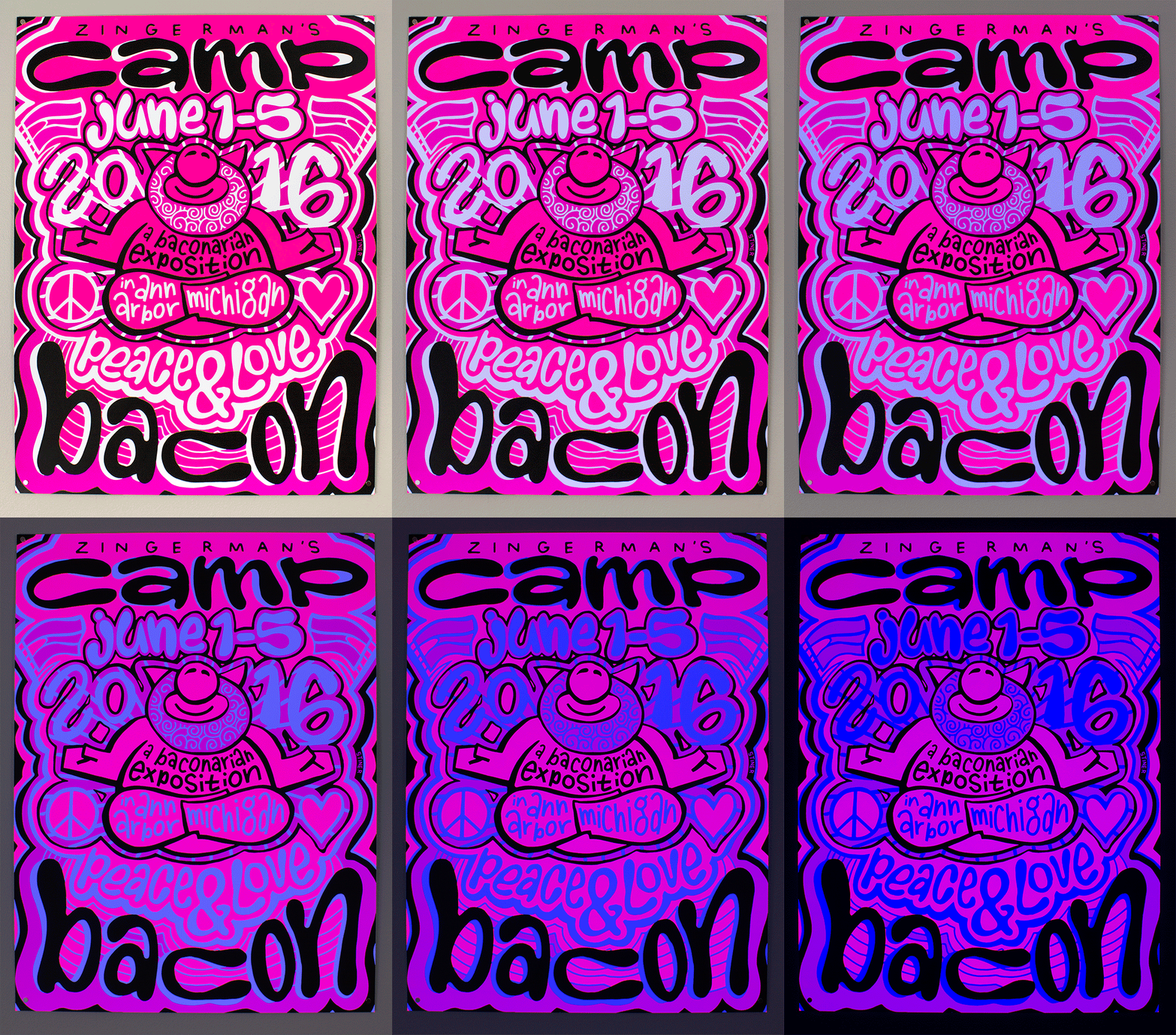
This beautifully rendered limited edition blacklight poster is numbered and signed by Zingerman’s staff artist Ryan Stiner, and celebrates the 2016 Camp Bacon event. While the bearded pig looks amazing under any light, the design really pops under a blacklight. Take home a piece of Ann Arbor history!
Visit our website to buy yours!
See you at Camp!
An Interview with Mike Zoromski, Smokemaster at Nueske’s
*Note: Mike will be a guest speaker at this year’s Camp Bacon® where he’ll give us “A Look Behind the Smokehouse Door.” Recently, Zingerman’s co-founder Ari Weinzweig had a quick chat with Mike about his background, and the smoky magic that happens at Nueske’s.
Visit our website to reserve your Camp Bacon seat and find more info. Please join us!
Pretty much every morning for the last 34 ½ years, the Deli kitchen crew has begun its day by cooking many pounds of Nueske’s amazing applewood smoked bacon! The same can be said for the Roadhouse over the past 13 years. Their wonderful product graces the menus at the Deli and the Roadhouse, shows up on sandwiches, in Bakehouse breads and Creamery pimento cheese. It’s a regular feature in our Mail Order bacon of the month club. It’s safe to say that without Nueske’s, Zingerman’s would be a very different place today!
It’s also safe to say that without the work of Mike Zoromski to design, build, and manage the artisan smokehouses in which all that bacon gets smoked, Nueske’s would be a pretty different place as well. To get a look, so to speak, behind the smokehouse door we’ve gotten Mike to make a rare public appearance at Camp Bacon this year!! What follows is an interview with him, and a chance to hear some behind-the-scenes, behind-the-smoke, sense of what makes the Nueske’s smoking so special. Come to Camp Bacon® 2016 and meet Smokemaster Mike in person!
How did you get involved with smoking? How did you get involved with Nueske’s?
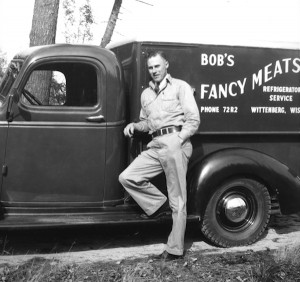
I was so young and foolish back in ‘83 when I was asked if I wanted to work here, that I had no clue of what I was getting into. But what I do remember was that everything that Bob and Jim Nueske, (sons of founder, Robert “R.C” Nueske), and my brother Jeff taught me about smoking this product stuck with me. Even back then it seemed like I had a knack for doing it, but I was young and still wasn’t sure what I wanted to do, so I left to get back into the building trade.
After fifteen years in construction, Jeff asked me if I wanted to come back. He needed someone to tend the smokehouses, so I came back and it was amazing. Everything that I was taught in 1983 came right back to me, almost as if I hadn’t left. I knew I was where I belonged, and I took it very seriously. I was going to make these smokehouses my own. Soon I started to see that each one had their own personality, and I knew I needed to figure them out so that the all the products came out looking and tasting the same every time.
What are some of the things that go into building a great smokehouse?
A controlled heat source, which distributes and disperses the heat and smoke evenly through the product, and a good consistent draft throughout the house that you have control of with a good damper system.
Many consumers love bacon but don’t really understand the details of the smoking process. I know some of the details will be proprietary, but can you take us novices through the process of smoking?
There are three basic cycles in almost every smoke process. There is a drying cycle, where you might have more of an open damper setting with smoke, and you slowly bring up the temperature. Then there are some critical meat temperature ranges that you need to get through in certain amount of time for food safety reasons. During that time you would have a more closed damper to hold the heat and humidity in, and during that that time you are getting a lot of smoke penetration into the meat. I have looked at the product during these early cycles, and you never believe that the product will end up with the beautiful deep color that it does at the end, but the smoke and flavor is getting in throughout the night. The last cycle in this long process is to start bringing up the smokehouse temperatures slowly to reach your final meat temperature. I like to use this time to put my final touches on the finish color, adding more smoke or adjusting the dampers. There is a science behind what really happens during the whole smoke process and there is always something new to learn.
What are some of the things that distinguish artisan smoking the way you do it at Nueske’s from the commercially smoked meats that people are used to buying in the supermarket?
Our competitors probably think we are nuts when we keep building single truck houses. They think the way to increase production is to build fifteen truck houses and mass-produce. Well, that’s not the way to hold onto what we have done for 80-some years. We use real Applewood logs in our houses, they use smoke injectors that burn wood sawdust, or even liquid smoke that tastes fake. We have a 24-hour cycle to get that full flavor; their process is about half that. Our houses are seasoned with a year’s worth of smoke on the walls; theirs are cleaned every day. You could probably run product through ours without putting any wood on and they would end up with more smoke flavor than a normal cycle with wood at one of those other places. That special attention that each rack gets in our houses is something that no mass-producing smokehouse could ever duplicate.
Are there seasonal differences in the smoking?
Yes, very much so. In the cold winter months, you have to control the draft more. The air is dry and it wants to get up and out, and if you don’t make those adjustments, you could end up with lighter colored meats. Then when the cold nights switch to the spring thaw and the frost turns to dew, we again make adjustments. Then comes the heat and humidity of the summer. Thunderstorms are tricky; they are unpredictable and usually bring a quick change in temps outside. Then, when the summer air starts to change to fall, and at the beginning there is a lot of dew, you start to see the differences again, then when the dew switches back to frost again, the draft in the houses start to speed up, and then we are back to winter. If I had a choice as far as how the houses best perform, I would pick the winter, because we have more control over the air flow in the houses.
Nueske’s has long used the applewood—have you smoked with hickory? How are they different?
I have not used Hickory here at Nueske’s. I have tried products that were smoked with Hickory and I do like the flavor, but it doesn’t compare to Applewood. Applewood has a much sweeter flavor and produces a deeper golden color. Hickory is a much harder wood that produces a bitter nut, so I think the differences in smoke flavor are similar to the fruit they produce, not that hickory smoke is bitter, but the oils that are trapped in the wood from a tree that produces an apple compared to that of a nut.
With the new cherrywood smoked bacon… Was it hard to learn to work with a new wood?
It’s funny how much your past helps you in everything you do. I spent a lot of time with my dad logging, making pulp and firewood, and all that time he would teach me about the different types of wood we would be working with. One of the trees we had worked with a lot in our area, was the Wild Cherrywood we now use here. The Wild Cherrywood is a lot different type of wood than Applewood; it is a solid but light wood, with a closed grain and a very bitter berry. When we were kids we called it a choke cherry.
When we decided to try it for our Cherrywood smoked bacon, I knew it would probably burn away faster than Applewood does. So on my very first try in our smokers, I figured I might have to use a little bit bigger size piece of wood than I do with Applewood, and I was right on. We use that much all the time now and the color is very good. A little lighter than Applewood, which I thought it would be, but by using the bigger pieces we get very close the color of our Applewood bacon.
I think that having that knowledge that was passed on to me from my dad really helped me, and it still does every day when I’m picking wood for the houses. I go through and select only the higher quality wood and the rest goes home to my fireplace.
Nueske’s products are clearly very special. But so is the company. What’s it like working at Nueske’s?
It is pretty special to work for a company that produces the products we do, and it has always been like working for family. I always admired Bob’s toughness on how he ran this company, yet I considered him a friend. It is no different with Tanya, she too is my friend, and I would never let them down. It’s quite an honor to have the title of Smokemaster of Nueske Meats.
What else should we know about your work at Nueske’s?
I now have three guys working for me in the smokehouses, including my son Matt. I also now have Steve and Dallas, and I couldn’t be more proud of the job they are doing. Every day it seems like they learn more and more about these smokehouses. It doesn’t take four guys to do this work right now; it’s about a two and a half man job. But with expansion on the horizon, we need to train them now, so that when there are more smokehouses to run, the products will continue to get the personal attention they need. These three guys have shown a lot of passion towards this job already, so it will be in good hands when I retire…someday.
Are you excited about coming to Camp Bacon?
Yes and no. I never considered myself to be a very good public speaker, but this bacon and my smokehouses are not hard to talk about. So I’ll try and pretend that I’m walking around and giving a tour of my smokehouses.