
Tag: ZINGERMAN’S CANDY MANUFACTORY
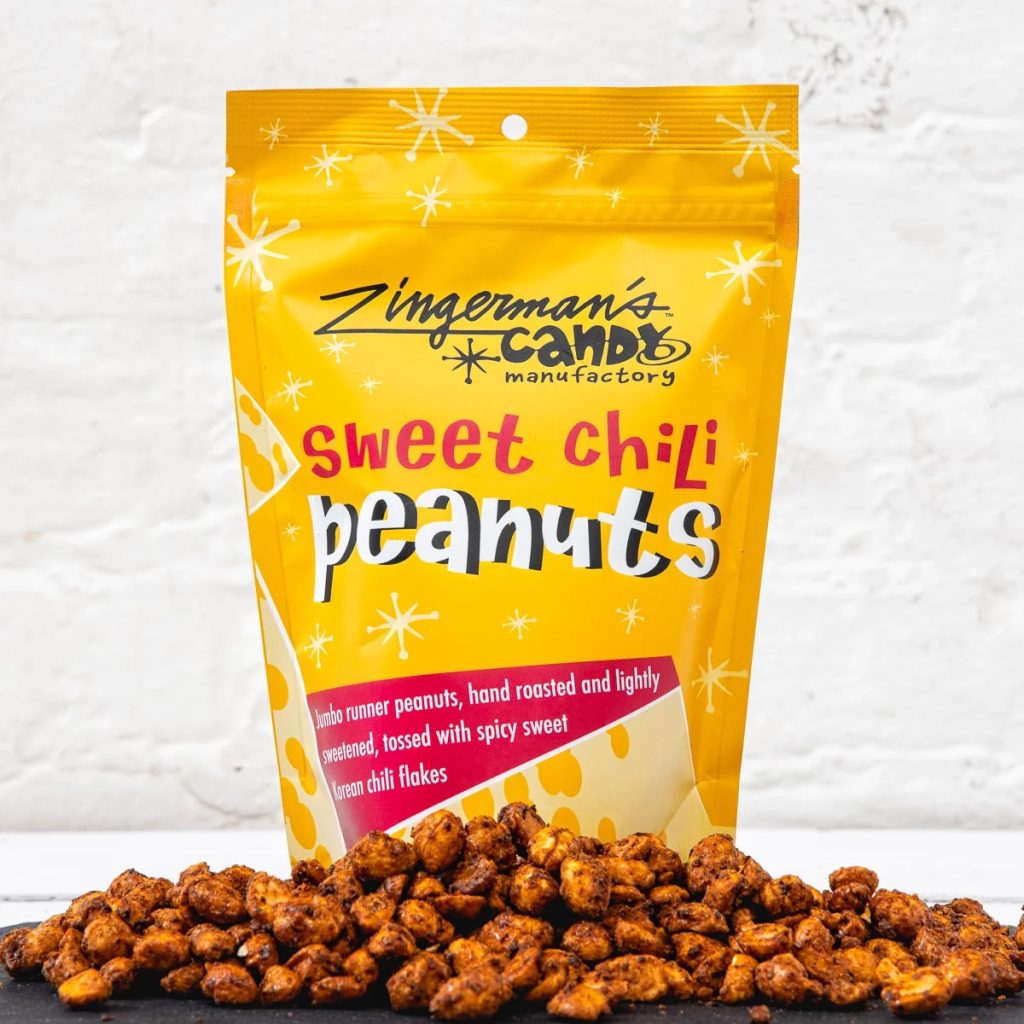
Slightly sweet, slightly hot, 100 percent delicious!
One of the tastiest treats we craft at the Candy Manufactory, these Sweet Chili Peanuts are ideal for this time of year! They taste great, of course. And take note that they also hold up in the heat, which means you can bring them on summer picnics or camping trips. Then there are all the wonderful ways you might enjoy them in any season: serve them with cocktails, eat them as a snack any time of the day, or toss them onto salads or noodle dishes.
The key ingredient in the peanuts are the very special Korean red pepper flakes we get from our friends at Épices de Cru in Quebec. What we’re getting now, Miss Kim chef and Managing Partner Ji Hye Kim says, is “very close to the best of what she had growing up in Korea.” The red pepper is produced by a family-owned company whose quest to make ever-better kimchi led them to grow and process their own chilies. It’s from the area around the town of Cheongsong, a well-known pepper-growing region in the East.
These special pepper flakes are what we use at Miss Kim for our kimchi and a whole range of other dishes. At my house, they’re on the kitchen table next to the Fleur de Sel sea salt and the grinder filled with Tellicherry black pepper. All three get used at virtually every meal, as they’re awesome on almost everything. I sprinkle the chili flakes on salads, soups, pasta dishes, fish—you name it, it’s good! I love the fact that the chili has some spice but not too much, and a nice undertone of sweetness but, again, not too much.
To make the Sweet Chili Peanuts, we toss toasted Virginia peanuts with butter, sea salt, and a bit of cane sugar, in addition to the pepper flakes. They’re terrific and really sort of magically compelling—sweet, salty, spicy, and crunchy all at the same time. Try them to discover a flavor that makes me think of what writer Maria Popova calls “that rare miracle of insight at the meeting point of the lucid and the luminous.”
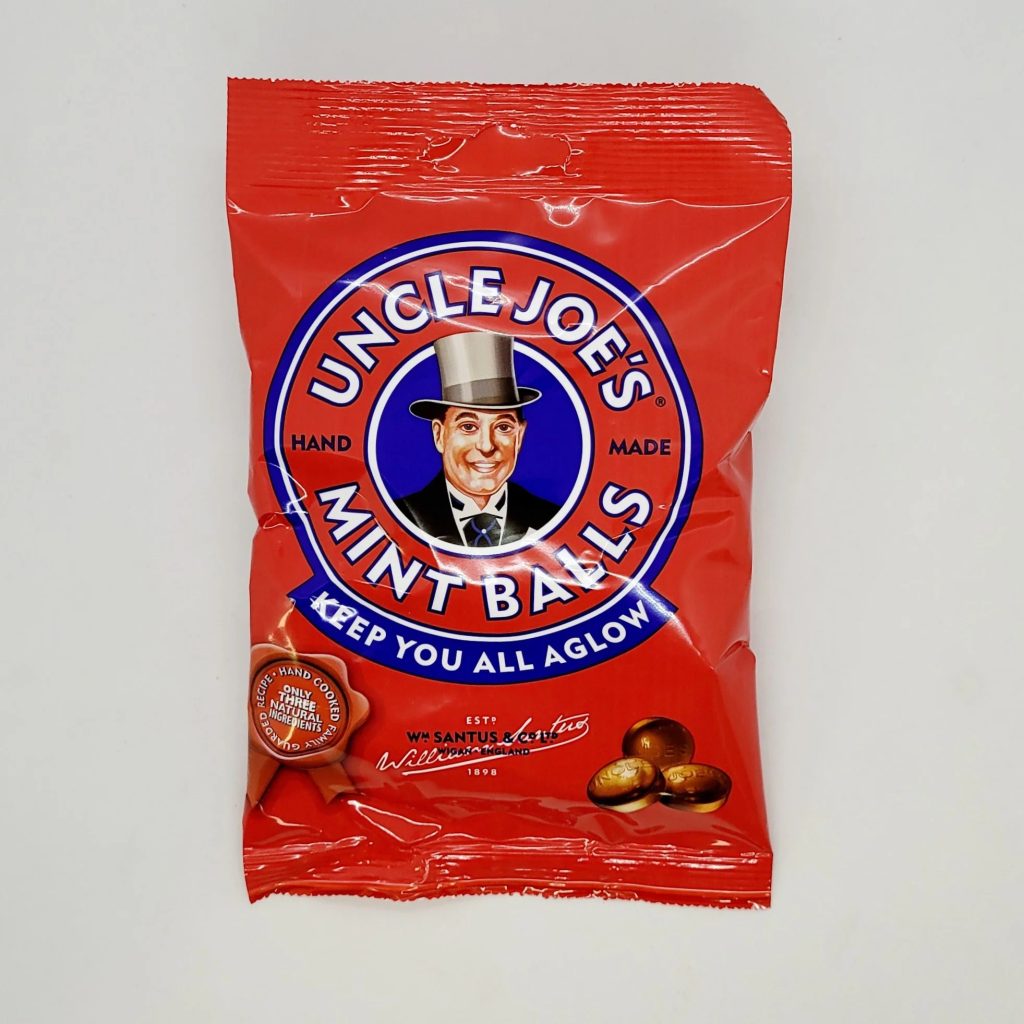
Handmade hard candy keeping mint lovers aglow for over 100 years!
If you want a subtle, sensuous note of mint to enhance your day, I’d steer you toward these special English confections—which are clearly for serious mint lovers! They’ve got a big mint flavor, backed up with notes of caramelized sugar that come together in a way that’s surprisingly not super sweet.
William Santus & Co. is yet another small, artisan business of the sort we love to work with—a company that’s still family owned and run more than a century after it was founded by William Santus. In the spirit of what I’ve been writing about succession in recent years, they have successfully kept both the company and the Mint Ball recipe in the family for six generations—John and Antony Winnard, Santus’s great-nephews, are the current owners. While nearly all the small confectioners who set up shop in that same era are now divisions of massive multinationals, Santus remains proudly privately owned to this day.
Uncle Joe’s Mint Balls are made in their hometown of Wigan, which is about halfway between the city of Manchester and the sea to its west. Due south of the English Lake District, where the poet Wordsworth did much of his work, Wigan is a market town with roots that go back to the seventh century. It’s probably best known today for its relationship to a different kind of ball—Wigan Athletic Football Club didn’t play in the World Cup, but it’s very well known around the world!
William Santus was born on July 27, 1873, four years and a month after Emma Goldman was born in Lithuania. Growing up in poverty, Santus left school at 14 to work at the market in fruit and vegetable stalls, and a few years later, he married a local girl named Ellen Seddon. Seddon had friends who had taught her confectionery, and gradually, the young couple began to make more and more of it. In 1908, they owned a series of market stalls—a photo of Ellen Santus standing proudly in front of an abundant display looks not unlike Zingerman’s Candy Store Retail Manager Allison Schraf doing the same today! In 1919— just after World War I and in the middle of the Spanish flu pandemic—they moved into a bigger factory, where they still work to this day. Their Mint Balls became increasingly popular, in part through great marketing work: “We make sweets to make life sweeter” was their slogan, modeling the power of purpose many decades before it was a common topic of business-school discussion.
Uncle Joe’s Mint Balls are, as they were in 1898, still crafted by hand. Sugar and mint oil are boiled down to make the candy, and then they’re rolled into balls. They contain no artificial additives or colors. During the two World Wars, they were hugely popular with British troops. The 21st-century slogan for the Mint Balls is that they “keep you all aglow.” And it’s true—these babies are the heavy metal of the mint world. If you need a midafternoon wake-up, pop one of these in your mouth, and I’m guessing you’ll be more alert in a matter of minutes!
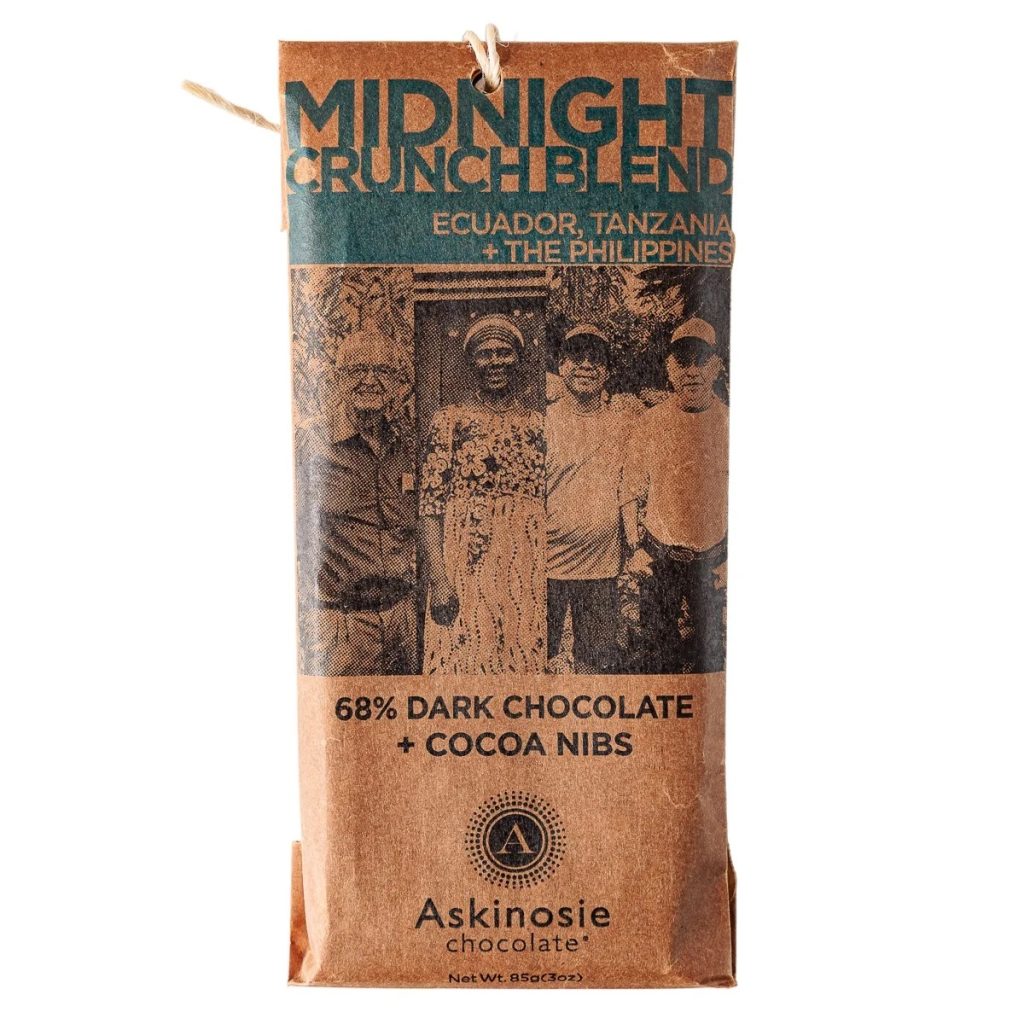
A coming together of three origins of cacao in one wildly good bar
Wow! Here is one very tasty new dark chocolate bar from my friend Shawn Askinosie down in Missouri. I’ve been enjoying it regularly since it arrived the week before last.
If you like good chocolate and you don’t yet know Shawn’s chocolate bars, come by and have a taste! I’ve been loving them since we first started stocking them nearly 20 years ago now, right when Askinosie was getting going. At the time, they were one of only five or six bean-to-bar chocolate makers in the U.S. Rather than buying beans in bulk containers from brokers, as nearly all chocolatiers had done previously, Shawn and a handful of caring colleagues made the commitment to willingly pay more to buy cacao directly from the growers—in the process, improving quality of life in the producing communities and achieving higher quality (i.e., better flavor) in the finished chocolate. You really, absolutely, 1000% percent can taste the difference.
Everything you see from Askinosie is excellent. The Candy Store stocks about 25 items, and the Roadhouse and Deli about half that many. You won’t go wrong with any of them.
My focus here, though, is on this new bar! It combines cacao from two different sources that Shawn has worked with for years, with nibs (the unsweetened “nut meat,” so to speak, of the cacao) from a third origin sprinkled liberally across the top to add crunch and contrast. Awesome! The aroma alone is exceptional. After you open the bar, stick your nose inside and discover it for yourself: deep, earthy, a little like a bourbon barrel, enticing, comforting.
Here’s what Shawn had to say:
This is a blend of Tanzania and Ecuador—two longtime favorites. As the name suggests, it’s a “crunch bar,” with small, crunchy Davao cacao nibs sprinkled on the back. I have always wanted crunch over creamy textures.
The tasting notes are velvety, nutty burnt-caramel crunch with notes of vanilla and molasses. Which makes total sense, because that’s what you get when you mix these three origins. I might have mentioned this in the past, but blends are much more technically challenging from a flavor perspective than single origins. This one is a 68% dark chocolate, so it’s neither super dark nor super sweet.
Since we combined all three origins, this bar also celebrates 19 years of direct trade with these same farmers. My most recent trip, a few months ago, was to the Philippines, and it was my 55th origin trip since starting the company, and I’ve been working with these farmers for 19 years. To me, that’s kind of mind-blowing, and I’m grateful to have been part of it.
The results of all those years of hard work are difficult to top. The bar’s natural savoriness makes it especially good with bread—try some with a chunk of fresh baguette from the Bakehouse.
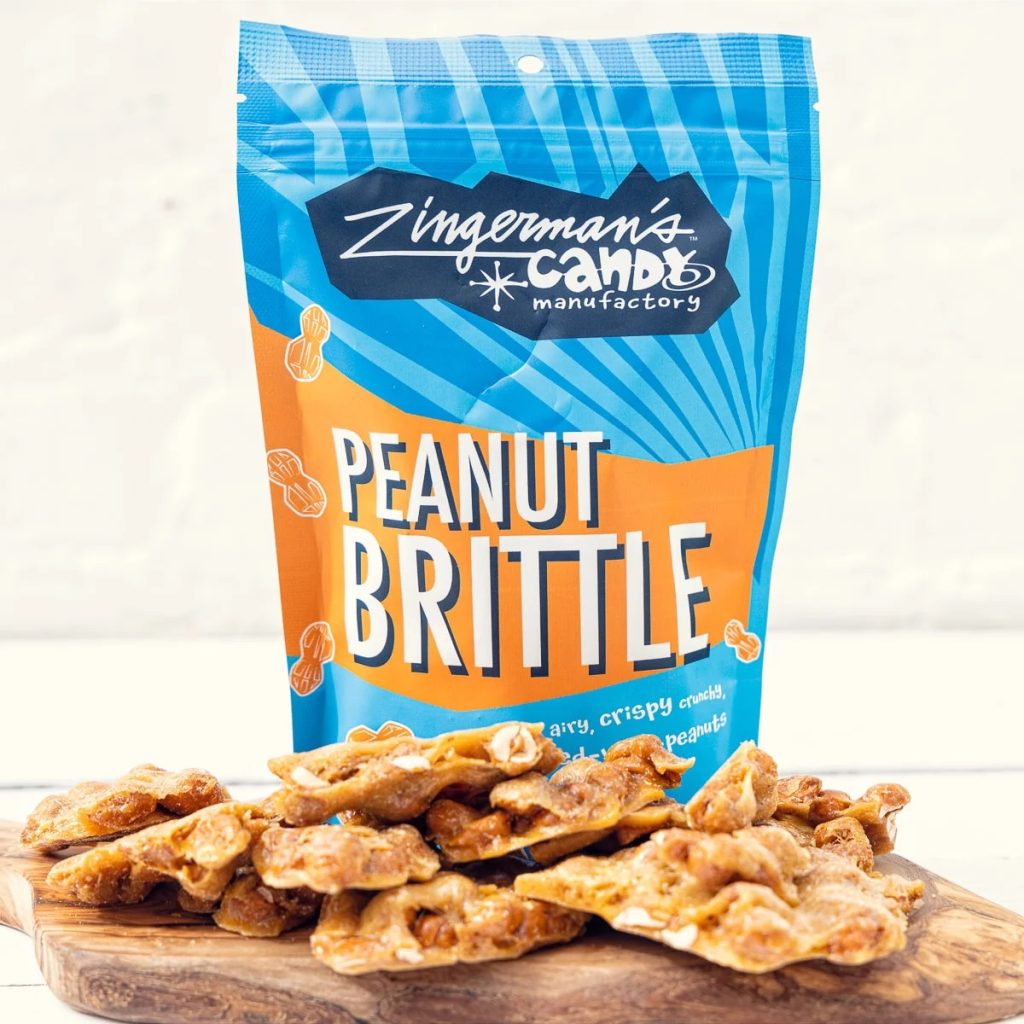
A terrific taste of the 19th-century American confectionery
Peanut brittle as we make it and know it is seemingly an American product, dating to the 19th-century American South. That said, it has culinary cousins in Spanish turrón, Persian pashmak, and French croquant. Thanks to George Washington Carver, the popularity and availability of peanuts grew rapidly in the early 20th century, and peanut brittle became a confection one could make at home for family and to give as a gift. Here we use the classic ingredients: lots of Virginia Runner peanuts, sugar, a little sea salt, and baking soda. We do a particularly dark toast to take advantage of the benefits of the Maillard effect, caramelizing the sugars much as we do with the Butterscotch Pudding at the Roadhouse or the darker crusts (my favorites) at the Bakehouse.
We also do another version: the Candy Manufactory’s incredible, darkly toasted peanut brittle dipped in dark chocolate. Great peanuts, dark chocolate, a bit of butter, and a snippet of sea salt—what could be bad? This stuff is delicious! In fact, the only negative thing I can say about it is that if you’re not careful, you’ll eat the whole package in one sitting. It’s a perfect snack—something to stick in your pocket if you’re hopping on a flight or going for a long drive. (It’s just not good for hot-weather picnics!)
The Peanut Brittle is actually excellent with cheese, like aged Gouda or Parmigiano Reggiano, and it goes really well with coffee, too. (Try some of the Colombian that’s the Roaster’s Pick right now—they make a marvelous pairing.) Crumble it up on an ice cream sundae, or, for some sweet-and-savory action, sprinkle small pieces on your next salad!
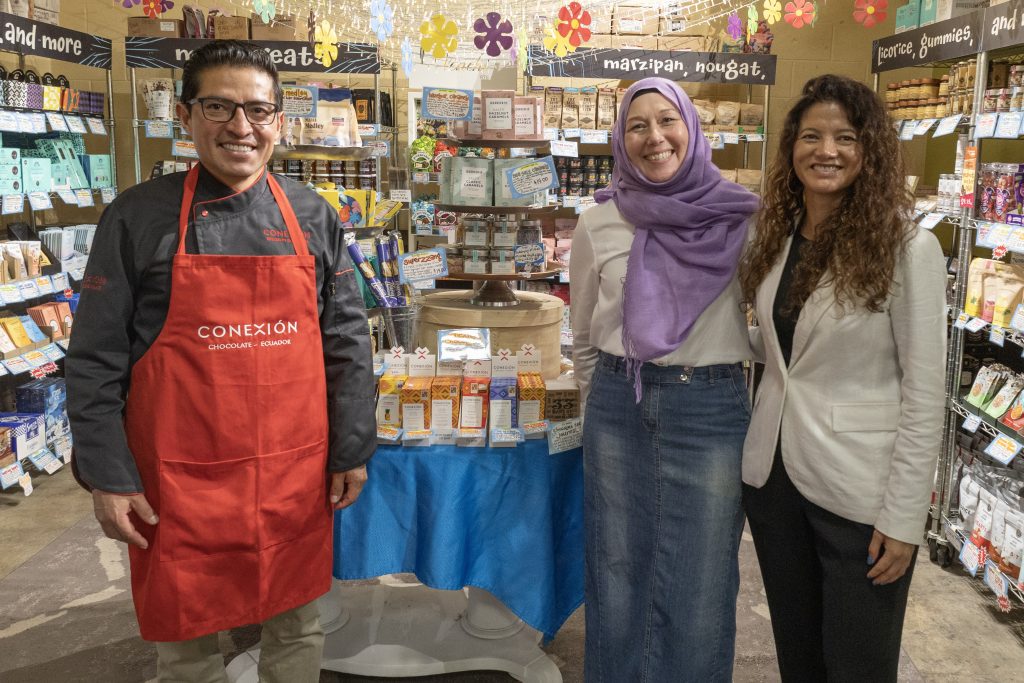
Local. Ethical. Sustainable. These words guide the bold mission of Conexión Chocolate, an award-winning Ecuadorian specialty chocolate maker that works hand in hand with the country’s small farmers of fine-flavor cacao.
The company’s founder and owner, Jenny Samaniego, and operations manager, Mario Remache, paid a special visit to Zingerman’s Candy Manufactory on Saturday, April 25, for the store’s first-ever “Meet the Maker” event. Located at 3723 Plaza Drive, the Manufactory is one of Zingerman’s Southside Shops, once aptly described by a guest as “the Diagon Alley of Ann Arbor,” in a nod to the magical district from Harry Potter.
A full house showed up for the 90-minute talk and tasting, which was hosted by Manufactory Production Manager Jamie LeBoeuf, whose own J. Patrice Chocolate Studio already possesses a strong connection to Conexión.
“We’re currently using Conexión’s Abundancia couverture in all of our milk chocolate products, and we’re working to use more of their couverture in the future for our dark chocolate and white chocolate as well,” LeBoeuf noted in her opening remarks. (“Couverture” refers to a high-quality, professional-grade chocolate that contains a higher percentage of cocoa butter, often used in candy and pastry making.)
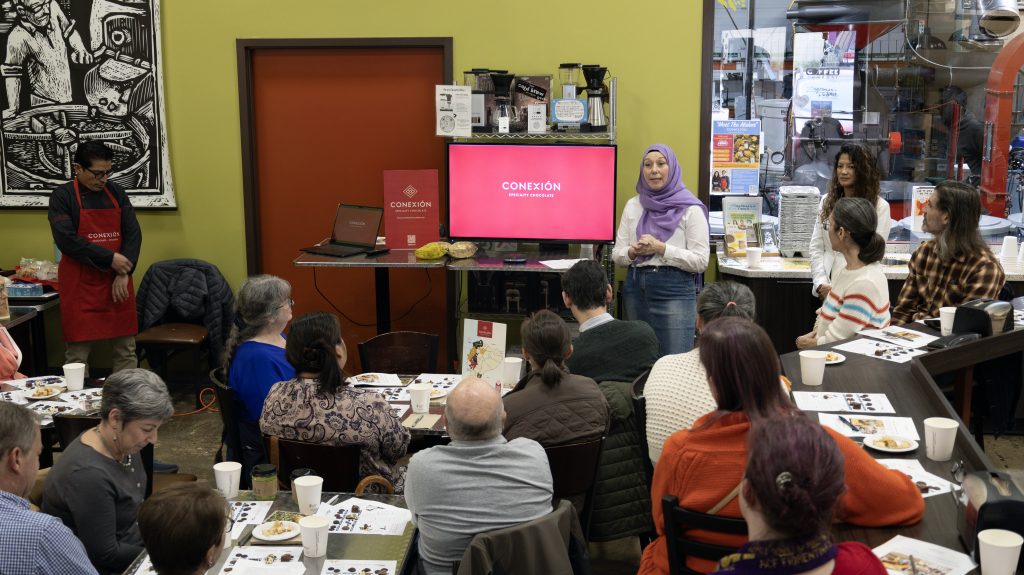
Samaniego then delivered a powerful presentation on the global cacao industry and her unlikely personal journey into the realm of chocolate. After studying hospitality in her home country of Ecuador, she traveled to New York City in the early 2000s and began working for a restaurant distribution company that did business with Anthony Bourdain, the late chef, author, and TV personality. It was Bourdain’s sous-chef at the time who introduced Samaniego to a New York–area chocolate maker.
“I knew zero about chocolate or cacao, but he said, ‘You look like a nice person,’ and he hired me anyway,” she recalled with a laugh. “It was an amazing experience, because I was able to really learn everything from the ground up. I learned about sourcing, about cacao genetics. And for me, being from Ecuador and understanding how the supply chain works over there, everything just got connected.”
Samaniego eventually launched her own operation, Porcelana Chocolates. And in 2016, she returned home to Ecuador with a passionate purpose: to become a direct bridge between the nation’s cacao farmers and the wider world. Accordingly, she renamed the company “Conexión.”
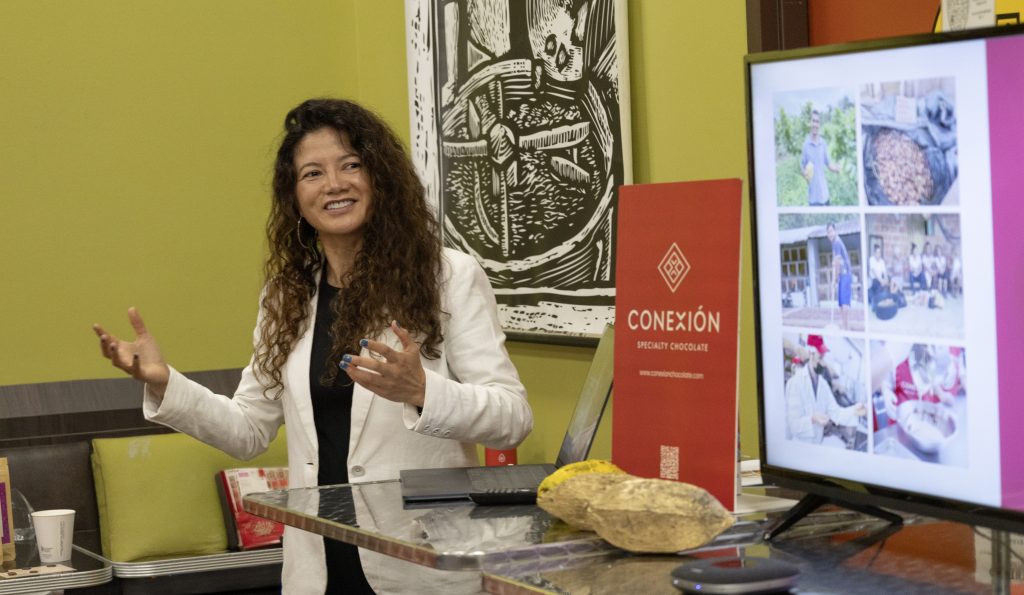
Ninety percent of the five million tons of cacao produced globally each year are traded as a “faceless bulk commodity,” Samaniego explained. This industrial focus on volume strips beans of their genetic identity while subjecting farmers to the price volatility of the international marketplace.
Conexión exists to combat this commodification and break the corporate chocolate monopoly. Based in Quito, Ecuador’s capital, the company works closely with four cacao cooperatives and more than 4,500 legacy farming families to preserve the country’s pure Arriba Nacional variety, from harvest to couverture. Only 5% of the cacao grown worldwide is considered to be “fine flavor,” and Ecuador’s crop belongs to that rarified class.
Samaniego has also assumed an ambitious public advocacy role, empowering farmers with information and training, and launching the first Cacao and Chocolate Summit in 2019. The event, whose seventh edition was recently held in Quito in December 2025, gathers producers, chocolatiers, investors, and researchers to support a more sustainable, inclusive future for the cacao industry both in Latin America and elsewhere.
“We really want everyone to know what’s happening behind all the chocolate they’re buying,” she said, emphasizing the vital importance of transparency and traceability.
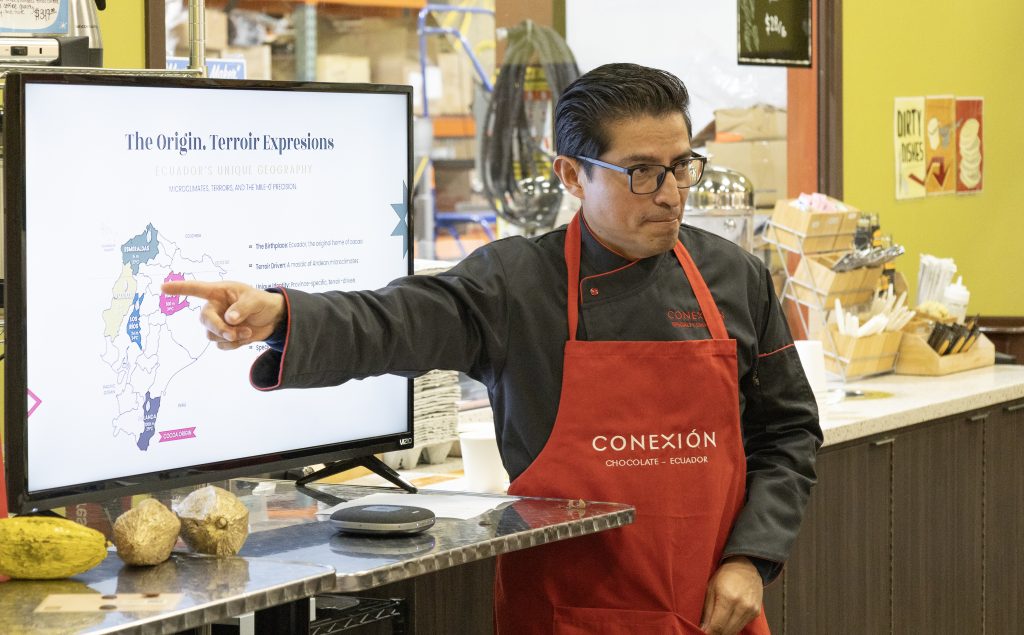
Guests at the Candy Manufactory had the opportunity to sample Conexión’s premium chocolate during a tasting led by Mario Remache, who worked as a chef in Europe before coming back to his native Ecuador and joining Samaniego at the company.
“In the massive chocolate industry, they say, ‘It’s chocolate—it tastes like chocolate,’” Remache said. “No. No way. Cacao from different regions has totally different flavor profiles. That’s the richness we have around the world.”
Remache put this richness on full display, sharing five Conexión couvertures—the dark chocolates Esmeraldas (70% cacao), Manabí (70%), Los Ríos, and Ecuador (55%), plus the milk chocolate Abundancia (40%)—as well as two of the brand’s own chocolate bars.
Along the way, he guided attendees in the delicate process of exploring the chocolate: examine its surface texture, smell its aroma, snap it in half next to one’s ear to hear the sound it makes, and then place it on the tongue and let it dissolve. Fruity, nutty, woody, savory—just as with wine or coffee, each cacao variety offers a unique tapestry of flavors.
As a point of comparison, guests also tasted a handful of mass-produced chocolate chips, whose waxiness and artificial sweetness—the result of industrial mixing and chemical additives—stood in stark contrast to their single-origin, heirloom counterparts.
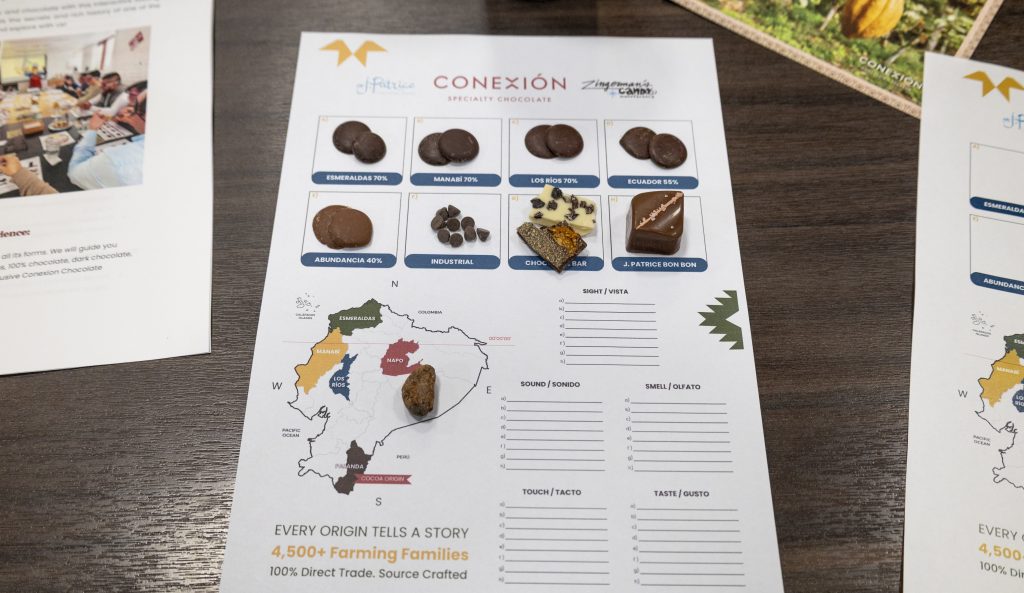
For a final treat, LeBoeuf shared one of her handcrafted J. Patrice bonbons—a delicious pink Himalayan sea salt caramel made with the Abundancia from Conexión.
“The caramel really brings out the caramel flavors of the Abundancia cacao,” LeBoeuf explained. “And there’s a little bit of sea salt on the outside that also enhances the cacao flavors and opens up your palate.”
Beyond Ecuador, Conexión operates a warehouse in Traverse City, Michigan, which provides direct distribution and support for the company’s Midwest partners. One of those partners may soon be Zingerman’s Candy Manufactory.
“We’ll be transitioning in the next few months,” LeBoeuf said after the event. “We’ll be using the Ecuador 55% that we tasted tonight, and also the Abundancia for milk chocolate. When you work with such high-quality chocolate, and when you’re trying to give farmers really great prices, that translates to us having to pay a little bit more for it. But we think it’s worth it, and our customers clearly think it’s worth it.”
As for Samaniego, whose path to chocolate was a circuitous one, she now can’t imagine doing anything else with her life.
“Making chocolate is my passion,” she said. “I love the equipment, the post-harvest, the genetics, the flavors, the people. But how do we keep all this going in the future? I once heard, ‘Without cacao, there is no chocolate.’ For me, there’s no chocolate without farmers.”
Conexión is doing the good work to ensure that these farmers survive and thrive for generations to come—all while producing some of the finest chocolate you’re likely to find anywhere.
A magical new spring confection from the Candy Manufactory
In her wonderful new book, Bread of Angels, rock icon Patti Smith shares one of her most meaningful childhood memories.
Once, when I was about five or six years old, I was on the way to school and took a shortcut through the forest. There was a little pond. I sat there for a moment, and a huge snapping turtle crawled out of the water. He was, to me, giant—the king of tortoises.
We looked at each other for a long time and just communed. It wasn’t unnatural to me because I communed with my siblings that way, without words. As a child, it seemed totally natural to commune with an animal, a dog, a massive snapping turtle, your brother and sister, without words.
But I must have been there a long time in tortoise consciousness because when I finally got to school, everyone was in an uproar.
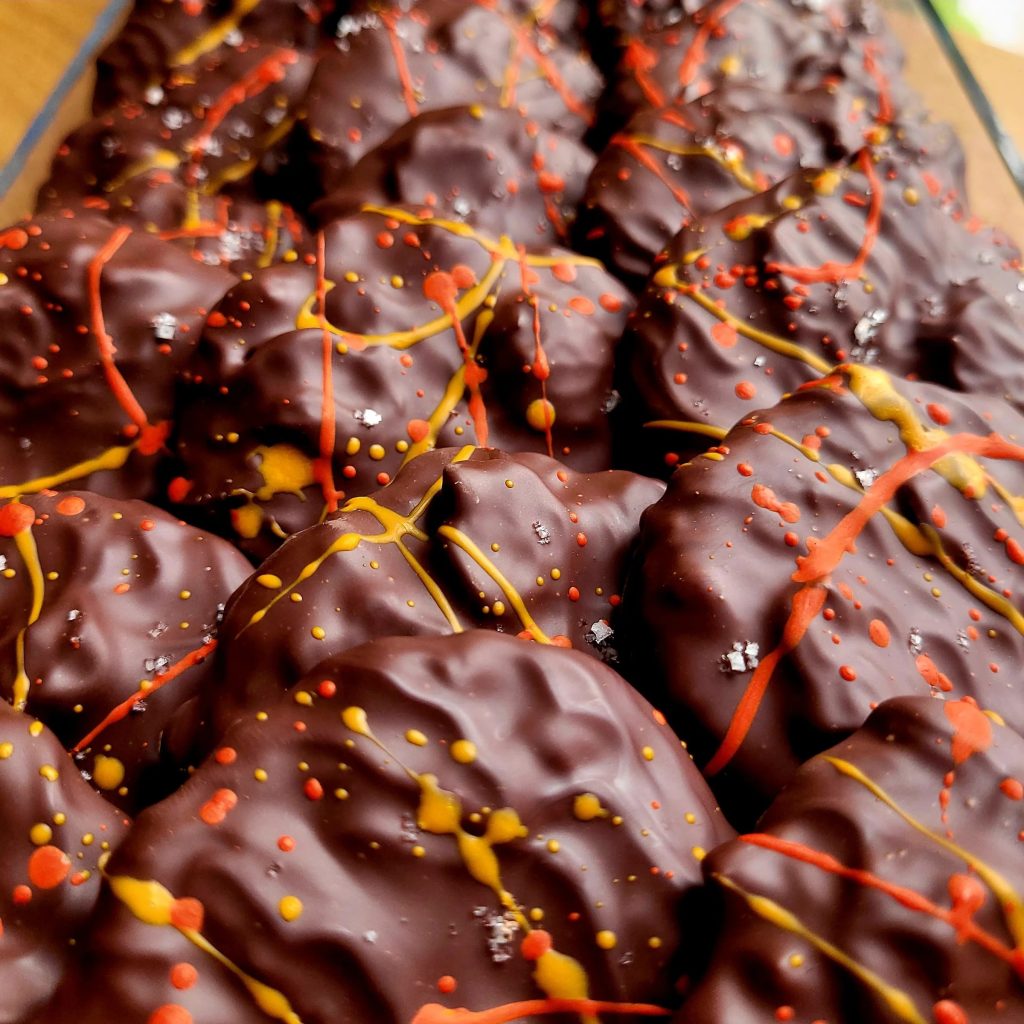
I, of course, can’t say how large Patti Smith’s tortoise friend actually was. I can say, however, that if you swing by Zingerman’s Candy Manufactory on Plaza Drive, we have some beautiful little dried-cherry chocolate turtles on hand—small in size, but massive in flavor. And we’re all in a bit of an uproar here about how delicious they are!
Some of you may be very familiar with chocolate turtles; perhaps you’ve been eating them most of your life. Others may be curious, even confused! Well, here’s the dope: Chocolate turtles are not new. They date back to the World War I era, when they were formally rolled out by a confectioner in my hometown of Chicago in 1918. Candy companies have been making versions of them ever since—and this is ours.
Pastry chef and food writer Elizabeth LaBau confirms what I usually say: “Because few ingredients are needed, each is very important to the final flavor, so use good-quality pecans and chocolate. Homemade caramel is always best.”
No surprise, then, that it’s the Candy Manufactory’s much-loved, handmade Muscovado brown sugar caramel that contributes so much to the complexity of the turtle’s flavor. Then dried Michigan cherries are added, pecans are mixed in, and it’s all dipped in delicious dark chocolate. As you eat and enjoy, let your mind wander a bit. Maybe muse on Patti Smith if you like. See where your magic turtle takes you.
At the end of Smith’s story, after her parents have realized she wasn’t lost, her mother asks her where she was. Her response is one I probably gave my parents a hundred times as a kid, too: “Nowhere.”
Smith’s father scores some big points in my leadership book, though, when he follows up with a brilliant tactic I would be wise to keep in mind. He doesn’t argue; he simply reframes the question, asking, “Can you show me your nowhere?” Smith does just that, and they sit there together, father and young daughter, communing and connecting.
My “nowhere” for the next few weeks will be standing within a few feet of the candy case at the Manufactory, directly communing with these beguiling little dark chocolate turtles.