
Tag: CHOCOLATE
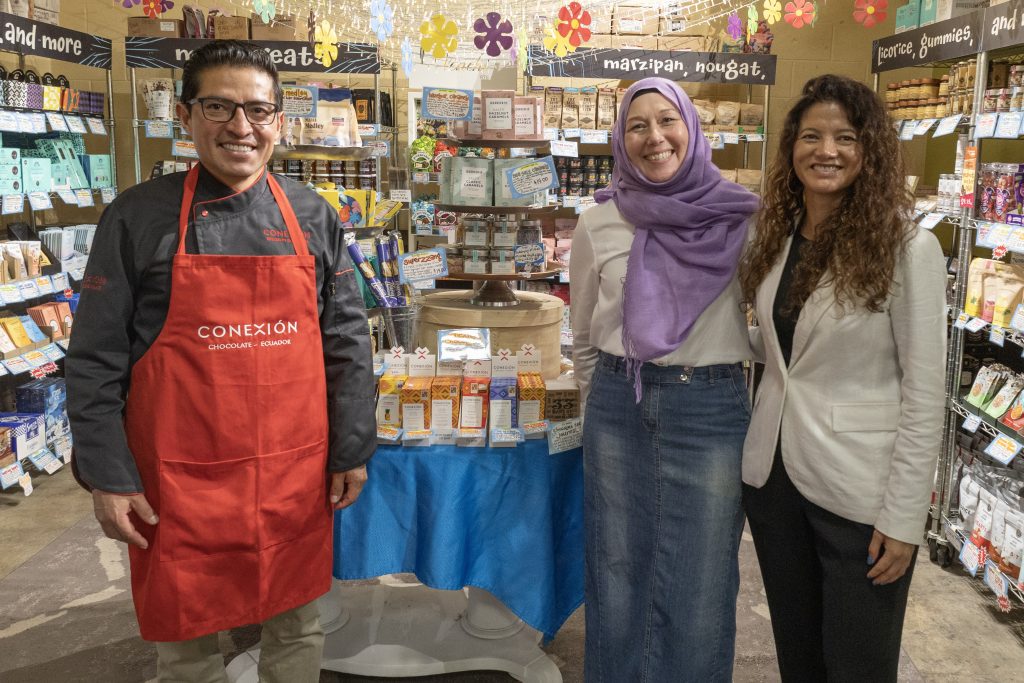
Local. Ethical. Sustainable. These words guide the bold mission of Conexión Chocolate, an award-winning Ecuadorian specialty chocolate maker that works hand in hand with the country’s small farmers of fine-flavor cacao.
The company’s founder and owner, Jenny Samaniego, and operations manager, Mario Remache, paid a special visit to Zingerman’s Candy Manufactory on Saturday, April 25, for the store’s first-ever “Meet the Maker” event. Located at 3723 Plaza Drive, the Manufactory is one of Zingerman’s Southside Shops, once aptly described by a guest as “the Diagon Alley of Ann Arbor,” in a nod to the magical district from Harry Potter.
A full house showed up for the 90-minute talk and tasting, which was hosted by Manufactory Production Manager Jamie LeBoeuf, whose own J. Patrice Chocolate Studio already possesses a strong connection to Conexión.
“We’re currently using Conexión’s Abundancia couverture in all of our milk chocolate products, and we’re working to use more of their couverture in the future for our dark chocolate and white chocolate as well,” LeBoeuf noted in her opening remarks. (“Couverture” refers to a high-quality, professional-grade chocolate that contains a higher percentage of cocoa butter, often used in candy and pastry making.)
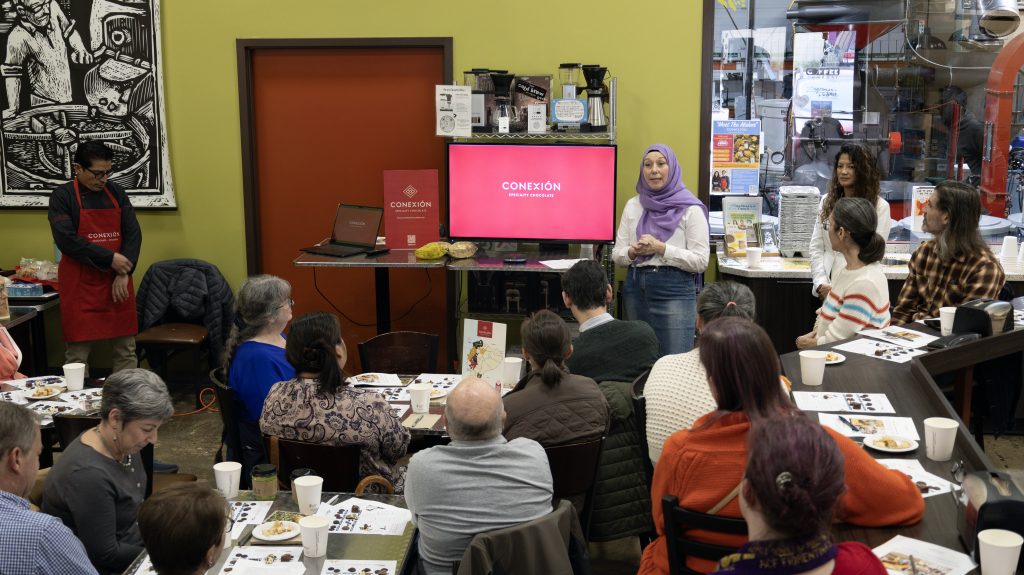
Samaniego then delivered a powerful presentation on the global cacao industry and her unlikely personal journey into the realm of chocolate. After studying hospitality in her home country of Ecuador, she traveled to New York City in the early 2000s and began working for a restaurant distribution company that did business with Anthony Bourdain, the late chef, author, and TV personality. It was Bourdain’s sous-chef at the time who introduced Samaniego to a New York–area chocolate maker.
“I knew zero about chocolate or cacao, but he said, ‘You look like a nice person,’ and he hired me anyway,” she recalled with a laugh. “It was an amazing experience, because I was able to really learn everything from the ground up. I learned about sourcing, about cacao genetics. And for me, being from Ecuador and understanding how the supply chain works over there, everything just got connected.”
Samaniego eventually launched her own operation, Porcelana Chocolates. And in 2016, she returned home to Ecuador with a passionate purpose: to become a direct bridge between the nation’s cacao farmers and the wider world. Accordingly, she renamed the company “Conexión.”
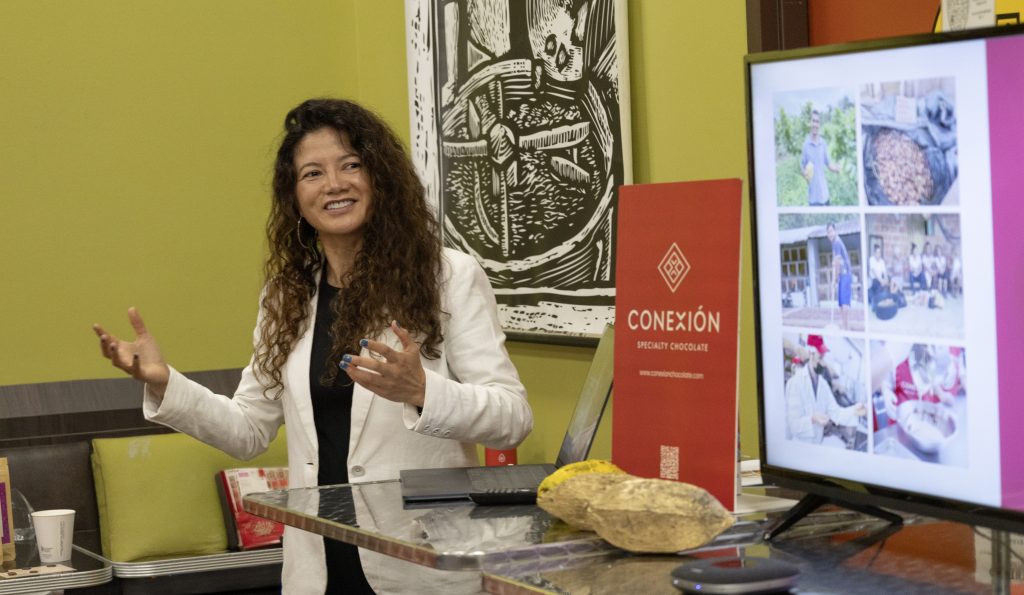
Ninety percent of the five million tons of cacao produced globally each year are traded as a “faceless bulk commodity,” Samaniego explained. This industrial focus on volume strips beans of their genetic identity while subjecting farmers to the price volatility of the international marketplace.
Conexión exists to combat this commodification and break the corporate chocolate monopoly. Based in Quito, Ecuador’s capital, the company works closely with four cacao cooperatives and more than 4,500 legacy farming families to preserve the country’s pure Arriba Nacional variety, from harvest to couverture. Only 5% of the cacao grown worldwide is considered to be “fine flavor,” and Ecuador’s crop belongs to that rarified class.
Samaniego has also assumed an ambitious public advocacy role, empowering farmers with information and training, and launching the first Cacao and Chocolate Summit in 2019. The event, whose seventh edition was recently held in Quito in December 2025, gathers producers, chocolatiers, investors, and researchers to support a more sustainable, inclusive future for the cacao industry both in Latin America and elsewhere.
“We really want everyone to know what’s happening behind all the chocolate they’re buying,” she said, emphasizing the vital importance of transparency and traceability.
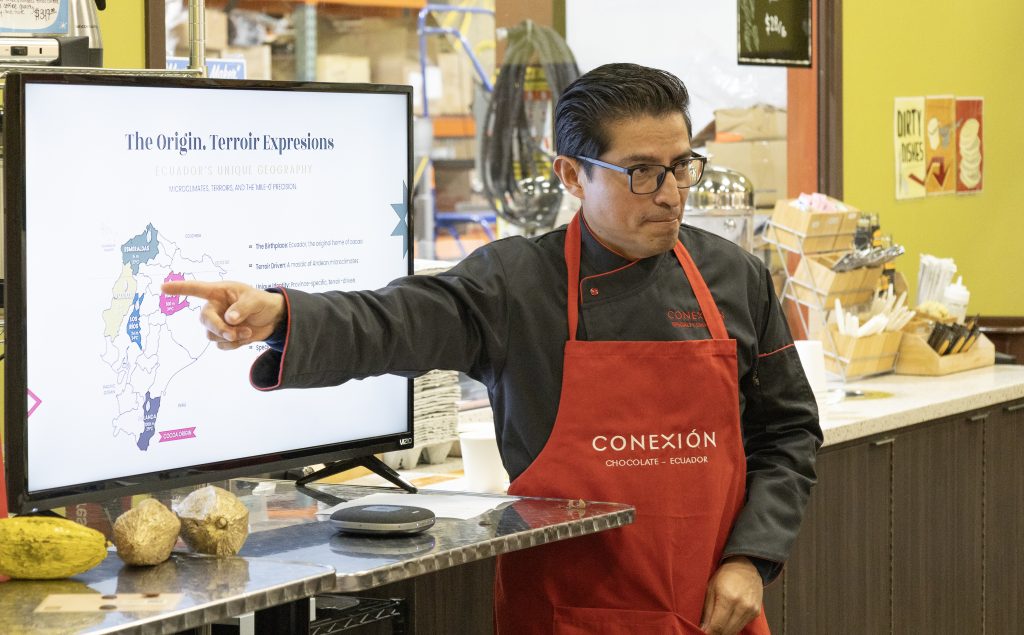
Guests at the Candy Manufactory had the opportunity to sample Conexión’s premium chocolate during a tasting led by Mario Remache, who worked as a chef in Europe before coming back to his native Ecuador and joining Samaniego at the company.
“In the massive chocolate industry, they say, ‘It’s chocolate—it tastes like chocolate,’” Remache said. “No. No way. Cacao from different regions has totally different flavor profiles. That’s the richness we have around the world.”
Remache put this richness on full display, sharing five Conexión couvertures—the dark chocolates Esmeraldas (70% cacao), Manabí (70%), Los Ríos, and Ecuador (55%), plus the milk chocolate Abundancia (40%)—as well as two of the brand’s own chocolate bars.
Along the way, he guided attendees in the delicate process of exploring the chocolate: examine its surface texture, smell its aroma, snap it in half next to one’s ear to hear the sound it makes, and then place it on the tongue and let it dissolve. Fruity, nutty, woody, savory—just as with wine or coffee, each cacao variety offers a unique tapestry of flavors.
As a point of comparison, guests also tasted a handful of mass-produced chocolate chips, whose waxiness and artificial sweetness—the result of industrial mixing and chemical additives—stood in stark contrast to their single-origin, heirloom counterparts.
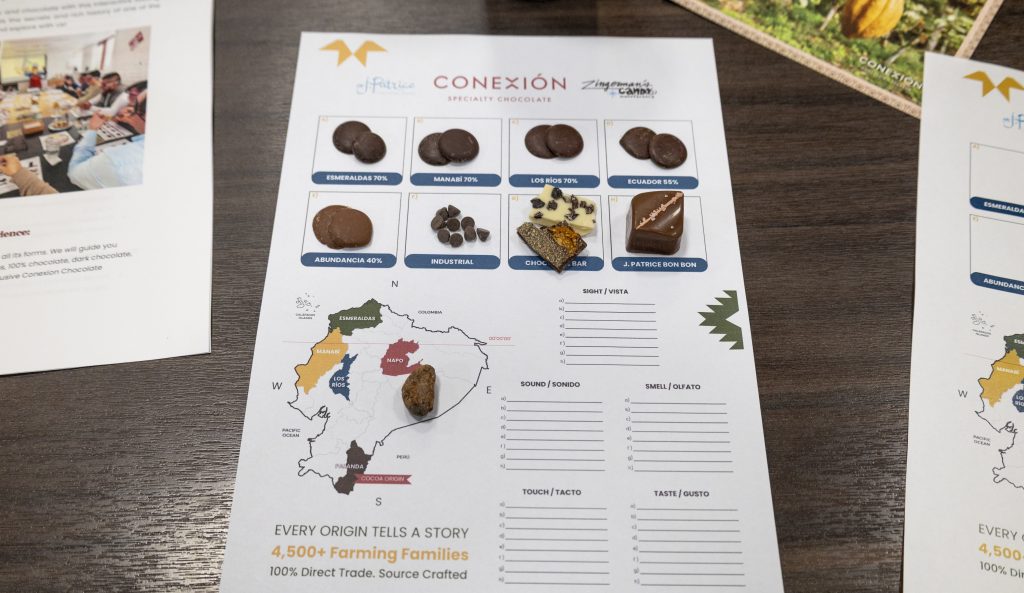
For a final treat, LeBoeuf shared one of her handcrafted J. Patrice bonbons—a delicious pink Himalayan sea salt caramel made with the Abundancia from Conexión.
“The caramel really brings out the caramel flavors of the Abundancia cacao,” LeBoeuf explained. “And there’s a little bit of sea salt on the outside that also enhances the cacao flavors and opens up your palate.”
Beyond Ecuador, Conexión operates a warehouse in Traverse City, Michigan, which provides direct distribution and support for the company’s Midwest partners. One of those partners may soon be Zingerman’s Candy Manufactory.
“We’ll be transitioning in the next few months,” LeBoeuf said after the event. “We’ll be using the Ecuador 55% that we tasted tonight, and also the Abundancia for milk chocolate. When you work with such high-quality chocolate, and when you’re trying to give farmers really great prices, that translates to us having to pay a little bit more for it. But we think it’s worth it, and our customers clearly think it’s worth it.”
As for Samaniego, whose path to chocolate was a circuitous one, she now can’t imagine doing anything else with her life.
“Making chocolate is my passion,” she said. “I love the equipment, the post-harvest, the genetics, the flavors, the people. But how do we keep all this going in the future? I once heard, ‘Without cacao, there is no chocolate.’ For me, there’s no chocolate without farmers.”
Conexión is doing the good work to ensure that these farmers survive and thrive for generations to come—all while producing some of the finest chocolate you’re likely to find anywhere.
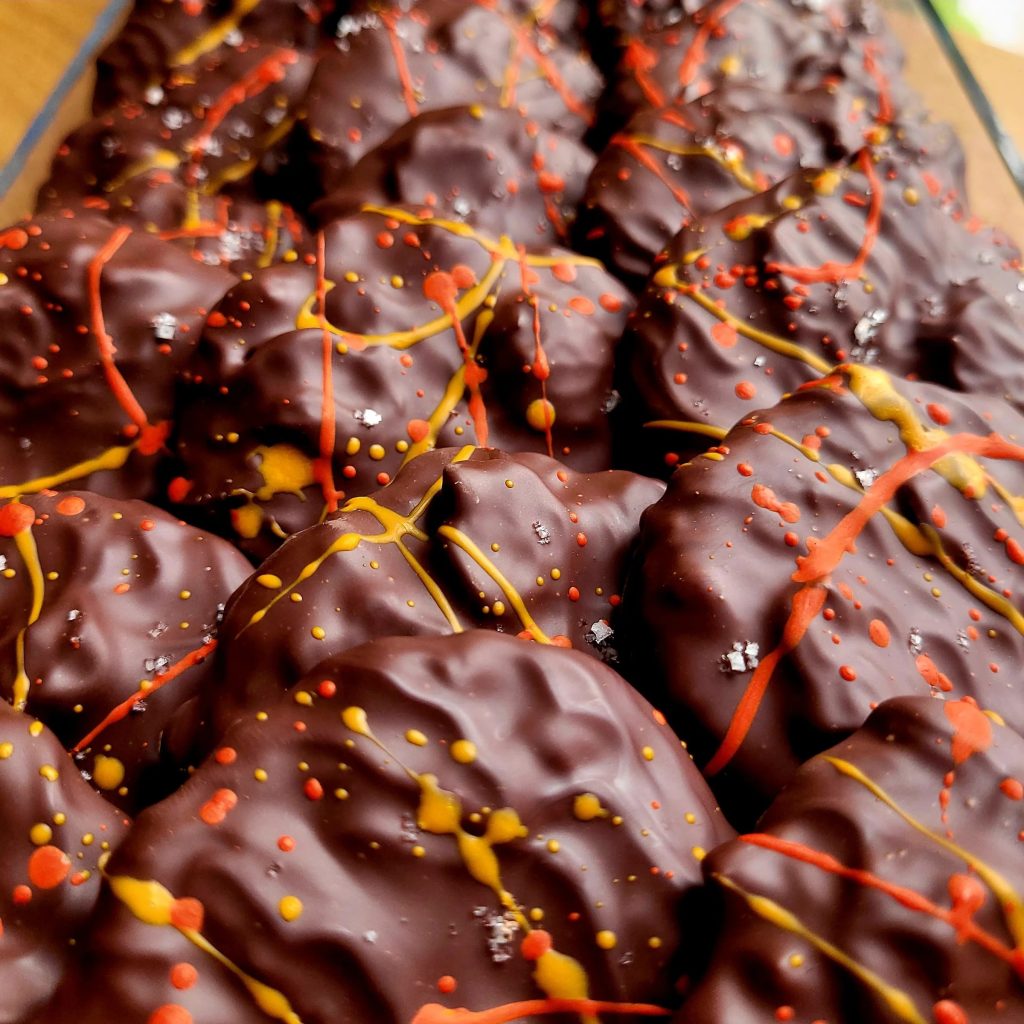
A magical new spring confection from the Candy Manufactory
In her wonderful new book, Bread of Angels, rock icon Patti Smith shares one of her most meaningful childhood memories.
Once, when I was about five or six years old, I was on the way to school and took a shortcut through the forest. There was a little pond. I sat there for a moment, and a huge snapping turtle crawled out of the water. He was, to me, giant—the king of tortoises.
We looked at each other for a long time and just communed. It wasn’t unnatural to me because I communed with my siblings that way, without words. As a child, it seemed totally natural to commune with an animal, a dog, a massive snapping turtle, your brother and sister, without words.
But I must have been there a long time in tortoise consciousness because when I finally got to school, everyone was in an uproar.
I, of course, can’t say how large Patti Smith’s tortoise friend actually was. I can say, however, that if you swing by Zingerman’s Candy Manufactory on Plaza Drive, we have some beautiful little dried-cherry chocolate turtles on hand—small in size, but massive in flavor. And we’re all in a bit of an uproar here about how delicious they are!
Some of you may be very familiar with chocolate turtles; perhaps you’ve been eating them most of your life. Others may be curious, even confused! Well, here’s the dope: Chocolate turtles are not new. They date back to the World War I era, when they were formally rolled out by a confectioner in my hometown of Chicago in 1918. Candy companies have been making versions of them ever since—and this is ours.
Pastry chef and food writer Elizabeth LaBau confirms what I usually say: “Because few ingredients are needed, each is very important to the final flavor, so use good-quality pecans and chocolate. Homemade caramel is always best.”
No surprise, then, that it’s the Candy Manufactory’s much-loved, handmade Muscovado brown sugar caramel that contributes so much to the complexity of the turtle’s flavor. Then dried Michigan cherries are added, pecans are mixed in, and it’s all dipped in delicious dark chocolate. As you eat and enjoy, let your mind wander a bit. Maybe muse on Patti Smith if you like. See where your magic turtle takes you.
At the end of Smith’s story, after her parents have realized she wasn’t lost, her mother asks her where she was. Her response is one I probably gave my parents a hundred times as a kid, too: “Nowhere.”
Smith’s father scores some big points in my leadership book, though, when he follows up with a brilliant tactic I would be wise to keep in mind. He doesn’t argue; he simply reframes the question, asking, “Can you show me your nowhere?” Smith does just that, and they sit there together, father and young daughter, communing and connecting.
My “nowhere” for the next few weeks will be standing within a few feet of the candy case at the Manufactory, directly communing with these beguiling little dark chocolate turtles.
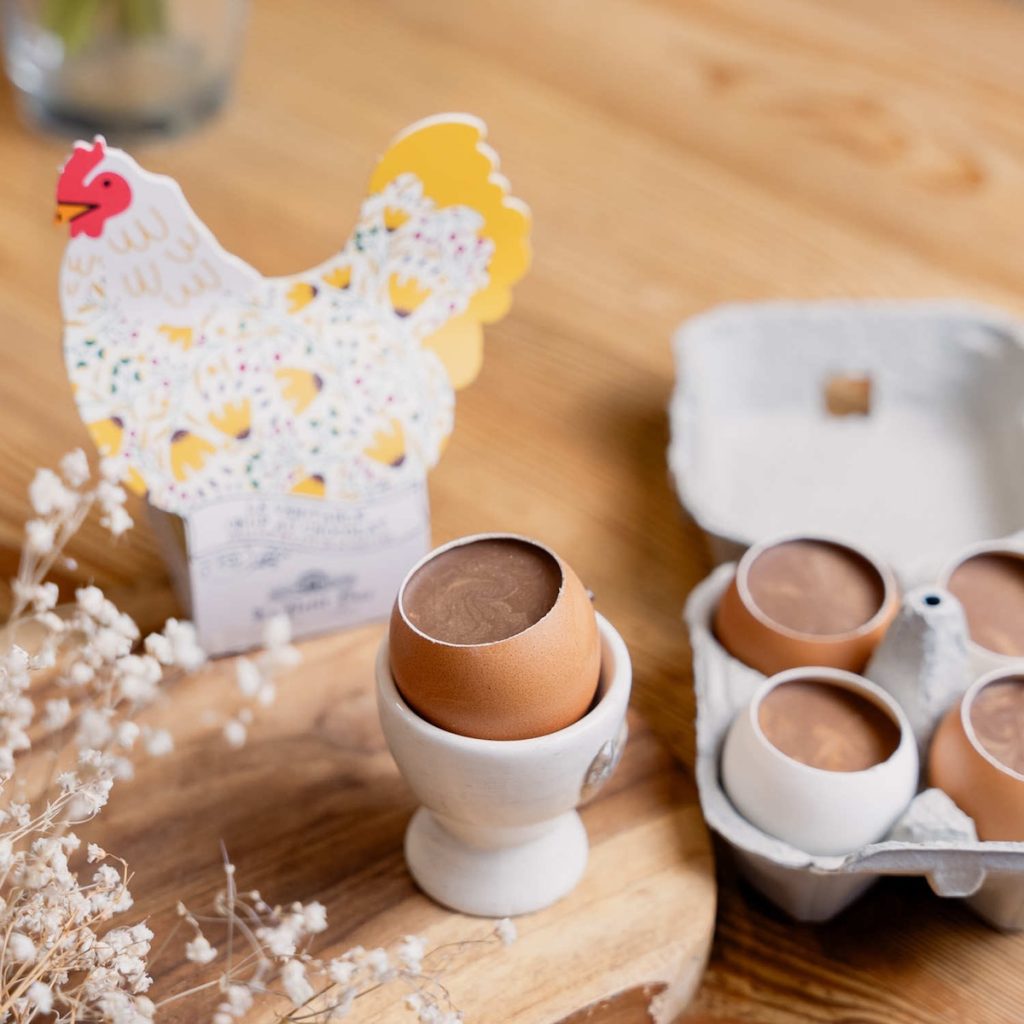
An amazing, limited-edition offering from the South of France
It’s still three weeks until Easter, but given the limited nature of these exceptionally cool and super tasty confections from Provence in the South of France, you may want to hurry over to the Candy Store and get some of them before they’re all gone.
What are they? It sounds kind of wild, I know, but they are real eggshells, tops cut neatly off, cleaned and sanitized, then filled with chocolate hazelnut praline. They look gorgeous, and they taste totally great! Yes, you really crack the shell and peel it off before you eat! No, they are not laid by some kind of chocolate-eating French chicken. Inside is a blend that’s over half hazelnut praline and the other, 45% milk chocolate.
The eggs are all handcrafted by the crew at Le Petit Duc, one of France’s leading producers of artisan calisson (the classic dried fruit and almond confection of Provence). Le Petit Duc was founded in 1991 in the small Provencal town of Saint Remy. To set the scene, it’s the place where Vincent Van Gogh did many of his most famous paintings. In the winter of 1888, having recently arrived in the region, Van Gogh wrote to his brother, Théo, “The sun dazzles me and goes to my head, a sun, a light that I can only call yellow, sulphur yellow, lemon yellow, golden yellow. How lovely yellow is!”
Le Petit Duc’s small workshop is located near the house of Nostradamus, the famous historical French forecaster. They use a minimal amount of sugar—which I like—so the chocolate and nuts are the main flavor components. The Le Petit Duc team is all about going back to traditional ways, staying true to old techniques, and steering clear of post-modern shortcuts.
The instructions on the package suggest either sticking the egg in the fridge for around 15 minutes before peeling, or, alternatively, melting the chocolate (while still in its shell) in the microwave for a super quick 15 seconds before dipping toast pieces, as you might for a soft-boiled egg, for a version of the classic European bread and chocolate. Longtime Candy Store manager Allison Schraf says, “I can also see dipping shortbread, pretzel sticks, apple or strawberry slices, etc. Imagine serving this ‘breakfast for dessert but not really’ at Easter brunch!” They’re available as a single egg in chicken-on-a-nest packaging or as a 4-pack in an egg carton.
A gift of these eggs will both surprise and delight whoever you give them to! Or, if you’re having one of those days, maybe grab one for yourself and savor it with some of the Guatemala El Regalito Coffee that we have on as Roaster’s Pick this month.
An egg-citing treat
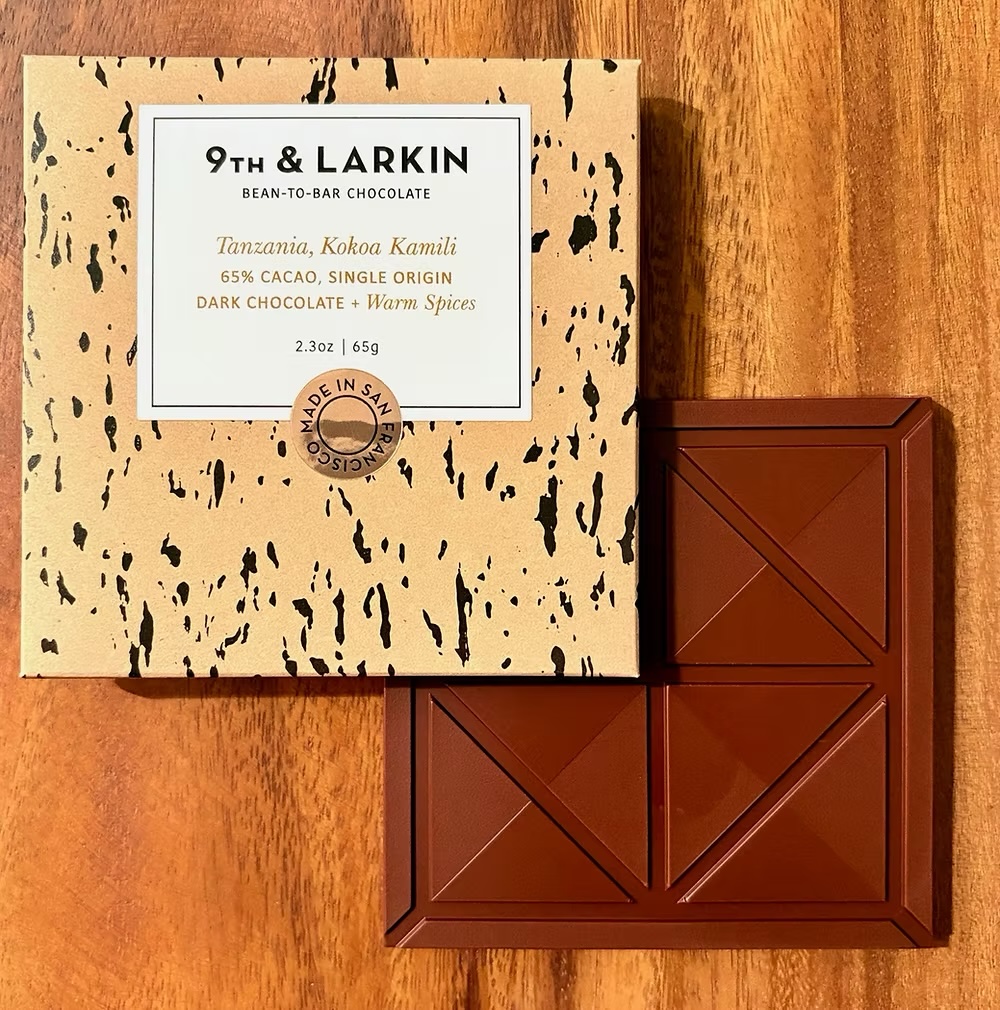
Single-origin chocolate bars to make a mark on your soul
Six years ago this coming winter, on the weekend of March 4–6, 2020, Tammie and I took a trip to her hometown of San Francisco. I did an evening book event on visioning at the amazing Heath Ceramics. And I attended a really great little artisan chocolate show. Everything, in hindsight, was very strange. We knew that something bad was coming, but no one was sure what. We flew home that Monday, and on Tuesday we held the 5th Annual Jelly Bean Jump Up Dinner, our annual fundraising event for SafeHouse Center, at the Roadhouse. (This winter we’ll have the 11th. The annual calendars are out now for sale!) Then, what we all came to call “the pandemic” really started. That weekend, we did very little business. By Monday, dining rooms closed. You know the rest.
Crazy as the weeks, months, and years that followed were, a number of good things came from that trip. A bunch of people learned our visioning process at Heath. It remains a life-changing process that we can all use now more than ever. And although we were all on pins and needles at the chocolate show, I did find some amazing artisan products. Given everything that went down, it’s not shocking that getting them here took a lot longer than it normally would. A couple of weeks ago, one of those products arrived at our Candy Store: single-origin craft chocolate bars from a small company called 9th & Larkin in San Francisco. It’s a good story and a great chocolate.
Founders Lan Phan and Brian Dusseault share that backstory:
One day, we got curious and wanted to make our own chocolate bars—from scratch—in our small kitchen in San Francisco. We can still vividly remember our first few attempts. Beans, husks, and nibs flying in the kitchen, smoke detectors went off, bits and pieces of chocolate stains were everywhere!
I’m glad they stuck with it through that initial awkwardness. A few years later, they had a line of chocolates so good that I’m happy to include them on the list of folks whose bars I love—Shawn Askinosie, French Broad Chocolate, Marou Chocolate from Vietnam, and more. As of a couple weeks ago, we now have a quartet of awesome artisan, bean-to-bar offerings from 9th & Larkin at the Candy Store. They’re made by an engineer (Brian) and an analyst (Lan), which makes sense in the best possible way: The flavors are so clean and elegant that I started to think of them like a world-class classical quartet. Here’s a description of each 9th & Larkin bar we offer:
Vietnam: A dark 70% bar from the region of Tiền Giang on the central east coast, north of Ben Tre. Lan says, “I love this bar because it was my first single-origin bar, and I am Vietnamese, so I always feel connected when getting to work with beans from my country.” Her tasting notes include “brown sugar, nuts, and cinnamon, with hints of figs and persimmon on a solid chocolate background.” It’s wonderfully smooth, with a delicate and intriguing warm bit of spice notes that linger long in the finish.
Tanzania: A super juicy and fruity dark chocolate with 65% cacao from the Kokoa Kamili Co-op. In Swahili, “Kamili” means “precision,” which is a good reflection of the quality of the beans that 9th & Larkin buy. The co-op is located in the Kilombero Valley, near the center of the country—a bit north and east from the other terrific Tanzanian chocolate we get from the Mababu Co-op and Shawn Askinosie. Beautifully balanced, with some lovely low notes, complemented by hints of dried raisins and cashews. A couple of folks have noticed a snippet of citrus in the background as well.
Colombia: A really great bar with 72% cacao. Super smooth, super juicy, super fruity. Lovely tannins. Terrific long finish. From the Tumaco region, on the very far north coast of the country. Something about the flavor just makes it extra special. Light, elegant, dances a little tango on the tongue. You’re likely to find hints of banana, toffee, and almond butter! This one might be my favorite of the four!
Madagascar: Made with cacao from the island’s Sambirano Valley, on the central-west coast of the country, the premier growing region on Madagascar. Bejofo Estate is there—it’s part of the holdings of the Akesson Estate. Bertil Akesson’s father was a Swedish diplomat in the middle of the 20th century. His work took him to the embassy in Paris, and from there to France’s various African colonies, including Cameroon. He ended up settling with his family on the other side of the continent, farming on Madagascar when the island was governed by the French. The Bejofo Estate, from whence this cacao comes, began farming 100 years ago last year, in 1924. They grow the harder-to-find and exceptionally flavorful Trinitario and Criollo cacao beans! Ripe red fruit is the main flavor I get—lots of the dark cherry that Madagascar cacao is famous for, with a citrus to boot!
Everything about the 9th & Larkin bars is done mindfully and well. Lan and Brian created the elegant wrappers for the bars by rolling a dried cacao pod in paint and then rolling that, in turn, onto paper. That pattern was screen printed for production. A lovely way to work that keeps the package congruous with the cacao from which the bars are made. As Lan says:
Eating chocolate is like traveling. What can be a richer experience than tasting food that is cultivated from the sun, the rain, the soil in that area, and taken great care of by the people who harvest, ferment, dry, pack and ship across the seven seas to all around the world where they are made into chocolate?

New, 70% Barrel-Aged Dark Chocolate Bar
This just in: A dark and super-tasty Tanzania chocolate bar has landed at the Candy Manufactory! It’s extra special because its nibs were first aged in whiskey barrels. If you’re looking for a chocolate to wow your friends and family, or just your own discriminating taste buds, this bar will fit the bill!
This new bar is made by my buddy, the amazing chocolatier and remarkable human being Shawn Askinosie, along with the rest of the team at Askinosie Chocolate in Shawn’s hometown of Springfield, Missouri. Shawn has shared a bit of the bar’s story:
We lucked into these used whiskey barrels years back and so we decided to make good use of them. We decided to age roasted Tanzania cacao nibs in those barrels. We wanted a flavor experience that was subtle and lasting, and not overpowering. It’s more art than science how one judges the flavor over time, and how that what one tastes will translate into the finished chocolate. One thing we’ve become decent at is forecasting what a roasted cocoa nib will taste like when it transforms into chocolate. That is what we did here with this new bar. I love [Ashkinosie co-owner] Lawren’s tasting note: “A soft and mellowed chocolate with subtle notes of malty smoke, charred oak, and mild whiskey-vanilla-sweetness.”
The rye whiskey barrels from Blackland Distillery are heavily charred to impart subtle but significant flavor to the nibs. What happens in the barrels? Essentially the same thing that happens with wine or whiskey. The flavors of the wood—and the whiskey that soaked into it during many months of maturing—enhance the flavor of the cacao that’s stored inside. Of the chocolate made from those barrel-aged nibs, the crew at the Askinosie factory has this to say: “It’s our most quietly complex bar ever, and did we mention it’s a limited edition? We have a finite amount of these aged nibs, and once these bars are gone, that’s it!” The chocolate really is terrific. Lovely tannins and a wide, well-rounded flavor. Like Lawren said, there’s a little vanilla and, to me, a titch of black cherry along with some of that superb oaky smokiness lingering along the edges. It’s super tasty!
Like a good bottle of red wine, I like to let dark chocolate breathe a bit after I open the bar. Side note: I’ve never seen anything written about this, but, after years of tasting, I swear that the bars are texturally creamier a day after I open them. Anyhow, if you have enough self-control to buy a bar, slit the paper wrapping and wait a day before you eat what’s inside. I believe this is when it will be at its best. Alternatively, you can do some research by tasting immediately and then again the following day. It’s a tough job, but somebody’s gotta do it! Make a toast to the meaningful work Shawn, everyone at Askinosie, and all the caring cacao growers do to make this possible!
You can buy this great new limited-edition bar at the Candy Store on Plaza Drive (inside the Coffee Company).

Orange and chocolate come together to make something super special
If you like orange and chocolate, this exceptional bar from my good friend Shawn Askinosie and the crew at Askinosie Chocolate is an awesome option! It has become a widely appreciated staff favorite across the ZCoB over the four or five years that they’ve been crafting it!
Four hundred years ago in Europe, the combo of orange and chocolate was completely cutting edge. If one wanted to impress a couple of your royal cousins, catch the attention of upper-crust colleagues, or get in good with a high-ranking court dignitary, chocolate with orange might well have been the almost-impossible-to-ignore ticket. Both ingredients were then relatively new on the European culinary scene.
But that was then, and this is now. Orange and chocolate in some form are everywhere. They’re on my mind, though, because of this very special iteration of the combination in my good friend Shawn Askinosie’s incredible chocolate bar. The bar begins with the relatively rare (it accounts for less than 10% of the world’s chocolate) and very carefully crafted Trinitario cacao that Shawn brings from the Philippines. It’s a 58% dark chocolate—very smooth and gentle—that comes from grower Peter Cruz. Thanks to Shawn’s good work, Cruz became the first Filipino farmer to export cacao since the country’s land reform in the mid-1970s. Shawn shares that “Peter is known nationally as an expert in organic and regenerative cocoa farming,” and his skill comes through in the quality of the cacao. The beans are conched and blended with turbinado sugar and cocoa butter (made by the folks at Askinosie from the same beans), and then a nice bit of orange pulp and orange peel. The finished flavor is something special.
To be clear, developing an offering of this quality is not an overnight activity. Natural Law #10 (see “Secret #01: Twelve Natural Laws of Building a Great Business”) is that “it takes a lot longer to make something great happen than most people think.” This bar is no exception—Shawn says it took about 20 iterations to get the ratios right, all done in a series of experiments that took about 18 months. I appreciate all the hard work, and I’m betting that, if you like orange and chocolate, you will most definitely want to buy a bar too. Or five. The flavor is fantastic. The chocolate and the orange are beautifully balanced. Like any good partnership, they bring different things to the table. The chocolate is the bass line—dark, nutty, cocoa-y. The orange comes at it from the other end—it’s the violin playing over top. Light, bright, sensual, ethereal. Together, the combo is otherworldly. The royal court of Spain, which brought cacao to the Philippines early in the 17th century, would likely have swooned over it
Can a chocolate bar make that much difference? Both Shawn and I are big fans of the work of the Irish philosopher John O’Donohue, so I’ll close this piece with a quote of his that conveys what I’m thinking after eating and reflecting on how good this bar is. Share a bit of your bar with anyone you care about. Or even someone you don’t yet know. As O’Donohue writes, “The time is now ripe for beauty to surprise and liberate us.”